Month: June 2009

  • iPhone 3GS

    It’s probably no surprise that my refrain around my house is, “I want an iPhone 3GS.”

    I also happy to report that, despite not getting one for Father’s Day as perhaps I’d hoped, I did, at least, get a promissory note for one in late July/early August. (The issue is not really the upfront cost of the phone but the ridiculous monthly service cost, which is $15 a month more than the original iPhone.)

    First let’s talk about my old iPhone. The 3.0 OS upgrade as not been good for my iPhone. Despite the welcome addition of cut/paste, push notifications and all the other iPhone OS 3.0 goodness, my phone is now dog-slow. Keyboard responsiveness is in the dumps, and often gets 10 seconds behind my typing. Some programs (not all) open at agonizingly slow speeds, and while push notices seem to work fine in the background, my e-mail doesn’t. Sometimes the phone will go 4 hours or more without receiving an e-mail, but as soon as I go into the e-mail program, all my mail over the last few hours suddenly downloads.

    I’m going to assume (hope) that these are teething bugs in the 3.0 version of the OS and that a 3.0.1 will be out any day soon (much like 2.0 had very similar problems) to fix them all, rather than the inevitable obsolescence of my original phone. Since there’s not that much technological difference between the iPhone and the iPhone 3G, I can’t imagine that this is the end for the iPhone just yet.

    I even went as far yesterday as to wipe my phone and load it from scratch. What a pain in the rear that is! I didn’t want to re-load any problems from my backups, so I had to do the clean sweep and manually re-configure the phone. It took hours. To be fair, it helped a little, but the phone is still not receiving mail regularly and the keyboard starts to lag very quickly. Here’s to the arrival of 3.0.1 (and hopefully not having to wait for 3.0.2.)

    So, that said, a co-worker and I went down to the nearby Apple Store and gave the 3GS a good 15-20 minute, side-by-side comparison to my iPhone for speed tests. Wow! Fast barely describes it – and I don’t mean network speed. The new phone has a huge improvement in operational performance. Programs zip open, even Google Earth is more responsive than on my desktop. It’s just one mean, fast phone. I can hardly wait.

  • New theme – mobile theme

    If you’re using an iPhone or other mobile browser (are there really any others?) you may have noticed I’ve installed a new mobile theme for the website – and over at pizzalocust.com, where it is probably more useful.

    If you encounter any problems with it, please do let me know.

  • BBC (in) America(?)

    The Telegraph is reporting the merest hint of a possibility of the glimmer of a chance that the BBC iPlayer might be launched internationally via a partnership with Google.

    Now all they have to do is work out all those nasty international rights issues. Still, I’ve said it before and I’ll say it again, I’d be willing to pay a fee for proper BBC access.

  • Cricket kills Pigeon


    This is a few days/weeks old, but I don’t feel like writing much and, apart from the unfortunate pigeon, this is somewhat amusing.

  • Primeval – Series 3, Episode 9 – Review, Spoilers

    Well, New Zealand are out of the World Twenty20, so it’s time to review this episode of Primeval I overlooked. (OK, I intentionally overlooked it the first time around.)

    Synopsis

    We open with a peaceful, pastoral countryside, suddenly disrupted by horrifying freaks of nature: A camp full of young people with ATVs. But there’s more than just modern horrors in the woods, there’s also embolotherium. A prehistoric rhino-like creature. In fact, there’s a whole heard of them and they don’t half make a mess of a guy on an ATV.

    Meanwhile, Danny Quinn is following up on the mysterious woman from the future who was captured by Christine Johnson’s military. Despite Lester’s warnings, Quinn breaks into Johnson’s facility after he sees the woman being held captive inside.

    Under interrogation, the mystery woman reveals that, in the future, everyone is dead. Killed by the predators, but she doesn’t know where they came from. She also reveals that anomalies are rips in time, and that they are “everywhere”, but that some of them are invisible. She indicates that she knows how to find them, but she must talk to the people at the ARC. She is also in possession of a device which she refuses to explain.

    Danny breaks her out.

    At the campsite, the rest of the team go through the typical plot complications trying to get the embolotherium back through the anomaly, which closes before all of them are through.

    Danny arrives with the mystery woman just as a stampede causes the embolotherium to thunder towards the unsuspecting campers. Just as all looks lost, the mystery woman uses the device to open an anomaly right in front of the camp and sends the herd through.

    Dumbstruck, Danny takes her to the ARC, but not before stealing her notebook and giving it to Sarah to decode. The mystery woman, in turn, steals a gun.

    Johnson hasn’t been taking Danny’s intrusion sitting down, and is at the ARC serving Lester with a warrant for Quinn’s arrest and the surrender of the artifact.

    Danny arrives and is arrested, but then the mystery woman reveals that she is Helen Cutter using future disguise technology. She explains that she had to kill Nick Cutter to save the world, but that it didn’t work, and so she has to make sure it works next time. She kidnaps Johnson, takes the artifact and heads back to Johnson’s headquarters and her private anomaly.

    She tells Johnson that she specifically is the civil servant that caused the entire destruction of the world by the predators, and she takes her through the anomaly, where she’s killed by a future predator. Helen also closes off Johnson’s anomaly after she’s dead.

    Danny Quinn vows to chase Helen to the ends of time to stop her.

    Analysis

    I purposely didn’t write this one up because there’s so little to recommend this episode.

    The episode adds a new piece to the equation: That there are lots of anomalies everywhere, but that they are somehow invisible/inaccessible. The device Helen has seems to be able to locate and open them. Also, for the first time, there’s some indication that Conner’s anomaly detectors experience some form of crude interference when near a closed anomaly. There’s never been any mention of this before and they’ve been standing next to several closed anomalies in the past. Even still, when the interference is introduced into the show, it’s not very clear what it is or why it is important. It’s not used or mentioned again.

    It’s somewhat interesting that, when Helen killed Cutter in an earlier episode, she blamed the ARC for the release of the predators and the destruction of the world. In this episode she blames Christine Johnson. Is she just guessing? If she was right, did she create a new kind of time paradox by taking Christine into a future that she created and killing her there before she could create that very same future? Is Helen just bat-shit crazy?

    Perhaps it will all make sense in the next and final episode? (Don’t hold your breath.)

  • Death of Economical Writing?

    For those who don’t know, I’m supposed to be in England this week, getting ready to watch the ICC World Twenty20 Final on Sunday, but I’m not and therefore I’m in a grumpy mood, so rather than take it out on England’s mostly rubbish performance (Seriously, they lost a cricket match to the Netherlands?) I’m going to continue to pick on Primeval for a while.

    ITV, the people who commission and broadcast Primeval, are loosing money. Ad revenues are down, and Primeval is an expensive show, even though its ratings are good enough to deserve a renewal. ITV has decided to concentrate on “post watershed programming”.

    For Americans who read my blog, the watershed is a curiously quaint British television concept. Before the watershed is time for family programming – cute furry animals, Doctor Who and lots and lots of gardening shows. After the watershed, which I believe starts precisely at 8:23PM each night, they are allowed to talk dirty and show naked women’s breasts in the shower with water erotically cascading off their nipples. (Hence the origin of the term, “watershed”.)

    (In America we solved this problem by evolving a television industry that never makes any program than anyone would ever want to watch.)

    If ITV wants to concentrate on post-watershed programming we can conclude one of two things. People are more likely to be home and watching TV later at night, or more people like to watch women in showers. (You can decide that one.)

    Primeval, being pre-watershed, doesn’t make was much money as ITV would like. They could solve this problem in one of three ways (or a combination of all three.)

    • They could have kept Jenny (and/or Claudia) and write in plot devices that would involve herself taking more showers, thereby forcing a move to post-watershed scheduling.
    • They could write high-quality and compelling scripts to increase viewership.
    • They could learn to write economically.

    I’m going to address the later, because the other two are self-evident and before anybody says, “You’re not a scriptwriter, you don’t know what you’re talking about”, I’ll just interject the disclaimer, nope, I’m not a professional scriptwriter, but I have studied the craft of scriptwriting and I’m paraphrasing the words of people who do know what they’re talking about.

    Writing is an art. Scriptwriting is a craft. This is because scriptwriting is a part of an overall production, be it stage, radio, TV or movies. If the script is not produced, it is a failed script. Part of being able to write a produceable script is to understand the limitations of the target medium and write accordingly.

    Prolific scriptwriters learn this and turn in scripts that producers read and say, “I can make this on my budget.” Producers, in turn, remember this and come back to those same writers for more work.

    Part of the writing process is for the author to take a critical look at each and ever scene of his/her own script and ask if it really advances the plot, and, even if it does, will it be difficult to produce. When a producer receives that script, he’ll do the same thing – or he ought to.

    I contend that the writers of Primeval could easily produce a few episodes (not back to back) which did not have an incursion by an expensive CGI creature from the past or future, or even an open anomaly. They had a ensemble cast and an overarching mystery. Time could have been spent on those issues. An episode of Primeval without an anomaly should be much easier than an episode of Doctor Who without the Doctor – and the Who production team pulled that off with varying degrees of success.

    In one episode of Primeval, they appeared to cut cost corners by not showing the anomaly being locked and unlocked, despite the fact that it made for an awkward scene without the visual. Yet repeatedly, they waste their FX budget on Conner and Abby’s adopted prehistoric animals, which virtually never advanced the plot in any meaningful way. If they needed a pet for comic relief, get a dog. They’re much cheaper.

    I’m not saying that a program like Primeval doesn’t require expensive FX. It does. It simply wouldn’t work without the credible threat of time-traveling creatures, but the judicious use of them could have helped save the show from extinction.

  • Spread the word, this is BAD!


    Honestly, I thought this was an incredibly elaborate joke a la the Ben Stiller Show, but apparently it isn’t. This is a real mini-series, coming to the small screen near you – if you happen to be in the US.
    But with an impact like this, there’s no where to run.

  • Claudia Brown and Pedigree Collapse

    A recent comment post on this blog got me thinking about the series Primeval’s Claudia Brown.

    Fans of the show will know that Claudia Brown was a character who was becoming romantically involved with Nick Cutter. The main series villain is Nick Cutter’s wife, Helen, long missing, thought dead, but actually just traveling through time.

    Very soon after Claudia and Cutter expressed their feelings for each other – which Helen was aware of – Cutter travels with Helen back to the Permian period (299 – 251 MYA – at the end of the Paleozoic era) to recover a future predator and stop it from destroying history. When they return, not realizing that they’ve left baby predators alive in the past, Claudia Brown no longer exists, and no one knows who she is, except for the returning Nick and Helen Cutter. Helen then craps all over Cutter, revealing that, before she disappeared, she was having an affair with his best friend Stephen. Clearly she does this to hurt Cutter, and it’s not unreasonable to assume that a vindictive Helen, with her time-traveling knowledge, may have engineered the disappearance of Cutter’s new love interest.

    But is that what happened?

    I don’t think so, but then, Primeval can be so ill-conceived at times you never can tell if some intentional is so poorly executed that you can’t discern it from background noise.

    Consider: Helen and Cutter enter the anomaly to the Permian, Claudia Brown exists. Helen and Cutter return, thinking they have succeeded, but not realizing they’ve left future predators behind. Claudia Brown now no longer exists. If Helen, 251+ million years in the past, was able to hatch a plot that, by leaving random agents (the predators) behind, exhibited so much fine-grain control that it could pluck one single person out of existence… well, if she could do that she was incredibly good. She might as well be trying to fire a bullet around the planet with a rifle and hitting Claudia on the 251,000,000 circuit around the planet. (Actually, it’s even more improbable than that.)

    No, I think she was unaware that Claudia was gone.

    Further, you might argue that Claudia may have been there when Cutter and Helen returned and she just wasn’t mentioned and wasn’t in camera shot and that it wasn’t until after she jumped back into the anomaly that Claudia disappeared. If that were the case, Cutter would have forgotten her as well as everyone else had, so that seems unlikely, too.

    Let’s, for a moment, consider the likelihood of Cutter and Helen’s mistake of leaving the baby predators altering the timeline enough to erase Claudia.

    With 251 million years to compound changes in the timeline, it seems that if significant changes were wrought, that the world would be a completely unrecognizable place, likely having no similarity to the world we inhabit today.

    It’s all hypothetical,of course, but here’s one way to look at it. The answer may lie in a concept called Pedigree Collapse.

    People have a lot of misconceptions about… well, for the want of a better term, I shall call the Mathematics of History. Most people, for example, view their history as a binary tree. I have two parents, they each have two parents, therefore I have four grandparents. Each of them had two parents, therefore I have 8 great-grandparents. The progression goes like this: 1, 2, 4, 8, 16, 32, 64, 128…

    Simple, you say? Obvious? Yes, and completely wrong… or at least wrong inasmuch as people tend to assume these are all distinct people. You don’t have to go back many generations to realize that your number of ancestors will rapidly approach a number greater than the total number of humans who have ever existed on this planet. How can this be? Answer: Kissing Cousins (wink wink nudge nudge say no more!) There’s a lot more of that going on than people think.

    The further you go back in you ancestors the more inevitable it is that multiple people occupy multiple places on your ancestral chart.

    If a single human – or, more specifically a single human being who had offspring – far enough back in time were wiped out, huge swaths would have been cut in our ancestry and it seems unlikely that any of us would be here. (And I mean here biologically. As beings made up of the same genetic material, not the ridiculous “gosh, Jenny Lewis is the same person as Claudia Brown with a different history.) Presumably a missing person on the chart would result in others filling in the holes, leading to an ever expanding web of genetic changes.

    If the future predators impacted the course of life on the planet, the changes would have been massive. And, of course, this web would have been unravelling since long before humans, mammals or even dinosaurs existed. That’s an inconceivably long period of time.

    It is not at all inconceivable that a disturbance back 251+ million years would completely end the world as we know it.

    On the other hand, it’s also possible to go too far back in time to have any effect.

    We have to consider the misconception of continuity of life on this planet. Virtually every creature that has ever existed on this planet has already died. The vast majority of species that have ever existed are extinct. That’s a whole lot of dead.

    Since 251+ million years ago, there have been at least two major planetary extinction events and lots of smaller ones. Ice ages, deserts, droughts, asteroids, mountains, seas, oceans and continents have come and gone.

    Over such an immense time scale, it’s very likely that the doomed future predators’ changes would be wiped clean long before they reached the Mesozoic era, let alone the Cenozoic.

    Aside: There’s 3 (if I recall correctly) baby future predators, without mother, in an unfamiliar and hostile environment. They’re mammals, therefore dependent on mom for milk (assuming they haven’t been weened.) There are no other mammals in the Permian, therefore it’s doubtful they could be raised, Romulus and Remus fashion, but some other beneficent creature. It’s likely that some or all of them will be killed before adulthood. Even if all three survived, their genetic pool is too shallow to have a long-lasting colony. There’s nothing even close for them to cross-breed with. They’re doomed in short order.

    The baby predators conceivably wipe out an entire species or even more than one, but if those species were already going to die out, the effect could be negligible.

    No. What Nick and Helen Cutter did back in the Permian could not have lead to Claudia Brown becoming Jenny Lewis.
    So what could have? Still working the premise that Helen did this on purpose, let’s see what she could have done. For starters though, let’s consider this bit of biology: A human being is produced by the combination of a single egg and a single sperm. Mom produces one unique egg per month for her adult lifespan, dad produces millions in a single toss (so to speak.) For Claudia and Jenny to be the “same person in a different reality” as the show intimates, Jenny had to be the product of the exact same sexual act as Claudia. Considering the number of sperm working towards their goal, they’re couldn’t have been even a seconds’ difference in the act. It couldn’t have been on the kitchen table instead of the bed or the nearby park bench or the back of a car because that would have changed the result of the sperm race.
    Therefore we have to conclude that not only are Jenny’s parents the same, but that her conception and the events that lead up to it were identical. That means whatever changed Claudia into Jenny happened after she was conceived.
    Here’s what I consider a likely scenario: Mr. and Mrs. Brown conceive a baby. Very shortly after this moment, Mr Brown is removed from the picture, by some means, and before what would have been baby Claudia is born, Mr, Lewis marries the ex-Mrs. Brown and they raise the baby entirely as their own child. Jenny would almost have to be completely ignorant of Mr. Brown’s role in her formation, as she’d likely put 2 and 2 together when told the name of Claudia Brown. (“Hey, my mother’s first husband was named Brown, too! What a coincidence!”)
    We also make some assumptions about the “normal flow of time.” We naturally assume something that didn’t happen in our timeline did happen in Jenny’s. But is that our natural tendency to see normality as a still stream that gets disturbed by a pebble. What if it is the reverse?
    We don’t actually know that much about Claudia, and her history was erased, so perhaps the opposite happened in her universe. Mr. Lewis and Mrs. Lewis were biologically the parents and Mr. Brown came along to do the paternal duties. She may very well have known, but never mentioned this aspect of her family background because it was largely a trivial matter to her. There’s no way to compare it to Jenny Lewis until after the timeline change, and then the only people who would know what happened, Claudia is gone, and anyone who knew her family has forgotten her.
    In this later scenario, it’s even possible that Claudia Brown was orphaned and adopted. Any of a number of things that might have led Jenny to becoming Claudia in our own timeline could have happened and we can never know – unless, of course, Helen knows, and if she did she probably took that with her to her grave.
    And now, the entire program, Primeval, has taken that to its grave, too.
    None of that explains the creation of the ARC, although it’s possible that, with no Claudia as government liaison, the alternate reality government team behaved differently and helped create the ARC. Perhaps the evil Leek (Claudia’s replacement) somehow pushed this entirely for his own machinations.
    So what have we got? If Helen engineered Claudia’s disappearance, she did something after Claudia was already conceived, which seems a completely stupid approach. The alternative is, as I suspect, that Helen was not involved and that the writers just didn’t bother to think things through, insulting the audience once more in the process.
  • Which way?

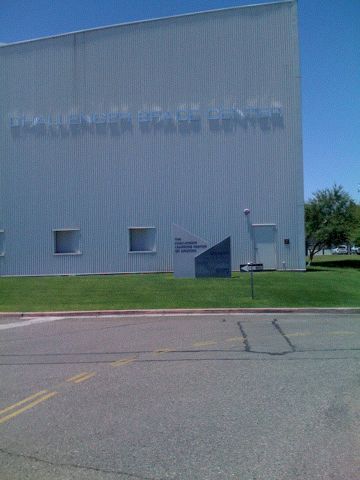
    We took the kids to the Challenger Space Center yesterday. It’s an odd building nestled inside a high school’s campus.

    Every car that entered had to pause to contemplate this.

    Do you follow the clear markings on the road guiding you right or do you follow the equally clear sign directing you left?