Author: Eugene Glover

  • Killer Sudoku Aide – What Is It?

    Just to be absolutely clear: My app, Killer Sudoku Aide is not a game. It’s a reference tool/utility to help solve Killer Sudoku Games.

    Killer Sudoku games are not killer Sudoku games. They are related, but different puzzles.

    Preface

    Several years ago, I got addicted to Killer Sudoku puzzles, not to be confused with “killer Sudoku puzzles.” I like them because the exercise the math part of my brain, and, I’ll say without too much boasting, I solve roughly 95-97% of them without the aide of anything.

    However, once in a while, I resort to using a calculator, and, somewhat less often, I would turn to a Killer Sudoku Cage Combination reference sheet.

    I hate using the reference sheets, not just because in the back of my head I think it’s a little bit of a failure on my part, but also because they suck to use.

    As a lifelong computer programmer I’d wanted to try my hand at iPhone development, and a digital, user-friendly version seemed like a good fit. As I built the app, some obvious enhancements over the basics of a reference card became apparent, and I implemented those. The result is basically the Killer Sudoku Aide that has been in the App Store for 3 years.

    Introduction for Testers

    I’m actively soliciting help testing the latest version of the app through Apple TestFlight. This is an app you can install on your iPhone, iPad or Mac and, by accepting an invitation, can install a beta version of the app and help me test it.

    If you’re not familiar with Killer Sudoku puzzles, you can try your hand at some Killer Sudokus here, and they even has an explanation of the rules. Playing some games will probably help with testing my program.

    As for my application, you can test all facets of it, including in-app purchases without fear of being charged. I’ll explain more about that later.

    I don’t that many people who play Killer Sudoku puzzles — in fact the number of people I know who play is zero. So, often people who help test the app are not very familiar to what it does.

    This will be a detailed introduction to the app and what it is supposed to do, and why, so that if you are not familiar with Killer Sudoku puzzles you can test what it does.

    We’ll go through this screen by screen.

    Tutorial

    When the app is newly-installed, after loading, it should first show you the tutorial. This tutorial is written on the assumption that you are a Killer Sudoku (KS) player and are familiar how the game works. If you are a KS player, please, go through the in-app tutorial first and let me know if I can clarify it further. You can replay the tutorial at any time on the Settings tab.

    Combinations

    The main tab, and most-used feature of the app is the Combinations Tab. It will normally be the first screen you see when you open the app.
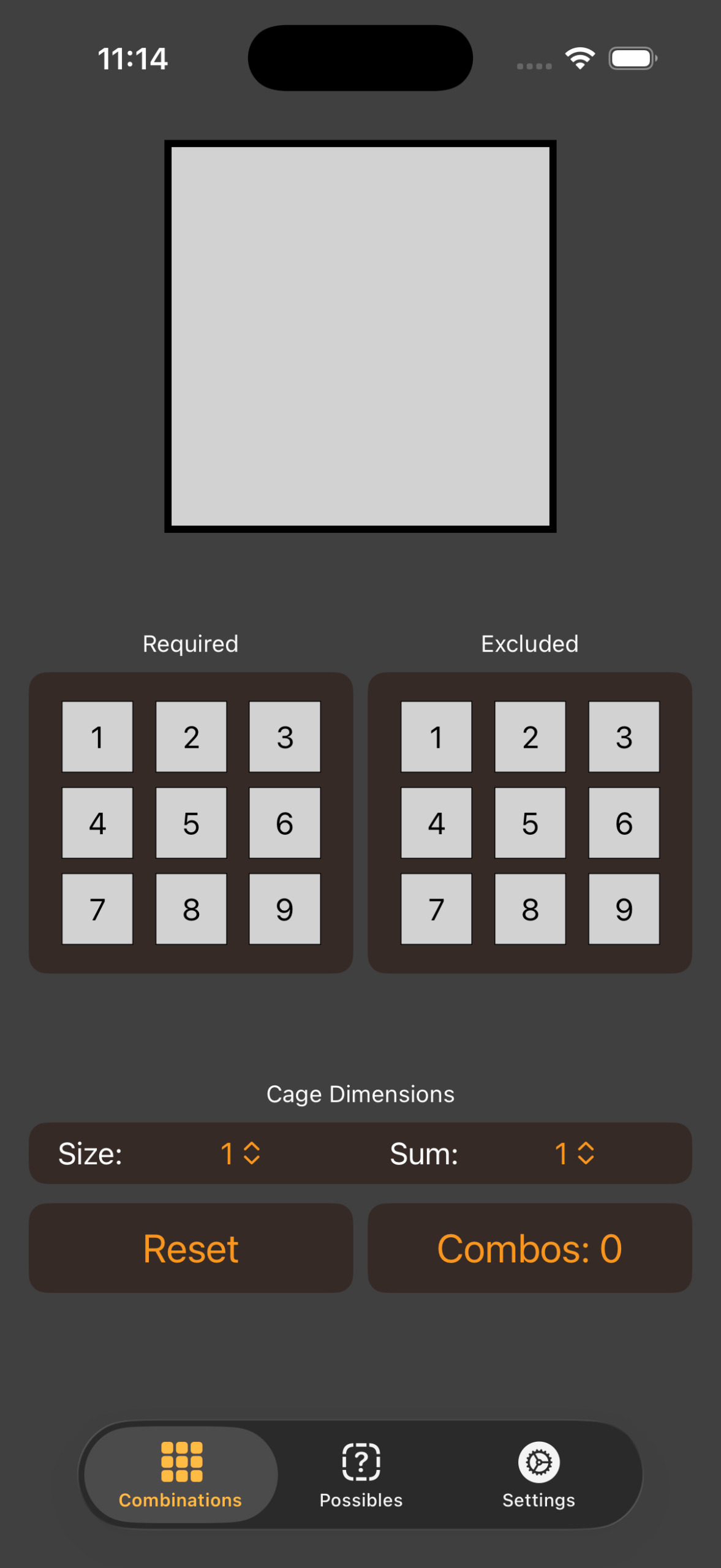
    In KS, groups of squares are called “cages,” and each cage will have a number in the upper-left square of the cage. That number presents the sum of the numbers that go in that cage. There can be no duplicate numbers in a cage.

    So, for example, if the cage size (the number of squares) is 2, and the sum is 8, the only possible combinations that can be in that cage are

    1+7 = 8
    2+6 = 8
    3+5 = 8
    It cannot be 4+4 because there cannot be duplicate numbers in a cage.

    Therefore, the numbers 1,2,3,5,6,7 are the only numbers in those squares within that cage, and those are in only three combinations, (1,7), (2,6), (3,5).

    I’ll phase this as [8 in 2] to signify a sum of 8 in a cage size of 2.

    [8 in 2] is quite easy, but, for example, [19 in 4] has 11 different combinations and the valid numbers as all 1-9. The reference doesn’t help much at that point until you start whittling it down. That is what this app is for.

    So, it’s important to remember that a Killer Sudoku puzzle must also conform to all standard Sudoku rules:

    • The board is a grid of squares 9X9 (81 squares)
    • The board is broken in to 9 smallers grids of 3X3 (9 squares)
    • Each smaller grid must contain each number 1-9 with no duplicates
    • Each Row (9 squares) must contain each number 1-09 with no duplicates
    • Each Column (9 squares) must contain each number 1-9 with no duplicates.

    So, if you had a column that had the [8 in 2] cage in it, and elsewhere in that same row you had already figured out there was a “5” you can eliminate the (3,5) combination from your consideration.

    OK, let’s take a look at the screens. About 2/3 of the way down the screen you see pickers to select the Size and Sum. Select the Size first, as this will narrow down the options in the Sum picker.

    For example, a Cage Size of 2 can only have sums between 3 and 17. 3 because the smallest combination you can have is (1,2) and 17 because the largest is (8,9).

    Select a Size of 2, then a Sum of 8, and the screen should look like this, with the top square filled in with (1,2,3,5,6,7). Each number has it’s own position because this is a common way that solvers annotate their puzzles when working out what might be in a square.

    You’ll also note that there is a button that says “Combos: 3.” We’ll come back to that button later, but for the moment just note that it is telling you that these numbers are only three possible combinations ((1,7), (2,6), (3,5)) as mentioned above.
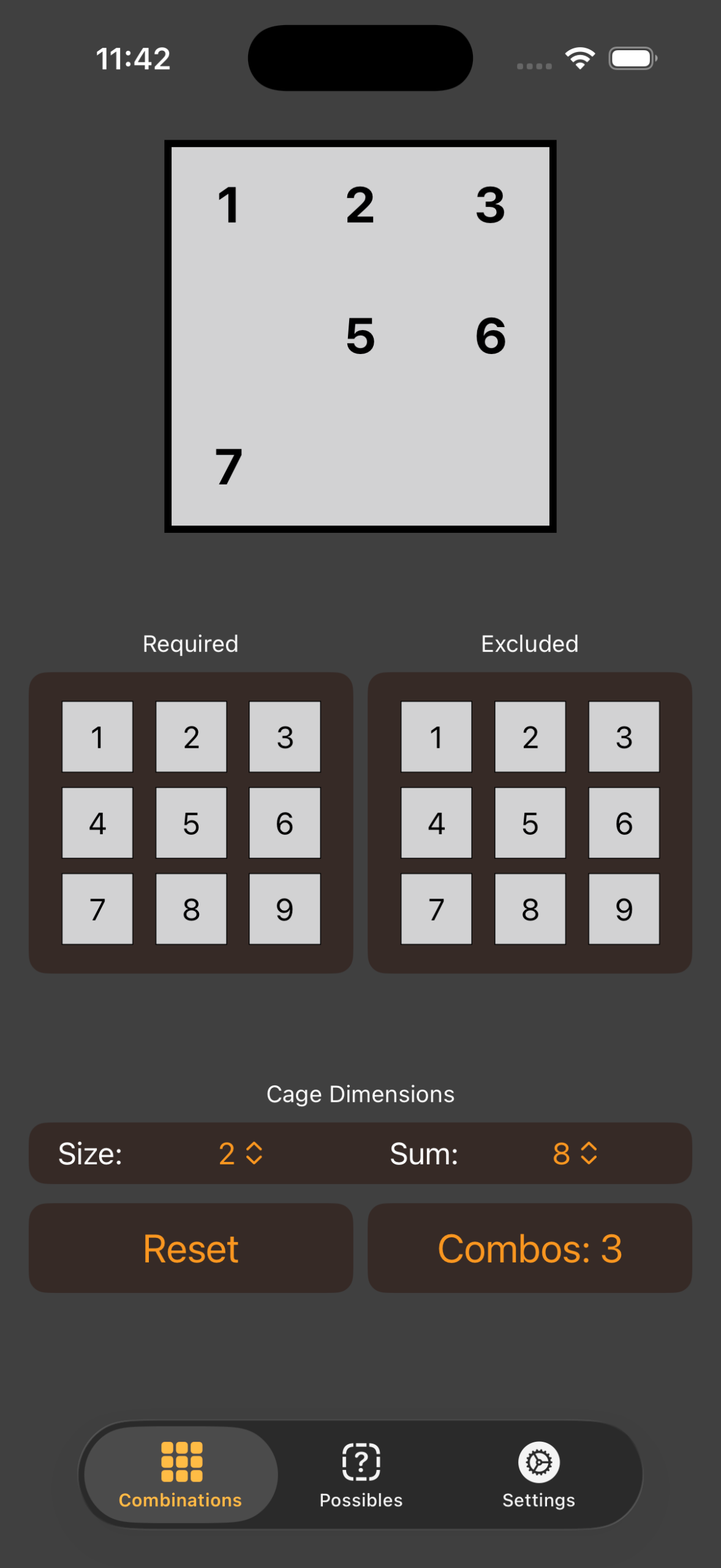
    But in our example, we know one other piece of information: It cannot have a 5 in it. This is what the “Required” and “Excluded” grids are for.

    5 is an “excluded” number, go ahead and press it and the screen changes. The top square no longer shows 5 or 3, the 5 in the Excluded square is red, and the Combos button now only shows there are 2.
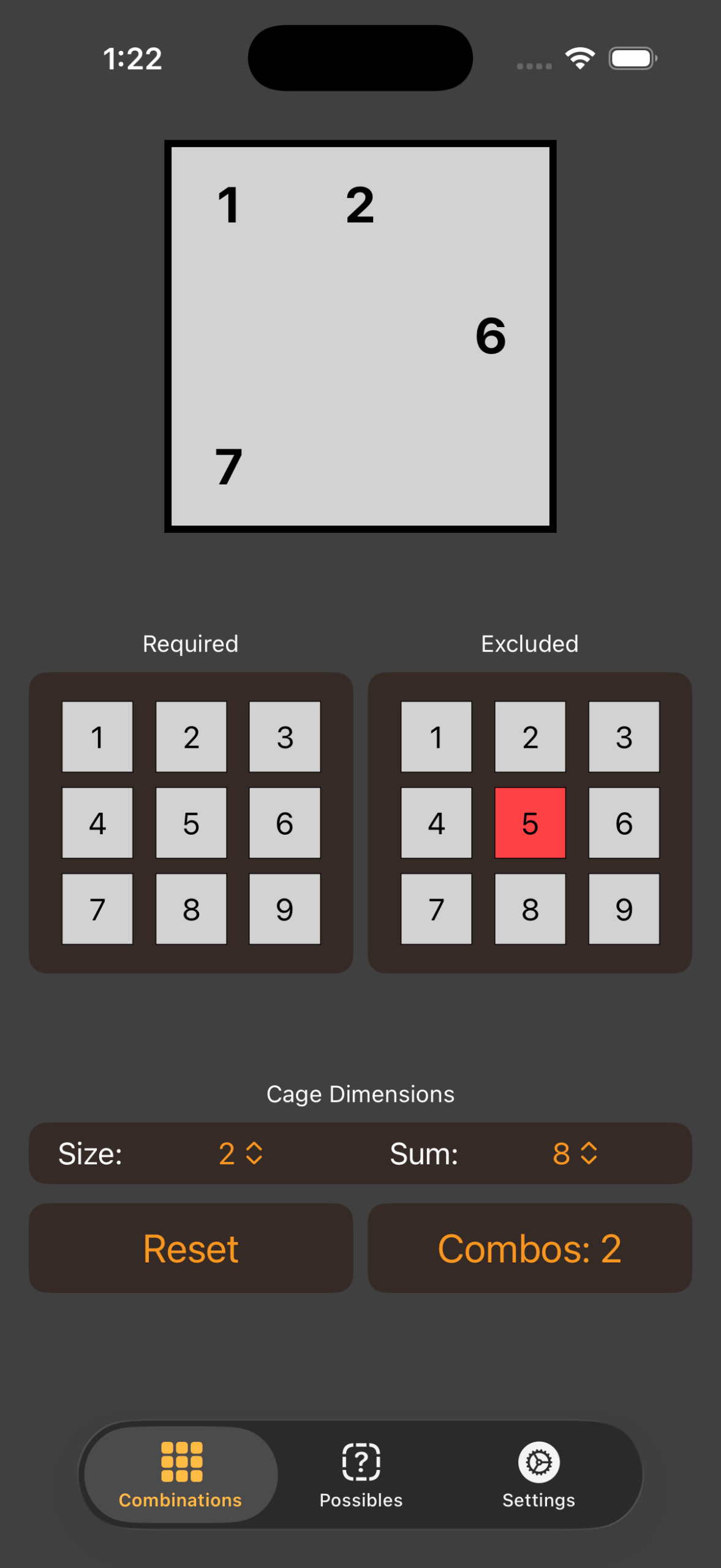
    By process of elimination, you can whittle down what might be in your cage. If you can narrow it down far enough, you will know exactly what can go in the cage.

    Let’s look at the Required square next. It’s not very useful for a cage size of two, so let’s look at that other example, [19 in 4], that I mentioned earlier.

    You can just change the picker values (Size first) and toggle the Excluded 5 off, or, just hit the Reset button to clear everything.

    For [19 in 4], you’ll see that all 1-9 appear in the top square reflecting the fact that, barring further information, it could be anything. You’ll also see there are 11 combinations.
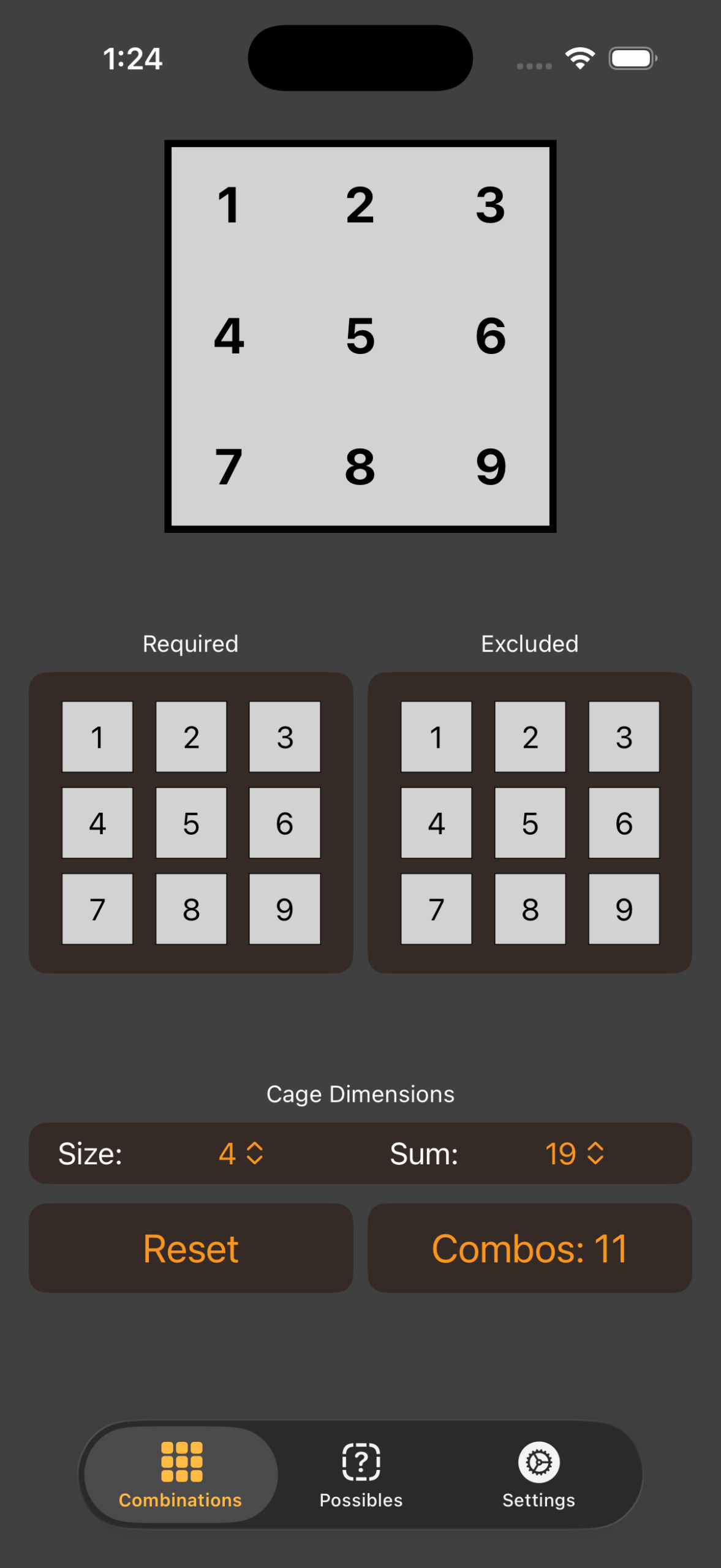
    Go ahead and hit the Combos button now.
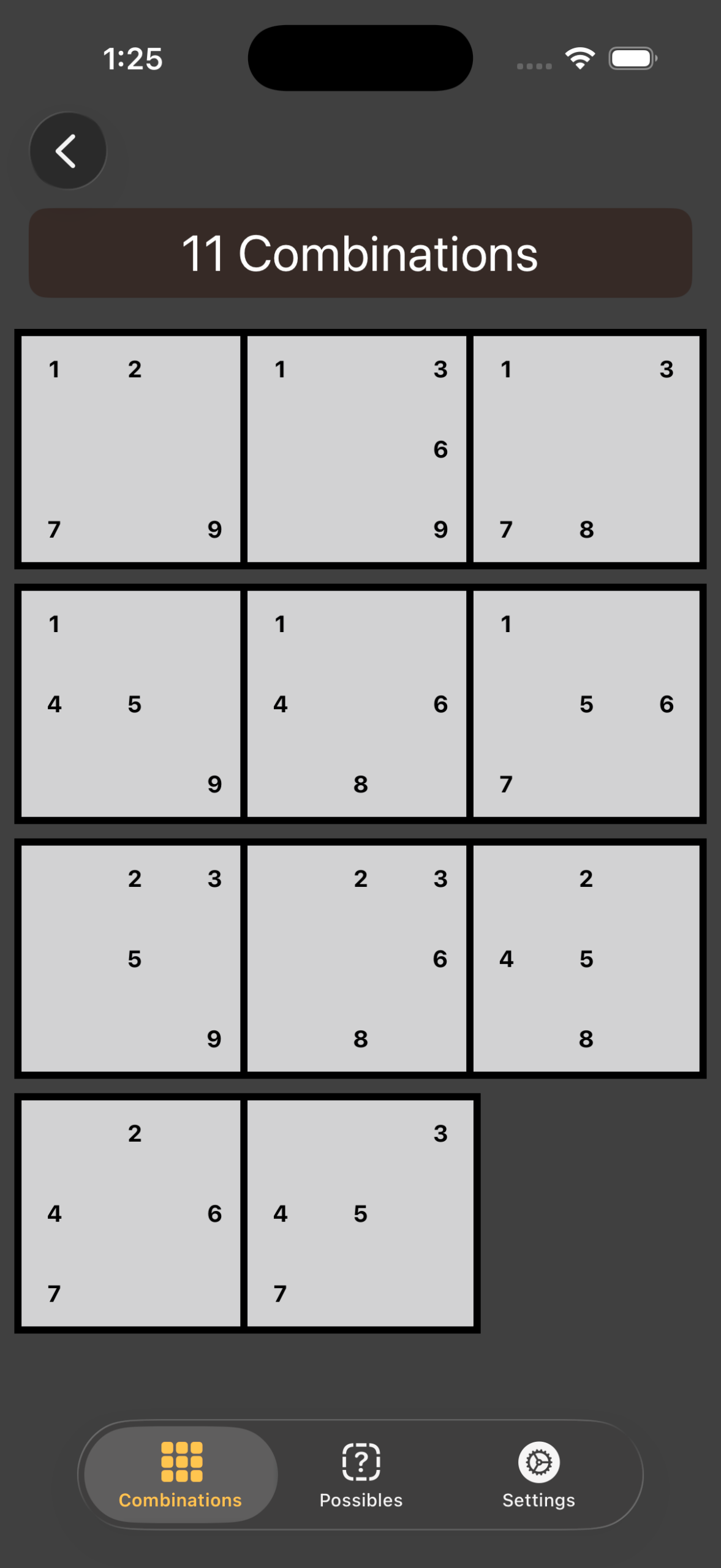
    You’ll see eleven grids, each with a different combination. This is essentially the reference sheet displayed in a different fashion. You can swipe back or hit the back arrow at the top to return to the main screen.

    Let’s play around with the Required buttons. Like the excluded ones, these are based on things you’ve narrowed down in the puzzle. If you know that there is a “1” in the cage, hit the Required 1.

    The number of Combinations to 6 and the one turns green in the top square. Green signify numbers that this number must be in the cage, and that may be because you’ve told the app that it is required or it has calculated that it is required.
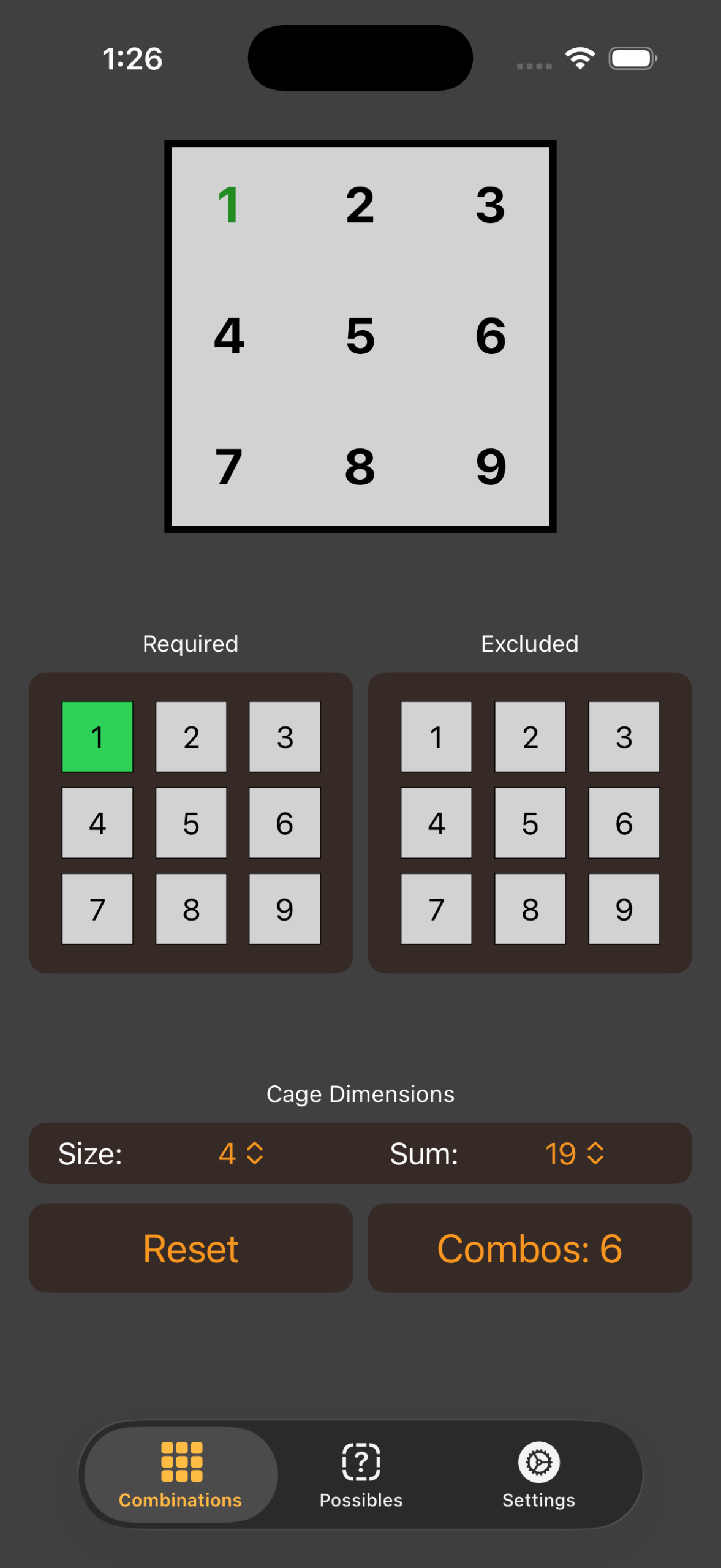
    Play around with various combinations of “Required” numbers.
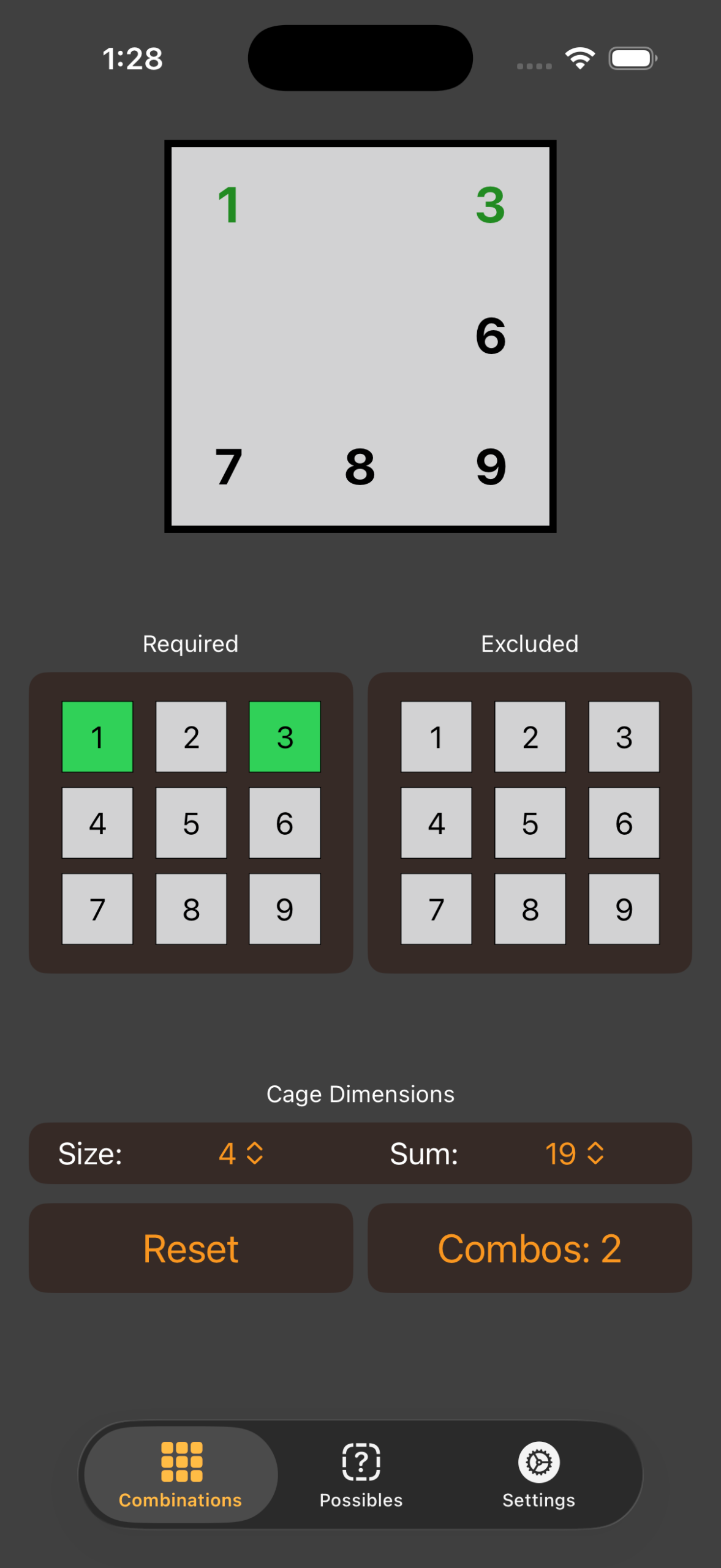
    If you select 3 as required, you’ll note that both 1 and 3 are green, the number of combinations drops to 2, and the numbers 2,4, and 5 have disappeared. It is now no longer mathematically possible for any number in your cage to be 2,4, or 5.

    If you also knew that there could not be a 9 in the cage, you could exclude 9, and the top goes all green, and all four numbers (1,3,7,8) are green, too. This indicates this is the only possible combination for your cage.
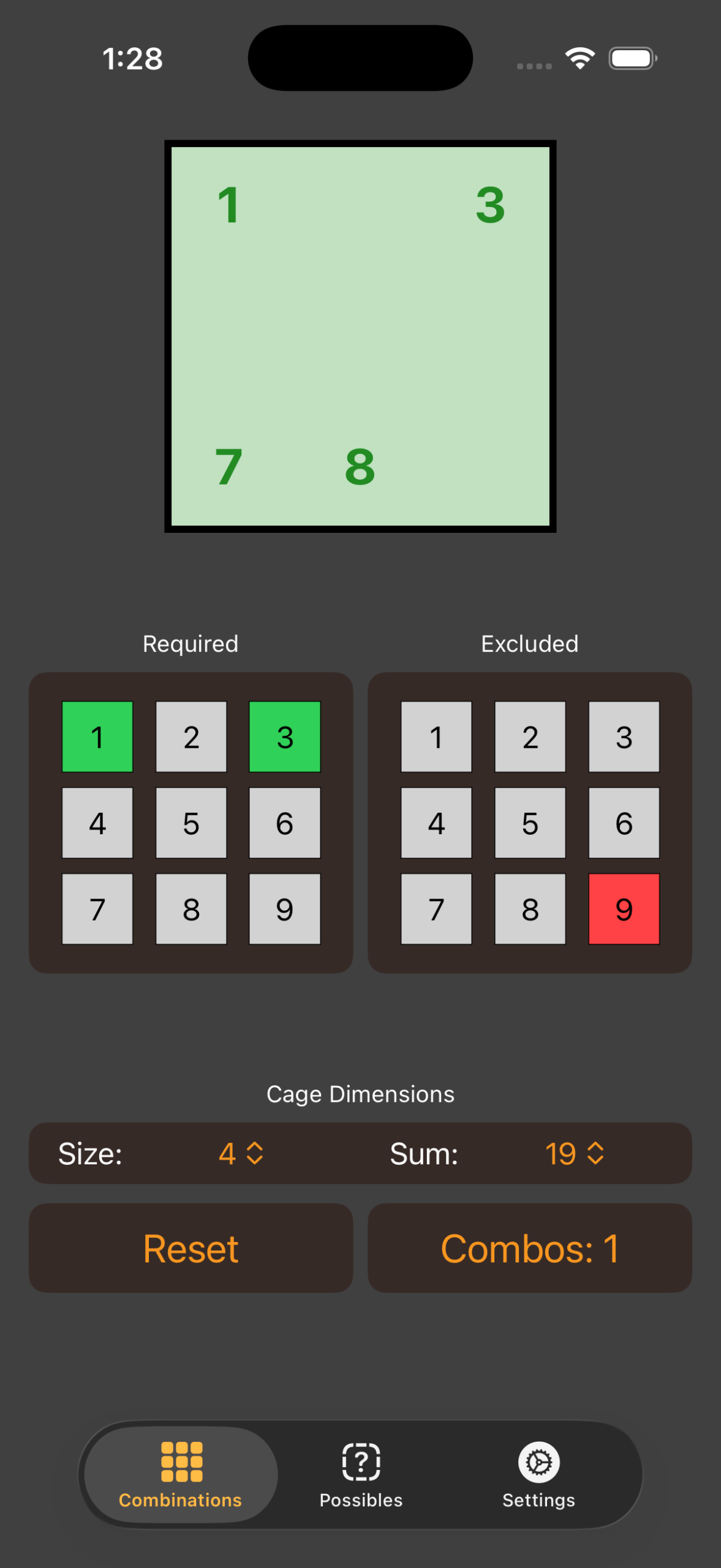
    That is how the main function of the app works.

    Possibles

    I struggle to explain the Possibles Tab, although it can be very helpful in a tricky solve.

    If you had a cage, let’s use [16 in 4], and instead of knowing what anything for certain what any Requirements or Exclusion were, let’s say that you had a square that you have narrowed down to either an 8 or a 9.

    Let’s start on the main screen, setup Size 4, Sum 16, and you’re confronted with all 1-9 as valid contents.

    Since you know there’s a single cell that’s either 8 or 9, you could click on Required 9, and you’d see that if it’s a 9 there is only 1 possible combination (1,2,4,9)

    Unset the 9 requirement, and then select the Possible Tab at the bottom. You’ll get a screen similar the main screen, but with an extra grid called “Possibles” at the bottom. You’ll also note that the top square is empty and red — this just means that the current setting is “impossible.”

    On this screen, instead of select 9 as a Requirement, select it as a possible. Note that the top screen now shows (1,2,4)
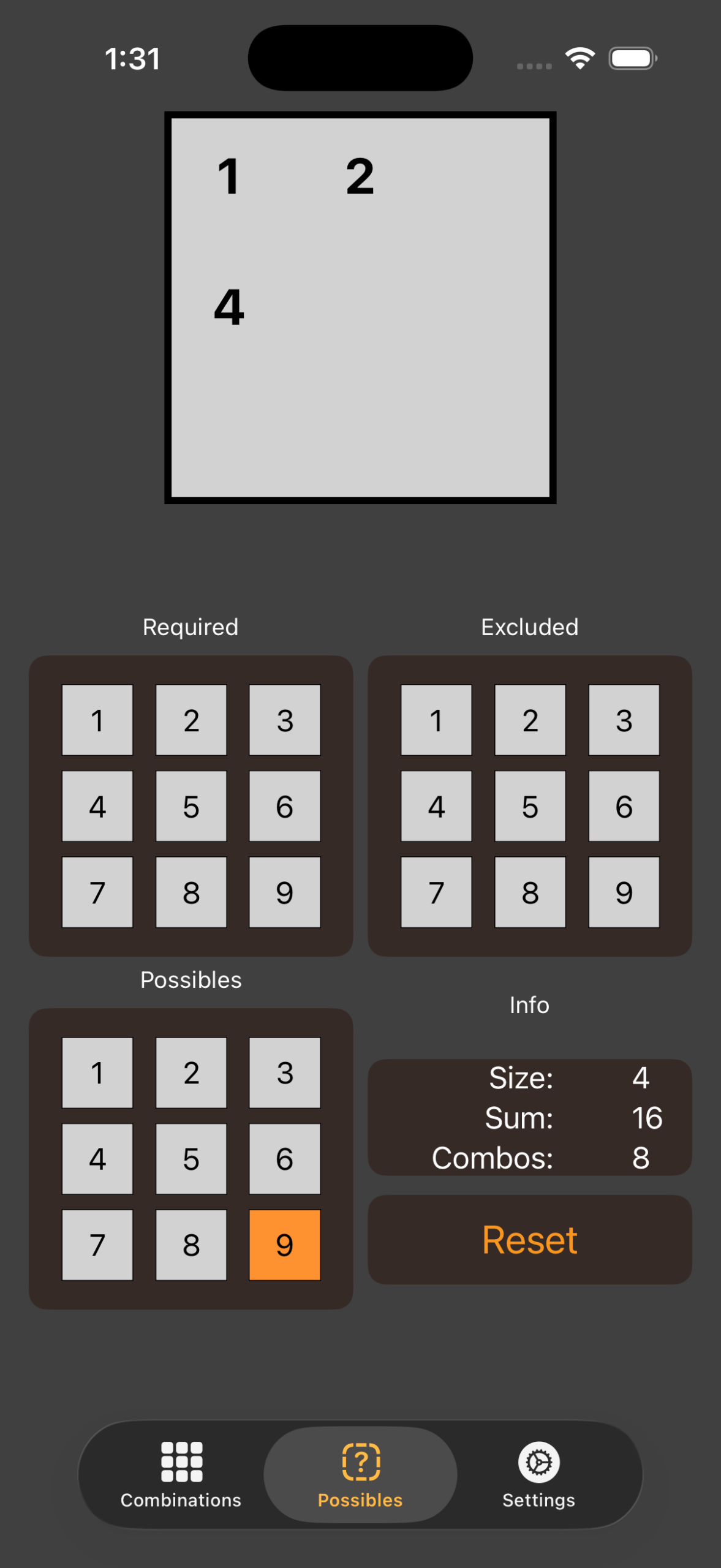
    What that means it that, If you had a square with a 9 in it, the other three squares could each have (1,2,4). Which, if you’ll recall from the previous screen, is just the (1,2,4,9) combination minus the 9.

    OK, back to the first screen, and this time, select 8 as a Requirement. Now you’ve got two possible combinations, and not only is 8 required, but all valid combinations have a 1 in them, which is why it is green. Looking at the valid Combos shows (1,2,5,8) and (1,3,4,8).

    Like before, unset the 8 Requirement and go to the Possibles Tab. Select 8 as a Possible. (If 9 is still selected, unselect it.)
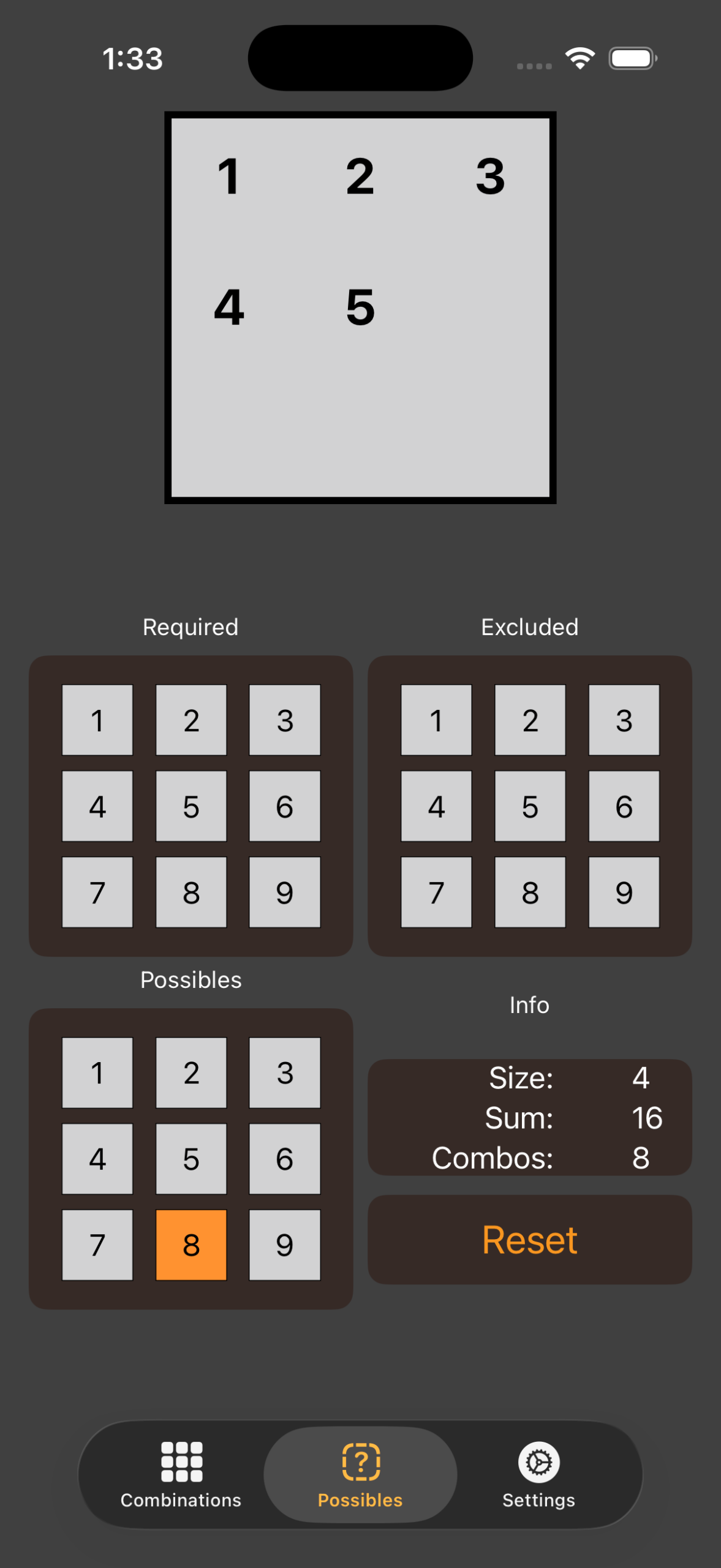
    Now the top square shows (1,2,3,4,5) which is the union of the valid combinations (minus the 8): (1,2,5) & (1,3,4).

    Again if the square was 8 then the other three squares can only be (1,2,3,4,5).

    You’re already being told this information on the main tab, just in a slightly different way. Where it can get useful is back to our premise that we know that a square can only be 8 or 9.

    Select both 8 and 9 on the Possibles. Unfortunately, in this example the result is exactly the same as 8 by itself. What you’re getting in the union of the Possible 9 (1,2,4) and the Possible 8 (1,2,3,4,5)

    If that square can be only 8 or 9, the others can only be (1,2,3,4,5.)

    I find this tool useful when I’m a bit adrift and noodling around trying to identify patterns that might help me solve either this cage, or cages that it might influence.
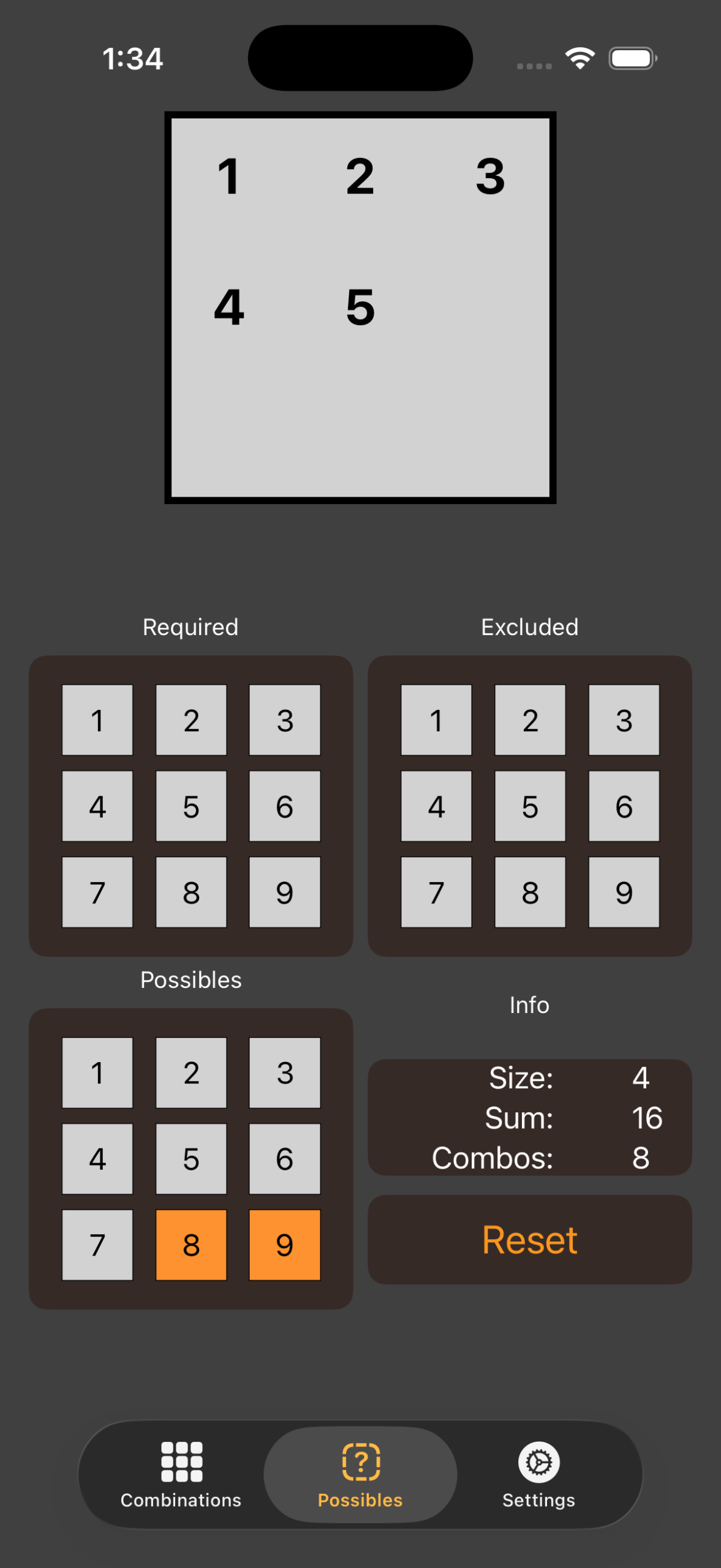
    So, that’s the main two screens. The code underlying them should be unchanged, and they’ve been used on hundreds of games and seem to be correct, although, with any new version, sometimes bugs happen. If you can help test these, that would be great.

    Settings

    Basically all the changes in this version are either cosmetic (Liquid Glass, new App Icon) or it’s on the Settings page.

    In the previous version of the app, light/dark mode followed your system setting. In this version, I added the option to continue to do that, or to force the app into light or dark mode.

    The Replay Tutorial is unchanged (or should be.)

    The biggest change I’ve made is the tip jar. This is completely new code and tapping into the in-app purchase system through Apple which is a whole new layer of complexity.

    Apple’s TestFlight betas allow you to test in-app purchases without actually spending money. Please test it out. Several times. Unfortunately, for some reason I cannot fathom, it does ask for your Apple password. This is Apple’s simulated in-app purchase asking, not my app.

    I’ve added two tip levels, Small and Large, which are set at $0.99 and $4.99.

    And that’s really all there is to the app. Your help in testing it is really healpful to me. There’s a way to report problems via TestFlight. If you encounter a problem in my app, just snap a screenshot of it, and it should prompt you to send the screenshot and a description of the problem to me.
  • Second Act

    I was in a board meeting for Camp Quest Arizona shortly after I retired from my day job, when one of the other board members (whom I respected quite a lot) asked me, “What are you going to do for your second act?”

    I’ve didn’t have an immediate answer, and, to that point, I’d never actually heard retirement called a “Second Act” before. Surreptitiously, I looked the term up on my phone.

    second act noun
    1. Figurative. A later stage of life or career, especially following retirement or a major career change, characterized by renewed purpose, exploration, or reinvention.?
    Example: “After retiring from teaching, she began her second act as a travel writer.”

    I’ve never viewed retirement as any thing other than the opportunity to do whatever the hell I wanted on any given day, but since that day, I’ve thought about it. I’m OK with living day to day. I’ve always been able to keep myself amused without clear direction.

    With our looming move to Hsinchu, Taiwan, I’m contemplating that idea of a Second Act more.

    Oh, I’m not thinking about getting a “regular job” or pursuing the dream of “opening my own business” — although, there are a few western food items that have not really caught on in Taiwan that, I think, just the right marketing campaign might launch to success, but that is not for me.

    I’m just thinking of how I can take the things I enjoy and “taking them up a notch.” In no particular order, and with no assertion that I’m any good at any of them, I enjoy hiking, biking, writing, podcasting, and making videos.

    It practically screams YouTube channel, doesn’t it?

    The fact is, I’ve recorded dozens, if not hundreds, of hours of video in Taiwan, but I’ve done very little with it. Partially because of a lack of purpose. On my first few trips, my impressions are overwhelmingly about how it’s different. That is an unsustainable model, as with time and familiarity, the remarkable becomes the unremarkable.

    I have been watching various YouTubers in Taiwan for several years now, and there are some very depressing lessons to be learned.

    Your Audience is Domestic

    YouTubers in Taiwan regularly confront the harsh reality that, no matter what the target audience is, the vast majority of viewers will be within Taiwan. If you think you’re telling the world about Taiwan, you’re probably wrong. You’re telling Taiwan about Taiwan.

    The audiences seem to have a fascination of hearing what foreigners think about them, and, by and large, they want to hear good things. This feels like some form of self-validation, perhaps because Taiwan doesn’t have a lot of curb appeal for the rest of the world.

    I have no doubt that almost any country can be fascinating for a visit, if you haven’t got your sights set on something specific. (For example, a surfer hoping to catch some big waves in Czechia is likely to be disappointed.)

    Don’t get me wrong. I love Taiwan. I find it a fascinating place, but it just hasn’t got the mindshare that other countries like Japan, France, Italy, or Australia have.

    But if people aren’t thinking about Taiwan, they aren’t looking for it on YouTube, and YouTube isn’t serving it up as part of the algorithm. Taiwan is making some tourist destination inroads, but it’s slow progress, and the local tourism industry seems very geared towards domestic (or at least Chinese-speaking) tourists.

    Given that a significant portion of the audience is local, and Mandarin is the lingua vernacula. Subtitles are essential — that means putting my wife to work on my hobby.

    And, the click-through ad revenue rates for Taiwan are lower than North American or European countries. Not that ad revenue would be my goal, but who would say “no” to money?

    Everything is About Food

    There’s a game you can play looking at YouTube channels focusing on Taiwan. Look at the number of views, then look at the thumbnail/title. If you see an odd jump in the number of views, there’s very good odds that the video is or appears to be about eating.

    The Taiwanese love to eat. Their days seem to revolve around eating. Their holidays revolve around eating. Their tourism is about going to places and eating. Places go out of their way to have some “famous” local dish to draw in tourists.

    …and they seem to love watching YouTubers eat food. Taiwanese food. A foreigner choking down stinky tofu is video gold. And you damn well better like most of it.

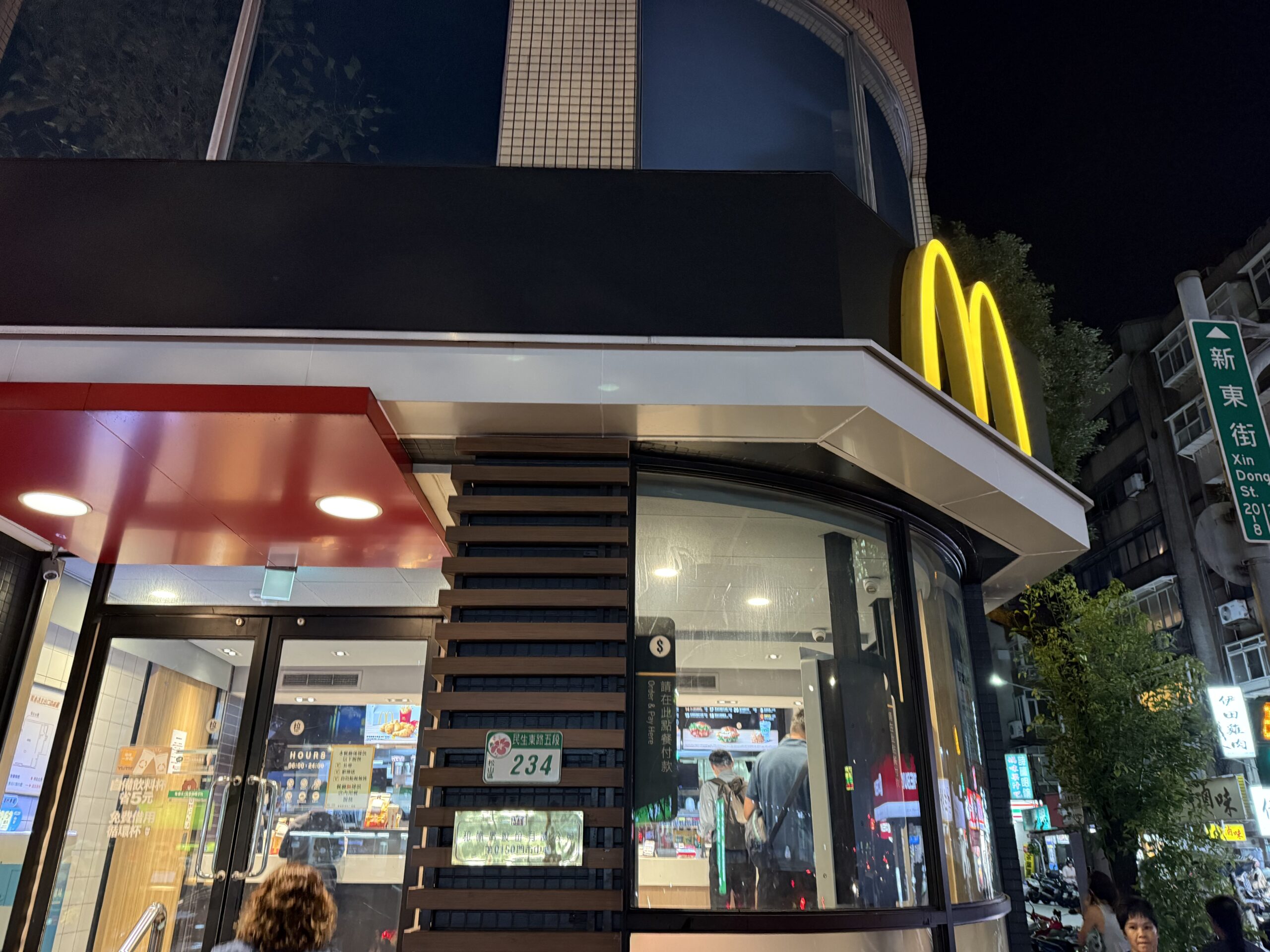
    That’s going to be a problem for me. I’m a picky eater at home in the US. On my first trip to Taiwan in 1998, I nearly starved. I could not adapt my palate to what was on offer. McDonald’s kept me alive in Taipei, but when we were outside Taipei, I had some rough, hungry days.

    In the interveneing three decades, I have developed a repertoire of foods in Taiwan that I can not only tolerate, but genuinely enjoy, and I anticipate learning to eat more things.

    For example, on my next trip1, I’m going to be searching out hu jiao bing (???) or a “black pepper bun.” It looks good, but for every one dish that looks good to me, there are dozens more dishes that don’t appeal to me at all.

    It’s almost a joke watching many “foreigner in Taiwan” YouTube channels that it doesn’t matter what the topic of the channel is about, they will stop for food. You gotta give the punters what they want. I don’t think I can do that.

    What Do I Want to Do?

    Do I have a story to tell? I feel like I do. Is YouTube the way to do it? I don’t know. I enjoy the technical challenge of shooting and editing video. I gravitate towards that idea.

    In a weird way, I also enjoy writing. That is, when I don’t hate writing. I vacillate between equal measures of enjoying and hating writing. Should I write books instead?

    What story do I want to tell?

    One thing I’d like is to open the world’s eyes about Taiwan. It’s a nice place. I wouldn’t be moving there if it weren’t.

    Unfortunately, unless they massively overhaul their immigration system, it’s not going to be a emigration destination for most people, so Taiwan as a tourist destination is it.

    What about telling my story as I try to integrate?

    Oddly enough, I think I’ve already passed many of the “culture shock” moments that make up the bulk of the “I’m new here and just learning my way around” stories out there. But perhaps there’s still a story there to be told.

    Life is going to be very different for me this time.

    I’ve spent months “living” in Taiwan, in a Taiwanese home, which is something most tourists don’t get to do. But that was in Taipei, the most populous and most developed (and dare I say Western-friendly?) place in Taiwan. Also, while I frequently spent my days exploring entirely on my own, my wife was always available to go do things and navigate the “difficult” day to day interactions.

    Living in Hsinchu is not going to be the same. For starters, my wife will be at work all day. That means 8-10 hours a day, 5 days a week, I’m on my own. It’s going to be sink or swim on my Chinese language learning.

    Hsinchu also is much, much smaller than Taipei, and while they do have most of my favorite restaurants, there aren’t as many and they’re not necessarily close to where I’ll be living.

    And then there’s transportation. No subways, no light rail, and a bus system which has been described as “infrequent, at best, and rarely on schedule.”

    Also, I’ll be living inside the Hsinchu Science Park, which, despite the name, is an industrial park. Convenient if you want to walk to a wafer fab, less so if you want to walk to a 7-Eleven.

    In the plus column there is a local train line or two that seems to run regularly, is inexpensive, and spans several areas I’m likely to go to, plus there’s the U-Bike bike share program to get me to the stations and out to my final destination.

    There will be hardships. Perhaps there’s a story to be told there.

    Two Wheels Good, Four Wheels Bad

    Maybe there’s a biking angle? Taiwan makes some of the best bikes in the world, and I’ve got my eye on a couple gorgeous Giant eBikes that I cannot get here in the US, but how much “fun” will that be on the crazy city streets of Hsinchu? I’d much rather get the hell out of town.

    What would be best would be if I could hop on a train and take my bike, but that gets complicated, unless you have a bike that folds and you can carry easily.

    Some trains have spaces for bikes, others do not, some subways do, but only during certain hours of the day, or only certain routes. Even the High Speed Rail (HSR) that goes through Hsinchu and connects with most of the rest of the island has restrictions.

    I’ve found exactly one bicycle that folds small enough to be taken on, as far as I can tell, any train at any time to any destination. That’s a Brompton — a bike not even made in Taiwan! There are a couple Brompton knock-offs made in Taiwan, but they still don’t fold small enough to get past every size limitation.

    I’m seriously considering getting a Brompton, even though it seems like a compromised ride over a proper road bike or an eBike.

    Or I can have both.

    Conclusion

    I haven’t got one.

    I started writing this post mostly to put my thoughts down and hopefully organize them, but it didn’t help.

    I just don’t know what my Second Act will be.


    1. “…on my next trip…” Who am I kidding? My next trip will be when I move there. ↩︎
  • How I Fell into a Rabbit Hole

    Sometimes I find it fascinating to think about how I get drawn off into a tangent, and just how far I’m willing to go once I’ve caught the scent.

    I’ve been contemplating what I plan to do with my time in Taiwan. And while I don’t think — for the most part — that there’s anything I’m doing here and now that I cannot do there, but I feel like there are new opportunities, and I should be thinking about it.

    I have another post (coming soon) that discusses that, but, I decided that I need to “re-visit” my memories of Taiwan over the years. Two things are certainly true: Taiwan has changed a lot since 1998, and things that shocked/amused/delighted/bewildred/disgusted me on earlier visits have become “ordinary” to me with familiarization. (Travel broadens the mind, doesn’t it?) Again, that’s for the other post, but I decided to look back at my journals/posts/videos ands perhaps use those memories to give me ideas for later.

    I also have some regrets. I’d been doing a public access TV show for several years when I first went to Taiwan, but that was a very different animal than travel videography, but I had my camera and I wanted to record memories.

    When I came home, I found myself telling the same stories, and I decided I’d try to do something with the video footage. I put together a 20-some minute travelogue that I think conveyed… well, not just Taiwan, but more importantly my reaction to it. In some ways, it’s more about me than Taiwan, but in 1998, Taiwan had pretty much zero mindshare with the people I knew, so everything presented was basically new to the intended audience: my friends and family.

    Even looking back, there are bits that make me cringe, but they are more about changes in me than anything else. Even the name, “Made in Taiwan” which seemed so fucking clever at the time, feels trite now. At the time though, I was pretty damned happy with the video, and it played well with the intended audience. It even later went on to play on local TV.

    There were many instances in original where I’m talking about something that I don’t have footage to cover, or that I don’t have Chu-Wan or myself in the footage to give a sense of narrative, and there are things that I left out because I just didn’t have suitable footage. My written narrative, An American Pizzahound in Taiwan, tells a different story, both true, but in writing I chose a different narrative path.

    But… the ol’ ego gets going and I started thinking, “Next time I’m going to do video so much better! Next time I’m going to cover it all!”

    …and I did, I shot tons of footage on the next trip where were did a huan dao (??) of the island, which I thought would be a perfect way to highlight Taiwan.1

    When I came home, I realized that what I’d shot was not just inadequate to the task I had set for myself, it wasn’t even as good as the footage I shot on my first trip.

    This put me off the whole, “Hey, I should do a video travelogue” on subsequent trips, although I did shoot footage on all my trips and have pushed out a few bits here and there. On our trip in 2015 for my brother-in-law’s wedding, and our 2019 trip, I vlogged the journeys, and those remain my most comprehensively covered visits to date.

    Here are three more things that are true: I have tons of footage from Taiwan, my skills as an editor have improved, and the technology I have available is vastly superior to what I had back then.

    I decided I would inventory my footage. I would see what I have, what its condition is, and what I’ve used previously and how, and then decide if I can salvage anything as part of a retrospective of my relationship with Taiwan. That relationship which has led me to moving to Taiwan this coming summer.

    …and then appeared the rabbit hole from Hell.

    I decided my first step should be to review Made in Taiwan and the source footage.

    And this is where it gets ugly. I cannot find the original final edit.

    Now, I mentioned that it had aired on local TV. I used it as an episode of the Fusion Patrol TV show back in 1999, I believe. And to do that, I made a new copy with Fusion Patrol branding and different music. The original version, never intended for public airing, used copyright music.

    I have a copy of the Fusion Patrol version, but it is of lower quality than the original, and I hate the music selection I chose for the TV version.

    What I do have in my possession are the original 8mm video tapes from the trip, which I have digitized but, like all videotape of that era are technically lower quality than SD television.

    It just so happens that, several months back, I was experimenting with that digitized copy. I was building shell scripts to use ffmpeg to scan the single file produced by digitizing the tape, and splitting it into individual files for each “scene” without re-encodoing it.

    I was doing that to make it possible to use Topaz Video to see if it was possible to upscale and clean up the original clips. Video upscaling relies on the quality of the source material, and, after a certain point, it simply cannot upscale low quality footage. My footage topped out at 720P. Most of the 720P footage looks “OK” without too many bizarre artifacts.

    So, I had a directory with all the individual clips from that trip, upscaled to 720P. I got an idea.

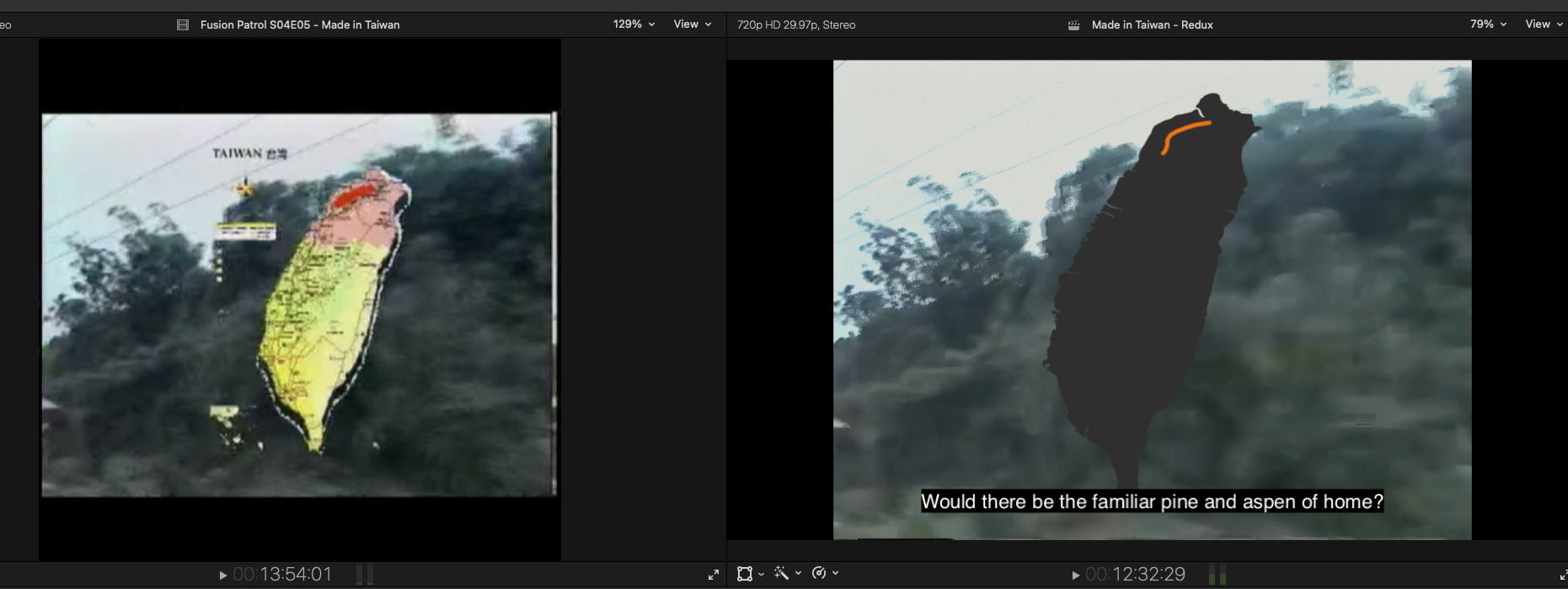
    If I loaded the TV version into Final Cut Pro, inside a 720P project, I could use the upscaled footage to create a clip-by-clip, frame accurate re-edit of the original. I’d just have to find each clip, find a synchronization point and line up the new footage like B-roll right over the top of the original. I would be re-creating the original faithfully with higher resolution video.

    Piece of cake! Right?

    Yes, but, no.

    That process would obscure any titles or graphics. Titles wouldn’t be a problem (I thought) but some of the graphics I created — I don’t even remember how I created them — would be too low-quality to use, so I had to set about recreating them.

    The most difficult was making traveling maps showing a moving progress around the island. Luckily, Apple Motion had me covered on that. With a royalty-free Taiwan map image, a bezier path, and a “write on” behavior, I was able to trace my train journeys on screen. They don’t look the same, but they convey the same concept.

    When I originally edited Made in Taiwan, I was using a PC. I had a no-name video capture card that came with a knock-off of Adobe Premiere. I don’t even remember it’s name, but it came with inbuilt titles, and I chose one that, upon reflection, I hate.

    I used lower thirds, and the titles flies in diagonally from the top to land at the bottom, then a bar of negativity slides in front of it inverting it to negative space.

    Oddly enough, Final Cut Pro doesn’t have that, nor do any of my title plugin packs. I had to choose a different one. In keeping with the spirit of the original, I chose one that’s way too elaborate, but not quite as awful.

    I faithfully went though the footage, I used cuts when there were cuts, and crossfades when there were crossfades — although for the life of me, I can’t figure out what the hell I was thinking when I made some of those choices. The titles and overlays cover the exact same duration on screen.

    But, I had to make some compromises. There’s one scene in the original where a pond full of koi are churning the surface as people above toss them food. There’s also a kid framed in the shot that’s a little close to the fish. In the narration, I commented that the fish would probably be just as happy if the kid fell in.

    I could not find that scene, neither in the upscales nor the original scenes. It seems that a glitch in the video tape caused that scene to be unsuitable for slicing up. I had another scene from a different angle which I just substituted, athough it does make the comment about the child falling in less meaningful.

    My technique for synchronizing the clips was to locate a precise frame in the aired version — for example, when a passing power pole first enters a scene. I would mark it, find the exact same spot on the new footage, mark that, then align the marks.

    About three times I found that glitches in the video caused the scenes to cut out early, and I was forced to “slip” the synchronization one way or the other a few frames to fit in the same time window. In one case, it was a whole second.

    And then there was the narration. Because this was a finished product, the narration, the music, and the background noises (because I chose not to remove them back in the day) are all on one track.

    Well, not problem, I thought. First, I can use my podcasting tools, in this case Auphonic, to take the audio track, strip out the music and the background noises, and enhance the quality of my narration.

    It did an OK job of it, but, parts failed miserably and would be unusable.

    That was a bit of a relief, really, because one of the “cringe” things I told you about was the narration. Somehow, simultaneously, I was trying to channel both my inner Michael Palin and David Attenborough. And failing at both.

    The upscaled footage still has the original audio, so I could include that in the new mix, but perhaps balance it a bit better. I transcribed a script of the video and recorded new narration in my natural voice.

    I did make three minor changes in the script. At one point I referred to a mudskipper as a “mutant.” This was unfair to the mudskipper, and I’m sure he was genetically sound for his species, so I changed that to “monster” in accordance with my reaction at seeing one of these beasties for the first time.

    I also noticed that, rather bizarrely, I had mixed between the use of metric and imperial measurements in the narration. In two places, I standardized the script on metric measurements as part of my personal policy of “Fuck You, Imperial Measurements!”

    All that was left was the music. I remember where I got the music, and, indeed, when I hear those songs in my music library, I can see in my mind where I used them in the video. I could have recreated that, but, it was wrong to use the music back then, and it’s wrong to use it now.

    I also could have reassembled the alternate music, but as I said, I hate it. It was a compromise that I didn’t want to make at the time, and it didn’t convey the “feel” that I was going for.

    Once again, 28 years later, I have more resources. Personally, I subscribe to Envanto, mostly for licensed stock footage, but they also have a collection of music tracks that can be cleared.

    The original music did lean heavily on (arguably cliched) traditionally-Asian-sounding tracks, but they were moody. Keeping with that creative choice I ploughed through dozens of tracks on Envato until a found a few that were of a similar style and feel.

    And having buttoned all the pieces together, I realized that I needed subtitles, so I did that.

    I had Perplexity analyze the subtitles and generate chapter markers, summaries, and SEO-optimized A/B titles. And finally, I gave Nano Banana a few photos from the trip and had it generate a “YouTube Thumbnail optimized for clicks” (And who but the Google AI would know what the Google YouTube algorithm thinks is clickable?)

    They’re definitely both a bit bullshit, but they amuse me at how “Bullshit YouTube” they look and feel.

    I should produce Chinese subtitles because conventional wisdom is Taiwanese like to watch foreigners in Taiwan more than foreigners like watching videos about Taiwan. Chinese subtitles help with that.

    On the flip side, I don’t eat anything in this video, and that, as any YouTuber in Taiwan can tell you, is the kiss of death for a video in Taiwan.

    Maybe on the weekend, I’ll run the English subtitles through a translator, then get Chu-Wan to proofread them. I can always add them later.

    …and that is how I fell into and climbed back out of the rabbit hole.

    Links mentioned in this video:


    1. A “huan dao (??)” means a “round the island trip” and it’s something you hear people talking about, although I don’t know if there’s any cultural significance to the idea ↩︎

  • When You Suddenly Feel Like Crap Minutes Before Bedtime

    Just about 30 minutes before bedtime last night I started coughing, then I got a headache, followed by a mild sore throat, fatigue, and then nausea.

    This all hit within a span of 10 minutes. I took some Tylenol, a whole bottle of water, and crawled off to bed for a very uncomfortable night.

    This morning, I felt a bit better, although the sore throat persisted. Got up to get some food, then discovered I had no energy at all.

    Now I’m beginning to wonder if I’ve finally caught COVID. I’ve avoided it so far.

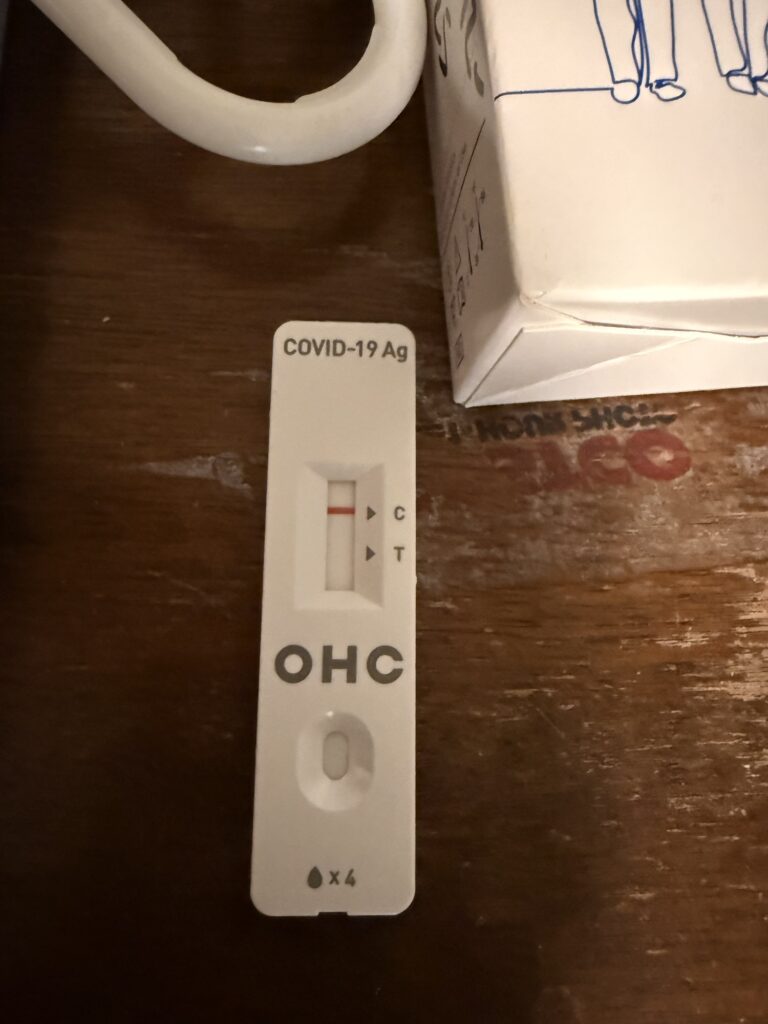
    First test: Negative.

    Negative COVID test on a dresser
  • Taiwan (2024) – Data Only Mode

    My last trip to Taiwan was in 2019, the year before the pandemic. I owned an iPhone X, and the only option I had to get inexpensive local phone/data service was to secure a physical SIM card from a local carrier and swap it out for the one in my phone. That system worked, and had been working for several years, going all the way back to my Motorola RAZR.

    But times, they were a’changing. Back in the early days, you’d pop into any 7-Eleven in Taiwan, and purchase a prepaid SIM off the rack. On later trips, you could still buy them at 7-Eleven, but they were behind the counter, and they recorded your identity information before they could sell you one.

    On yet a later trip, even that option was gone. Too many people bought prepaid cards as burners for criminal activity — and this is why we can’t have nice stuff. Our only choice was to go to a local telco outlet, and this was a pain in the ass. My wife was able to (relatively) easily get signed up, she has a Taiwan identity card, but I don’t, and they weren’t really equipped to deal with foreign passports.

    They suggested the best way was to get a SIM at the airport when you arrive — not much help since we were already in the country, AND the booth that sells SIMs was on the outside of immigration and customs. We got it sorted out, but, we knew what to do next time.

    Unfortunately, as with almost every flight I’ve ever arrived in Taiwan on, it was somewhere in the 1:00AM-4:00AM area, and the booths were closed. It was back to the Telco outlet for an entire morning getting setup.

    When Apple put an eSIM — as a secondary line — in iPhones starting in 2018, I was ecstatic at the possibility of getting a line digitally. Unfortunately, in 2019, I still didn’t have a phone that supported eSIM, and, as it turned out, carriers in Taiwan weren’t yet supporting it anyway — or at least they claimed they weren’t. Adoption of eSIM was a bit slow because carriers really didn’t want to adopt them, it helped overcome some of the sweet, sweet lock-in that they loved so much. Fortunately on that 2019 trip, the booth was open and we got physical SIMs in the airport upon arrival.

    But I was looking forward to the day when I all had to do was scan a QR code.

    All that is prologue to this post. It has been FIVE LONG YEARS till I’ve had the chance to try out eSIMs on foreign travel. Just days prior to the trip I got an iPhone 16 Pro, which supports 8 eSIMs (although only 2 can be active at any given time.) Mine doesn’t even have a physical SIM slot anymore, so I got my first eSIM from Verizon when I got the phone.

    The “good” thing about waiting so long between trips is that eSIM support is now widespread, and there are various services that allow you to purchase them right from your phone before you travel — although that comes with a caveat. We’ll come back to that in a minute.

    My eldest child has “moved” to Taiwan, or at least is on an extended study program for 6 months to a year at NTNU in Taipei. Because they were planning to be there for some time, and because they have family, they got added onto my brother-in-law’s family plan, so they have a local phone number and data plan.

    Now let’s come to that caveat. As far as I can tell, these online travel eSIM sites sell data-only local eSIMs. You will not have a phone number locally.

    Do you need a phone-capable one?

    Nooo…? Maybe?

    Internet wisdom says, “no,” rather decisively.

    Back in the pre-eSIM days, your choices were probably limited. If you wanted to stay connected and have data locally, you had to swap out your SIM, meaning you got a local number and you lost your home country number for the duration. In a case like this, Google Voice would probably be perfect.

    I don’t know if its “perfect” or not. I never get or make phone calls.

    People who know me know not to call me, unless there’s an emergency like, for example, arterial bleeding. In which case, I say, “Fine. That’s a good reason to pick up the phone and call… fucking 911. After that, text me.” So for that reason, I never needed my home country number and I never needed the local country number, either. All I ever got on that were calls in Mandarin for presumably wrong numbers or sales/scam calls.

    For me, “texting” has become Apple iMessage almost exclusively, and as a fall back there’s half a dozen other services that offer Instant Messaging. Plus the fact that my phone supports two active lines, I don’t even have to swap out my US-based Verizon line, I could just temporarily de-activate it, and, in an emergency, turn it back on and let the roaming charges be damned. (If you have Verizon’s travel program activated on your phone, answering or making a call, sending a text message, or using cellular data incurs a $10 charge, but you are then free to use roaming without further charge for 24 hours.)

    The long and short of this is that Internet wisdom says, “no,” and I was 100% onboard with that idea.

    My wife: not so much.

    She felt she needed a phone to keep in touch with family and friends while in Taiwan. I asked her some simple questions:

    Q: “You call your parents every week. How do you call them?”
    A: “Facetime or Line.”

    Q: “When you talk to your child, how do you call them?”
    A: “Facetime.”

    Q: “When you talk to your brother, how do you call him?”
    A: “Line.”

    Q: “What about your friends, Nora, Phoebe, and Judy?”
    A: “Line.”

    Q: “Why do you need a local number?”
    A: “I guess I don’t, I just feel like I should have one. Maybe. Maybe not?”

    At first, we compromised. I would use Holafly (one of the eSIM services, and I’ll come back to why I chose them in a minute) and Chuwan would purchase a local eSIM with local phone service. That isn’t what happened.

    Why Holafly?

    So far as I knew, no one I had personal contact with had used any of the eSIM services, although on various podcasts, I had heard of people with satisfactory experiences with Holafly, Airalo, and Saily. Holafly had one thing going for it that the others did not: Unlimited Data. You know how that goes — actually limited high speed data, falling back on lower speed unlimited, which I felt would be OK given that WiFi is also quite prevalent in Taiwan, but I though that would be better than being stranded high and dry if I exceeded one of the limited plans.

    Just before the trip, Chuwan realized that we’d be arriving during the “cell phone booth closed” window at the airport, and the fact that Holafly had a steep discount for purchasing a second eSIM for a friend or family member, convinced her to go with data-only.

    Install and Setup

    The transaction was painless, and installation was easy, and well-documented.

    A couple caveats that they will warn you about, and I recommend you heed: You must have internet service to install the eSIM. Don’t wait till you need it to try to get it. Install it in advance, and just keep it turned off.

    Holafly’s instructions, which are very clear, documents how to turn off your local carrier’s data, and turn on Holafly’s data service. Following their configuration, you local line is still active. Whether you want that to be the case is up to you. In my case, I just deactivated the Verizon eSIM.

    Note, this actually caused problems with Apple iMessage, which was tied to my phone number, and I had to futz around with that for a while to get it to be primarly email-based. If I’d left the line on, this wouldn’t have happened.

    When our plan took off from San Francisco, we turned off our Verizon eSIMs, and when we arrived in Taipei, we turned on the Holafly eSIMs. It was smooth, except for the iMessage glitch, which didn’t manifest right away.

    Performance

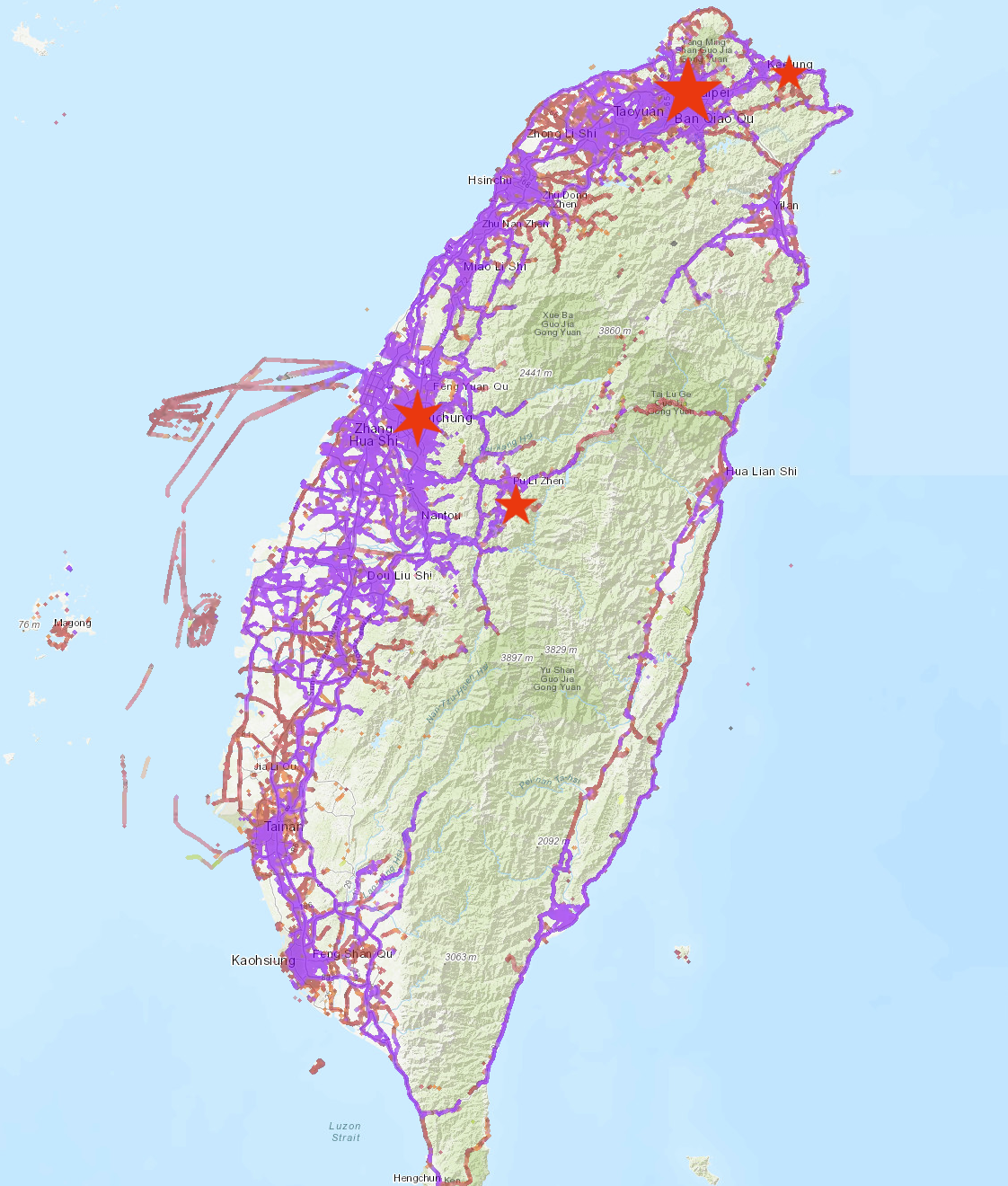
    Chunghwa telecom map of coverage in Taiwan.  The western side of the island is coveraged, the central area, not much, and another stretch along the eastern seaboard.

    Everything worked great for the first 2 and a half days in Taipei, but then we headed south into the central part of Taiwan. Holafly used Chunghwa telecom, and this image is Chunghwa’s network coverage. The stars represent where we spent time. Taipei is the capital of Taiwan and, with it’s environs, the largest city. As you would expect, coverage is excellent.

    Taichung is another major city, with excellent coverage, and, per the map, the entire space between the cities has excellent coverage. In fact the western seaboard contains the bulk of coverage.

    For a quick geography lesson on Taiwan: The western coastal plains are the best, most arable land. It’s flat and relatively easy going. it is were most of Taiwan’s population lives. The central mountains, are absolutely brutal, almost uninhabitable, and they plunge straight into the eastern coast. Still, some towns and cities cling to some of the better spots on the east, and there’s a nice rift valley that’s also inhabited. There are only three roads that can get you across the mountains. (There’s a fourth, but it really skits the mountains rather than crosses them.) I’ve traveled across all three. One is no fun. The second was the most frightening road I’ve ever been on. That is, until I was driven across the third, which is the kind of road that probably fills a lot of pants with shit. After that crossing, we all vowed to never travel on that road again. Two of them have been significantly damaged and closed (and, in cases, re-opened, re-closed, etc.) by earthquakes and typhoons. The bottom line is, there’s not much up there except beautiful scenery.

    The one place on the map towards the center of the island is Puli, and nearby Sun Moon Lake, which is in the mountains, but the area isn’t terrible for human habitation.

    Our cellular service was great until we got a ways up the highway to Sun Moon Lake. At the time, I was certain it was spotty coverage, but looking at the coverage map, the roads to Puli and Sun Moon Lake have solid coverage. The behavior was exactly like you’d expect on a moving bus moving in an out of cellular range. Signal-no signal-signal-no signal-signal-no signal, ad nauseam.

    But when we reached Sun Moon Lake, the problem didn’t go away. Yes, it wasn’t as frequent, perhaps just a few times per hour, but it clearly wasn’t because we were moving.

    And this is the way it stayed for the duration of the trip.

    What happened? I don’t know. I can only speculate. Did our problem begin because we were on the bus? Or was that a coincidence? Should we have rebooted our phones once we returned to Taipei? (I wish I’d thought of that at the time!)

    Did we both hit our high-speed data cap at around the same time, and the slow speed data was so pathetic as to be nonexistent at times? I don’t think it’s this one because it wasn’t just a case of the data being slow, the actual signal disappeared — no bars.

    Here’s my best guess: Network traffic shaping. Services like Holafly contract with a local carrier, in this case Chunghwa Telecom, to provide service. In much the same way that Mint Mobile in the US uses T-Mobile’s network. I don’t know what type of service guarantee their contract with Chungwha has, but you can bet that they’re second-class citizens compared to Chunghwa subscribers.

    [Content note: It’s now been months since I wrote the previous portion of this narrative, and it has languished in “Drafts” from that time, forgotten and unloved. I’m picking up the story here in probably much less detail because the details aren’t as fresh in my.]

    Above I stated that it remained this way for the “duration of the trip.” I don’t mean for the duration of the trip to Sun Moon Lake, it remained that way for the entire trip to Taiwan. What had been fantastic service when we started out, degraded into just useable to not-at-all-useable at times.

    It felt as if we had hit some barrier, and we were permanently second-class citizens.

    As we got to the last two or three days, I considered dumping the Holafly eSIM and grabbing one from Airalo or Saily to if the problem went away, but in the end, I opted to activating the data on my Verizon international roaming and pay $10/day for it.

    That worked great, once I remembered to switch the “primary” mobile data designation from Holafly to Verizon.

    Next trip, I’ll try a different eSIM provider, and go with shorter duration service and purchase multiple eSIMs to cover the trip – perhaps even alternating providers to compare them.

    …and, I’ll remember to use my Verizon data when necessary.

  • Taiwan (2024) – Day Thirteen – The Longest Day

    October 17, 2024 (Twice)

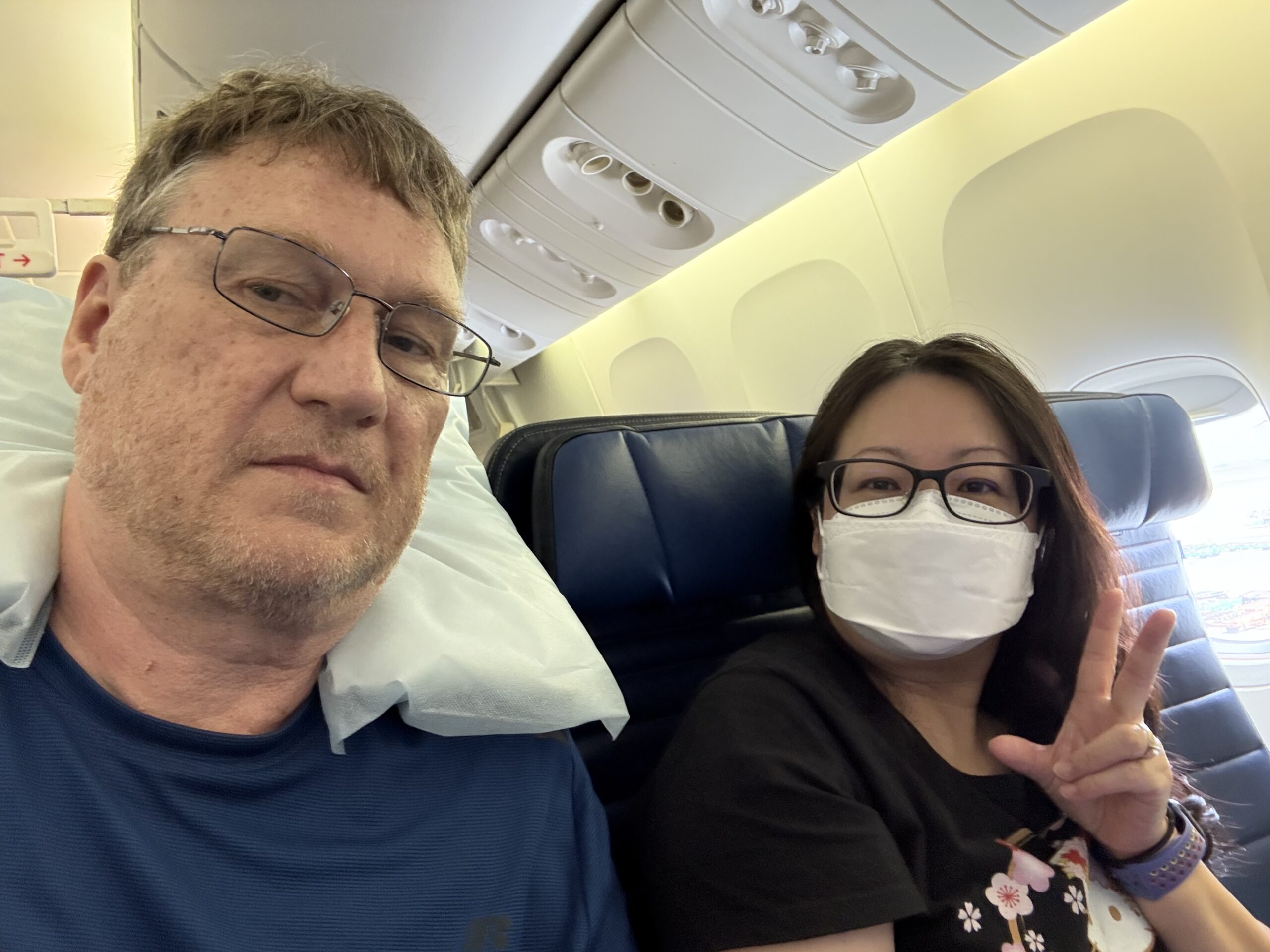
    My wife and I on a plane.
    Yes, I’m not wearing a mask. I have a rope burn behind both my ears from wearing a mask that started to bleed. I had to go maskless.

    I believe this was my 14th trip to Taiwan. That’s 28 crossings of that damned Pacific Ocean. You really appreciate how big it is when you’ve crossed it for hours, then look out and still see nothing but the cold, silent death below that is the great expanse of the Pacific.

    I am mentally uncomfortable with the idea of crossing the ocean and physically uncomfortable being cramped into a plane for 11-14 hours.

    When Chuwan and I got married in 1998, the legal ceremony was here in Arizona. We had a second ceremony on January 1, 1999 in the Catholic cathedral next to Daan Park in Taipei for the benefit of her family who are all (or were) painfully Catholic. (Despite the fact that Chuwan and I are both atheists.)

    We invited my father, then 67 years old, and a man who joined the Navy at age 17 just to see the world and spent his subsequent life traveling all over North America, to come to Taiwan for the ceremony. He said to me, “Son, as much as I’d love to be there for you and see more of the world, thank you, but no. At my age, I don’t think I could possibly stand flying on a plane for 14 hours.”

    At age 59, and with the airlines shrinking their seats at every opportunity, his words of wisdom now ring very true in my ears.

    Until this trip, we’ve flown Singapore Air (the best!), Eva Air (a Taiwanese carrier, also excellent), and China Air* (not as nice as Eva, but still very good.) I cannot say I’ve ever enjoyed a flight across the Ocean, but these carriers have made it almost tolerable.

    There are also other ways to improve the experience. Chief among them is to avoid flying out of Los Angeles and instead fly out of San Francisco, Seattle, or Vancouver. The extra time you spend reaching those airports is saved back in the long east-to-west flight leaving the USA. (Typically, they use the longer polar route from east to west. The further north you are, the shorter the trip. They power directly across the ocean on the way back, and it doesn’t make as much difference to the crossing time.)

    This time we flew with United Airlines. I have nothing good to say about them. I’m not going to detail my list of grievances, but at the same time, I want to warn you. The seats are incredibly small and uncomfortable. On the flight out, I was in a window seat, and because of the cramped space, my back was jammed against the window-side armrest (that didn’t raise up), and my back was wrecked by the time we landed. It cast crap over the entire time in Taiwan for me.

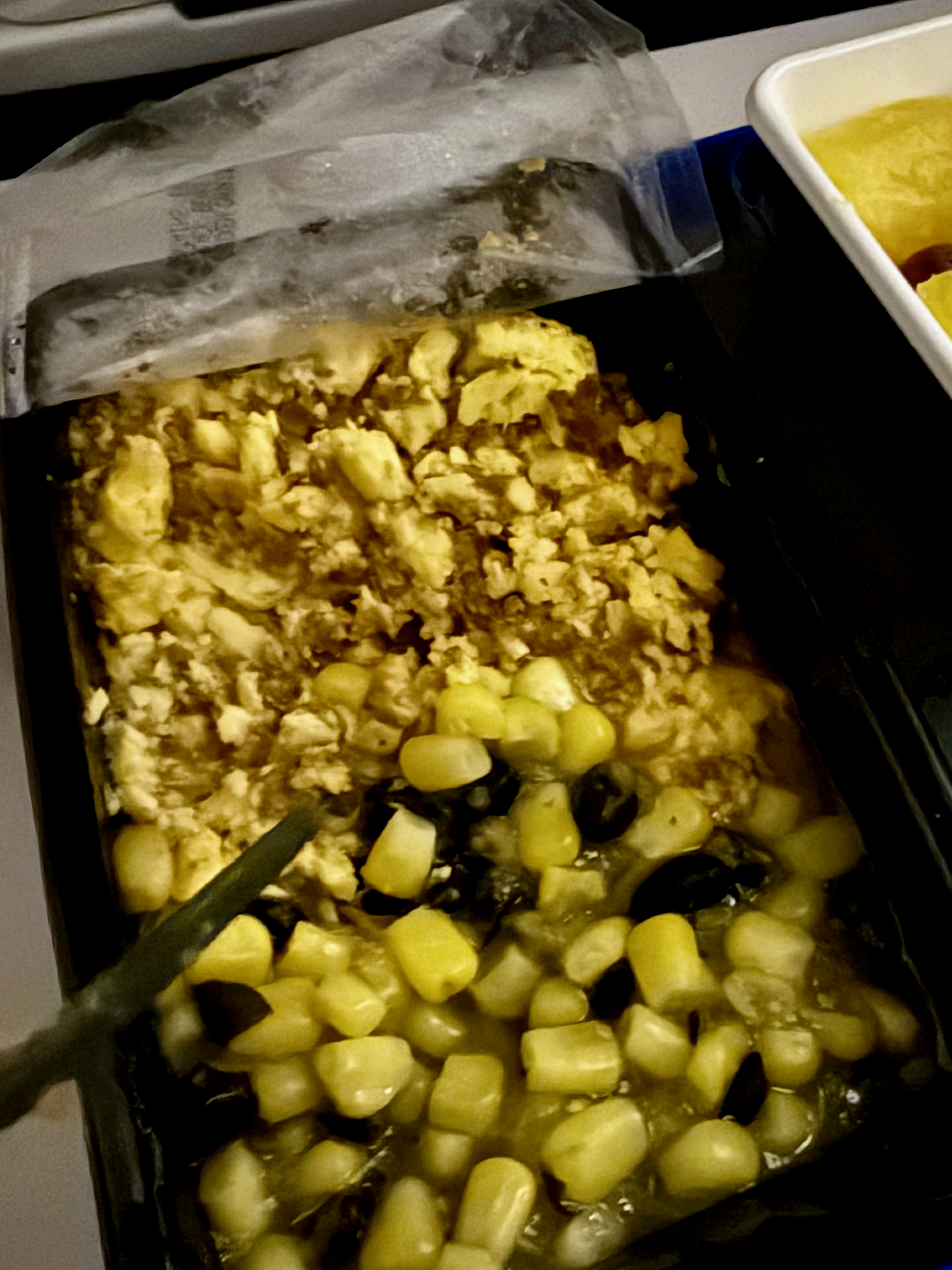
    A tray of substance, purportedly food, that looks like it might be previously owned.

    The food was terrible. If you have nothing do but sit on the plane and wait for the next meal, you don’t want it to look (or taste) like this. I’ll let your imagination tell you what this reminded me of. (Also, feel free to guess what this is.)

    When we got up in the morning, all I can say is that I was dreading the flight back. We considered upgrading to Steerage Plus class, but that was $600 more, and they didn’t have any seats to sell us, anyway. “Grin and bear it” is the order of the (very long) day.

    We would be picked up at the in-laws’ house at 8:00 AM, and since Melz leaves for school at 7:00 AM, our goal was to get there by 6:30 AM. We said goodbye to our Airbnb, which has to be the best overall accommodation I’ve ever had on a trip, and grabbed youtiao for breakfast. It was the greasiest damned youtiao I’ve ever had, and my thoughts turned to what that would do for me on the flight.

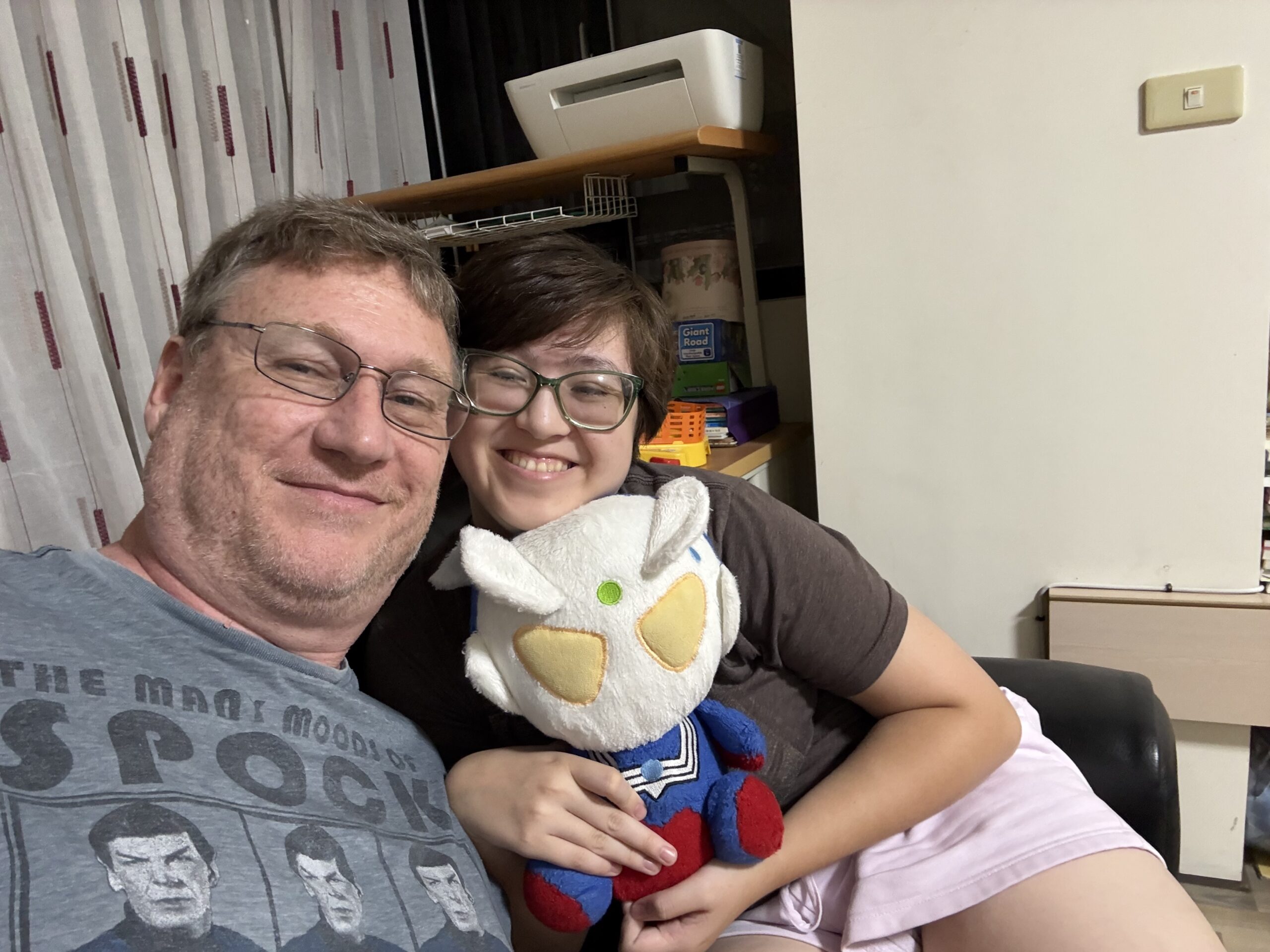
    Myself and Melz, on a sofa, with an Ultraman Zero plushy

    After last night’s waterworks, I was concerned that Melz would again get the sads right before going to school this morning, and they had a test this morning, but Melz was upbeat, and we had a nice farewell. Chuwan, always cognizant that her parents are quite old, always has a rough time when we leave, but leave we must.

    We were shuttled back to the airport in a damned nice Mercedes. If someone is going to drive you around, I highly recommend it.

    The recommendation for arrival for international flights at Taoyuan International Airport is 3 hours before flight time, and it’s an hour drive to the airport. We arrived at the airport around 9:00 AM and it never takes 3 hours to get though security. We had time to kill.

    The author, plus some bears watching planes fly off

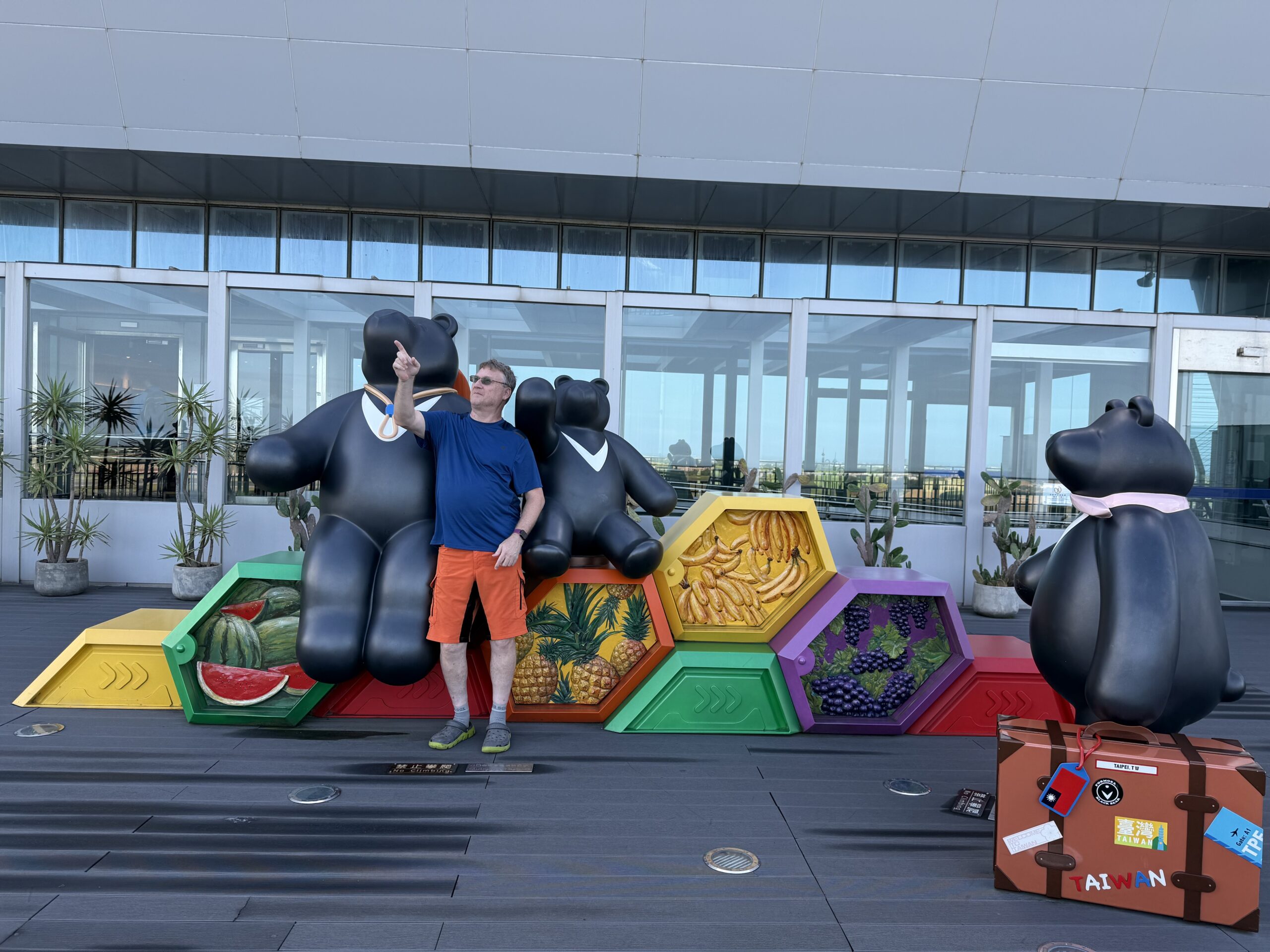
    There are observation decks at either end of the main terminal, and we spent some time watching the planes taxi and take off. Apparently, the planes need an audience, so there were artwork bears in the observation area watching the planes at all times.

    Food on international flights has an oddly bipolar nature. Foods for the flights out of the US are prepared in the US. Foods for the returns flights are prepared in the country of departure. There was a slight hope that the return flight food would be better, but we decided to have a nice big lunch before leaving.

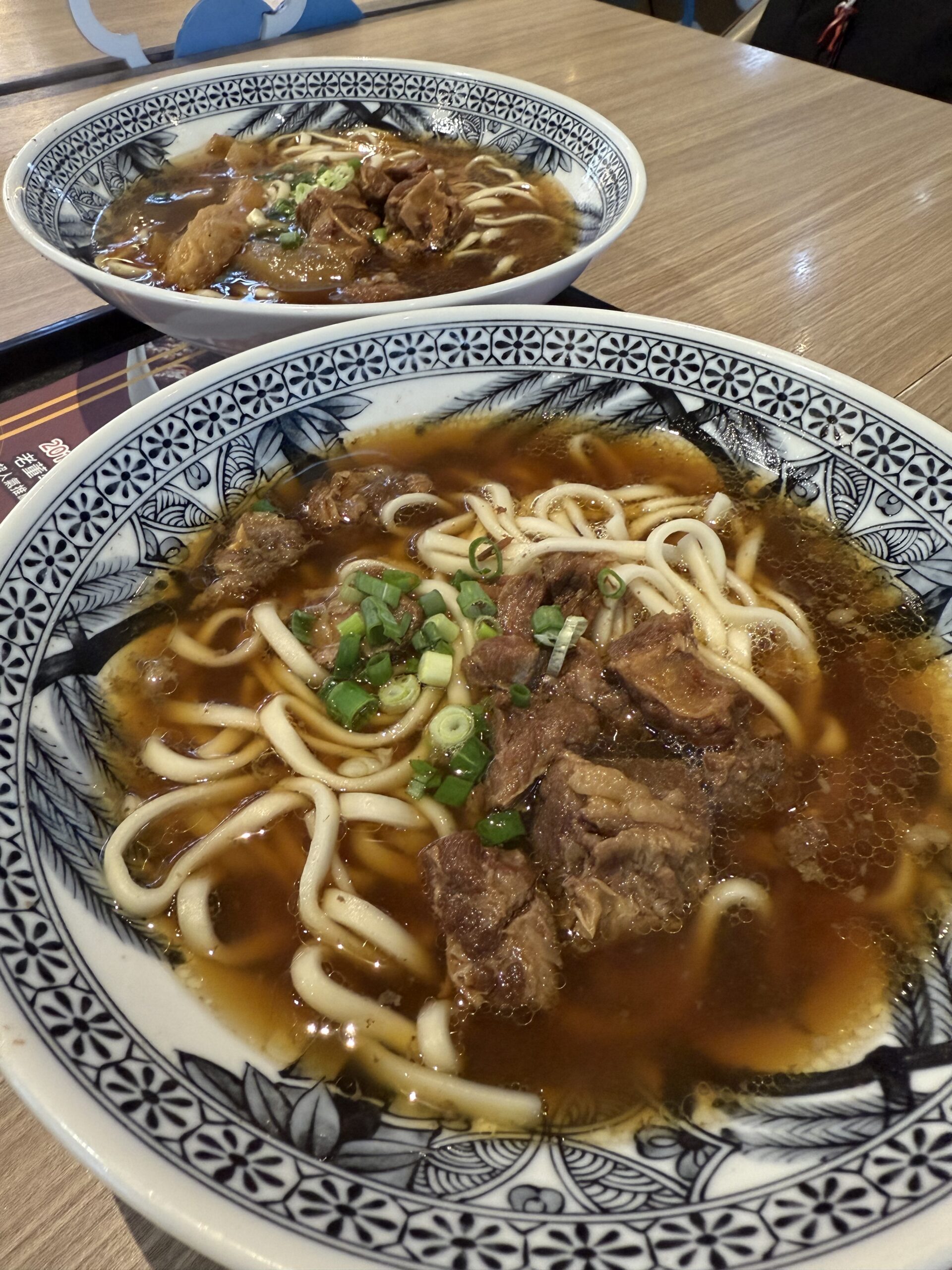
    Two bowls of beef noodle soup

    I hadn’t gotten around to trying Lao Dong Beef Noodle** on this trip, and to my delight, there was one at the airport—and it was great! We thoroughly enjoyed every bite.

    The subject of “best” beef noodle soup in Taipei is a much-contested title in an annual contest, and I’m not sure if Lao Dong has ever won, but it’s certainly in many “must-try” lists.

    If you ask my kids, the best is always mom’s version, but I will have to consider Lao Dong the best I can recall ever having. This might sound like a recipe for marital strife, but my wife knows a spice in hers doesn’t sit well with me, and we’ve never been able to isolate what it is. It’s very common in beef noodle soup, whatever it is, but I didn’t notice it in this bowl, and that puts it over the top for me.

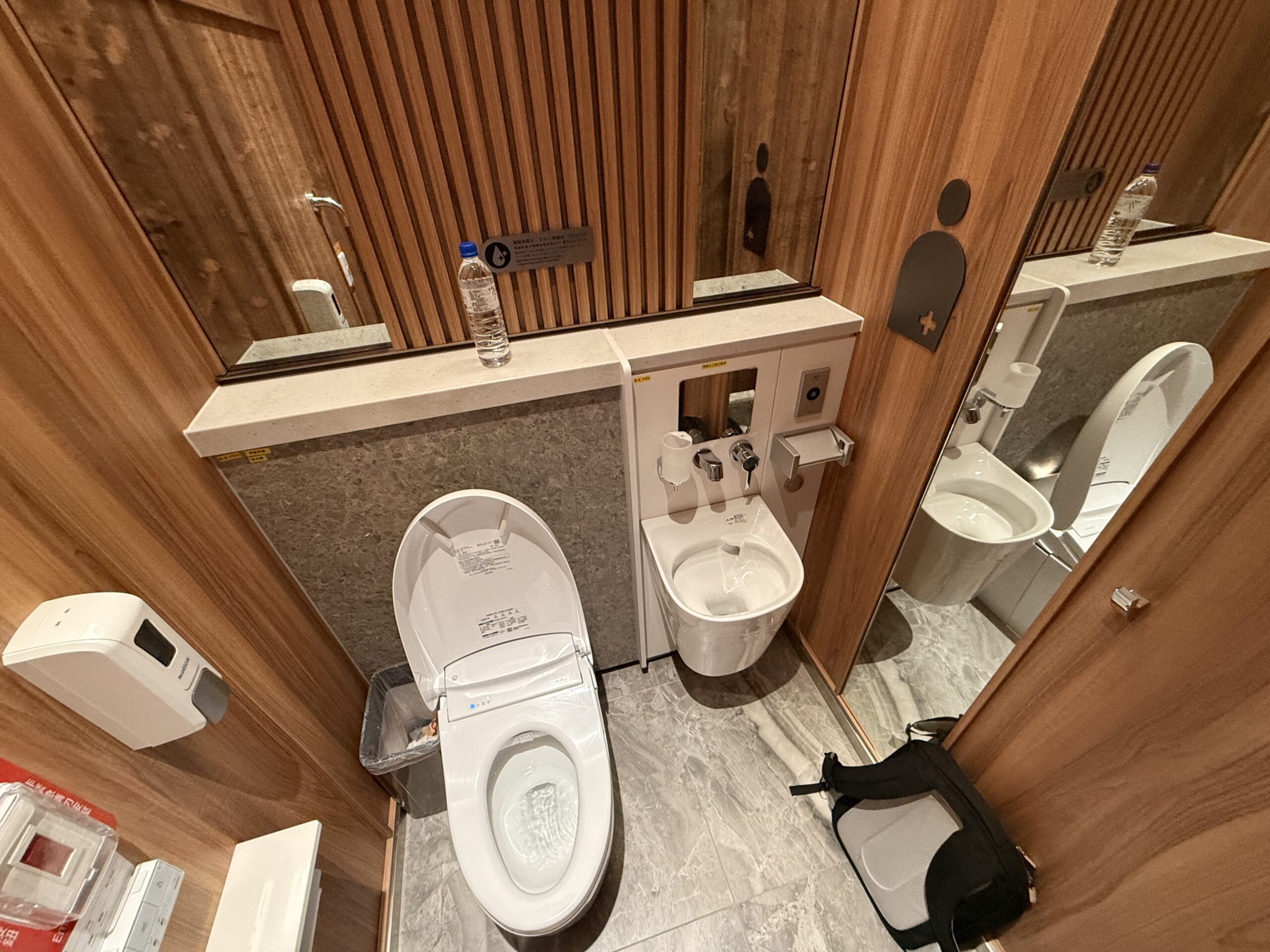
    Very special toilet.  Japanese bidet seat, sanitizer, some form of low sink (please tell me its not for washing your genitals) and full length mirror.

    Digression: Ever since our trip to Japan in the early 2000s, I’ve been a fan of Toto Washlet toilet seats. We’ve had several in our home, both authentic Toto and various knock-offs. They’re getting more and more prevalent in Taiwan. My in-laws have them, hotels have them, and even train stations have them. Practically, the only place that didn’t have one was our Airbnb. It was the only strike against it in our book.

    As we were heading for our gate, the restroom on the way was prominently branded as a Toto Restroom. I had to check it out. Dig this picture; it’s an individual stall in the men’s room, although I think I might have stumbled into a “special” stall. I have no clue what the small “plus” sign is superimposed over the usual man symbol.

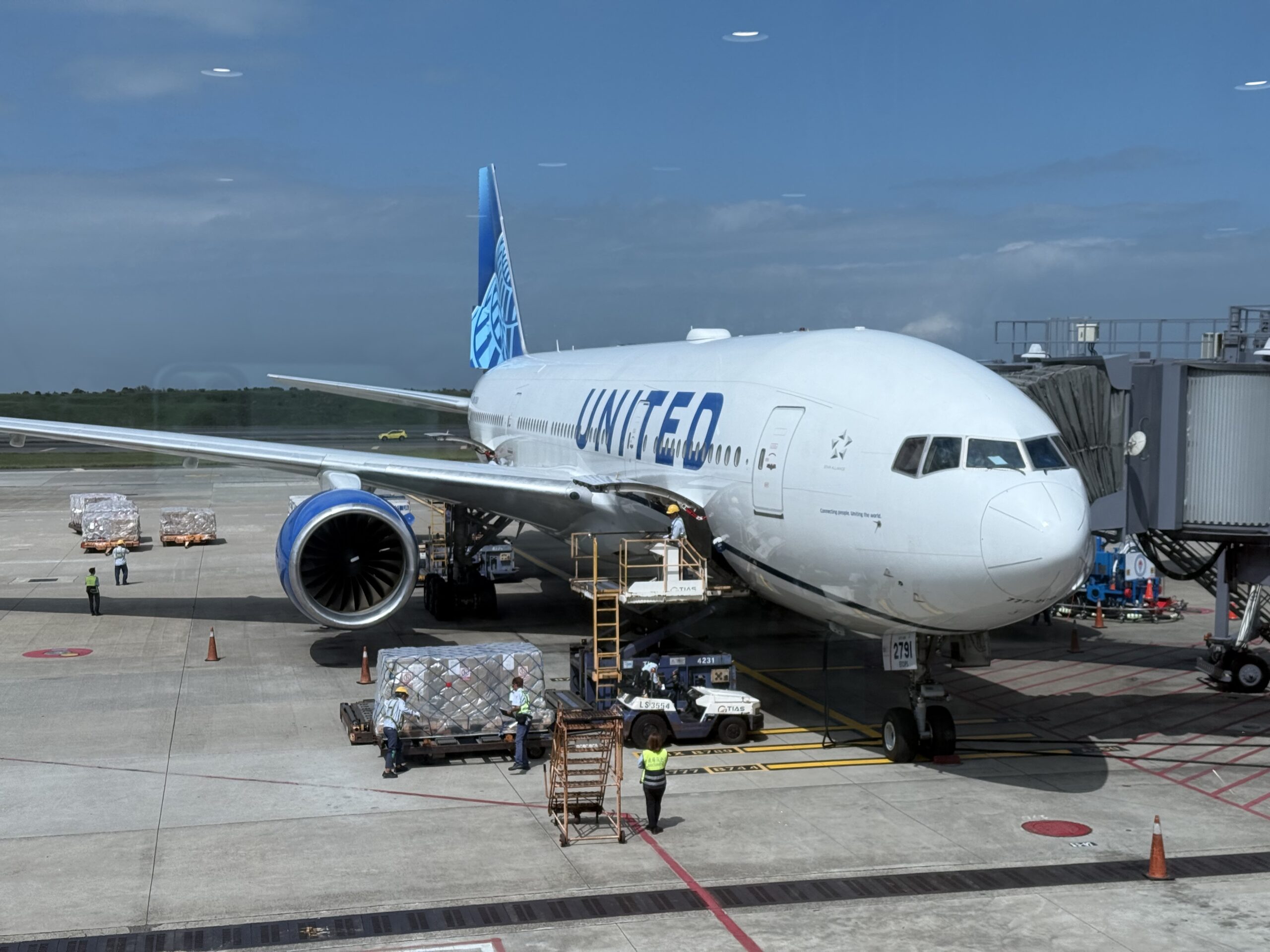
    United Airlines plane at the gate in Taiwan

    Finally, it was time for us to fly. We had slightly better seats. (I was on the aisle.) The flight was a bit shorter, and ahead of schedule. The food wasn’t great, but it was better. I survived it, but I didn’t enjoy it.

    The flight from SFO to PHX was the worst, though. We were separated. I was at the very back of the plane, in the middle seat, wedged between two large assholes that hogged both armrests, and even when I “accidentally” dug my sharp, pointy elbow into one of them, he just kept on snoring.

    We are home and safe, but there’s been some drama on the homefront that I need not recount here. I’ve got additional posts on various aspects of the trip, including our experiences with data-only eSIMMs, rice husk chopsticks for sustainability, the National Taiwan Normal University’s Mandarin Training Center, using Taiwan YouBike 2.0 for foreigners, and there might be one or two more as I go back through my scribbled notes.

    If you’ve made it this far, thanks for reading!


    *”China” Air is the flag-carrier airline of Taiwan (AKA The Republic of China) because they got to the name first. Taiwan was setting up an airline in 1959 while Mao was tearing China apart with his so-called Great Leap Forward.

    **”Lao” means “old,” and “Dong” is a name. Yes, their name is “Old Dong.” Someone must have clued them into how that sounds in English because their company’s English character URL says “old don” instead.

  • Taiwan(2024) – Day Twelve – The Elephant in the City

    October 16, 2024

    Last full day in Taiwan!

    Tomorrow, we must leave at 8:00 AM to get to the airport, so there will be nothing but the business of travel.

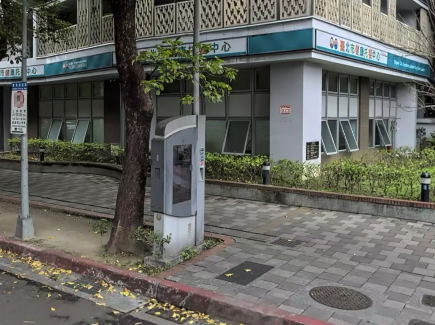
    An informational kiosk on a street corner

    Chuwan and I got out reasonably early and had breakfast at WMD. Near the restaurant, there’s a little kiosk-like thing at the corner of Jiankang Rd & Baoqing St. If I recall correctly, it’s been there since at least 2019, but I didn’t know what it was. It looks like an informational kiosk in Chinese. (The picture included here is lifted from Apple Street View.)

    Today, I was casually looking at it and realized it had a camera on it, and even though Chuwan reads Chinese, she still wasn’t sure exactly what it was for.

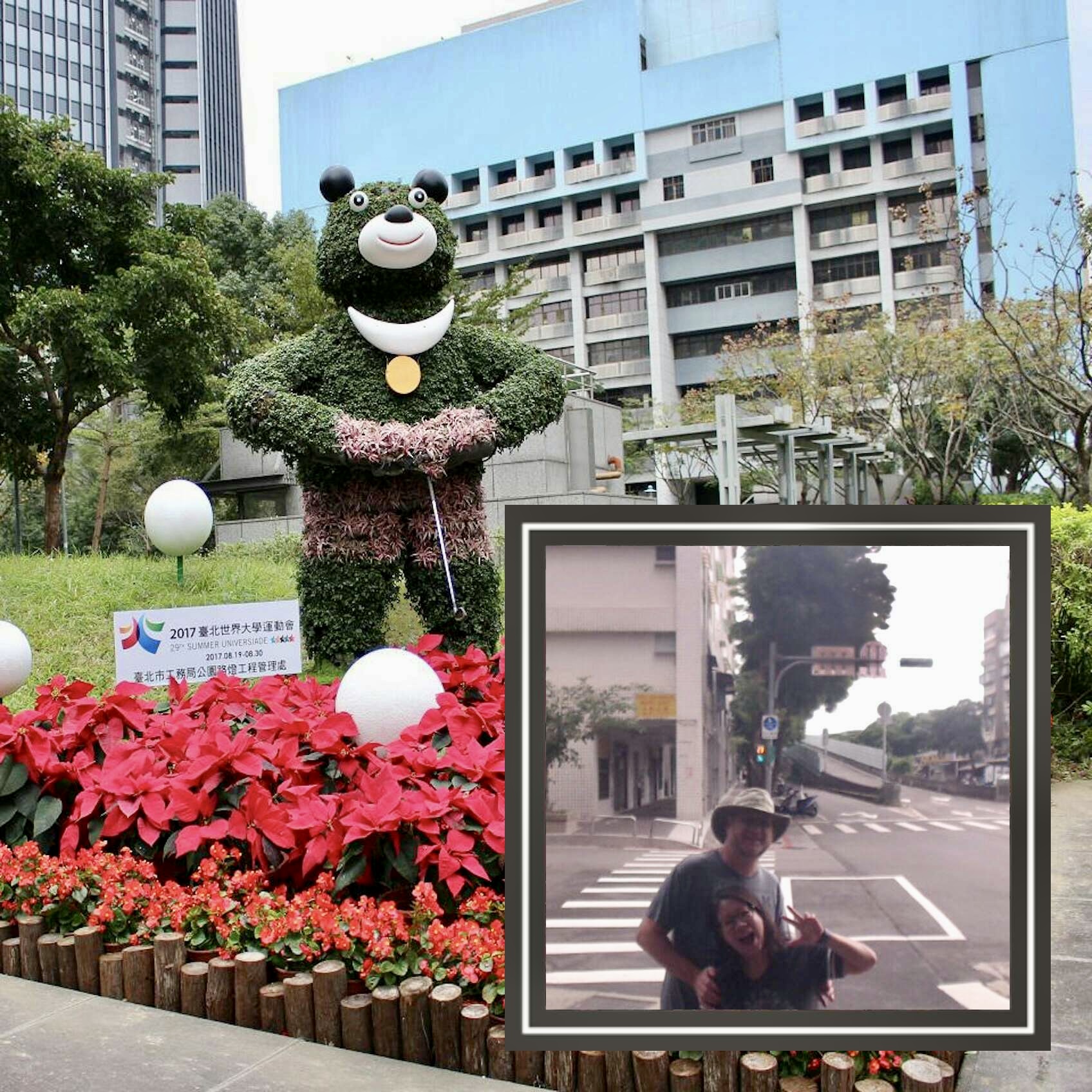
    Nonetheless, we had it take a picture of us, and it gave us a QR code, which allowed us to download this picture of us on the street corner. The picture is superimposed on top of an image of a topiary bear mowing the lawn.

    Us, superimposed over an image of a topiary bear mowing a lawn

    We have absolutely no clue where that bear is — it’s not anywhere in sight of where we took the picture — nor why they would want to superimpose us over that bear. We now have this picture as a memory of the bear we’ve never seen.

    Taiwan is a quirky place.

    Chuwan left to meet with Melz and go to the textile trade show, and I was left contemplating my list of things I wanted to do.

    Although my back hurt yesterday, I didn’t take any pain medicine until bedtime. I hoped my luck would hold out again today, and so I hatched what might be the worst possible plan for the day: To climb Xiangshan.

    Xiangshan means “Elephant Mountain,” and if you’ve ever seen a panoramic skyline view of Taipei, it was probably taken from Xiangshan. It is situated within the city and very near the upscale area that boasts Taipei 101.

    Guidebooks will tell you it’s a short (they sometimes even use the word “easy”) walk to the top, made more “accessible” by stairs. If you are unfamiliar with Taiwan, you might not realize that all the mountains are steep as hell. I knew that, but I still didn’t have any clue what I was letting myself in for.

    I arrived at Xiangshan MRT station, the nearest to the trailhead, at around 11:00 AM, and a new wrinkle was added to the equation — for the first time since we arrived in Taiwan, it was going to be a rainy day. The clouds were moving in, and the sprinkling had begun.

    I don’t know how long the Xiangshan Trail is. Various places give it lengths from 0.7 to 1.5 km and a height of only 183 m. I suspect the length variance depends on if you start at the park near the MRT station or at the first set of steps on the trail as you leave the road.

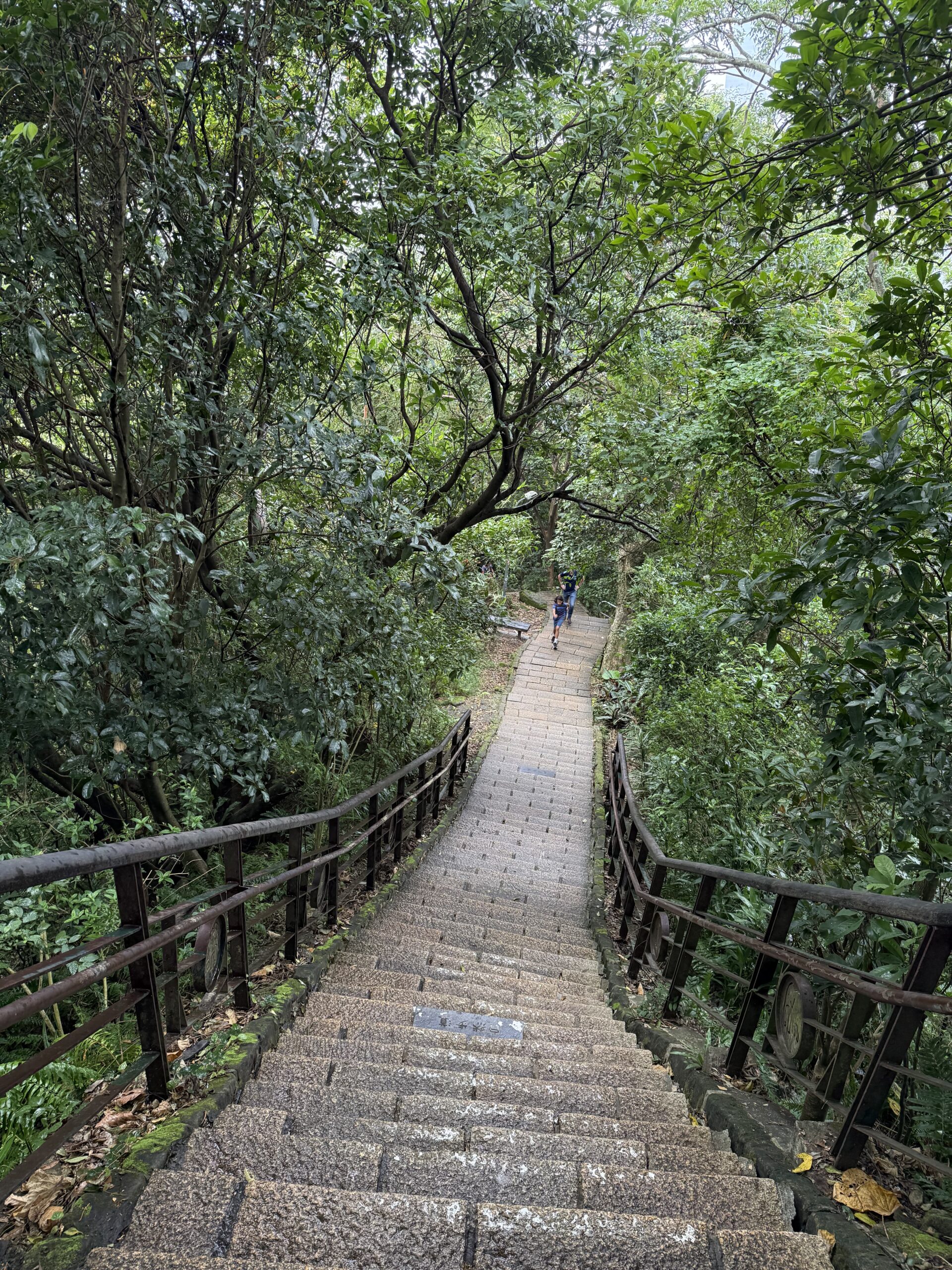
    “Trail” is a misleading word. It conjures up images of winding paths amongst shady trees and nature’s splendor. In Taiwan, and, indeed, at Xiangshan, “trail” means rock stairs leading up the side of a steep mountain. I counted one flat section of the trail that was longer than 3 m. Any other flat areas were just landings.

    Narrow, steep, wet, and mossy stairs climb through the jungle, and in most places, it is impossible to see anything except the trees immediately surrounding you. It was dumping down rain now, too.

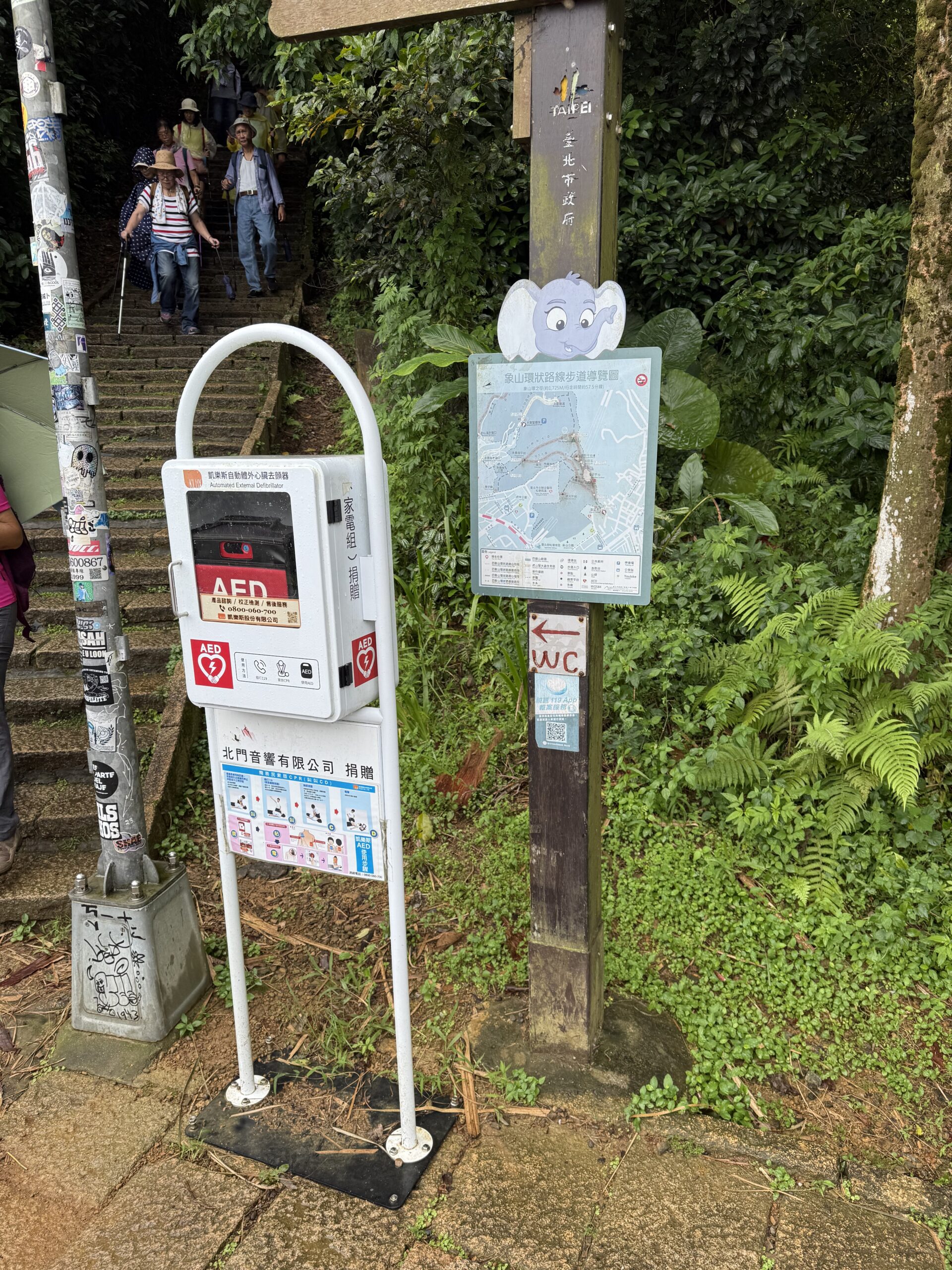
    AED machine along the trail

    It took 45 minutes to reach the top, and along the way, I passed two AED machines positioned along the trail. I’ve never been on a trail where the managers felt defibrillation was required before. If it’s meant to be reassuring, it isn’t. It’s downright scary.

    By the time I reached the top, my Apple Watch had registered that I had climbed 34 flights of stairs. I felt every one of the steps in both my back and my knees.

    At one point, when I reached the first photography landing, two young Americans came along and asked me to take their picture, which I did. As they continued on up the mountain, I thought to myself, “I did those guys a favor, and in return, they might have to carry me down off this rock.”

    I rested a few more minutes, then started out again. Soon, I caught up with them again, and just about the same time, an Australian woman came down from above.

    Seeing our tired and defeated faces, she said, “Hang in there, guys, you’ve almost made it to the top.”

    It was what I needed at that moment because I was on the verge of admitting defeat. I probably wouldn’t have quit, but it was crossing my mind in that moment.

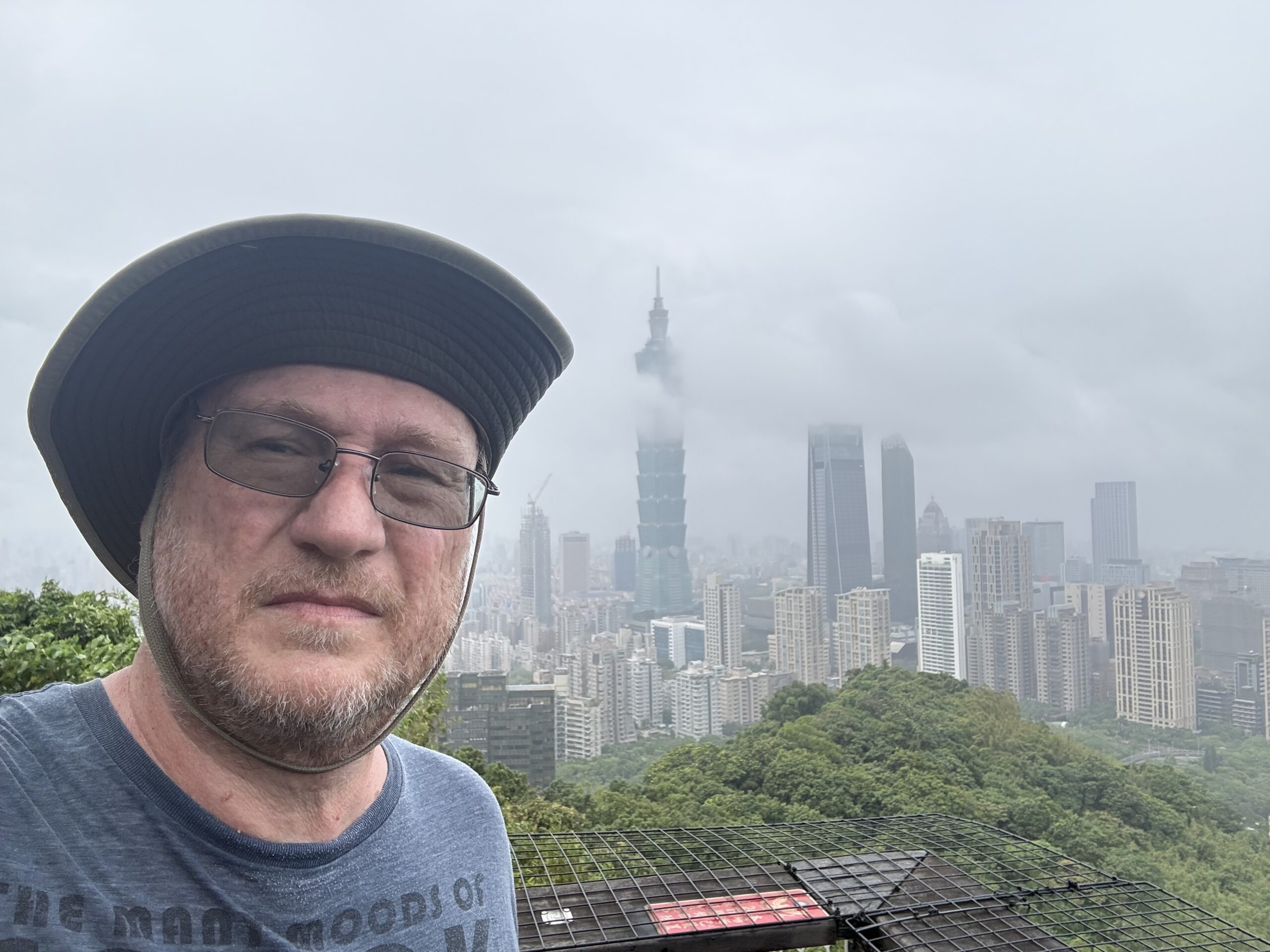
    Me, at the top of Xiangshan, Taipei 101 can be seen behind me in the clouds.

    The view from the top was good, but the weather wasn’t cooperating. The rain was driving, the wind blowing, and the clouds were obscuring much of the skyline.

    The pictures I took from the lower landing were better because the clouds were only wafting about Taipei 101 then, making for a more dramatic photo.

    The climb down was much worse. My knees were not cooperating at all, and I found myself side-stepping down, one stairstep at a time, while clutching the railing — when there was a railing.

    Stairs looking down

    I witnessed a curious phenomenon twice on the stairs. Whereas most people were taking sensible and cautious steps down the mountain, I saw two different women, at two different times, walking backward down the stairs.

    You couldn’t pay me to walk backward down those stairs. Madness.

    It took another 45 minutes to get down the hill. The going was tougher, but I didn’t have to stop and rest. Also, the rain had stopped, making it a bit easier.

    It was now late for lunch, and I was starving, but I was faced with the daunting (to me) task of trying to navigate the purchase of food. There’s always 7-Eleven, but I have been trying to stretch my Mandarin and get outside my comfort zone.

    That didn’t stop me from contacting Chuwan to see if they were done at the trade show. I thought they might want to meet up for lunch, but they weren’t ready, and I would still have to find my own.

    I’m always happy to take the path of least resistance, so I hatched a plan. Taipei 101 was nearby, is in a more affluent area, and hosts several international companies. It has a shopping mall in the lower levels and, below that, a food court and grocery store that caters to a more global clientele. It’s likely one of the most English-friendly places in town. I was still going to try to use Chinese, but a reliable fallback was appealing.

    The food court was absolutely packed. I circled the entire area several times, and there wasn’t any available seating. Crowds of people with trays of food circled like zombies searching for brains as they looked for a seat, and I hadn’t even negotiated to get food yet.

    I was also a bit embarrassed by my appearance. Typically, I don’t give a flying fuck what anyone thinks, but Taipei 101 was loaded with men and women dressed professionally, down from their offices on their lunch hour. I was dressed down for hiking, drenched in rain and sweat, looked like death warmed over, and I would certainly have to share a table with other diners. Even I thought this was over the line.

    I bailed out and caught the subway back to our home base area, hoping to spy something or try my luck at Yoshinoya or Sukiya.

    Lu•Rou•Fan (braised pork scrapings over rice) is a beloved Taiwanese dish. I’ve nibbled at it a couple of times on past trips and was neither offended nor impressed with it, but it was always served to me as a side dish to something else (like a pork chop or a chicken leg) and in very small quantities — like someone sprinkling a light garnish on rice.

    Although I never wrote it down on my “to-eat” list for this trip, I had decided before we left to go somewhere and try it properly.

    Formosa Chang Logo

    Independent of this decision, a restaurant chain caught my attention over my last few trips. Featuring distinctive artwork of an Asian man with an unusually prominent full beard, I had begun to notice their distinctive signs, which had risen above the noise of all the signs assaulting my senses. In English, the name is Formosa Chang, but I had jokingly started calling it “Beardy Chang.”

    It didn’t appear particularly foreign-accessible, and I’d never really gotten close enough even to know what they sold. There was one near our Airbnb and I asked Chuwan what it was. “They’re famous for their bian dang (That’s “bento” for people more familiar with the Japanese term, or a boxed lunch, usually taken on the train) and their luroufan.”

    “Oh, really?” I thought, and packed that away for future use. Today might be the day.

    Another little tidbit I learned is that in Chinese, their name isn’t “Formosa Chang.” It’s “Bearded Chang.” Since I’d been calling him Beardy Chang in my head for years, this amused me no end. That is good logo design!

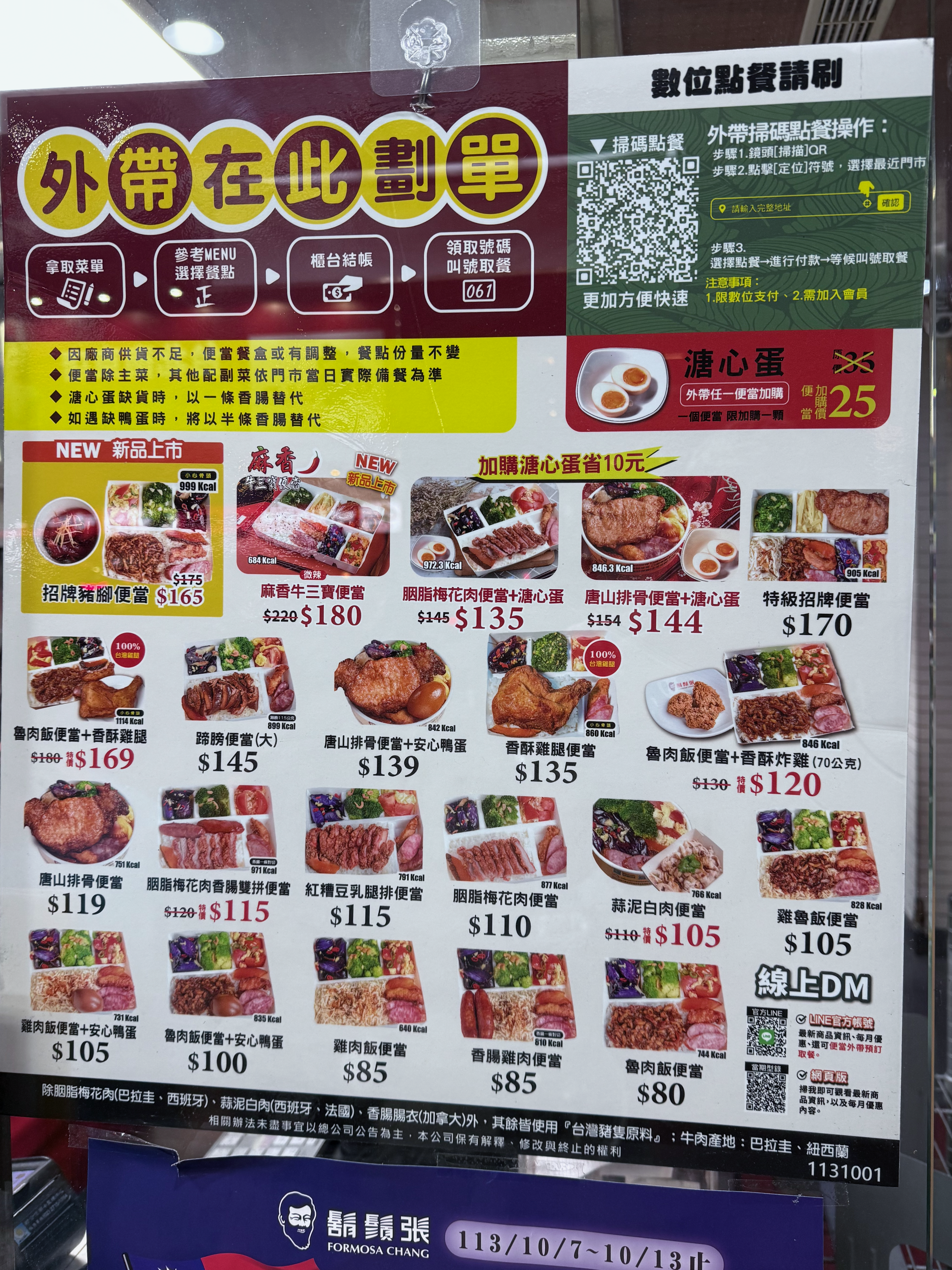
    As I passed, there was no one there — no customers, and, more importantly, no obvious employees. Sideling up from the blindside, I approached the posted menu. It was in Chinese, of course, but it was a picture menu.

    Chinese-language picture menu for Formosa Chang

    Nothing was obviously a serving a luroufan, and it seemed to be a boxed meal menu. That wasn’t a problem, I was very hungry, and would have eaten a chicken leg or pork chop, but I was hoping to find a meal that featured, as its main course, luroufan. There were a couple that looked possible, but I don’t know the character for “lu” and I was hesitant.

    …and then the employee spied me.

    She immediately came to the window to help me. Realizing that I was looking at the menu, she pulled out a laminated menu and handed it to me. “Oh, excellent, they’ve got English menus!”
    Nope. It was the same as on the wall. I was committed, and I was going to go for it; I would try to communicate in Chinese. “Nimen you mei you luroufan?” (Do you have luroufan?)

    You a,” (We have it) she replied, thankfully realizing I was not conversant and keeping her answers simple. I expected her to point out which of the likely meals was the luroufan, but instead, she reached into a drawer and rummaged around for another menu. She took the other menu back, handed me the new one, and then pointed to a picture of a bowl of luroufan.

    OK, let’s do this. “Xie Xie. Wo yao yige wan.” (Thank you. I’d like one bowl.)

    Again, all props to her, she kept it dead simple. “Yao xiao wan haishi da wan ma?” (Do you want a small or large bowl?) (She also pointed at the prices for the large and small bowls as she asked.)

    I had no concept of how big these bowls would be, nor if I would like the food I was buying. Erring on the side of caution, I went small. “Xiao wan.” (Small bowl)

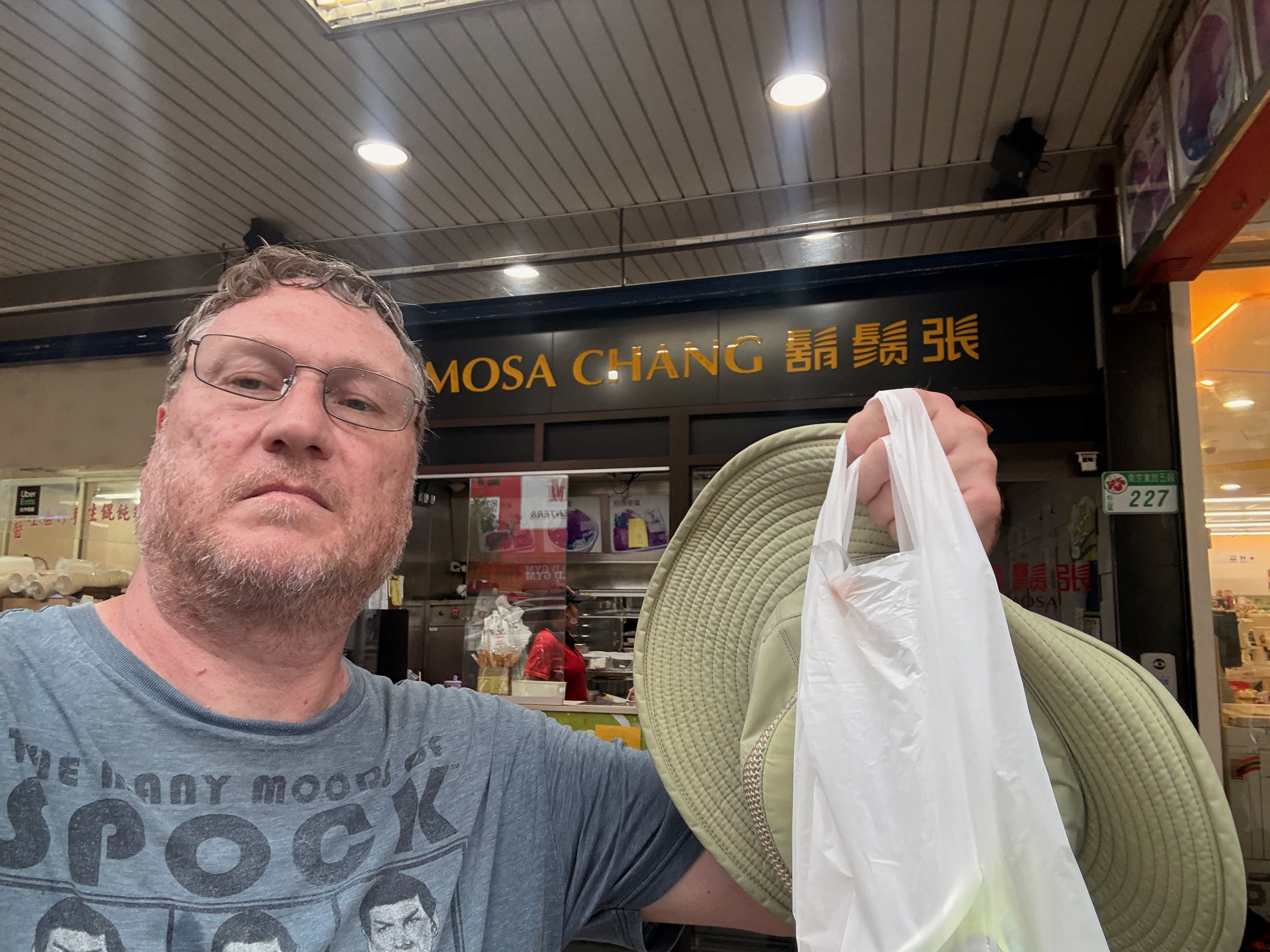
    Me with a bag of food in front of Beady Chang's

    This was the first I felt like I’d made a misstep, because she looked at me oddly for a moment, and then countered with, “Yao dan ma?” (Do you want an egg?) While she pointed at the eggs on the menu. I’m not sure if it was a tea egg or a century egg, but I wasn’t feeling that adventurous.

    “Bu yao, xie xie.” (No, thanks)

    She told me how much it was, which was not much, I paid, and she gave me a bag of food, and off I went back to the Airbnb feeling pretty damned self-satisfied with myself.

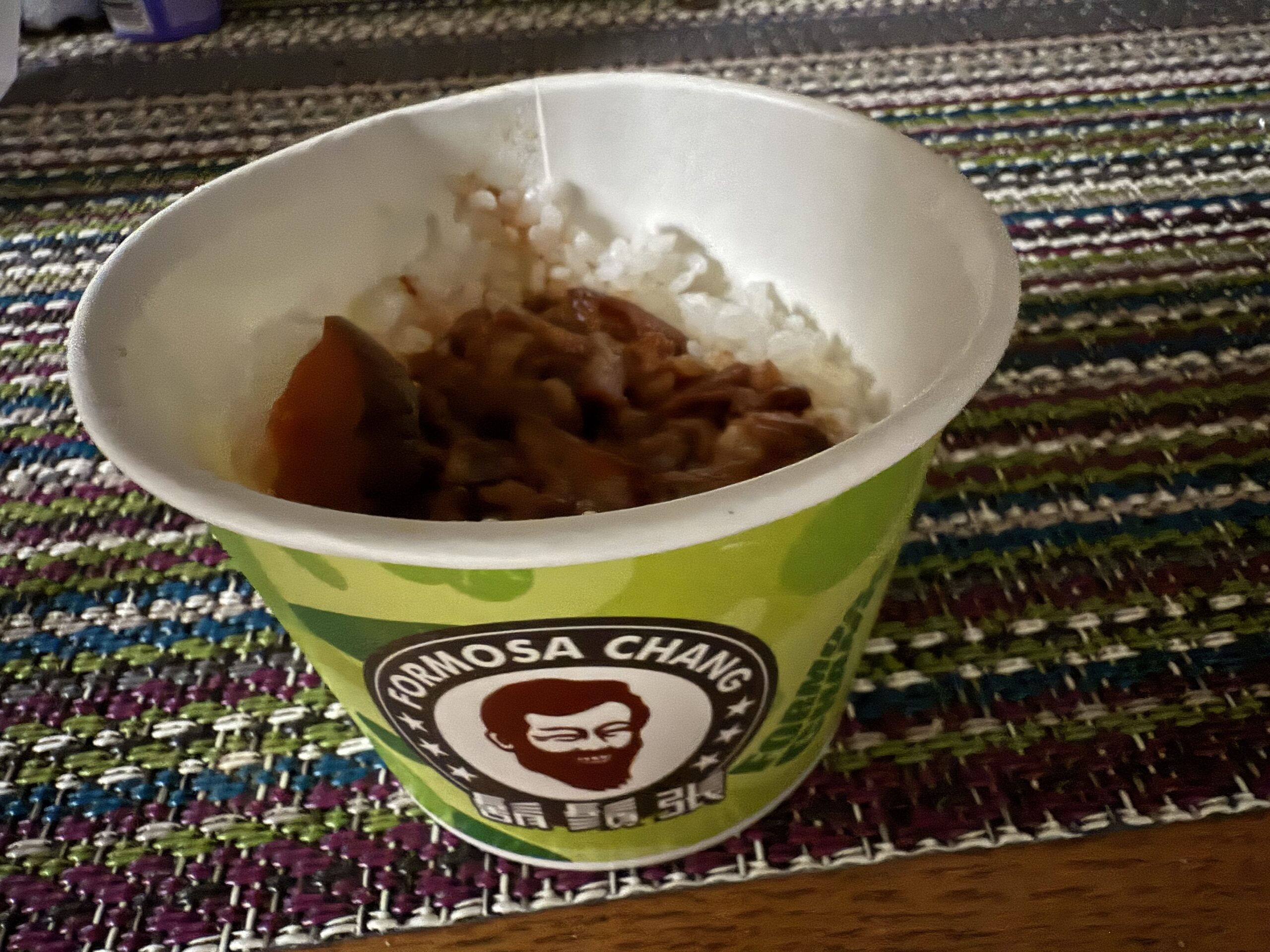
    a small bowl of luroufan

    Back at the Airbnb, I figured out what the misstep was: A small luroufan is very small—definitely a side dish item rather than a main dish. I devoured it because I was hungry and also because it was very good. I enjoyed every bite of it except for one weird meat-colored vegetable (seen on the left side of this picture) that was absolutely revolting.

    I would eat luroufan again, but ensure I got a larger portion next time.

    When Chuwan and Melz returned to my in-laws’ place, I was called over. It was time for one last family dinner. In consideration of me, the family would go to a nearby Japanese/Tonkatsu restaurant for dinner.

    That is until I got there and found out that my mother-in-law did not want to go, so they ordered tonkatsu for takeout instead. They don’t actually have enough table space in their house to support nine people, so that was a bit comical.

    Was it good? It was OK. Was it tonkatsu? No. How can it be tonkatsu without tonkatsu sauce? It was yet another Japanese-style pork cutlet, like we had at Sun Moon Lake.

    It’s the thought that counts, right?

    Tomorrow morning will just be a short farewell in the morning before we head off to the airport, so there were lots of tears this evening. These trips always seem to end in tears. I wish there were something I could do or say to ameliorate it, but human emotions are not subject to logic.

  • Taiwan (2024) – Day Eleven – Eating Away at Vacation

    October 15, 2024

    Eagle-eyed readers may have noticed that these “daily” blog posts are coming out about six days after the actual date. I won’t lie. I’m back home and finally getting around to “polishing up” my daily notes, which are incoherent to anyone but me. As an exercise in style, I try to retain the author’s point of view at the end of the day about which I’m writing and maintain the mystery of what is to come.

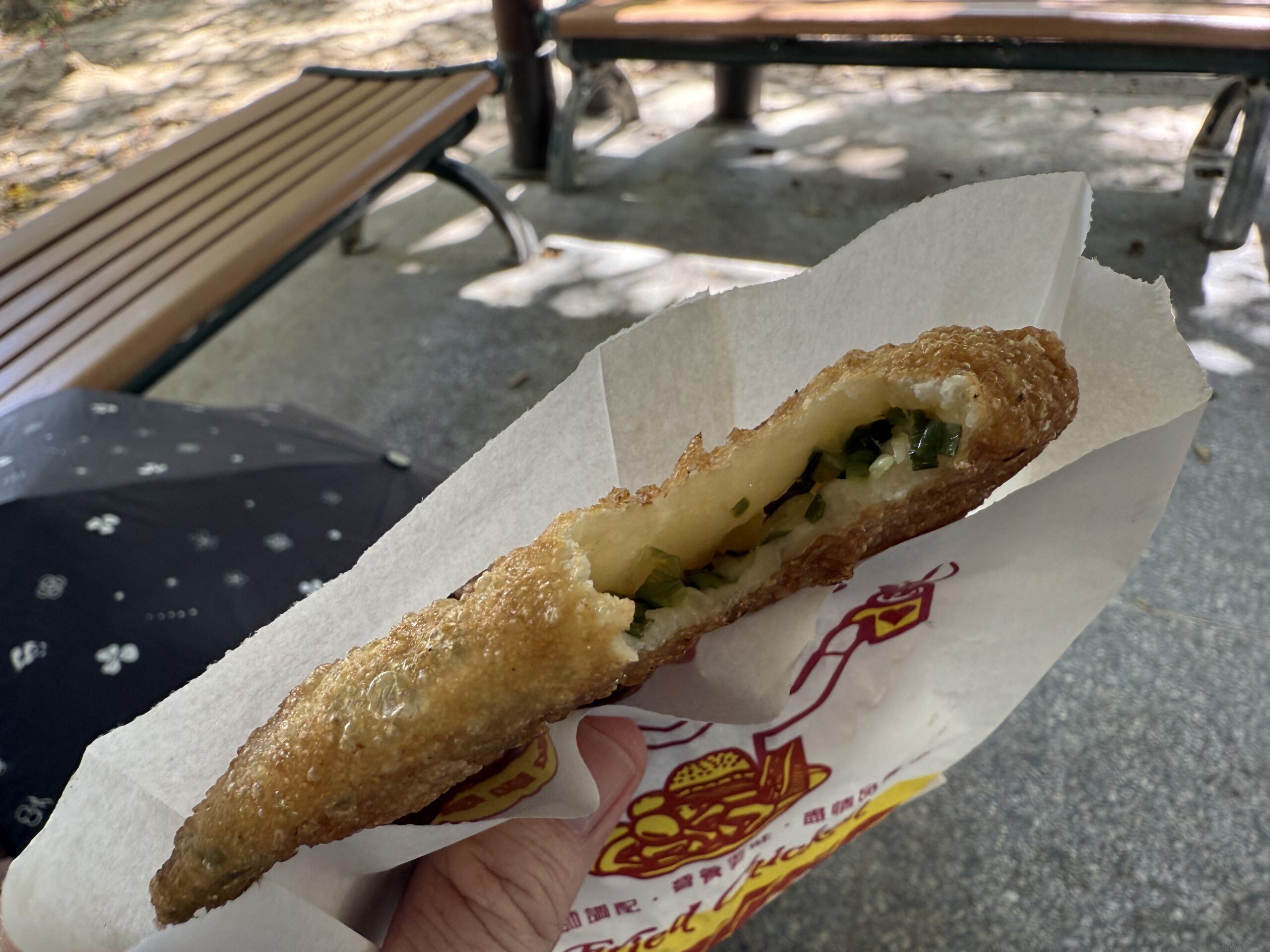
    Cong You Bing (Scallion pancake) with a bite out of it
    Cong You Bing

    It’s coming down to the wire now, and while it’s been fun, it’s also been a disappointing trip so far.

    I cannot express how angry I am at United Airlines. We’ve never flown an American carrier across the Pacific Ocean before, and we never will again. It was horrible. The food was terrible, the leg space was as bad as a domestic cattle car flight, and the seat I was crammed into absolutely wrecked my back.

    Not only has this back problem hampered many planned activities, but now, as it finally gets better, the specter of the return flight looms large in my mind. Will I be screwed up for another two weeks upon my return? If spaces were available in Steerage Plus, it would set us back another $600 for the return flight. It’s something to consider, but it feels like highway robbery for another 2 inches of legroom. (Or perhaps, Skyway Robbery? See what I did there?)

    While in Taipei, I had expected that my wife would spend a significant amount of time with her parents and nephews, Melz would be in school half the day, and I would be free to explore on my own or with Melz in the afternoons, but I’ve spent at least half each day resting my back, and when not resting, I’m moving more slowly than I typically do and planning jaunts that involve less walking or standing.

    In addition to wandering freely, I had a short list of sights to see that, over the years, I’ve somehow missed. Like The Four Four South Village, The Lin House, The Leaning Mailboxes, and Elephant Mountain. None of them are earthshaking, but I had compiled a list and so far managed to see exactly none of them. Elephant Mountain, in particular, galls me because it’s the one I want to see most, and it would be a considerable hike; I cannot see myself possibly feeling well enough to attempt it by tomorrow and convincing either Chuwan or Melz to go with me seems unlikely.

    There are also a number of food establishments that I wanted to get to that I had not, including Ichiran Ramen, Mr. Long’s Chicken, and Lao Dong Beef Noodle. Considering that my wife’s plan was to cook for her parents tonight, that meant I had only breakfast and lunch to be a bit adventurous. The language barrier still makes ordering difficult.

    Naturally, I wanted to get up early, get breakfast, and get out of the Airbnb. Chuwan, however, just wasn’t feeling it, and it took me till 10 AM to get her out and on the street. I guess jet lag truly is over for us. Just in time to leave.

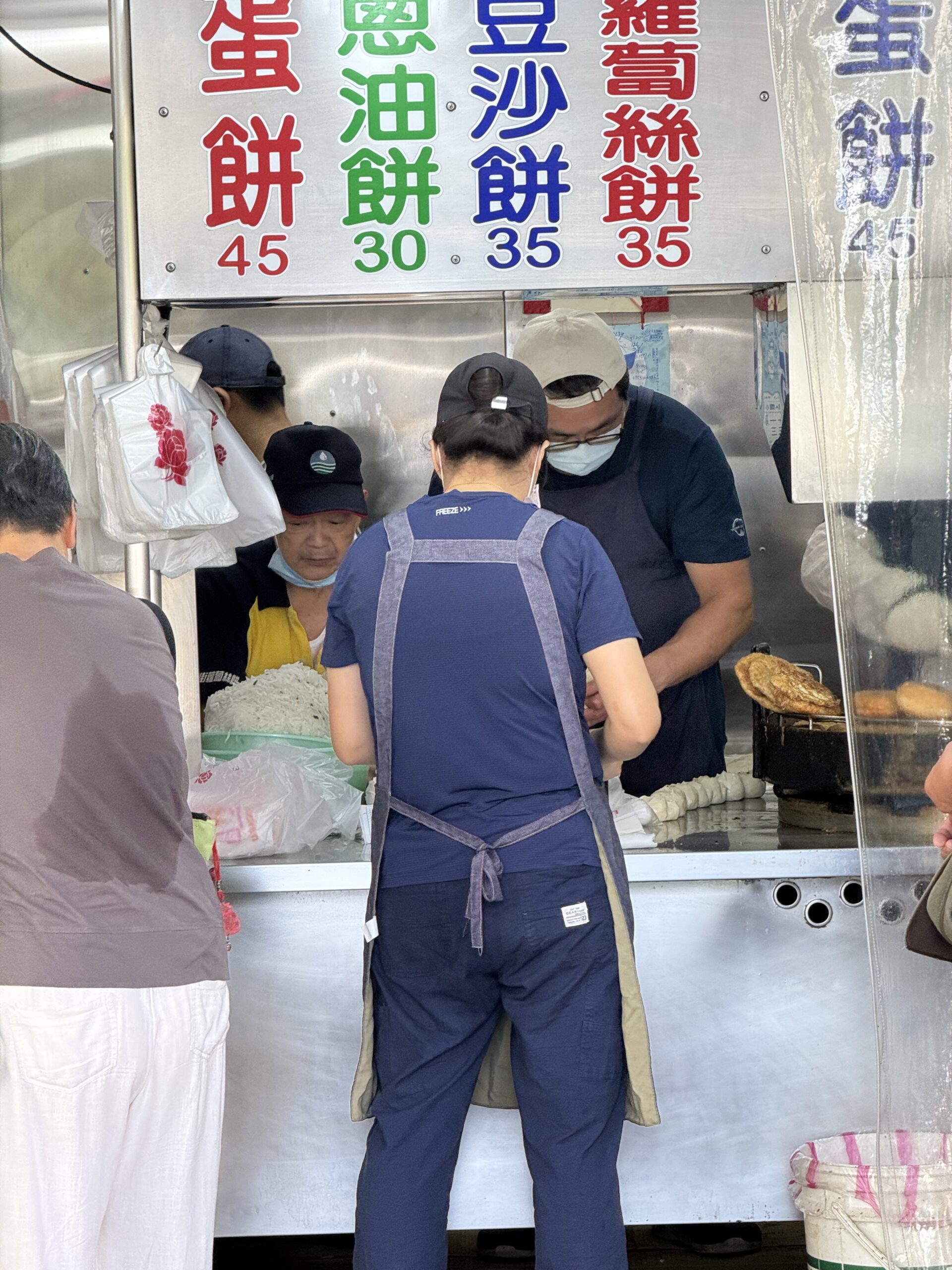
    Wenzhou Street Scallion Pancakes storefront

    This morning, I had another must-visit food stand, Mr. Cong You Bing. That’s not his name or the name of his establishment*, and honestly, it isn’t even what he’s famous for. For years, he was just a couple blocks away from my in-laws’ old house. I’d walk there every day and fuck up my order every day. It was my morning humiliation (except when I could convince Chuwan to come along and do the ordering), but the food was so good!

    In English, Cong You Bing is alternately called a “green onion pancake” or a “scallion pancake.” It is dough infused with green onions and fried. The name pancake is misleading. The “pancakes” are savory, not sweet. Most are fried on a griddle, but Mr. Cong You Bing deep fries them in oil.

    A few years ago, he moved further away from my in-law’s old house, and he’s even further still from the new old house and their current new house. He is, however, fairly close to NTNU, where Melz is attending class.

    Since it was so late, we contacted Melz to meet us there, and after a couple of false starts, we got that coordinated.

    Mr. Cong You Bing has never been a young man since I’ve been going there, and I was really pleased to see him still making the pancakes this morning.

    I decided that today, I needed to knock off a couple of items on the “to-do” list. Based on ease of access, we opted for the Four Four South Village.

    Background: In the 1940s, Chiang Kai-Shek’s forces retreated to Taiwan with their tails between their legs after being dragged by Mao Tse-Tung’s People’s Liberation Army. Two million soldiers, plus various other family members/refugees, including my wife’s grandfather, her grandmother, and their infant son, my father-in-law, retreated to the island.

    Chiang’s delusion was that he would muster his forces on Taiwan and take back the mainland “real soon now.” Taiwan had just been liberated from being a Japanese colony for the last half century, and the natives weren’t really thrilled with the invasion by Chiang’s army, but that’s a story for another day.

    Chiang needed to house 2 million soldiers and their families, so they built “temporary villages” all over the island. These were crude, temporary structures because they were going to take back the mainland “real soon now,” but as “real soon” dragged onto “someday” and finally “never,” these became permanent homes.

    They have since been mostly torn down.

    I actually got to visit a “real” one, still inhabited, in Hsinchu in about 1999 — the one that my father-in-law grew up in. His mother still lived there, and we went to pick her up. I have never seen a smaller home in my life. It was all cement, and the height of the doorway was as low as my chin. I had to bend over to stand in the house.

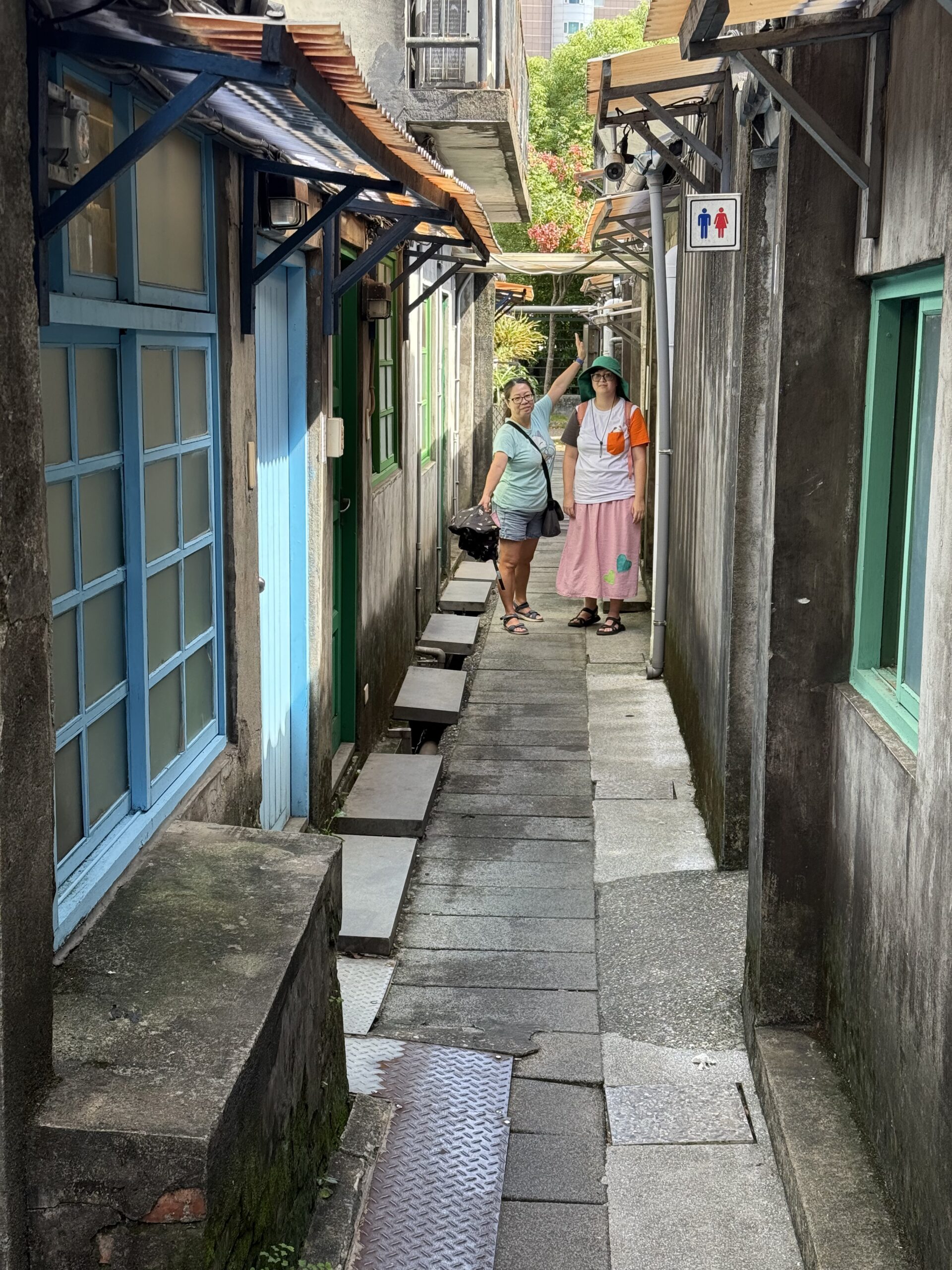
    Narrow alleyway at Four Four South Village. Two humans stand at a distance for scale.

    The Four Four South Village is one of these military housing projects that has been preserved as a historical site. I was interested to see how they preserved this piece of history.

    It wasn’t particularly impressive and didn’t seem nearly as tiny as the one I had seen. If you’re in the area, stop by; it’s free, but I wouldn’t make a special trip for it.

    In the interest of full disclosure for things that might be of interest to others (but not to me) they do have a brewery there that sells Taiwan Head beer, and they also have a place that, according to several sources online, sells the “only real bagels” in Taiwan. That’s probably apocryphal, but I did see the bagels, and they looked real.

    Four Four South Village wasn’t as interesting as I’d hoped, but it was not very far from Ichiran Ramen, which, like the Din Tai Fung we visited yesterday, was also in Shin Kong Mitsukoshi building A11.

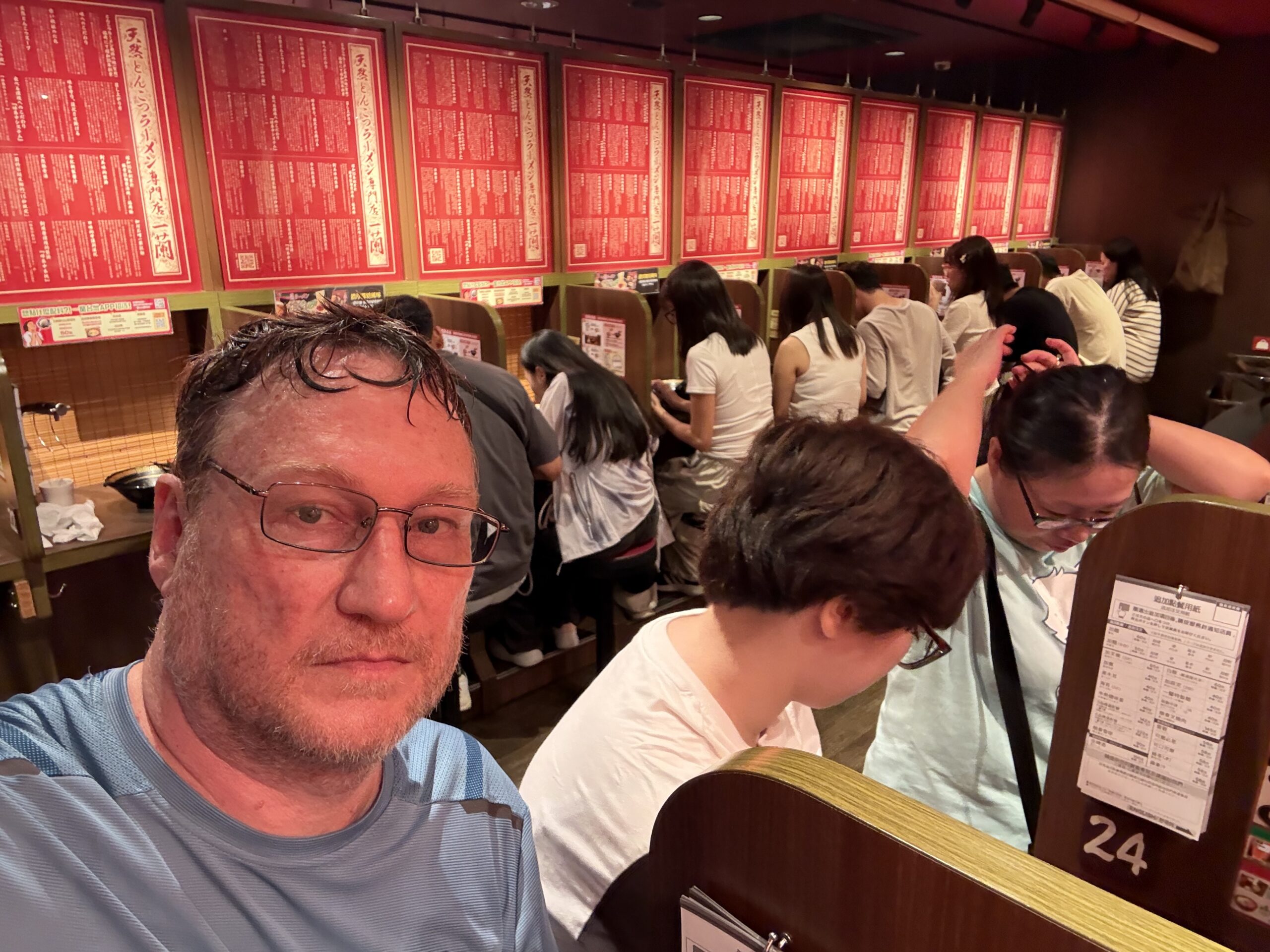
    The three of us at Ichiran Ramen

    Ichiran is a major Japanese Ramen chain. One of the things that makes them unique is the distinctive dining style they have adopted. In an effort (I guess) to mimic the close-quarters style of eating at a ramen cart, Ichiran restaurants feature everyone sitting side-by-side in small private cubby holes. You are, essentially, dining alone, even with a group, crammed into a small counter.

    The three of us were placed side-by-side in our private dining stations. Each station has a water tap for unlimited drinking water and a curtain in front of you. You’re given a form, which you fill out, you press a button, and they take it. The custom ramen is delivered moments later, the curtain closes, and you are left to eat alone. There is a mechanism for ordering additional food, such as more noodles. You never see the face of your server.

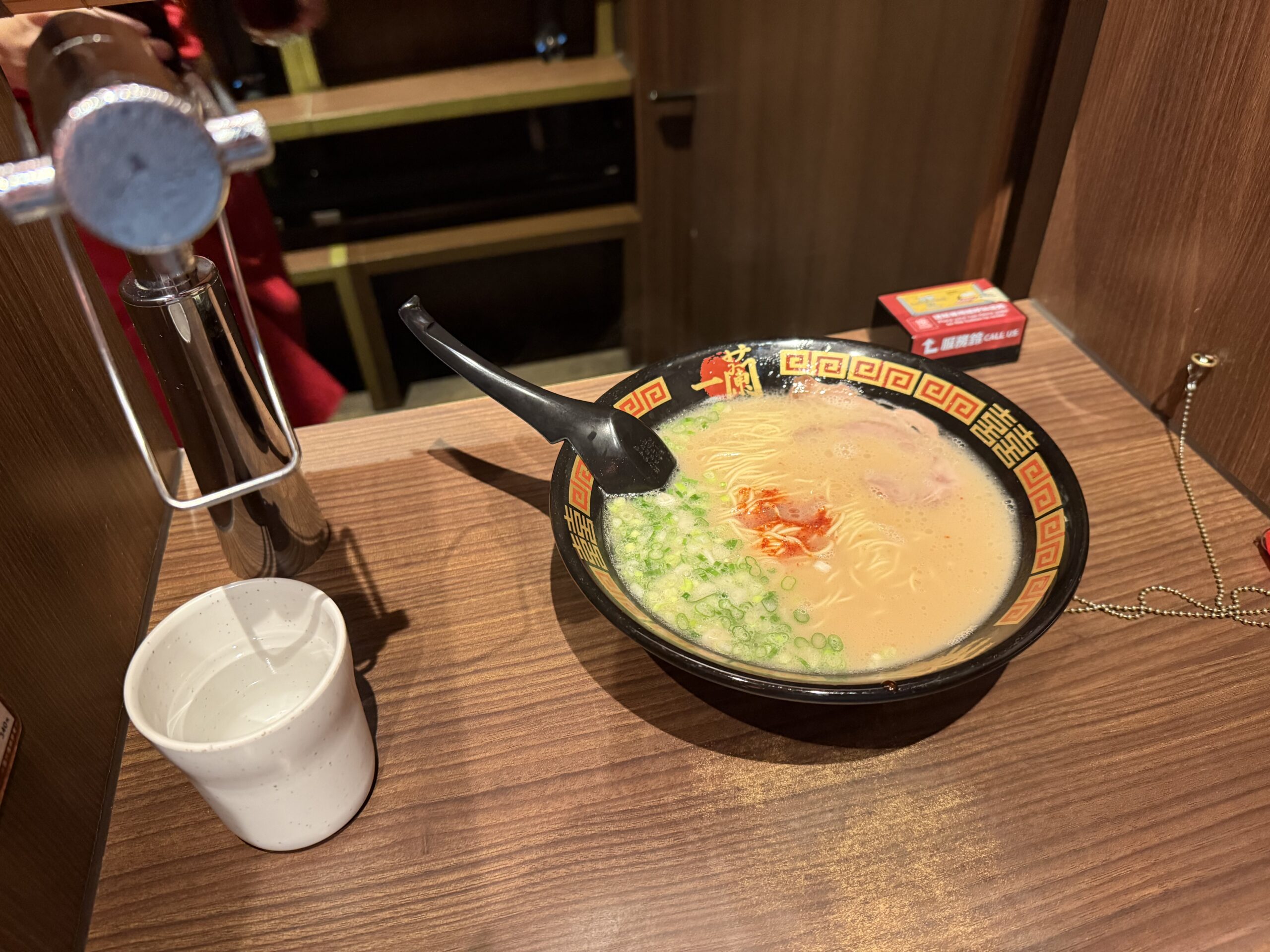
    a bowl of Ichiran ramen

    Despite never having eaten at Ichiran before, I’ve been a fan for years. You can get Ichiran ramen kits through Amazon in the US for about $6/bowl. I don’t eat a lot of ramen, but it’s my ramen of choice, and compared to the outrageous prices you’d pay for a bowl of ramen in Phoenix at a restaurant, it’s still economical. These are the same kits they sell at the door of Ichiran as you’re leaving. (For just under $5/Bowl.)

    But now I can decide if it tastes like the real thing.

    The dining experience is more of a novelty than an attraction to bring you back, and the booths aren’t designed for large foreigners. I was a bit hemmed in, with less than comfortable legroom, but it does encourage you to eat and get the hell out quickly.

    The ramen itself was delicious but a bit unfair compared to the boxed version. When I ordered mine, I was able to add a chunk of chashu pork, spring onions, and fresh garlic — things you don’t get in the box. Taking those things out of the equation, I’d say the boxed ramen is very close to being the same. That makes it one of the few things I can get in Phoenix that actually tastes “authentic.”

    Lest you think Ichiran Ramen in the store is somehow cheap, it isn’t. My bowl and a glass of Coke cost $11.52.

    I’m still going to write up my experiences with Holafly eSIM service at some length, but suffice it to say that we’ve been having some issues with sporadic service. That shouldn’t happen in Taiwan, let alone Taipei, which is massively saturated with cell service.

    My carrier in the United States, Verizon, offers an international roaming “deal” of $10/day for “unlimited”** calling, texts, and data. Essentially, if you make a call, send a text message, or use cellular data, you’re charged $10, and your 24-hour period begins.

    I wanted to test the service compared to Holafly, and also I just wanted to see the novelty of two eSIMs active at the same time on my phone. I’d had the US eSIM turned off completely for the trip, but I slipped it on today while we were at the Four Four South Village.

    I noticed no obvious difference in my data speeds or availability; however, when I was in Ichiran, I suddenly got a barrage of text messages from Kamala and Democrats all over the United States begging for money. In theory, I would not be charged for that (apart from the $10 fee that I believed I had incurred but turning the line on.) I tried the data connection again, and there was no apparent difference. I also received notification of a couple of voicemails that had come while I had the line off. I left them unread because they were junk. I was not that impressed with the service so far.

    After Ichiran, I returned to the Airbnb to rest my back. Chuwan and Melz went to the in-laws’ house where Chuwan would be making them dinner.

    Around 5 PM, I was contemplating how poor my data service from Verizon seemed to be, and then I realized that I still had Data Roaming turned off on the line. The instant I turned it on, two things happened: My data speeds popped up to where they should be, and I got a notice that my 24-hour period had begun.

    Aha! I could have had the line turned on the entire trip without incurring charges as long as I’d kept data roaming off and not answered the phone or responded to text messages. It’s a working hypothesis, and when the next bill comes in, I can hopefully confirm that. In the future, that could mean I could always have the availability of my US-based line if I needed it without having to switch it on whenever I thought it was necessary.

    Melz slipped out of dinner at the in-laws’, and we met up for one last pizza and Dr. Pepper before I leave Taiwan.

    Late at night, when Chuwan returned from her parents’, she stopped by the Mr. Long Chicken stand near the Airbnb and picked up a snack. It was excellent chicken.

    There’s been a last-minute change of plan for tomorrow. Taiwan is a large player in the textile/fabric industry, and they have one of the major trade shows in the world starting tomorrow. Chuwan’s friend has direct connections to the industry and has gotten Chuwan and Melz passes to attend the trade show. Melz has recently graduated with a degree in textiles and fabric, and the show seemed too great an opportunity to pass up.

    What it means, though, is that I will be completely on my own after breakfast for my last day in Taiwan.


    *His actual business name (in English) is Wenzhou Street Radish Pancake, despite the fact that he hasn’t been on Wenzhou Street for years. And his specialty is a big, fat, deep-fried bun (too thick to be characterized as a pancake, but they do nonetheless) stuffed full of shredded radish. If radish is your thing, it’s what he’s famous for, and there’s always a long line. Scallion pancakes are just his sideline.

    **Of course, there are actual limits.

  • Taiwan (2024) – Day Ten – Biking for Food

    Monday, October 14, 2024

    I’ve said it before, but I think this one will be a short one!

    Today was a bit of a “down day” after yesterday’s excitement. Melz was back in school, and Chuwan and I had no plans for the day.

    We rented YouBikes and headed out for breakfast. We stopped at Sukiya for breakfast. Now this was a necessary stop. I’m a big fan of Yoshinoya, and I love gyudon. Gyudon is workman’s food. Cheap and filling.

    A bowl of gyudon

    The few places selling gyudon in Phoenix treat it like it’s a rare gourmet dish from Japan and price it accordingly. The one place remotely near me in Phoenix sells it for $14 bowl. A standard bowl in Taiwan equates to $3.40.

    I go to Yoshinoya every time we go to Taiwan, but this is the first trip I’ve noticed Sukiya, which is a competing Japanese chain to Yoshinoya. I’ve never tried them or even heard of them until this trip.

    On Day Three, I went there for the first time, but in a fit of uninhibited craziness, I didn’t try the plain gyudon. I went with gyudon with cheese. It was interesting, good even, but it wasn’t a fair comparison to Yoshinoya. It was absolutely essential that I go to Sukiya and try the plain gyudon before we left.

    Chuwan was happy to go along and have a full Japanese-style breakfast with fish and a variety of small plate items. It was all under $10 between us, and I had a larger portion of gyudon to boot. I put it as neither better nor worse than Yoshinoya, but it was delicious.

    Honkai Starrail artwork on a Pizza Hut in Taiwan

    After we ate, Chuwan had what she called a “crazy idea” (and it was.) She plays a game called Honkai Starrail, and Pizza Hut Taiwan is currently running a cross-promotion with the game. Chuwan proposed that we ride the bikes to the nearest Pizza Hut where she could take pictures of Honkai Starrail decorations on the restaurant.

    Crazy, but harmless, and an excuse to ride the bike more, so I went along.

    After she snapped her pictures, we continued until we came back to Hung Rui Chen (see also Day Three) and bought some more sandwiches to stick in the fridge at our Airbnb. Plus, it gave me an excuse to ride the bike more.

    Me on an eBike

    Aware that we had not yet managed to eat at Din Tai Fung, Chuwan had been monitoring the average wait times at the various locations. She had decided that the Din Tai Fung in the A11 Building of Shin Kong Mitusukoshi was the one that usually had the shortest wait time.

    We contacted Melz to see if they wanted to meet near the restaurant.

    Buses in Taipei are frequent and go pretty much everywhere. Historically (for me, that means in the years I’ve been going to Taiwan), they’ve also been illogically routed, with multiple different buses going to the same place via different routes. The routes are circuitous. There are multiple different bus companies. They drive like maniacs. A single bus stop can have as many as ten or more different bus routes servicing it, and, of course, the signage was entirely in Chinese characters. The buses also don’t seem to run on any meaningful schedule. They follow extended loops but don’t have scheduled times to be at the stops. They just get there when they complete the next loop. Depending on the route’s popularity, there may be more than one bus on the same route, cutting the interval time down.

    It was virtually impenetrable for a visiting foreigner. I avoided buses like the plague unless Chuwan was leading the way.

    But things have changed for the better.

    Many of the bus stops now have digital signs showing how long until the buses on all the routes arrive next. You still need to know which bus routes will get you where you want, but that is now solved by the fact that Apple Maps now has public transit routing info for Taipei (Google Maps does, too, but it’s Google, so fuck ’em!)

    To get to Shin Kong Mitsukoshi A11 we decided to take the bus because the subway would require three trains and two transfers. One of those transfers would have been at a bitch of a station, where you get off the train two or three stories underground, then transfer to a train that requires you to go three stories above ground, and then back down underground on the next transfer.

    I decided today was the day I would figure out which bus to take!

    Apple Maps also had the bus arrival times, presumably fed by the same data feed that updates the digital signs at the bus stops. Because the bus routes are so plentiful and follow many different routes but cross over many of the same destinations, this leads to the weird situation where if you ask Apple Maps for a route now, it may walk you to bus stop A and then tell you to grab bus X, but if you wait a minute or two, it may tell you to walk to bus stop B and catch bus Y. A minute later, it will be different again.

    That lead to more than a little anxiety on my part because, there is one thing certain about Apple Maps routing directions: If they tell you it’s a 9-minute walk somewhere, it most certainly is not a 9-minute walk. But if the best route is so contingent on timing down to a minute or two, will you be catching the best bus?

    I decided to wait till we got to the bus stop before asking what the best route was. That worked perfectly. The buses have also upped their automated “announcements” of stops game, often including English when appropriate.

    I knew which bus to get on, and I knew when to get off, and I could double-check it by following along on my phone. Perfect.

    Note to visitors to Taiwan: I just watched a YouTube video where a family tried to catch a bus, and they were mystified as to why the bus just drove past them when they were at the stop. They speculated that the bus was out of service. They probably did not know that the buses won’t stop unless they’re letting someone off or you flag them down.

    All hail the bus!

    There was a wait at the door of Din Tai Fung, even though we arrived as they opened, but it was only about 5 minutes, and the food was excellent, as always. I really could eat here every day, but they’re not cheap. There’s one opening in Phoenix next year, and I fear what it will do to my budget.

    Honeybee the robot

    This location had a little robot that showed us to our table. This is the same type of robot used by Kura Sushi to serve drinks. One wonders why Din Tai Fung uses it for a different purpose than what it has clearly been designed to do. (In the picture, you can see the “I’m Honeybee, please follow me” sign on the tray where you place food or drinks for delivery.)

    After lunch, there was a temporary(?) Pokémon store in the complex, so we went there at my wife’s and child’s insistence.

    I had a bit of a sad moment while wandering the Pokémon store. I overheard a man explaining to a woman that these Pokémon they were looking at were Taiwan-exclusive products.

    It was a sad moment because I have been working very hard on learning my Mandarin lately, and I have been trying to listen to people on the streets and the trains and pay attention when my in-laws are talking, and I am making some progress; however, this man wasn’t speaking Chinese. He was obviously Taiwanese but spoke rudimentary Japanese to the woman. I picked up more Japanese than Chinese.

    For 26 years, I’ve been exposed to Chinese and have been trying to learn it (admittedly, most of that time, not aggressively). I haven’t taken a Japanese course in over 27 years, but I still picked up more Japanese in that one conversation that I can after several hours of listening to the Taiwanese people. Disheartening. My brain has clearly ossified.

    We took a break for the afternoon.

    My dinner plan in a nutshell was: God dammit, I’m going to eat at a fucking McDonald’s, and they’re not going to stop me.

    I’m not even a big fan of McDonald’s; it’s just been shitting me that every time I try to go, they’re too packed to have a seat.

    McDonald's restaurant at night

    Melz was up for it, and Chuwan suggested a plan. We rented YouBikes and rode to McDonald’s near her parents’ old new house. It was a two-story restaurant that we used to go to for breakfast with some regularity. It was neither near a subway line nor any major urban nexus points.

    When we got there, they had eliminated the second story and converted the location to take-out only. The pandemic has much to answer for.

    Melz located the next-nearest McDonald’s, and we continued riding into the night.

    The next one was about 1.8 km away along a major road, but when we got there… it was 9:00 PM and packed but, by sharing a table (common), we were able to get three seats to eat.

    My aim has been to have the fried chicken at McDonald’s. On previous trips, it was pretty damned good, although, on our last trip, everyone felt the quality had significantly declined. Hoping that was just an anomaly, I wanted to try again.

    Me, wearing plastic gloves, eating messy fried chicken in a McDonald's

    And then my brain went haywire when I saw they were selling “K Chicken,” which was Korean-style fried chicken. I ordered that instead. You know you are in trouble when they serve you your food with a pair of complimentary plastic food service gloves.

    It was messy and it wasn’t good, and it seemed that the underlying chicken wasn’t very good either. It was a lot of effort for a very disappointing meal. If there’s one thing you can say about McDonald’s, it’s that it’s not supposed to be a lot of effort.

    We ended the evening walking to the nearest subway station and returning home, sadder and a little wiser.

    Only two more full days are left in Taiwan, and we have no plans for either day.


    *Google Maps is far more prevalent in Taiwan than Apple Maps, and you’ll end up using it from time to time whether you like it or not. Google Maps also has one obvious and very helpful advantage over Apple Maps. Google and Apple will both show you where the YouBike stations are, but Google Maps will tell you how many bikes are available and if there are any open spaces to dock your already-rented bike.

  • Taiwan (2024) – Day Nine – The Day We Lost My Father-in-Law

    Sunday, October 13, 2024

    Yesterday’s post was long because lots happened, even though nothing really happened. Today, lots happened. Full stop.

    Let’s dive in.

    My brother-in-law planned a “family day” for today. My father-in-law used to plan these packed excursions, but my brother-in-law has taken over the duties. He learned them well, too.

    Today’s plan was to take us (in two vehicles, one hired, with a driver) to three different places in Yangmingshan Park, then back in Taipei to the Grand Hotel for Peking Duck (A favorite of Melz,) then head out to Jiufen and Jinguashi. That is a busy day by any stretch of the imagination. Let’s see how we got on.

    We had to meet at 8:00 AM when the driver was scheduled to show up. On the way, I grabbed a green onion pancake with an egg. They’re more filling that way, and I had a feeling I was going to need the extra protein.

    At 8:00 AM, the plans changed almost immediately. Johnny planned to take his wife in his car while Chuwan, I, her parents, and his kids rode in the hired van. The “van” turned out to be a small school bus that easily fit the entire family and carried my mother-in-law’s wheelchair.

    My understanding of the original plan was that Johnny would use his car to take my mother-in-law home after lunch and then return. The hired driver was, as best as I can understand, trying to say that it was unnecessary to take two cars and, perhaps, not a good idea. In the end, we all went in the van.

    Water buffalo

    Our first stop was Qingtiangang in Yangmingshan. They’ve been taking me there since my first trip to Taiwan. It’s a grassland area with a population of water buffalo. It’s pretty, and it’s very popular. There is something perverse about it to me. They go into the mountains to see an empty grassland. Mountains, to me, mean forests and trees. It just feels wrong to my sensibilities.
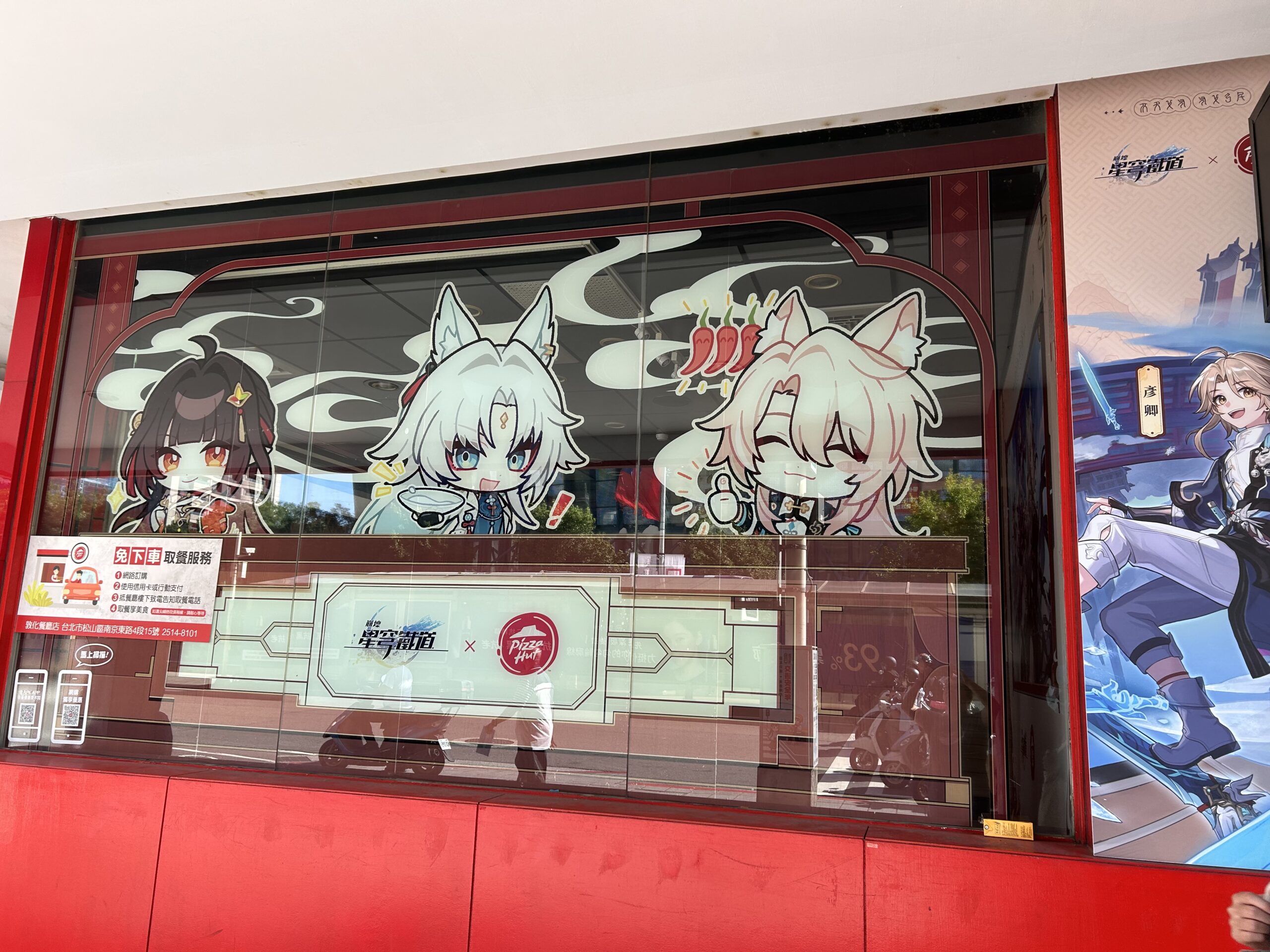
    It also took us a long time to get into the parking area at Qingtiangang. The number of parking spots it limited, and access is tightly controlled, like an airport parking garage. There is a gated entrance and a big sign indicating how many spots are available. The number of available spaces was zero, and the line of cars to get in was about ten deep. As one car would leave the parking lot, the gate was opened to allow one car in. We waited 15-20 minutes. Then, the driver had to find that one available spot and fit a small bus into it. He was a pro, but it took a few tries.

    It was probably a good idea to take only one vehicle, but even with only one, if we were going to have to wait that long at each stop, we might be pressed to visit all three places in Yangmingshan.

    What can I say about Qingtiangang that I haven’t already? It’s a grassy area with water buffalo in the mountains.

    Panorama of Qingtiangang
    Qingtiangang

    Our next stop was the Erziping Visitor Center. The road up to it was winding, passing through dramatic forests and gushing water. Now that’s what I call the mountains! The “visitor center” was little more than a toilet. High up in the hills, on a narrow, winding road, the parking lot was absolutely packed with bike riders, and they were sporting some mighty fine looking bicycles.

    Of more practical interest to me was the 1.8 km Erziping trail. In my mind, the only logical thing to do is to go see where that trail leads. Considering how awesome the ride up had been, whatever lay at the actual Erziping must be awesome. I assumed we came to a trailhead to walk the trail, so Melz and I set off.

    a bridge along the Erziping trail

    Although he still wouldn’t speak English (or anything) to me, this was the first time my 8-year-old nephew seemed to take an interest in me, and he followed along, although he was mostly following Melz. Chuwan and my father-in-law followed up from behind, although he dropped out and returned to the visitor center shortly after.

    The trail wound through the forest, or perhaps I should call it the jungle. It’s a bit of both, really. It wasn’t particularly steep, but it was wet, muddy, and slippery.

    I could tell I wasn’t doing my back any favors, and I also suspected that they hadn’t really intended for us to walk the whole trail, but there’s a certain stubborn perverseness to my nature, and suspecting that made me want to finish the hike all the more.

    Two humans and grassy hills behind

    And when we got to Erziping, I finally learned what it was: Another fucking grassy area.

    At least this one had a little lily pond and was, overall, more picturesque, but it certainly felt a bit anti-climactic.

    Whatever the third stop had been planned to be, I knew that the parking delays and my hike to Erziping had put an end to that idea. It was probably the flower clock. It’s always the flower clock.

    We had to make our way down the mountain for our lunch reservation at the Grand Hotel.

    Side view of the Grand Hotel

    The Grand Hotel is a major landmark in Taiwan, and I’ve never been there. As it is nothing more than a Chinese folly hotel, I’ve never been interested in going.

    “Chinese folly” might be unfair, but it’s my opinion. Wikipedia says it’s one of the largest Chinese Classical buildings in the world, but let’s face it, it was built that way to satisfy Chiang Kai-shek’s need to assert that Taiwan was the last true outpost of China to foreign dignitaries. One definition of a folly (in architecture) is: “A building in the form of a castle, temple etc. built to satisfy a fancy or conceit, often of an eccentric kind.”

    All boxes checked.

    The Grand Hotel has hosted notorious war criminals and monsters such as Richard Nixon, Ronald Reagan, Margaret Thatcher, and the Shaw of Iran, plus, I imagine, a few other people who weren’t so awful. The building dominates several views of Taipei and is quite imposing, so imagine my surprise when we entered the Grand Hotel through the Family Mart in the lobby.* Cue trumpet wah wah waaaaah.

    Several people around a round table

    Lunch was the aforementioned Peking Duck (which has to be ordered in advance), plus the usual banquet-style Chinese meal. This means that the family picks out several dishes which are shared amongst the diners. They try, often without success, to pick some dishes to accommodate my decidedly Western taste, and they also usually hand me a menu to select one or two dishes that appeal to me.
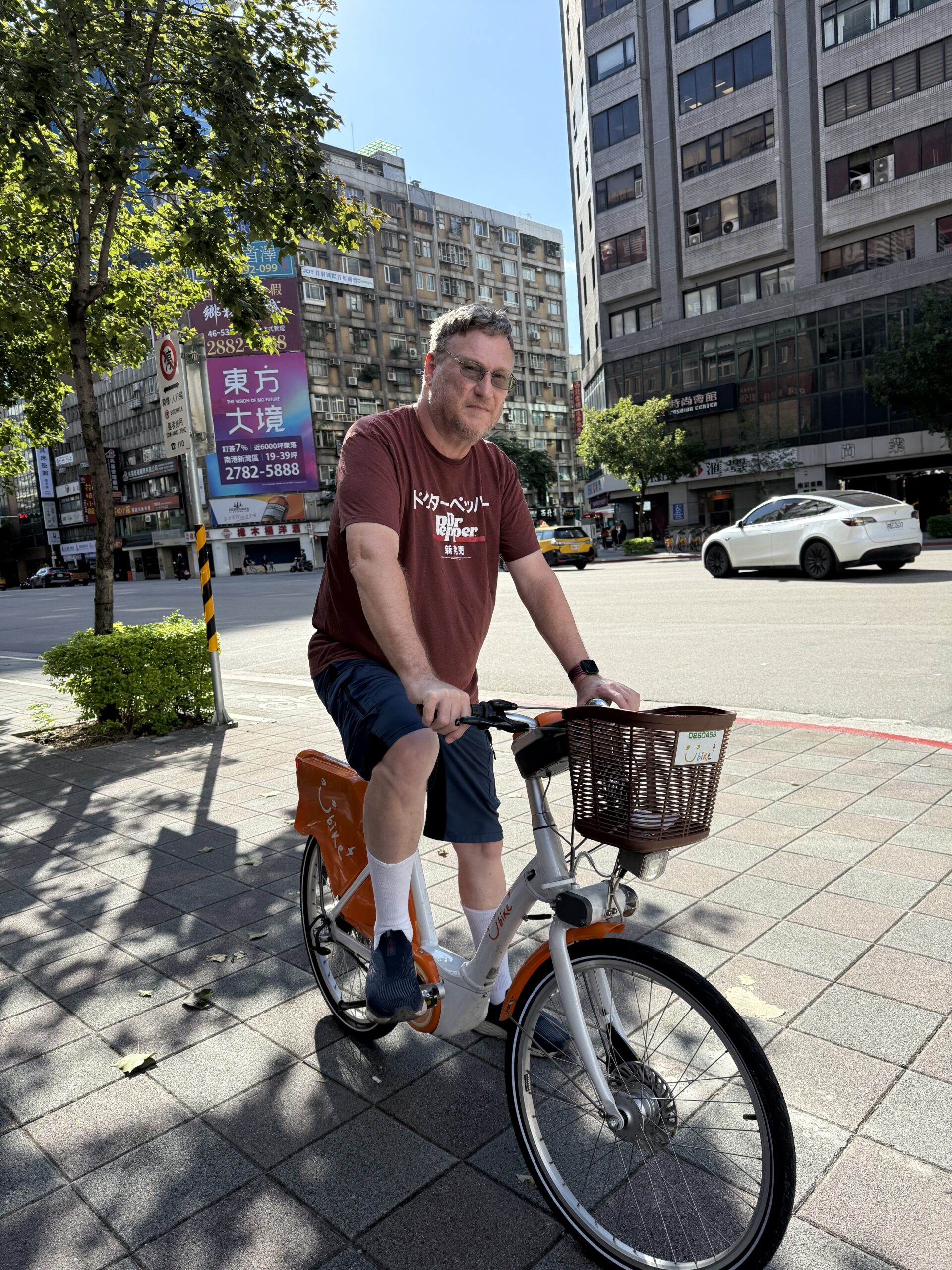
    The Grand Hotel’s menu was very Chinese and more than a bit froufrou. I did find one dish that sounded interesting, but the Grand Hotel was out of it that day. Cue trombone slide.

    I’ll spare you (most of) my commentary on the food, save that they serve perfectly good-looking meats ice-fucking-cold, and that duck is one of the most overrated, fatty, greasy birds ever to grace a plate.

    Typically, my wife and I have an understanding that after a giant family banquet, she and I go to McDonald’s so I don’t starve. That wasn’t possible today because the magical mystery tour wasn’t over yet! Starvation might still be on the menu.

    Our first stop was back to my in-laws’ home to drop off my mother-in-law, but then, in a surprise, unplanned move and over the protestations of my nephews, my brother-in-law, and his family also dropped out of the rest of the tour.

    A greatly-diminished pack of only four tourists departed for Jiufen.

    Looking down from jiufen to the ocean. Temple in the foreground

    Jiufen was a gold-rush town of the 19th and 20th centuries. It sits precariously on a mountainside that slopes right into the ocean on the north side of Taiwan. The gold in the mountains is long tapped out, but the modern gold is tourism.

    Jiufen is frequently featured by travel bloggers and vloggers in Taiwan because of its quaint, cramped, mountainous streets, which are often compared to scenes from anime. There’s another thing they are on the Sunday of a holiday weekend: packed.

    Our driver, who was very experienced in taking tourists around, suggested that the best way to experience Jiufen was for him to drive us to the top and drop us off. We would then walk to the bottom and call him for a pickup.

    None of us wanted to be walking up the stairs of Jiufen, so we readily agreed.

    Maybe I’m getting jaded, but I have been to Jiufen more than once before, and with the extra-thronging crowds, it reminded me of nothing more than a diagonal night market. There might have been interesting stuff to see or even some food to eat, but what I wanted was to get the fuck out of the crowd.

    Being a major tourist destination, there were public toilets along the way. They’re not particularly nice toilets and they don’t offer much privacy. For example, the urinals are close together and either have no screens between them, or the screens are very, very small, like 15 cm. But you just have to acknowledge that you’ll never see the other humans next to you ever again and go on about your business. Also, as a foreigner, they aren’t going to talk to you.

    At one point, I decided it would be prudent to use the restroom, but to get there I had to walk down a very narrow side passage, which came into a small central area that had two more small passages and a larger street. It was here that the restroom was.

    Packed and shoulder to shoulder, I went about my business, and then my father-in-law was standing shoulder to shoulder with me. We acknowledged this slightly awkward moment with a slight grunt and head nod and I finished and left.
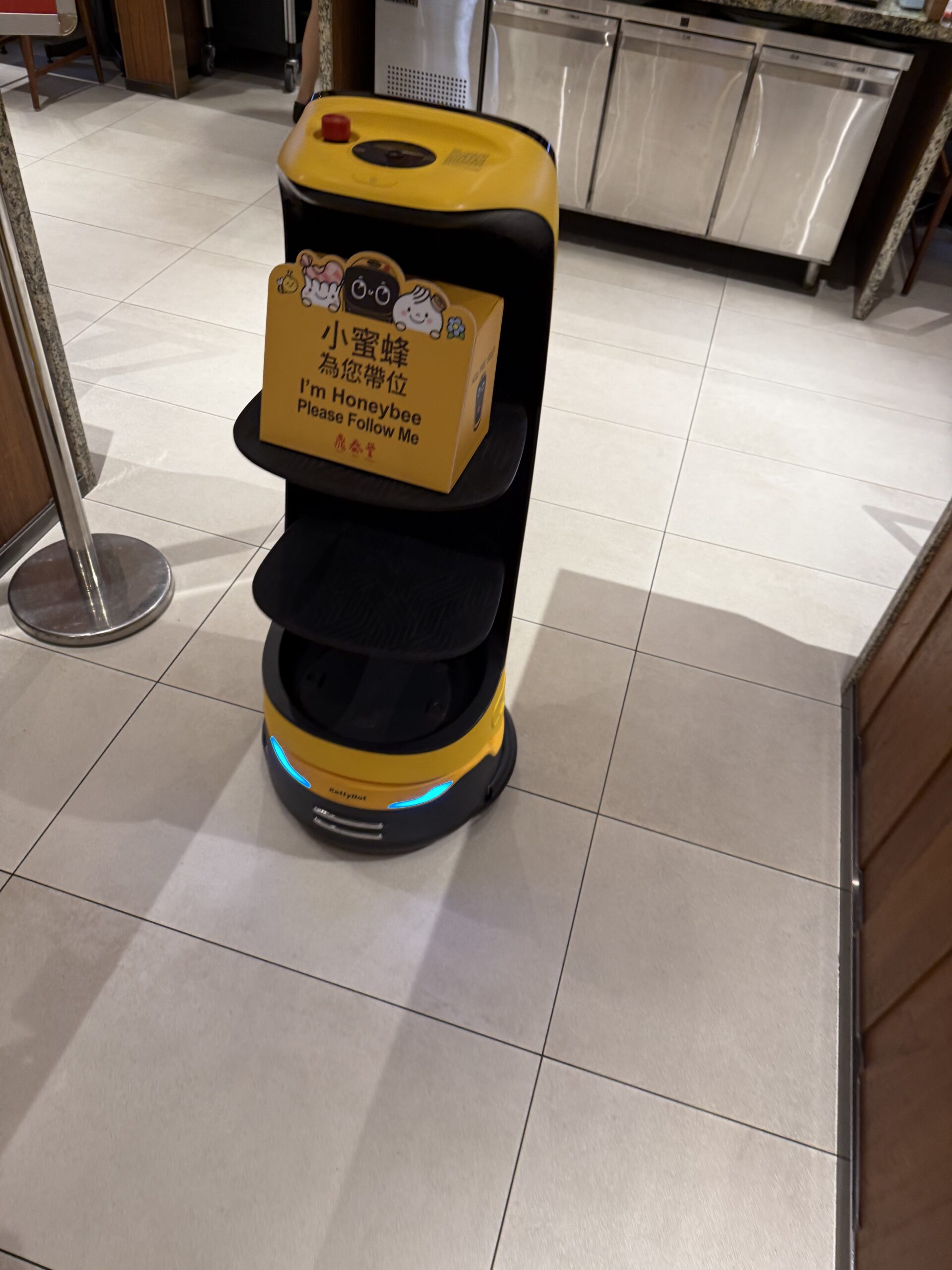
    Jiufen mountain

    I returned down the narrow passage and rejoined Chuwan and Melz, and we waited for Chuwan’s father.

    …and we waited, and waited, and he didn’t return.

    I returned to the restroom, he was not on the path to it, nor in it. I even satisfied myself that he was not in a stall. I stepped out into the 4-way junction and started looking down each path. The narrow ones were empty. The larger street was packed with people, but there was no sign of my father-in-law.

    I reported back to Chuwan who was now (rightly) concerned.

    “Don’t worry,” I said, “everyone in Taiwan has a cell phone. Just call him.”
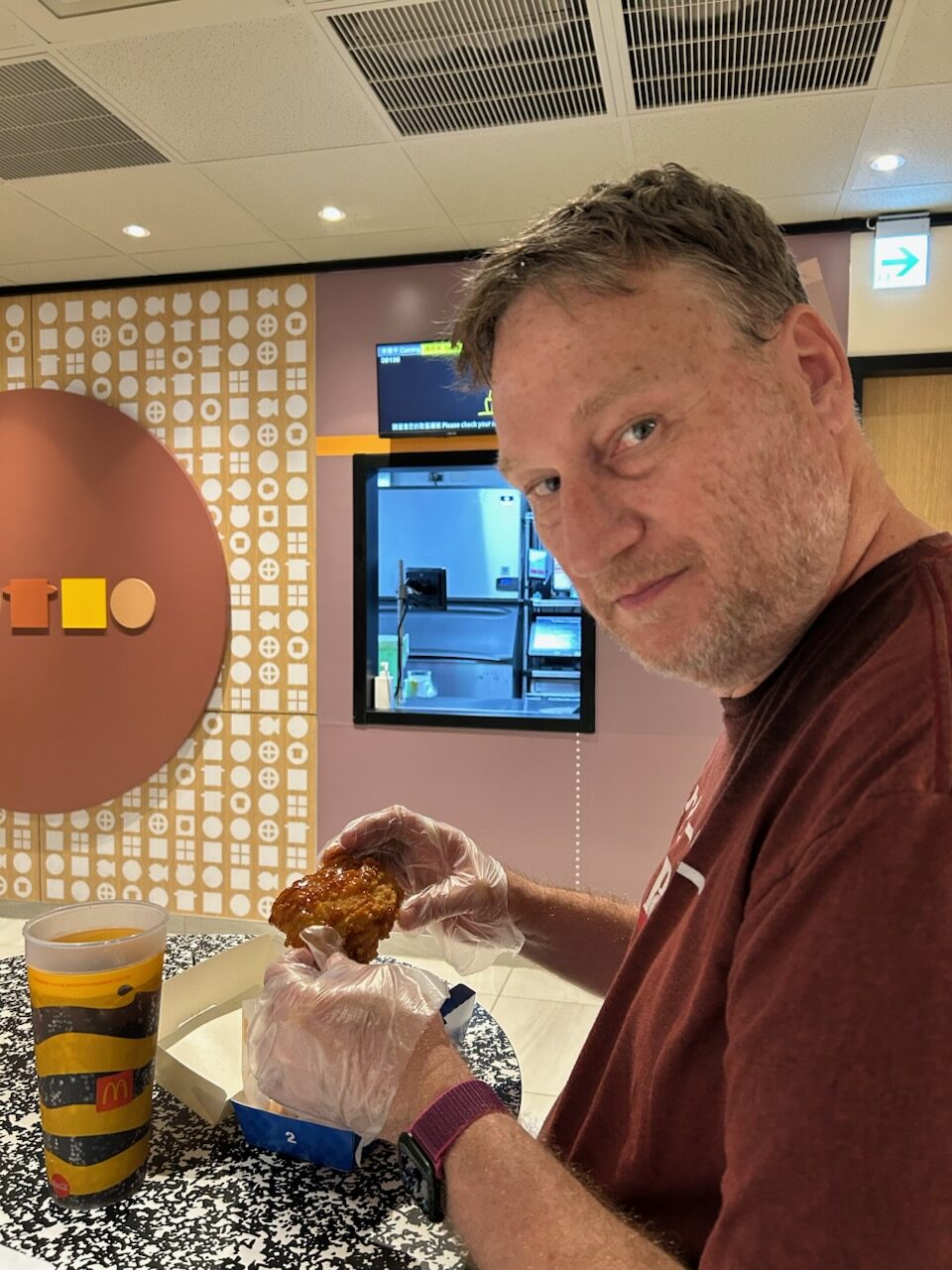
    “My dad has a phone, but he usually leaves it at home.”

    “Of course he does. Try anyway, just in case he thought, ‘I’m going on a trip today, I might need my phone.’”
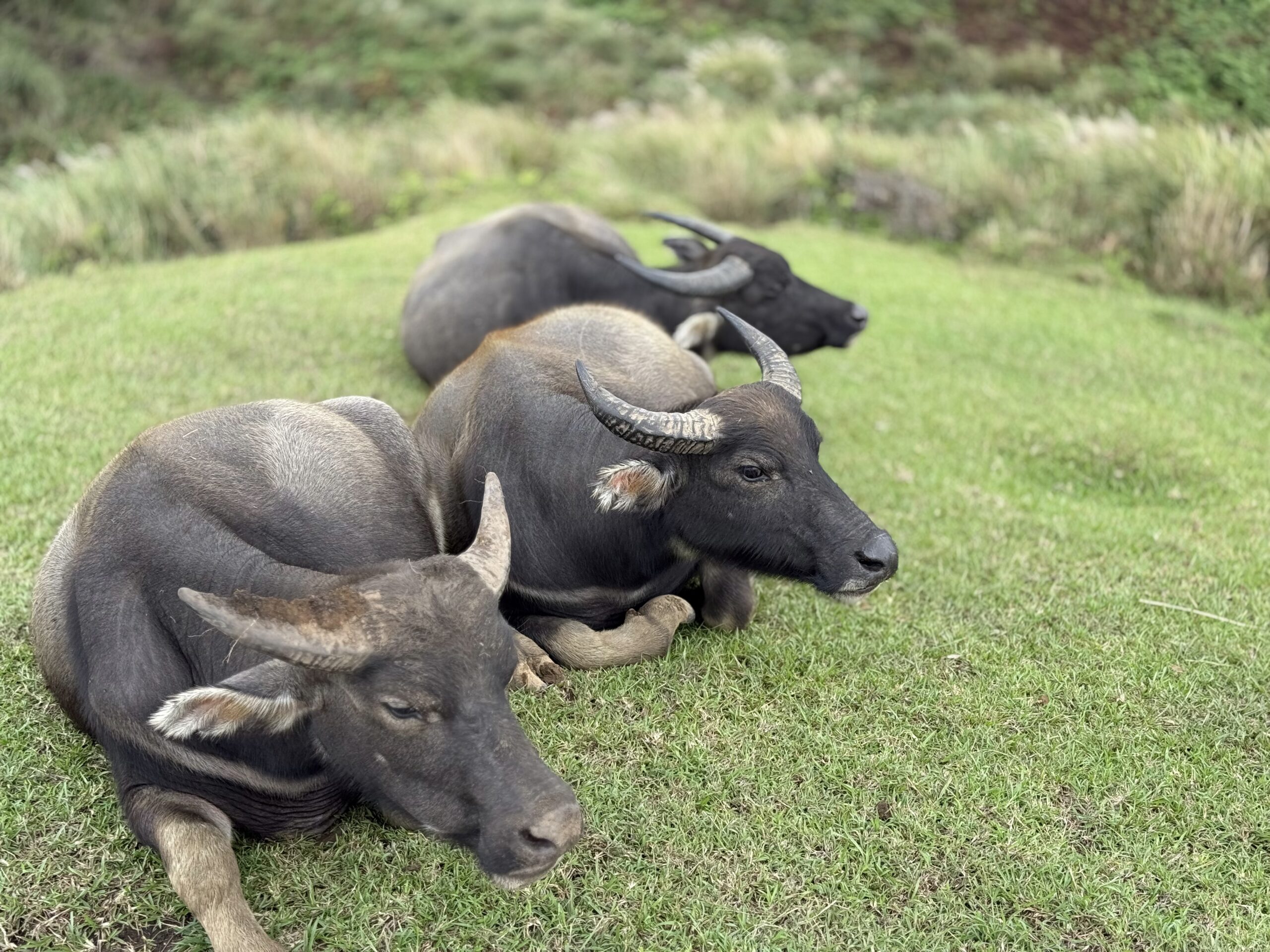
    No luck. And, of course, even if he borrowed someone’s phone, Chuwan and I don’t have callable phones, and it’s doubtful he’d memorized Melz’ number, and he won’t be able to reach the driver, either.

    Now we’re freaking out. There are thousands of people here and the whole place is rabbit warren on a steep mountain. Chuwan calls her brother to let him know (Line call) but there’s not much he can do.

    Chuwan is thinking, “Let’s split up and look for him.”

    Melz and I are, “Hell no we’re not splitting up! Then we’ll all be lost!”

    Our plan was to meet at the bottom of the hill, so in the end, Melz and I continued to the bottom, hoping that he’d think to meet at our rendezvous place if we got seperated. Chuwan continued to search the shops and streets.

    No father-in-law at the bottom of the hill.

    Crowded streets in Jiufen

    There were two thing at the bottom of the hill: a police station, and an emergency PA system. After Chuwan finally gave up and came down the hill an hour had passed. She went to the police and reported her father missing.

    The police alerted the other officers in town, and also broadcast an announcement. Chuwan’s father heard the announcement and about 10 minutes later we spied him coming down the stairs. He had thought we were meeting at the top of the hill where we’d been dropped off. He returned there and sat down in the 7-Eleven waiting for us.

    Everyone was much relieved, but he needs to start carrying his phone with him.

    No time to visit Jinguashi.

    It was a long day and a long drive back to Taipei.


    *It turns out we entered through the side lobby. The main lobby was much more dignified.