Author: Eugene Glover

  • San Diego – Day Three – When Animals Get Wild!

    Day three brought us to the San Diego Zoo Wild Animal Park.

    Which constitutes a lot of walking and driving around looking at animals. ’nuff said.

    Afterwards we explored the area, bought some “fresh” california produce from a roadside stand and stopped at Famer Boys Hamburgers, for a decent, if unremarkable late lunch.

    That put us, unfortunately, at what is commonly called “an inopportune time” to be crossing town: rush hour.

    We dodged into a nearby mall to kill some time. What we found was an Apple Store. Inside, I discovered that they had released a “Mac/iPhoto” edition of the EyeFi Wireless SD card, which not only uploads your photos wirelessly to you computer, but geotags them using the skyhook method. It’s a little expensive for a 2GB SD card, but I decided (after having spent last evening manually geotagging yesterday’s photos) that it might be a valuable addition to our vacation enjoyment.

    (Typically, when I’m out and planning on geotagging, as was did today, I take my Garmin GPS and run it all day while I’m out and about. When I offload the pictures at the end of the day, I use HoudahGeo to synchronize the GPS track log and geotag all my photos. It works pretty well, but it would still be better if the photos were tagged as they were taken.)

    We got back to the hotel room and I tried to setup the EyeFi card. That’s where the problems began.

    The EyeFi card doesn’t quite work the way I expected. I had assumed (somewhat incorrectly) that the device communicated wirelessly with your computer, but rather it’s a device attached to your wireless network. Perhaps if I explain the setup the problem will become more obvious. I’ll stress here that the problem wasn’t with the EyeFi card, but with the resources I had available to me and my hopes of getting the card working for the rest of the trip.

    The Woodfin San Diego, that we’re staying at, has wired internet in the rooms, for which they charge $6 a day. Yesterday, I signed up for two days’ worth, since we’ll be leaving tomorrow early. I thought I’d be clever (I’ve done this before) and I brought my Airport Express, which I connected to the wired network, and then connected to with my MacBook. As with most of these places, upon first use of the web you’re presented with the hotels terms and conditions plus, in this case, the ability to purchase internet access. I had expected that this would properly activate the internet for any device (such as my iPhone as well as my MacBook) over the wireless network, but it didn’t work out that way. Only the MacBook was authorized. A pity, but not a real problem – or so I thought. I continued to use the Airport Express because it was more convenient to be able to haul the computer around.

    Along come the EyeFi card.

    The EyeFi comes with a card reader (required for setup and handy, since I didn’t bring one with me). You plug the card and reader into the Mac and you load the software that is embedded on the SD card. The EyeFi software fires up on the Mac, you register an account with them (over the internet) and then you’re ready to initialize the card.

    Problem: The card cannot be initialized without reaching their servers over the net, and it must do so wirelessly through your network, not using the computer’s pre-existing connection to EyeFi’s servers. This cannot be done on networks that force you to an agreement page, so I was stuck.

    Next bright idea: I’d switch my MacBook to using the wired connection and then share my internet over the MacBook’s wireless. I’d then reconfigure the EyeFi setup to use the shared network instead of the Airport Express. That didn’t fly because the hotel network recognized the MacBook over the wired connection to be a different machine and forced me to pay for more internet, which I’m not going to do.

    My hopes of using the EyeFi tomorrow are dashed, but hopefully the “complimentary” internet at the Omni will allow me to set it up just in time for our return drive to Phoenix.

    For dinner we went to a strange little place called Jollibee, a Philippine-based fast food chain that specializes in hamburgers, fried chicken, spaghetti and a local rice/shrimp dish.

    Irene ate some of James’ spaghetti and nostalgically said it tasted “…just like spaghetti did when I was growing up (in Taiwan)”. The fried chicken also had a familiar, “back home” taste to her. I was impressed, it was easily the hottest, most spicy fried chicken I’ve ever had. Curious place, and it was frequented by quite a few people who looked to be Filipinos. Pity they don’t have any in Arizona.

  • Nostalgia Pizza – Shakey’s Pizza Parlour

    Ah, our memories from childhood! Oh, you youngsters don’t remember the days before microwave ovens, or before Domino’s Pizza and Pizza Hut had expanded out and dominated the entire country.

    In those old days, there were one or two Pizza Huts in town – the old kind, with no delivery and a table-top video game in every store. We rarely went there when we were home, they were the poorest of the bunch, but we frequented them when we’d travel across the western United States. There was always one in most any town of any size. Just one, mind you. They hadn’t yet expanded to gargantuan proportions.

    There was Pizza Inn, which I don’t remember well, but their motto was, “For pizza out, there’s Pizza Inn.”

    There was Village Inn Pizza, with their distinctive A-Frame buildings. Completely incongruous in the Arizona desert, but several of the buildings still survive and are immediately recognizable to those of us who remember them.

    Finally, there was Shakey’s Pizza Parlour. Of all the places, Shakey’s was my favorite, with their dark restaurants, long dark communal wooden tables, stained glass windows and those ridiculous red-striped shirts and straw hats that the employees had to wear. It was not the best pizza to be had, but it was consistent, good and, at lunch time, there was a great all-you-could-eat buffet with pizza, fried chicken and spaghetti. The only downside was that, back in those days, no one had ever heard of “free refills” on drinks, so you had to purchase a pitcher of soda to last through the meal – which could, if you were a growing boy like me, last 2 hours.

    I don’t know when the last Shakey’s Pizza closed in Tucson, but I think it was about 1982. I used to go there for lunch during high school, but they were gone after I returned home from college for the summer. I’ve not had a Shakey’s pizza for at least 27 years.

    I had thought them dead and gone until 2001 when I was planning a trip to Japan. I was looking through a Lonely Planet guidebook and, there, to my utter astonishment, on one of their maps of Tokyo was Shakey’s Pizza. I checked more maps and found more. I used the Internet and learned that Shakey’s wasn’t gone, just withdrawn back to their original areas back east and, strangely, some overseas markets.

    I thought, “how excellent! When I’m in Tokyo, I can find one and try it!”

    I made a slight tactical error. Just before leaving, a new edition of Lonely Planet Japan was released. Wanting the most up-to-date information possible, I bought it and packed the new edition without ever looking in it, leaving my old edition behind. The authors had chosen to remove Shakey’s Pizza from the maps, and, in the grindingly convoluted streets of Tokyo, and only going by what I could remember, I was never able to find Shakey’s.

    Fast forward to 2009. I knew that as I passed through Yuma, the last Round Table Pizza in Arizona awaited me. (Round Table came in just a few years before Shakey’s disappeared.) I also knew that, at one time, there was still even a Village Inn Pizza in Yuma. That got me thinking perhaps Shakey’s still existed in Yuma or California, and with iPhone 3GS in hand, I was quickly rewarded with the information I sought: The do exist in California. (The bastards! Still, I can’t blame them, Phoenix is the city where restaurants come to die and Tucson isn’t much better.) Further, one is not far from LegoLand.

    We arrived to grumblings from the kids, “Why are we having pizza again?”

    I’d be lying if I said they were impressed with my explanation of the importance of childhood memories, but fortunately, I don’t need their agreement to set the agenda.

    Inside Shakey’s was nothing like I remember. Long dark tables had been replaced with booths and ordinary single family tables. The lighting was good, and there were big screen TVs broadcasting sports all around the place. The employees now wore black with baseball caps rather than the old-time straw hat regalia.

    Not everything was dissimilar, you still ordered at the counter, but even that had been updated. They had the most overly complicated table number system I’ve ever seen. Patrons were handed a number, much as you might just put on your table so the server knows where to bring the food, but this number has a complex series of punched holes in it, much like a hollerith card (there’s a term I never thought I’d get to use again in conversation!) At each table was an electronic beer signaling device – that’s the best way I can describe it.

    The number was slid into the main orifice on the beer signaler, which caused the beer service light to momentarily light up – clearly priming the device and transmitting a coded signal back to the front desk telling them where each patron in.,

    The card doesn’t remain in the main orifice, but has to be pulled out and then placed in one of the side orifices. Beer can later be requested by pressing the button on the device.

    Beer is the obvious example, since that is what they use to describe the operation with. Presumably anything could be requested in this way, but since Shakey’s is an order-and-pay-first restaurant, one wonders what the practicality of this system is. It’s not as if I decided to order a second pizza I’d hesitate to get up and order at the front counter.

    But what about the pizza?

    Ah, I’m glad you asked.

    It’s funny how first products can influence our tastes for our entire lives, isn’t it? Certainly, Shakey’s isn’t a pizza that will be in the running for best in the world, but I was very fond of it as a kid.

    We know from years of research that, if there are different styles of something, people tend to like their first. For me, my grandmothers fried chicken will always be the benchmark that other fried chicken is compared to. For others it might be Kentucky Fried Chicken. It often depends on what you had first.

    I had completely forgotten what Shakey’s Pizza tasted like, and I barely expected it to taste the same after all these years. Who knows how many iterations of “new and improved” it has gone through?

    None, I think.

    My first bite was an amazing experience. The flavors of my childhood flooded back with such strength I was taken aback. I think, had this been a blind taste test, I could have told you it was Shakey’s. I didn’t remember it until I tasted it and then it tasted exactly as I remembered it. (I’ll concede that there’s plenty of room for error in that equation.)

    It’s an oddly bitter cheese, with a slightly too sweet sauce. It had a bubbly, almost-but-not-quite flakey crust. It was a joy. I couldn’t dream of reviewing it because my memories would betray me.

  • San Diego – Day Two – We Lost Our Son at LegoLand

    Getting out fairly early, after a breakfast of toaster waffles, we headed towards Legoland, which is 20-30 miles north of our hotel. First we had to stop at a nearby (to LegoLand) outlet mall and pick up our three-day passes to San Diego’s major attractions. While we were there I stopped, for the very first time, at Hot Dog on a Stick. Although I love corn dogs, and their name is fairly explanitory of what they sell, I was still rather surprise at their limited menu. Hot dog on a stick, cheese on a stick, hot dog on a bun, lemonade, fries… yep, that’s it. And they were turkey dogs to boot.

    It was almost lunchtime and my justification for stopping for a snack was that food prices in theme parks are frequently akin to rape… and not just rape, but prison rape. My hope was to last through the day and then proceed to Shakey’s Pizza afterwards. (More on that later.)

    LegoLand is… well, what can I say? It’s an amusement park, mostly just rides for smaller children (2-12) with lots of Lego statues. Their artwork is impressive – but I feel if I had access to an unlimited number of every Lego ever made, I could probably make an elephant, too.IMG_6378

    I’m not very impressed by how the park is run, and I can give two examples. Although every ride has height requirement and they are posted at each ride; however, for some reason they don’t work very well. I saw no fewer than five instances where children (and their parents) were turned back at the boarding of the ride. Height requirements were enforced strictly at the last possible moment. The displays at the beginning of the line look like they ought to be clear, but at one point even we were scratching our heads over what the requirements were.

    Considering how devastated the children who were turned away were, perhaps a re-think of their system is in order.

    Second example: Children get easily lost in some of the play areas. There are large playgrounds where the parents and children enter, the children can play, the parents can watch, but in some places, the children can exit the playground out of sight of the parents.

    In the first case, I saw a young asian girl (maybe 3 or 4) come down a ladder/slide thing that lead to the outside of the play area. Her guardian was obviously still inside, probably on the ground floor. Who would expect an exit on the second floor? The child popped out, looked around and had no clue how to get back into the play area, she headed off. At first she seemed to know where she was going. I kept watching her as she soon started to look worried, then started crying.

    I got up to go help her when a woman came up to her and started holding her hand. Not her mother – just a kindly stranger noticing a child in distress. She hadn’t seen her come out of the playground, so I went to her to tell her where the child came from. They got her back to her mother – who never saw her leave the play area.

    Second instance, different playground, same scenario, different child – ours. There’s a large playground with lots of ladders and climbing things and slides. The parents can come along, but not all the parts are suitable for adults. There are alternate paths up and down for the parents and kids. Michelle and James went up (to a third lever) to come down the slides and only Michelle came down.

    I ran up, James wasn’t there. I ran back down, James still hadn’t come down. Then I look through the playground (we are standing at the back) and see a woman walking James towards the exit. He is crying. I shout to him, but he can’t hear me. I also can’t get to him because you have to go all the way around the playground to get there. Apparently there is another slide that leads to the opposite side of the playground.

    I run around the front, pushing slow, old women with strollers out of the way and get to the front – they’re not there. I run to the guy “guarding” the entrance. I say to him, “I just saw a woman walking my son towards this exit. He may have gotten lost. Did she bring him to you?”

    “No, what did he look like?”

    “Small boy, four years old, brown hair.”

    “Nah, I didn’t see anything. What kind of clothes was he wearing?”

    “Blue shirt, pants, white hat.”

    “What type of hat?”

    “White, Gilligan hat.”

    “Were his pants long or shorts?”

    “Ummmmm, actually, I’m not sure.”

    Now, mind you, he’s not the slightest bit concerned or even giving any impression that this is something he should even really give a rat’s ass about.

    Just about then a woman (“the” woman) comes up behind me and says, “Was his name James?” After I confirm she says, “He went back in there. He seemed lost and I tried to help him but he wouldn’t let me take him anywhere.” She pointed in the direction he went and there he was.

    Case solved, but I ask myself, “Would the LegoLand employee have actually tried to do anything?” The playground was designed in such a way as it was easy for him to go down a completely wrong direction, and then it was not easy to get from the front to the back. What if he’d tried to wander out of the area? Would the Lego Guy have stopped him? Are there even any basic controls in place to stop children from leaving the play area unattended?

    The whole place seemed rather lacksidasical.

    …and then we got hungry and had to eat. 2 slices of pizza, 1 salad, 1 cup of fruit, 4 breadsticks, 4 sodas…. Over $40!

    Otherwise, LegoLand… ehhhhh, I don’t know. Maybe I’m just not too keen on amusement parks to begin with.

    So it was off to the highlight of the day: Shakey’s Pizza!

  • San Diego – Day One – iPhone 3GS on the road

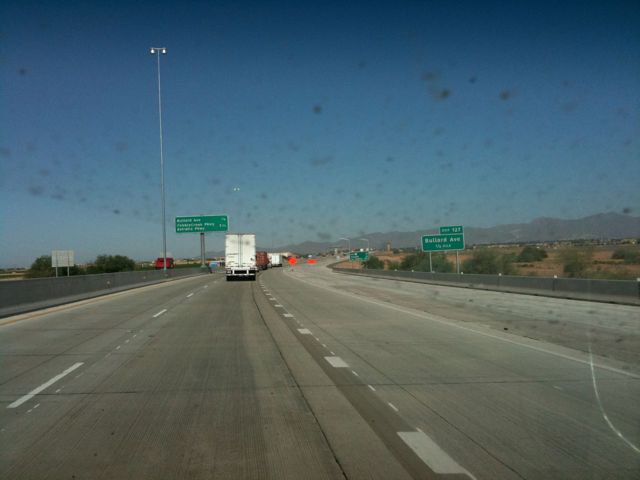
    It’s a bit of a fudge to call this “day one”. Any trip road trip to San Diego involves basically wasting all day on the 376.01 mile drive over. Even though we left at 8:30AM, we didn’t arrive at the hotel until 5:00PM.

    It’s really one barren, desolate wasteland, with Yuma smack dab in the middle. It’s a lovely town, Yuma, and one that I’m sure most Arizonans would willingly cede to California, if only that darned Colorado River didn’t make such an obvious border. Personally, I wouldn’t cede Yuma to California. I’d like to trade it for the Imperial Dunes, where they shot the Dune Sea sequences of Star Wars: Revenge of the Jedi.

    To be fair, Yuma does have two things of interest: The last remaining Round Table Pizza in Arizona and the last remaining Village Inn Pizza in Arizona. On the way over, we stopped at Round Table for a bit of nostalgia for the taste buds.IMG_0083

    We’ll be having Village Inn nostalgia pizza on the way home.

    Shortly after we checked into our room at the Woodfin San Diego, which seems like a nice hotel, situated right next to a huge Qualcomm complex, the fire alarms sounded and we had to evacuate. As the fire trucks arrived, we decided to go to dinner. Michelle, who had to leave her toys behind was in tears, worrying that one of her favorite toys was going to be destroyed in the fire.

    We browsed a nearby shopping area and found Luong Hai Ky, the Original Chinese Noodle Shop and had a decent batch of noodle soups. I had beef, the kids had duck and Irene tried the seafood. All agreed that it was good, but was more Vietnamese than ChineseIMG_0092

    Our room has a kitchenette, so we stopped by the nearby Fresh & Easy to get some supplies for the morning and headed back to the hotel. The hotel was still standing and there was no sign of a fire, so we turned in early.

    Looking back at my previous San Diego trip, I commented how incredibly helpful having my MacBook was. In that instance, we’d return to the room and could make all our plans with everything at our fingertips each night. This time, I’m on my first “real” trip with an iPhone, which should extend my information store to 24X7 and geo-aware. So how well did it do on the first day?

    We lost the 3G signal just before we reached the last major housing developments on the west side of Phoenix – about 20 miles out from home, leaving me with the older, slower Edge connection. Since this was just like my original iPhone – well, it was disappointing, but I was used to it – and, I’d rather have slow internet than no internet – even if all I did was just continue to receive e-mail from work.

    We never got 3G back until we arrived well into the suburbs of San Diego.

    After you leave Yuma, you travel very close to the Mexican border. The new border fence is often within sight of the freeway, At one point, at a gas station that doesn’t even seem to appear on Google Maps, you’re so close that both my iPhone (on AT&T) and Chu-Wan’s phone (T-Mobile) started receiving SMS messages saying, in effect, “Welcome to Mexico”. The iPhone message included a note that said, “International Data Roaming rates are in effect at $19.97 per megabyte.” Youch! Luckily I have International Data Roaming turned off – as should everyone, unless they intentionally are planning to use it. What would have happened if we’d driven past the border just as a bit e-mail with attachment had arrived?

    Inside San Diego, the iPhone Maps application gave different directions than did my Garmin GPS. We went with the GPS directions only because traffic was looking a little ugly on the Maps route – although we had to travel through the only “solid red” traffic problem in San Diego no matter which route we took.

    At the room, we quickly used the iPhone to locate a nearby shopping area, and were easily able to check out restaurant reviews before we chose our dinner location. So far, that’s all good.

    Now the bad: battery life. It’s appalling. When using GPS features, even plugged into the car for charging the battery is being drained at an incredible rate. Using the GPS while plugged in for over an hour and the battery only charged 2%. It was literally draining as fast as it could charge. I kept the phone on the charger for much of the drive. It was 100% charged in Yuma. 53% when we reached San Diego 3 hours later. It was charging in the room when the fire alarm sounded and was back up to 75% and was down again to 50% at bed time.

    On Day Two (which is actually today) at Legoland, I’ll try to conserve a bit. Typically, at home, I get one day out of a charge and typically have 25-30% charge left. Here’s hoping 3.1 OS will improve this!

  • The First

    9:02 AM
    24 Km from home
    Less than 20 minutes into a 6 hour drive.

    James says, “Are we almost there yet?”

  • Waters of Mars

    Can you believe that the BBC would have the audacity to show a new trailer for Waters of Mars at the San Diego Comic Con – which is, I might point out, in the flippin’ United States – and then post the damned thing to their website and make it UK-only?

    That’s over-the-line – and also totally ineffectual. Here it is:

    Oh, and John Simm is back as the Master.

  • The Prisoner (of fools tampering with things they cannot improve)

    My hopes have been dashed. I don’t know why I ever had them.

    This preview of the new Prisoner… movie, mini-series… whatever… has just come out of ComicCon.

    Ummm… I hope it’s better than this 10-minute trailer makes it look.

  • Priceline.com – Observation 1 – The Language of the Deal

    In several weeks’ time, we’ll be going to San Diego. This is hardly a planned thing and almost could be considered impromptu. Our summer vacation plans this year have been thwarted and thwarted again. Now, with just weeks before both my wife and the kids go back to school, we’re making one last effort to get somewhere, anywhere before the summer is over.

    Without shifting to flying s a mode of transport, San Diego and Los Angeles were the extreme limit of travel time with the kids. Since LA has “that mouse place” we decided to go elsewhere.

    California is not the cheapest place to stay and we decided, for the first time, to try priceline.com.

    You’ve no doubt heard their spiel. You name your own price, for flights, hotels, etc. In our case, we only wanted accommodations for $100 per night, which we felt would be quite reasonable for a three-night stay.

    Of course, Captain Kirk, er, sorry, the Priceline Negotiator, says “go lower”, so, what the heck? We thought, “$75 per night would be a ridiculous price for even a passable hotel”, so my wife tried bidding on a 3 star or better hotel for $75 per night.

    That wasn’t even a problem for the Negotiator, and in minutes we had booked our room, quite pleased with ourselves.

    Then we started thinking: Hmmm, at this price, and with the drive time being what it is, and with the number of “all day” attractions in San Diego, we could really use an extra day. The time was not a problem, as we have a 9-day window, which our vacation is smack in the middle of.

    Thus start the beginning of our “problems,” Priceline offers you the opportunity to attempt to extend your stay – at the same rate, if possible, so we decided to try that,

    You’re given a choice as to which direction you wish to extend your stay (starting earlier or ending later) and how many nights. We could have chosen either earlier or later, but it was slightly more logistically desirable to extend the trip at the end, so we tried adding one night.

    That wasn’t so easy for the Negotiator. (Sorry, Bill, you must be loosing your touch. There was a time you could have talked an alien computer into self-destructing, but now you couldn’t get an extra day out of a 3-star hotel for only $75,) The price came back as $116, which, because it wasn’t able to meet our bid, wasn’t a “done deal” like it would have been if they’d met our price.

    “No worries,” we thought, “we’ll just try to see if we can secure $75 by extending the vacation forward a day instead.

    This is where it got weird. Each time we attempted to get to the web page, following the link, we got redirected to a page that said, “Sorry we couldn’t get you $75, would you like the $116 price?”

    If was as if the browser cache from hell was turned on kept redirecting us to the wrong page. I love our Macs, but you do occasionally meet a web page designed by some knucklehead who still thinks it’s cool to be IE-compliant, and so you take a few of these little abnormalities as par for the course and this can cause aberrant webpage behavior. (It’s far. far more infrequent these days.) So we went to a different computer… no chance of some cached data screwing us up there.

    …and still we had the same problem. Alight, it was time to regroup. Sometimes you just have to take the computers out of the loop, so my wife called priceline about the problem.

    It turns out, that isn’t a problem. It’s the way their system works. You can’t go back and try again on the other end of your vacation.

    So were we screwed? Three nights at $75 and one at $116 is $85.25 per night overall, which really isn’t that bad. Not as good as $75, but still a price we’d be OK with.

    You do have one other option with priceline: You can bid on a new hotel stay for the extra days – of course, that means you’ll almost certainly have to change hotels. A nuisance, to be sure, but… what if we tried bumping up to four-star only hotels for that same price? Would Bill laugh at us?

    We decided to find out. We held the $116 option open on my wife’s priceline account and proceeded to bid using my account on a different computer – in case we encountered any more of those – “oh, once you’ve done it, you can never go back again” gotchas.

    Once again, the Negotiator didn’t even break a sweat getting me a four-star room on the scenic downtown waterfront for $75.

    In part 2 and/or perhaps 3 of this series of posts, I’ll analyze the accommodations we received. Both hotels appear to be perfectly nice (one more so than the other, obviously) from the information we can derive online. It remains to be seen how reality stacks up.

    Now we know one very important thing about priceline, only pick four star hotels first and “go lower, wuss.”

  • Torchwood – Who are the monsters? (Er, Children of Earth) review, spoilers

    I loathe Torchwood. It is the Slitheen of the Doctor Who universe… oh, wait, the Slitheen are the Slitheen of the Doctor Who universe. In that case, Torchwood are the fart jokes of the Doctor Who universe – crude, boorish and juvenile. (While, at the same time, attempting to be all grown-up. “See, I can tell fart jokes, I’m an adult!”)

    A program so awful that, after series 2, episode 1, I just gave up, and apart from a few clips here and there that I’ve seen on TV or online, I banished it from consideration of watching ever again.

    …and then along came the reviews of Torchwood: Children of Earth. Reviews so positive and glowing, from blogs I generally trust to be reasonably compatible with my viewpoint, that it seemed impossible to reconcile with the train wreck that was Torchwood, series 1 and 2.

    Well, I just had to see for myself.

    Torchwood: Children of Earth is more of a mini-series than a normal year’s worth of episodes. It is one single story, aired (and told in five parts) over 5 consecutive days.

    Brief Synopsis without a lot of the details

    Nasty aliens come to Earth. They’ve been here before in the 1960’s and the British government gave in to blackmail back then and gave them 12 orphaned children to make them go away. Now the aliens are back and have announced themselves by “stopping” every child on Earth and speaking the words, “We are coming back.”

    The first order of business: The British government must find a way to cover up what they did back in 1965, that begins with killing everyone that might talk. One of them, the man who actually handed the children over, was Captain Jack Harkness of Torchwood. Torchwood, being what it is, an organization that investigates alien threats, must also be eliminated.

    Captain Jack, being immortal, cannot be killed. Or can he?

    A bomb is planted in his stomach (they have to kill him twice to get the bomb in him) and then he, and Torchwood’s HQ are blown into tiny parts. Ianto, Gwen and her husband Rhys go on the run from the assassins.

    The aliens arrive and demand 10% of all children on the planet Earth. The alternative: the total extinction of the human species.

    Jack pulls himself together (literally), so they encase him in cement, but Ianto and Co. rescue him.

    The governments of the world reluctantly agree to the aliens’ terms and begin planning how to deliver 10% of the children to the aliens. Meanwhile, Torchwood uses the last of their Torchwood technology to record what’s being discussed regarding the plans. They use this information to blackmail the British into letting them fight the aliens.

    Jack takes a valiant stand in front of the aliens, telling them that we’ll not give them our children and that we’ll fight. They aliens respond by killing the entire human race. Or they would have done if Thames House (where the aliens are represented) hadn’t been a bio-hazard lockable building. Instead of killing the whole world, they just kill everyone in the building, including Jack and Ianto.

    Jack gets better. Ianto doesn’t.

    Beaten and depleted, Torchwood gives up, and the government begins a campaign to round up 10% of the children, who will not be killed or eaten by the aliens, but will be permanently attached to the aliens’ bodies as a form of narcotic, where they will live as possibly still-sentient children indefinitely.

    The round ups begin, and Gwen and Rhys try to save Ianto’s niece and nephew and several other neighborhood children from the cull. Meanwhile Jack’s daughter convinces the one-time assassin who was trying to kill Jack that he is the only one who can save the world. They spring him from prison and he hits upon an idea that could kill the aliens, but it will require a sacrifice. He send a signal back at the aliens using the brain of a child and the only child available is his grandson.

    He saves the children of Earth by using his grandson and kills him in the process.

    The story ends with Jack leaving the Earth, perhaps forever.

    Analysis

    Here’s a series that is saved – no, lifted up – by some truly awesome performances.

    The supporting cast in this story, particularly the members of the British government, are exceptional. I can’t think of a better word for it. They are deep and nuanced in a way that has for decades set British acting above the rest in the world. Not the performances of the one-dimension heroes, but the performances of the “ordinary” people caught in extra-ordinary circumstances. Director Euros Lyn has also provided them a tight, dramatic canvas to work within and it comes off perfectly.

    If there’s a weak spot, it’s the story logic, but even that isn’t bad and it’s punctuated with moments of real, human dialog that rings so real as you might think it was surreptitiously recorded from strangers rather than scripted.

    Let’s get a couple things out of the way first before we get into the big questions. This series should not be set in the Doctor Who universe. This has become a major problem with the Doctor Who spin-offs. We can forgive the Doctor for not showing up for every Earth destructing event, but where was Martha Jones? Answer: on her honeymoon and Jack is forbidden to call her by Gwen. I must say, Martha’s husband’s “technique” must be mightily overwhelming that he was able to keep her totally oblivious to all the children on the whole planet stopping and chanting over the period of five days! For cryin’ out loud, didn’t those two at least stop to eat meals? Surely long enough to make a quick phone call to the Doctor. (I told you that damn inter-time, inter-universe cell phone was a stupid plot device that would kick them in the ass later, didn’t I?)

    What about Sarah Jane Smith. She’s got a kid in that age group, she hangs out with kids in that age group. Didn’t she notice? Where was Mr. Smith identifying the aliens, or at least the location of their ships or just finding ways to block their signal?

    No, this story needed to be isolated to convey the full menace of the situation and it wasn’t sufficiently. Further, by bringing up the Doctor once or twice, they reaffirm the interconnectedness of the whole thing.

    From this point forward, I’m going to grant them their isolation and pretend the rest of the Doctor Who universe doesn’t exist.

    A lot of the commentary I’ve read about this story revolves around the question of, “Who are the monsters?” That’s what I want to concentrate on mostly.

    The argument goes that the British government (and presumably the other governments of the world, too) are the monsters in this story, because of their machinations or perhaps Jack is for killing his own grandson. I want to be very clear on this point – The aliens are the monsters.

    The aliens come to Earth, threaten to kill everyone and demand blackmail. For the sake of this story, we have to take it as read that the alien threat is credible and that there is no doubt that they would follow-through. Also, we have to recognize that there is no time to craft an adequate defense plan. In the five days since the beginning of the incident, the knowledge of the aliens obtained is virtually nil. We don’t know where they’re from, how many there are, what the total of the defensive and offensive military might be. There’s no one to fight, no time to fight them, nothing to fight them with and no second chance.  Given that premise, what would you do?

    It’s all well and good to say, “Yeah, I’d fight back.” Jack started to do that, and it was foolhardy and stupid. What was he going to do? Pose until the aliens we awed by his movie-star good looks?

    Sometimes in this world you’re beaten and the phrase, “He who fights and runs away lives to fight another day,” is never more relevant. Sometimes capitulation is the only option.

    To give up 10% of the children to be used in what promises to be a horribly agonizing not-quite-death is distasteful (putting it mildly) but is that worse than condemning those same children to certain death, along with the other 90% and along with the rest of the planet?

    It’s not a simple economic equation but, to Russell T. Davies’ credit, that’s the point of the whole story. People making very difficult decisions makes for good drama. And when the difficult decisions have no good answer, the drama can be even more intense. This choice between 10% of the kids and the entire species isn’t reality. It’s an absurd exaggeration that allows writers to explore human nature. That is, at its best, what Science Fiction is all about – the ability to play out scenarios that simply cannot happen and deconstruct the human element.

    The discussion around the cabinet table about how to choose the children was the high point of the show. It rang so very real and, given the lack of time, I probably would have come to a similar solution. Given more time, other solutions (whole or partial) might come to mind – children dying in hospital, families with many children who really are on the dole, starving children in third-world countries. Again, nothing tasteful, but recognizing the reality of the situation and trying to minimize the overall damage as much as possible.

    All that is to the writers’ credit (and what’s up with a single story being written in parts by different people?) for using the medium of Science Fiction to its potential.

    But… Why did the aliens go about things the way they did? Did that really make sense? They can make the kids all stop and talk and point. It seems reasonable that they could make them walk. We know that have some level of granularity over their control because they can make different nations’ children speak different numbers. Why did they need to go through the ambassadorial rigamarole? Why not just walk the kids to collection points and hoover them up before anybody could even figure out what they were doing?

    And, assuming they had some reason to go to the government, why establish quotas for each one? Why not go to India or China and force them to turn over 50% of their kids?

    I think the answer is that this is just a contrived convenience to try to tell the story about the British government (oh, ahh, that’s obvious.)   

    Obvious though that may be, it does make the alien threat seem more implausible. Rather than just do the job themselves, the aliens are forcing all the governments to do the dirty work, despite the fact that the approach would be inefficient and unlikely to achieve their goals in the shortest length of time, What if one single government refused or failed? Would they kill the whole human race? Would another government cough up additional children to make up the difference to avoid annihilation? Would that be more wrong than turning over the 10%? Does that then raise the issue of “not my kids” as was raised at the cabinet?

    No, I’ll argue that the solution that the cabinet came up with does not make them monsters. What was monstrous was the attempts to cover it up. Oh, I don’t mean the false inoculation program, obviously the had to lie in order to get the children, but the unwillingness to stand behind their decisions, difficult though they were, made the Prime Minister, in particular, abhorrent.

    So let’s turn, finally, to Captain Jack Harkness – immortal man.

    One of my complaints about Torchwood is that Jack is… wrong. I don’t mean wrong in the same way a Time Lord just feels he’s wrong, but wrong in the sense that he isn’t portrayed accurately. This is not an indictment of John Barrowman.

    Consider: As the series has progressed, we know more and more about how old Jack really is. I gather he was buried under Cardiff for a thousand years or so, but I’m not sure if he was conscious, but at the very least Jack has 150+ years of consciousness, and he’s used to seeing everyone die around him. It’s hard to imagine that Jack would behave recognizably like a human at all. The fact that he does act, for the most part, normal, leaves a deceptively false sense of familiarity.

    Jack’s solution to the alien 456 is to destructively use his grandson as a weapon. Is that morally different from being willing to sacrifice 10%? Jack wasn’t willing to give up the 10% to save the others, but he was willing to kill one. The moral dilemma is the same, but his choice is the opposite. What changed his mind? Recognition of the futility of his earlier position? Revenge for the death of Ianto? Or a different perspective on death? Does he see a moral difference because in both cases he chose to fight? If he could have poisoned the 10% of the children so that they would have killed the 456, would he have gone along with that?

    Heroically, I have no doubt that Jack would have laid down his life (such as it is) to save the children. I’m sure Gwen or Ianto, or perhaps even Froebisher would have laid down their lives too.

    But that wasn’t the choice available to any of them.

    Does the immortal Jack Harkness even comprehend death as we do? A mortal man could easily imagine that, in the normal course of life, his children or grandchildren will outlive him. Not so with Jack. He knows that it is just a matter of time before the boy dies anyway. Does that perspective change the morality of his decision?

    In this, ultimately, the writers of Torchwood: Children of Earth have left us with more questions than answers and they have given us the chance to look, briefly, into the depths of the human mind.

    For that reason, I recommend this series as an exceptional throwback to the days Nigel Kneale and John Wyndham.

    But whatever you do… Don’t watch Torchwood series one or two!

  • iPhone 3GS Experience – The Speed

    This video I recorded of my old and new iPhones side-by-side should explain this subject without further words.