Author: Eugene Glover

  • The future of creepy weird

    I’ve been playing around with iPhoto ’09 for the last few days and, on the whole, I’m impressed. Unlike some claims I’ve heard, it does not cause my (1st generation) MacBook’s fans to spin up or even seem to bog down the computer.

    Faces is an interesting technology and it makes a pretty good shot at figuring people out, although, it seems to have trouble telling my wife and my mother-in-law apart, and in one case, it thought I had a second face on my knee. (We aliens do, but they’re invisible to the camera.)

    My photo library is huge. Oh, maybe not huge by a professional photographer’s standpoint, but huge from the standpoint of available disk space on my MacBook. I’ve had to break my albums apart in single years’ albums, and my 2007 album is over 42gb. 2008 is smaller, but still over 30. Earlier years, taken with smaller-resolution cameras or scans weigh in around 10gb each.

    I had to convert each and every one of them into iPhoto ’09 format, and the face scanning process (which looks at each photo and identifies potential faces) took several hours on some of the albums. If Faces misses a face, you can add it manually, which is great for the occasional miss. It sucks though when Faces seems to fail miserably, as it did with my 2004 album. Only one in 10 photos is tagged for Faces – and there’s no way built-in way to re-initiate the scan to try again. You can; however, go into the photo package and delete the faces.db files. That causes it to rescan – with equally bad results. Before I invest a lot of time tagging faces, I’m going to wait for a bug fix to come out.

    More interesting (and useful) to me is Places. iPhoto has got this right – at least that’s my impression so far. I do geotag some of my photos. I use a nifty piece of software called HouDahGeo to map the track log of my GPS to the date/time stamp of my photos. It sets and saves the GPS coordinates right into the EXIF data. That’s great when I’m out with my GPS and the GPS is turned on – not so good when I don’t have my GPS with me. My iPhone stores geotagged coordinates, but the GPS functionality in an iPhone 2G is pretty slack.

    What do you do when you don’t have GPS data for a photo, but you want to add it? Well, it’s a tedious process and not worth the effort. iPhoto has gone and fixed that. Pick a photo, or group of photos, hit the info button and start typing in the name of the place. Ofttimes it will find it, but the mix it knows about is eclectic. Why does it know where Heritage Square (a ratty old park in Phoenix) is, but doesn’t seem to know where Los Angeles International Airport is? No problem, you can add frequently used places to your list and then adding them to photos is a snap. Further, the places you add can have a range of precision, for example, if I wanted to tag my house, I could expand the zone to just the house, but if I wanted to make a place for a park, or a city, I could expand the zone accordingly. I’m not entirely sure what effect that has on the coordinates just yet, but the idea sounds good.

    Here’s when it gets creepy weird. For the first time, to my knowledge, someone has made a program that makes geotagging old photos easy. In fact, I’ve geotagged all the photos I’ve got of my childhood. Of course, I don’t live in those houses anymore, and if I upload to flickr… what would the people living there think if they go to “their” house and see it populated with dozens of strange photos?

    This will only accelerate. Soon it will be YouTube videos too. Already I’m seeing lots of meaningless personal videos on Google Earth (if you have the YouTube channel turned on.) The usefulness of geotagging visual information will rapidly decline. For example, what if a company decides to make a commercial for their product – let’s say it is food powder – what’s to stop them from geotagging the video at the location of Eiffel Tower? People going to Google Earth to see videos about the Eiffel Tower will be presented with foot powder ads.

    It will all end in tears.

    But for now, it’s pretty cool in iPhoto.

  • Trial of a Time Lord – Review (in retrospect)

    A lot has been said about “Trial of a Time Lord”, some of it by me, but that’s neither here nor there. This Colin Baker series comes from another era. It was era of disappointment in many ways – of enormous potential squandered. A time when optimism was slowly eroded away to despair.

    I remember those times well, or at least passably well, I was Vice-President of the local Doctor Who fan club, TARDIS. (The Arizona Regional Doctor Who Interest Society – don’t blame me for the tortured acronym, that was from before my time.) TARDIS was at the time the largest Doctor Who club in Arizona with a typical meeting attendance of about 30.

    Peter Davison episodes of DW had been shown on the local PBS station, but to watch the Colin Baker episodes was an exercise in international intrigue. In those days, you could typically expect years before DW would be syndicated and arrive in the Phoenix market. In those days, the conflicting video and videotape standards between the US and the UK were formidable. Tapes had to be made when the episodes aired in the UK and mailed to someone in the US. They, in turn, needed to have a British TV and VHS deck, plus a second US standard VHS recorder and a video camera – which they would aim at the screen and record the playback on the UK VCR. The result was of low quality, and as they would get copied and mailed around the US, the quality deteriorated. The holy grail was to either be in the first tier of copies or, better yet, to actually be the recipient of the original tape.

    How long it took from original airing until we sat around at our bi-weekly meetings on Saturday nights was highly variable, and much anticipated.

    Trial of a Time Lord though was something special, not only was the Doctor back after an 18 month “rest” but we all thought, “This will be something special – something that will bring the show back to its glory days.” We had, perhaps naively, hoped it would reverse the decline that had begun at the end of Tom Baker’s era.

    Here’s another reason it was special – it was the first, and only, time that I personally listened to Doctor Who live – as it actually aired in Britain. It was over the phone.

    I suppose I should explain how that came about. Around that time I was a FidoNet BBS operator, and through those connection, I met a nice chap named Frank Thornley. (Frank, if you’re still out there, here’s a shout out!) Frank was visiting the United States with the aim towards establishing a business arrangement between his Compulink BBS and the US’ BIX service. He and his wife Sylvia, who I didn’t meet for several years, were contemplating setting up some sort of office in the US. Honestly, I don’t know what they’re exact plans were, but I do know that they ultimately didn’t cut a deal with BIX and, in the end, established their own online service called CIX (The Compulink Information eXchange) which was, I gather, quite successful.

    I was unemployed and had plenty of time on my hands, so I was helping Frank get acclimated to Phoenix. I happened to be at his apartment at the very time that the first episode of Trial of a Time Lord was on, and he was talking to his wife on the phone. They turned on Doctor Who for me and let me listen for a few minutes on the phone. Well, that was a big thrill in those days. They were terribly nice people. I haven’t heard from them in years, ever since they were talking about buying a yacht and traveling the world. What I remember of that phone call was, “Hmmm, the phone makes the theme music sound very different!”

    Anyway, a few weeks to a month after it aired in the UK, I had seen Trial of a Time Lord, and had some opinions on the matter. Since then, several months ago, I watched the first two episodes of it again, and then didn’t finish. Now, in the last two weeks I have watched it in it’s entirety, and the complete contents of the “bonus features” on the DVDs. Now, it’s time to re-evaluate the Trial.

    Synopsis

    The Doctor is on trial for his life. Snatched, alone, out of time and space he is brought before an “independent” inquiry by the Time Lords of Gallifrey. The charge: meddling.

    Bringing the case against the Doctor is the bloodthirsty Valeyard, a Time Lord who seems desperate to have the Doctor executed for his alleged crimes.

    In the case for the prosecution, the Valeyard uses evidence from the Matrix – the Gallifreyan computer that contains the sum total of all knowledge. He demonstrates two tales from the Doctor’s history, the second, culminating with the death of his companion Peri.

    In rebuttal, the Doctor presents a case from his own future showing that, “he gets better.”

    The Master arrives, inside the Matrix, proving that the evidence has been tampered with by the Valeyard in an effort to kill the Doctor. The Valeyard is revealed to be a future incarnation of the Doctor himself, who has gone evil. In the end, the three renegade Time Lords battle it out inside the Matrix where nothing (least of all the script) makes sense. In the end, both the Doctor and the Valeyard escape, the High Council is deposed and Gallifrey is in anarchy after yet another one of the Doctor’s visits.

    During the whole 14-part trial, we get to see three new stories which, although officially untitled, are known as “The Mysterious Planet”, “Mindwarp” and “Terror of the Vervoids.”

    Analysis

    First, the background. I’m not a fan of producer John Nathan-Turner’s era. As far as I can tell he made nary a good decision. New theme music during Tom Baker’s final year – poor. New style at same time – usually jarring and unconvincing. The question marks – trite! Peter Davison’s Doctor – weak and ineffective. Colin Baker’s Doctor – obnoxious and loud. Colin Baker’s costume – yuck. Sylvester McCoy – stuffs ferrets down his pants. McCoy’s theme music – too dance music. The companions – horrible. In fact, the only things that I recall liking about his decisions were: Colin Baker’s casting (sadly, the scripts failed him), The Trial of a Time Lord theme version by Dominic Glynn and Peri’s first appearance in a bikini.

    And so it came that when I first saw Trial of a Time Lord, I thought it was a depressing failure. The show continued in the vein it had been. Their 18 month hiatus had taught them nothing.

    Now I wonder.

    Having watched the bonus material, I have a much better feel for the reasoning – and where to put the blame – for the failure.

    The story simply cannot be treated as a whole as it is a disjointed mess. The trial sequences foul up the other stories continually, so let’s start with them.

    Eric Saward, script editor for the series, claims to have written them. That’s not a claim I’d boast about. Never has there been a more poorly conceived trial sequence in the history of television.

    Consider: The Doctor is accused of meddling. He was previously convicted of it and sentences to exile on Earth. Since then the Time Lords have kept track of him and on occasion used him. Let’s be blunt: the Doctor always meddles. If all they needed to do was prove that, he’d be convicted. He is guilty of that “crime.” Of course, he’d argue it shouldn’t be a crime, but that’s a different case. Given that, the Valeyard could choose any of the Doctor’s adventures and convict him without chicanery.

    Instead, he starts with the adventure of the planet Ravalox, which, the Doctor discovers is actually the planet Earth, renamed, nearly destroyed and hidden. Who could do that? We later learn it was the High Council themselves. The destroyed the planet to protect Time Lord secrets and then tried to cover it up. The Doctor stumbles into the situation and that’s what ultimately precipitates the High Council’s attempt to have the Doctor tried and destroyed.

    During the court sequences, the discovery that Ravalox is the Earth is revealed, and some characters have their words “bleeped out” because they contain top secret information. (Later revealed that they were talking about the Matrix.) Why oh why would the Valeyard choose that particular story to try to convict the Doctor?! Surely he raised more questions in the court than he answered when any other adventure would have done! Answer: It reveals plot points to the audience, but it makes no sense in the context of the trial. That’s bad scripting. If Saward were working with a script editor, that never would have passed, but he wasn’t. No one was watching the watcher.

    Mindwarp fairs a bit better as evidence. Unfortunately, we’ll never know how much of the story really happened. The Doctor’s brain is scrambled by an alien mind probe and he begins acting like a villain… or does he? The Doctor can’t remember and the Valeyard is tampering with the Matrix to make the Doctor look worse. In the end, Peri’s brain is killed by the bad guys and then her body is destroyed – on the orders of the High Council. Later we’re cheated out of even that ending when we’re told Peri is alive and living as a warrior queen. At least this one makes sense in the context of the trial, both showing the Doctor is the worst possible light and bringing us up to the point where he is brought on trial.

    Finally, the Doctor get’s to put his case. He, paradoxically, decides to use his adventures in the future to demonstrate that he gets better. This falls apart logically and legally. He gets better? So what? He still committed the crime he was accused of. How can this be his future if he gets convicted executed before it happens? (Let’s not try to understand Time Lord time lines… the Valeyard really fouls this one up.) The only defense the Doctor could have is to prove he didn’t commit the crimes or, perhaps more cleverly, he might have proved somehow that meddling shouldn’t be a crime.

    Finally, after the Vervoid segment, the Valeyard calls for the charge to be changed to genocide – the Doctor wiped out the entire Vervoid race. Did he? I thought these were events that hadn’t happened yet! How can he be guilty of a crime he hasn’t committed yet? And of course, if he’s found guilty and executed, he cannot commit the crime, so there’s no reason to convict him.

    I can only conclude that copious amounts of drugs were involved in the creative process and it shows.

    Let’s look at the individual stories. I’m not going to say a lot about them. The Mysterious Planet, written by Robert Holmes isn’t bad. It’s not his best work, but it shows his characteristic trademarks. The Doctor and Peri are finally getting along. I can remember that from back when it first aired. That was a breath of fresh air. It’s a pity that, from the interviews in the bonus material, it was revealed that they were supposed to still be snarking at each other, only Colin and Nicola played across their lines and made them affectionate instead of acrimonious. Watching the episode with that knowledge and it becomes obvious – what they say and how they’re saying it are totally out of sync. Amazing what acting can do to the written word.

    Mindwarp by Phillip Martin suffers terribly from not knowing if it is real or not. As it stands it’s an unpleasant tale which serves as a sequel to the equally unpleasant Martin tale, Vengeance on Varos. Brian Blessed always puts in a 200% performance, and his stint as King Yrcanos is no exception.

    The Doctor’s evidentiary tale is Terror of the Vervoids, by Pip and Jane Baker. This story is a plain old fashioned murder on an ocean liner mystery set in space, with killer vegetables thrown into the soup. (I couldn’t resist.) I thought this was a good solid effort by Jane and her husband, Pip. It won’t be remembered as one of the greatest episodes of Who, but it may have been Colin Baker’s most traditional story. Pity they didn’t start him that way and work from there.

    Finally, there’s the Ultimate Foe, which serves as the conclusion of the Trial, as the Doctor and the Valeyard battle it out in the Matrix. This was a two part story that was supposed to be written by Robert Holmes, who, in conjunction with Saward, had plotted the conclusion out. (This also explains why Holmes’ Mysterious Planet setup the info about the High Council’s crimes.) Sadly, Holmes turned in the script for part 1 and promptly fell ill and died. Saward, who was completely in the loop about where the story was going, stepped up and finished episode 2 in accordance with Holme’s outline.

    John Nathan-Turner didn’t like the ending, which apparently ended with the Doctor and the Valeyard trapped forever in some sort of void. JNT wanted a happy ending. He and Saward had a falling out and Saward quit, taking his script with him. JNT was forced to turn the task of completing the story over the Pip and Jane Baker, but they were not allowed to know any of the contents of the second part of the story. They were given the completed first script and told to write a second part based upon it.

    We should not forget that Holmes originally wrote The Deadly Assassin, the first Gallifrey-based story and the introduction of the Matrix and it’s ability to form fantasy worlds manifested by the minds of the people trapped within. This time the Matrix is a dark, foreboding Victorian back-alley of a world but all too suddenly it becomes Pip and Jane Baker’s tortured, illogical fantasy mess. I suppose, given that they were told nothing about the original plot, they did a fair job of tying up the pieces – I suppose. I wouldn’t want that assignment, but I guess it pays the bills.

    All’s well in the end, of course, and the Doctor leaves with Mel, a companion he hasn’t even met yet. That would be bad enough if I didn’t know what was going to happen next in Time and the Rani.

    No panning of Trial of a Time Lord would be complete without mentioning the rubbish cliffhangers, apparently at JNT’s insistence: Colin makes dramatic face and holds it, camera zooms in, cue end music. Episode after episode until you begin to laugh about it. If it weren’t for Dragonfire in Sylvester McCoy’s time, they would surely be the worst cliffhangers ever.

    Conclusion

    I mentioned hope for the future. Back then everyone except, apparently, the production crew knew what was wrong with Doctor Who. Too much shouting, too much in-fighting, shitty stories. After the 18 month hiatus we just knew they’d had time to figure it out, and perhaps they did. Taken individually, both Mysterious Planet and Terror of the Vervoids showed a distinct improvement over previous series. Mindwarp was an unpleasant holdover to the bad old days. Despite that, it would have been passable if it hadn’t been tinkered with to make damning evidence. But all that was destroyed by framing the episode inside the trial, which ruined everything.

    Even though it had been mangled, there were signs of improvement for the future. There was still hope for the Sixth Doctor, and for the entire series.

    As we all know, then they fired Colin Baker, and things were about to get a lot worse.

  • They won’t be doing my taxes

    Flyers on the door. How I hate flyers on the door. They never advertise anything I want. (usually a church or a landscaping service) and they waste natural resources and create liter.

    Once in a while, though, the idiocy of one takes my breath away.

    Here’s a scan of one that showed up on the door today. I’ve blocked out the name of the company (I don’t want them to get any business) and punched up the color on the “sentence” I wish to highlight.

    Would this inspire confidence in anyone that these jokers are qualified to do income tax returns?

  • Big Cats

    The question I ask is… do I trust a story in The Sun?

    The official confirmation came yesterday — proving thousands of members of the public have been right for years.

    Forestry workers conducting deer surveys have TWICE got within 50 yards of the fearsome creatures in the wild, it was revealed.

    These so-called “fearsome creatures” are big cats. “Big Cats” being an unspecific term for mysterious felines, larger than a house cat, that have been reported in rural England for many years. Even if they really were spotted, they remain a mystery. Are they ordinary tabbies that got hold of Colonel Sander’s growth hormones, exotic wild cats such as panthers that escaped (or were released) into the wild or some heretofore undiscovered species of native feline.

    Only time, research and more trustworthy reporting than The Sun will tell.

  • Nothing for free

    Well, just in case you thought you were saving the world by not using phone books printed on dead trees which promote deforestation, or by doing your research online instead of going out in the field instead.

    From the BBC:

    US physicist Alex Wissner-Gross has conducted research into the environmental impact of “googling”.

    Environmental physicists are worried about the environmental impact of information technology.

    A recent study estimated the global IT sector generated as much greenhouse gas as the world’s airlines put together.

    Mr Wissner-Gross’s study found a typical Google search on a desktop computer produces about 7g (0.25oz) of carbon dioxide.

    If you enter another request you obviously end up with double that amount, which is the roughly the equivalent of boiling an electric kettle for a cup of tea.

  • Encouraging train snap

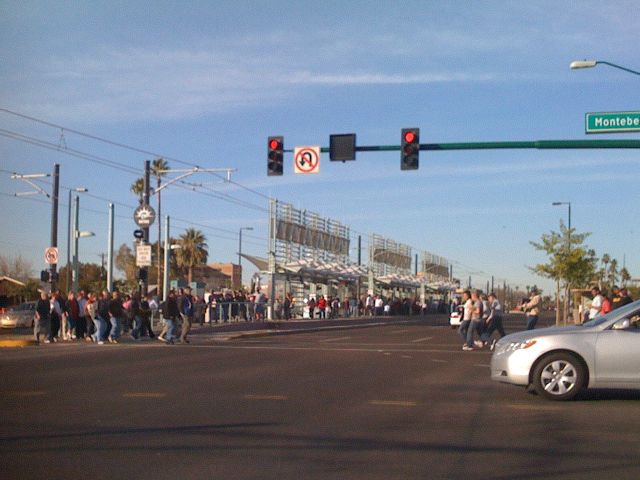
    It’s been two weekends now and we’re long past the free rides on the Phoenix Metro (oh, how I abhor that name!) but today we were driving by the large park and ride as the train was disgorging and I was really impressed at how many people were getting off the train.

    I really believe the trains will work well for the city, but I thought it would be months or even years before I saw this many people using it on a Sunday afternoon.

  • It’s a big world out there…

    Darn it, I never get to do Internet memes! So I’m just going to do one on my own:

    This is where I’ve been in the world, and when you put on a map, there’s a whole lot of world left to see:


    visited 7 states (3.11%)
    Create your own visited map of The World or try another Douwe Osinga project

    And this is the US


    visited 19 states (38%)
    Create your own visited map of The United States or try another Douwe Osinga project

  • Doctor Who – The Next Doctor – Review

    I think I’ve finally figured out why I never seem to get around to reviewing the Doctor Who Christmas episodes – it’s because, Christmas is over and by this point it all seems hokey to dredge up stuff about Christmas. It’s like watching A Charlie Brown Christmas in July.

    Therefore, I will make this short:

    (more…)

  • Phoenix Metro Light Rail – My Impressions

    I’ll preface this with my comment that I’m a strong supporter of the light rail initiative for the Phoenix metro area. I’ve seen how urban trains and subways alter the cities (in generally good ways) that they pass through, and, while Phoenix is a ghastly urban sprawl with few “destination” areas, it could certainly use a bit of consolidation.

    While a supporter of the light rail, and even though I only live one mile from the nearest station, I’m not likely a frequent rider. My work is not really near the line, I virtually never have any desire whatsoever to go into downtown Phoenix. We don’t have Cricket in this country and I don’t do the other sports. Once in a while I might want to go downtown for the Asian festival, or perhaps a show at the Arena (such as when the BBC’s Walking With Dinosaurs was here). I don’t attend classes at Arizona State and if I did they probably wouldn’t be at the Tempe campus anyway. There might be something going on (like Fourth of July celebrations) at Steele Indian School Park or Tempe Town Lake that would warrant not being able to drive there. Someday when they extend it into Mesa, I could see visiting the Arizona Museum of Natural History (Mesa Southwest Museum.)

    For now, though, for me, it’s mostly a curiosity and something that I hope causes things to start sprouting up around the stations. The Time Lords know we could use some build up around 19th/Camelback.

    For the remainder of the year, the rides are free, and the city has really pulled out the stops to get people to try the trains this weekend. Yesterday, the lines were outrageous at the end and west endpoint stations. Nearly two hours in line for the one hour ride, standing, falling-out-the-doors room only.

    Today wasn’t so bad – or so I thought.

    We caught the train at fourth station along the line from the west end. We chose to use the Park & Ride in the nicer area around Camelback and Central than either on 19th Avenue. The train was already at standing room only when we got on. Fortunately, somewhere not too far down the line two people vacated seats and I was able to thrust the kids into them.

    The train itself runs nice and smoothly, the only hints of a rough ride occur as the train passes crossover points and even those are minor. The acceleration of the train is quick enough that you really do need to hang onto something if you’re standing.

    The interiors are very reminiscent of the buses in town, which have the poorest seating arrangements I’ve ever seen. I’m sure it must have something to do with ADA requirements, but they make terrible use of space and there are a lot fewer seats than there could be. Other train systems handle disabled access with better seating arrangements, but the light rail here seems to have intentionally eschewed other tried and true arrangements to continue with the lousy city bus seating plan.

    As for the ride across town itself – this left something to be desired. Of course, these were not typical days and, in retrospect, I think Valley Metro screwed up with these opening celebrations. People won’t be riding this thing end to end for the most part, but that’s what most everyone was doing this weekend, and,when the train is packed to standing room only, it’s miserable standing for an hour crowded together. In a real-world light rail scenario, people would be getting on and getting off regularly. This weekend people just kept getting on. With each stop the train just kept getting more and more unpleasantly crowded and you knew it wasn’t going to get any better until the very end of the line. (At one point I was dreaming that they’d all get off in the downtown area or at the Mill Ave shops, but it didn’t happen. I mean, why the hell would anybody want to go all the way to Sycamore and Main in Mesa? There’s nothing there, but to anticipate your question: We went that far because the Mekong Plaza is about 1/2 mile from the last stop, so we used this as an excuse to go back to Taiwan Food Express for lunch.)

    There were lots of people this weekend riding the train – indeed any form of Phoenix metro public transit – for the first time, and it wasn’t the best first experience to cram them all in a sardine can for an hour, I should imagine.

    So that’s not really a complaint about the train, more the nature of the startup. Perhaps people will be more understanding than I think, but people typically astound me with their lack of perception, so I doubt it. Just read the user comments at the Arizona Republic’s or ABC 15’s websites on most any news story (but especially about the light rail) if you want to see just how dumb people can get.

    One other observation, and this one is a major flaw in the train system itself… although, perhaps they can right this one easily.

    The train stops way too often at red lights.

    I recognize the fact that any train system that travels down the middle of the roadways must stop at red lights. That’s inevitable and necessary, sometimes they have to stop at green lights – for example, this weekend I witness an idiot in a truck creep into a U-turn across the tracks. He was running a red left arrow and completely in the wrong; however, he was was stopped on the tracks as a train came up on him. The train honked and honked, but could do little other than stop for him. It turns out the nimrod wasn’t just in a truck, he was towing a second truck.

    But there were times when the train was stopping at least one extra time for every station. The Valley Metro website used to respond to that question by saying the lights would be synchronized with the train. They sure as hell weren’t synchronized yesterday. We stopped at streets that were literally T-junctions, that didn’t even have any through traffic. The streets themselves were barely more than alleyways and, to add insult to injury, they had no traffic at all waiting at the lights. We were stopping for nothing – no traffic, no pedestrians nothing!. I can understand this sort of thing at major intersections and at busy times of the day, but many of these stops were ridiculous.

    They’ve got to improve that. The train speed was very good in most places, but going down Central, starting about Indian School was too slow because of the traffic. it’s that stretch alone that will prevent me from being able to take the train and get to work in a timely fashion. To use the train, I’d have to travel 4 superfluous miles north-south, which, if they were quick, might still be faster than just taking a bus along the east-west route I need to follow to get to work. (Working on the assumption that I’d make up a lot of speed on the east-west leg.)

    When we got to the last stop, we could see a huge line of people waiting to board the trains. They were keeping the crown controlled in a parking lot, filtering them across to the platform in small groups to fit on the train. It looked to be about an hour’s wait, so instead of taking the train back, we grabbed one of the “special” buses the city had laid on that were running parallel to the trains for the weekend. It was mainly designed for people who didn’t want to wait in line, and it was free, so we travelled, in comfort, sitting down the whole way back. It took the same amount of time the train ride did.

    This week is rather messed up for me, but I may try to take the train just to time the ride. If not then next weekend.

    This morning before 7, the stations were mostly empty along Central and the trains were less than half the seats full.

  • Every good idea…

    I used to eat at Fuddruckers once or twice a month and in addition to giving you a pager, they’d ask your name to call out. (How does that make sense?)

    Every trip was a new adventure in bad spelling. It was unbelievable how many ways they could misspell “Eugene.”

    I actually started collecting the receipts with an eye towards blogging them because they were so outlandish.

    Now, everytime they’d ask, I’d already handed them my credit card, turned conspicuously so they could read my name. This isn’t just Fuddrucker’s that fails to look at the obvious (and definitive) place to get the name, it’s pretty much everywhere.

    Last weekend, we stopped into Venezio’s pizza and the girl at the counter took my card, looked at it and said, “Is the name on this order ‘Eugene’?”

    I was so impressed I complimented the girl on the spot for being the first person ever to read my name off the credit card.

    Today, after our Light Rail adventure, we stopped in Fuddrucker’s and, miracle of miracles, the guy took my name off my credit card! I couldn’t believe it. He didn’t even ask me if that was the right name.

    Funnier still: He still misspelled my name as “Eugine”.