Once in a while, I’ll get drawn into one of those things going around social media where somebody does a thing, then challenges everyone who sees it to do the same. Recently on the Fediverse someone posted such a thing where you describe five interesting things about yourself.
Considering that I have always had a raging ego and have had six decades to do interesting things, I was surprised of how I could not think a single interesting thing about myself.
I realized maybe I should try to rise to this particular challenge, if only for my own self-aggrandizement.
I’ve chosen to stick with things from my first 20 to 30 years. This list has taken me days and, perhaps, says more about me than I originally expected.
Whether anyone else finds these things interesting remains to be seen.
Since there was no practical way I would ever be a starship captain (my preferred career path) I spent a fair amount of my childhood with no clue or direction on what I wanted to be “when I grew up.” (Arguably, I’ve gotten around that by never growing up.)
By the time I reached high school, I had begun to get an idea what I wanted to be, or at least I had narrowed it down to three things.
Foremost, I wanted to be a forest ranger.
When I was younger, we spent a lot of time camping, and I always had good interactions with the rangers. They gave nature talks, were usually friendly and helpful, were paid to be camping, and seemed to enjoy what they were doing. And they got to spend all summer in the pine forests. Who wouldn’t want to do that?
That idea got nixed when I discovered a few things about the job. Not all forests are pine forests, rangers have to help fight forest fires, and they have to stay in the forest when the winter snows1 come.
Forest Ranger was a no-starter. Snow sucks.
Second, I wanted to be a vertebrate paleontologist, and I was particularly fascinated by pre-Holocene Cenozoic and Permian life. (Yeah, I got that fascination from reading the Encyclopædia Britannica.) I mean, what’s not to love? Spending all your time camping in places almost invariably called “the badlands” and digging in the dirt. Most importantly, you can’t really do that in the snow. (Probably, I hoped.)
Then I learned the brutal reality of paleontology. We don’t live in the United Federation of Planets. Science isn’t funded or valued by our society, and paleontology isn’t even near the top of the sciences that get funded.
Only a handful of paleontologists were actually out doing digs in the 1980s, and even those were often punctuated by long gaps of years between expeditions. Paleontologists spent all their time teaching at universities or sometimes curating at museums.
I have the most tremendous respect for anyone who takes up teaching as a profession, but y personality makes this an absolutely unsuited career for me. Paleontology fell by the wayside.
This left only my third and least-preferred choice: computer programming.
You might think I got my interest for programming from Star Trek, but I did not. I don’t know if you’ve noticed, but the computers kind of suck in Star Trek, and are often, for want of a better word, evil. Think M5 or Landru.
No, what got me interested in computers was a full box of wide-carriage, green bar, fanfold paper that my dad was given by someone, which he, in turn, gave to me. I may have been wasting too much paper trying to draw the USS Enterprise, and this would be a lot of big paper that I could waste that he didn’t have to pay for.2
Instead, I found it endlessly fascinating.
Sure, it was great to draw on, but why was it all stuck together? Why were there holes on the sides? What a cool idea these micro-perforations are to make it easy to tear! Isn’t it cool to tear those end pieces off in huge strips and use them for art projects? These green stripes are fantastic for drawing straight lines! I fell in love with that paper.
My fascination with computers started there, and I was able to parlay that enthusiasm into convincing my dad to buy me a Radio Shack TRS-80 when they came out. (No printer green bar printer, though.)
I taught myself to program, first by getting books and magazines with TRS-80 programs in them and later by doing the same with Apple II programs and porting them to the TRS-80. (That wasn’t always possible.) I went to university to earn a degree in Computer Science. Then, things went wrong.
I’m going to partially (and probably unfairly) blame Star Trek for this, too. Perhaps being a little too invested in a fictional world that embraced post-scarcity economics may have caused me to be a little less than frugal with my savings when I moved out.
My first IBM PC cost me $5,000, or about 20% of my savings at the time. I bought it to use it as a terminal so I could dial into the ASU data center (at 300 baud) and do my homework. ASU school work was done on a series of multiuser mini-computers, like PDPs back then. I also had ambitions of learning to program it.
(ASU had two or three rooms with DecWriters for doing computer classwork, but it was virtually impossible to get in and do work during daylight hours. Until I bought the computer, I often went in at 3:00 AM to get a terminal and work in peace.)
There were other less practical expenses, such as my quite impressive collection of albums on cassette tape and repairs to not one, but twoTriumph TR7s that I owned.
I wasted my savings.
Nonetheless, I had a reliable, steady income from the United States Government in the form of my mother’s Social Security Benefits. And then that fucking fucker Ronald fucking Reagan eliminated those, and I was incomeless. (It’s more complicated than that, but let’s leave it there for this narrative.)
Feeling that I was only partway through my degree and, in my mind, probably unemployable in the computer trade, I got a break from a friend who helped get me a job alongside him at an electrical contracting company. It was manual labor, but it paid (barely) the bills.
The good thing for me is that electrical wiring is just the simplest, most rudimentary form of programming, so I was able to pick up and understand what the journeyman electricians were doing in days. I was able to study the electrical code book at home, and then move from one contractor to another (lying about my experience along the way.)
Meanwhile, I had that “fancy” IBM PC (with dual double-side floppy discs, no less!) and what it was doing was… being used as a terminal to log onto local BBSs. Based on some of the sysops that I encountered, I thought, “If those people can do, I certainly can,” and began my preparations.
I cannot remember why I chose the Fido BBS software. Maybe it was because I could run it on a dual-floppy PC, maybe it was because of the chatter amongst my online friends. Several of us were setting up to run Fidos, but there were still obstacles, not the least of which was that there was no room at the inn.
FidoNet, the interconnected messaging system between Fido BBSs, had a programmatic limit of 2503 nodes… and they were all taken.
John Kerr was the local sysop who had one of the actual numbers, and he was a really nice, helpful guy. He knew that “coming soon” Fido would be expanding to a Net/Node configuration that would allow new BBSs and he worked to coordinate with locals who wanted to get in on FidoNet.
When the day came and Phoenix’s network, FidoNet Net 114, was born, John doled out node numbers in no particular order that I’m aware of. I was officially 114/12 The Crunchy Frog BBS – a discussions-only BBS, with a bent towards Monty Python’s Flying Circus.
That’s the unimportant part, though. The important part is that the collective sysops of Net 114 interacted and networked with each other and became friends. There was a sysop who was formerly of Texas Instruments and became my roommate, and I learned how to tear apart my PC and rebuild it from him. There was a sysop who was a higher-up electrician at the Palo Verde Nuclear plant; he got me a better electrician’s job through his connections (not at the nuclear plant.) Then, there was the sysop, who ran a computer company selling electrical estimation software to contractors. When the contractor I was working for ran out of work, I started helping at the computer company. I knew computers, I knew programming, I knew how to troubleshoot computers, I understood how electricians worked and knew the electrical building code, and I fucking knew how to fucking talk to fucking electrical contractors because I was one of fucking them.
That’s when I realized how much I actually knew about computers and PCs in particular.
Once I understood that my computer knowledge and experience were practical (because universities hadn’t caught up to PCs yet) and marketable, I moved onwards and upwards. First, doing technical support and networking jobs4, then programming, and finally, project management and upper management. (Free tip: Don’t do upper management. Upper management sucks.)
While in management at my last employer, I oversaw the surplusing of our last wide-carriage green bar printer. I almost shed a tear.
1I hate snow.
2I couldn’t draw then; I can’t draw now.
3My memory of what was going on at this point could be better. I feel like something else was going on, and the Wikipedia article didn’t really clear it up for me.
4Remind me to tell you someday about when I went to work as a network support tech but caught their programmer defrauding the company on my first day. By 5:00 PM I had his job and a raise.
This is actually about bicycles, not the metric system. I’m not going to drone on about my position that we should just all say, “fuck it,” and start using the metric system exclusively and damn the retrograde cavemen all to hell if they can’t keep up.
My dad and I shared a love for sports cars. We used to have many books on them, talked about them a lot, and went to car shows to gawk at them. Despite that, as I moved into my high school years, I had little or no desire to learn to drive a car. (When I finally learned to drive, it was on a 1963 Porsche 356B. Take that, mudanes!)
I had read somewhere that the bicycle was the single most efficient machine for converting human energy into motion, and considering how tiring it was to ride my AMF Huffy 10-Speed to school, I had my doubts, but then I learned that there were differences in the quality of bikes. I convinced my dad to take me to a large bike store in Tucson.
After a good hour or so of talking with the “bike guy” at the shop, I convinced my dad to buy me a Centurian Super LeMans, a decent starter roadbike.
I never rode it to school because I was afraid of bike theft, but if the days were long enough (and it didn’t conflict with Star Trek reruns), I’d always get in an hour’s ride after school and several hours on weekends and school holidays.
There were no satnavs to measure distance in those days. You either installed an odometer on your bike, which reduced efficiency, or you worked it out on a map. I soon wanted to know how far I was riding, so I began to come home from my rides, measure them on the map, and then log them.
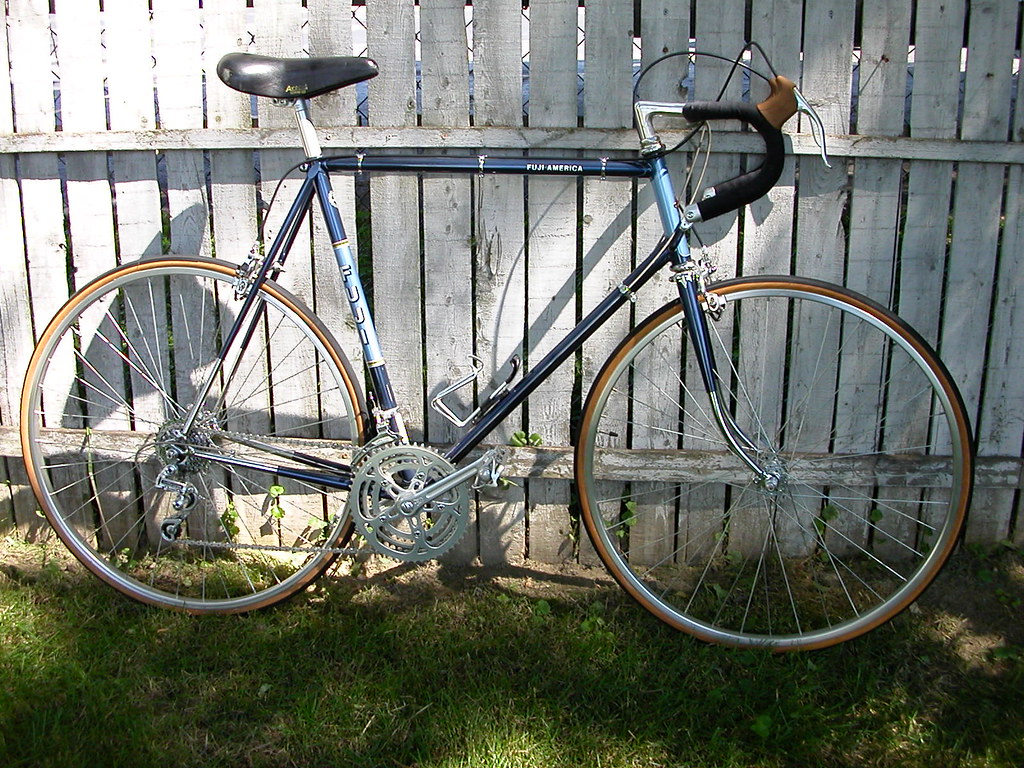
In my first full year, I hit almost 8,000 miles or about an average of 21 miles a day. This was actually enough to convince my dad that riding bicycles wasn’t just a passing fad for me, so he helped me buy a newer, better touring bike. My new bicycle was a beautiful blue, hand-detailed Fuji America, which was still manufactured in Japan in those days. It was a dream to ride, and an absolutely perfect frame size and geometry fit for me. It immediately increased my average speed with the same amount of work, increasing my daily distance.
And then I got a crazy idea. If I can do 8,000 miles in a year without really trying on a lesser bike, why not set my sights on an even 12,000 miles per year? (I picked that number because 1,000/month appealed to my sense of aesthetics and nothing more.)
I wasn’t in training for anything. I didn’t have any goals or ambitions. I just really enjoyed being alone with my thoughts on the road. I hit my numbers, but it was tough, and it had its toll on me. I couldn’t get enough miles on weekdays, so I had to make it up on the weekends. I would frequently be out all day, and summer temperatures in Tucson were no picnic, even back in the 80s. Sometimes, I’d have to make up a month’s shortfall in the next month… or even the next.
Even after a year of it, I would come home absolutely exhausted. I drank a lot of Gatorade. I hate Gatorade now.
As I’ve gotten older, I’ve noticed the parts of me wearing out first are my knees and my neck, consistent with where the strain was riding my bike back then.
If I had been using the metric system all along, that first year would have been roughly 12,500 km (because I was using a map to estimate). I wouldn’t have decided I needed to hit a higher goal, and if I did, it probably would have been an aesthetically pleasing 15,000 km, or only 78% of what I actually did.
I regret not switching to the Metric System earlier. The Metric System saves knees.
I suspect this list shall bear witness to the fact that I can be both obsessive and compulsive. In first grade, my dad received a quarter-end report card with a note from my teacher saying, “Gene1 could be a fantastic student if he could just not fixate on Batman all the time.”
It’s true. I was obsessed with the Adam West/Burt Ward Batman series, and it wasn’t even on TV anymore! I got banned from all things Batman over that one.
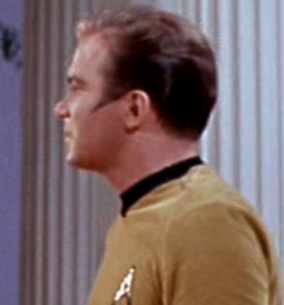
I switched my attention to Star Trek.
Younger readers may not be able to grok the concept that when I say Star Trek, I mean Star Trek proper — the series that the young’uns today improperly refer to as “TOS.” There was no other.
As Star Trek reached the point where it was airing every single weekday, I was there for it every single time. I have no concept of how many times I’ve watched every episode of Star Trek. A hundred? Maybe. Maybe more.
I knew them line for line and word for word, backward and forward.
Star Trek was more insidiously invasive on me than Batman. It showed me what the world should be. In many ways, particularly in my pre-teen years, I think I believed it was the way the world really was. If nothing else, I thought it was what everyone was striving to achieve.
Star Trek indelibly imprinted my baseline moral compass on me without me realizing it. It may be simplistic and pollyannaish, but I believe that science and exploration are good, the search for knowledge makes us better and more prosperous, wars are bad, violence is only justified in defense, men and women and people of all colors and races (even Scotsmen!) can live and work together without prejudice, bad laws should sometimes be broken (I’m looking at you Prime Directive), and that you should never turn weapons over to a super-computer.
Looking back on Star Trek from the 21st century, there are still many problematic things in its depiction of the world that were a product of its time, but that’s true for everyone’s view of things if you live long enough. We must all grow, but I think Star Trek provided me with a pretty solid foundation.
Oh, and sideburns.
I am oblivious to fashion unless it rises to the level of the absurd. I don’t see it, and I don’t care; however, I would be lying — no, I would be deluding myself — to say I am not, at least subconsciously, influenced by the things around me.
In the mid-80s, I was quite poor, languishing in my ambitions to work in the computer field, and surviving by working manual labor as an electrician. I’d been on the job for six months to a year (and had learned how to curse really fucking well by then), and one day, we were sitting on a job site, having lunch from the roach coach, when one of the guys made a light-hearted crack about my “pointy-assed Star Trek sideburns.”
I had no clue what he was talking about until I looked around at everyone else there and, indeed, every other man I saw after that point. None of them had neatly trimmed pointy sideburns. Clearly, the world was mad.
When I started shaving, I had just simply adopted what I had seen and normalized a thousand times before and trimmed my sideburns like the crew of the Enterprise. I had no clue that was an affectation for TV to show that hairstyles in the future were different.
I didn’t go home and shave them off that day, but I did, slowly over the course of a couple weeks, continue to trim them at a less rakish angle until they were “normal.”
A little bit of joy and individuality2 died in the world that day.
1My name of record is Eugene. My parents called me Gene, so the schools and whatnot also called me Gene. I always disliked it. When we moved to Oracle, AZ, in 1975, I just started going by Eugene from that point forward.
2Arguably, that’s not individuality since I was copying someone else. You decide.
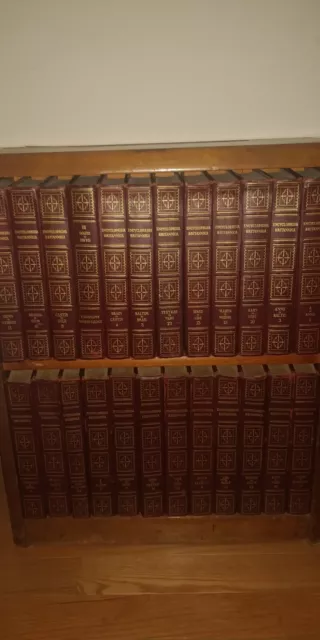
When my dad returned from the Korean War, he used the GI Bill to attend university, first studying Geology and then switching to Law. As a “Going to University Present,” my grandparents bought him a complete set of the 1954 Encyclopædia Britannica1. It was a bookshelf-worth of books (in fact, it came with a bookshelf, a giant Atlas of the World, and several “Book of the Year” updates for a few years).
After he left university, he was a bit footloose, carefree, and not at all bogged down with personal possessions. He prided himself on not having more possessions than would fit in his Triumph T3, so those books went back to my grandparents. After my mother died in the late ’60s, my grandparents moved in with us. Those books and that bookshelf came with them and ended up in my room, where they remained until I moved to university in the early ’80s.
Sometime during elementary school, I decided I needed to absorb that knowledge (It’s what Spock would do), so I got myself a bookmark and started from Volume 1, Page 1. Slowly, day by day, I worked through every volume, article, and plate. I can still feel that curiously thin paper between my fingers, the thick, glossy photo plates, and I can still smell those books.
It took years to complete the task. It’s not a gripping read.
The author(s) didn’t manage to weave together a coherent plot and huge swaths didn’t interest me at all. Many subjects that did interest me were boring as hell, I’m sure there was much I read and didn’t absorb, and much of it was horribly out-of-date, but it was knowledge for knowledge’s sake, which was good enough for me (and Spock).
I don’t claim to have an “encyclopedic memory,” but I have a legit leg up on one. Did I do myself a disservice by reading an encyclopedia already at least 20 years out-of-date? I’ll never know.
1I’m not exactly sure what “year” you’d call this set. 1954 is an estimate. The Fourteenth Edition of the Encyclopædia Britannica was published from 1929 to 1973 and had what they called a “continuous revision” policy. This set would have been roughly current when my dad went to university in 1954, and we had several Book of the Years going up to 1957 (IIRC).
When the day started, the new wheel only had about 75 km on it. What are the odds I’d have a problem? (Spoiler: It turns out about 1:1.)
Why?
Phoenix is a weird metropolitan area. At first blush, it’s laid out on a perfect grid, with straight line roads that should, in theory, wisk you directly from one place to another along logical paths… and if you’re in a car, it is, mostly.
On a bike; however, it’s a fucking nightmare.
Phoenix streets* fall into three categories: major roads, feeder roads, and residential streets.
The major roads crisscross the city in the aforementioned grid and are multi-lane death traps for bikes and pedestrians. I have yet to find one in Phoenix that feels safe to ride on, even ones with so-called bike lanes painted on them.
The feeders are smaller, one and sometimes two-lane roads running parallel to the major roads halfway between them. These can be very good for bikes, like Maryland Ave or a nightmare like Missouri Ave, just one mile distant. This depends on the design of the road and the characteristics of the traffic that flows along them.
The residential streets are the most pleasant to ride on; however, in Phoenix, they’ve been designed with various ways to dissuade through traffic. It makes them quieter but also funnels everyone, including bikes, back to the major or feeder roads. Getting from A to B is impractical on the residential streets.
And then there’s the geography and the legacy. There are mountains, canals, freeways, rivers (dry or otherwise), and rich motherfuckers’ homes plunked down in the middle of what should be a street. Only the major streets consistently get around these, and it’s very haphazard with the feeders.
This means that you must explore and learn the best bike routes to various parts of town and plan accordingly.
Last week, I learned that Oak St (a feeder between Thomas and McDowell roads) has a pedestrian bridge crossing Highway 51, which (on the map) makes it look like Oak can travel from 3rd St, over the freeway, over the Arizona Cross Cut Canal and to El Dorado Park at Miller Road in Scottsdale. That’s about 16 km in a straight line, and if you cross the park, Oak continues on the other side for another 4 km to the Indian Reservation at the outskirts of the conurbation.
Yesterday, I decided to test that. (Or we could, at this point, just say, “And then I got stupid.”)
I love riding bikes. I hate riding the same damned roads over and over again. I am sick to death of every route that leads away from my house, so I am always looking for somewhere new. I love that when on a bike, you actually see what’s around you. Places you’ve passed many times in cars are new because you’ve never really seen them before.
The Outbound Ride
I cycled down the Grand Canal, through Steele Indian School Park, and south on 3rd St until I intersected Oak. My goal: Travel as far east as possible on Oak, turn around and come home. On the way back, I planned a lunch stop at DiVito’s Pizza, a place I used to frequent when I worked in the area, but rarely get to anymore.
This isn’t the most logical route I could have taken. I could have stayed on the Grand Canal and intersected Oak at about 26th Street, having already passed under Highway 51 along the canal, and shaved a few kilometers off the trip. However, the objective wasn’t efficiency; it was all about the ride.
Despite not having taken the full Oak route before, I have biked over many stretches of it, so little was new till I got about 17 km from home, and then I hit new territory. Passing first through a cemetery, Oak then travels along behind the National Guard Base, which, for those who haven’t seen it, has some very picturesque geologic formations within. This was at 52nd St.
The road’s character changes a bit at this point, too. While still well-paved, the curb is gone, replaced by dirt siding that is easily wide enough for cars to pull onto and be entirely off the pavement. About 75 meters ahead of me, I saw a truck parked, with a family searching up and down the siding with a metal detector.
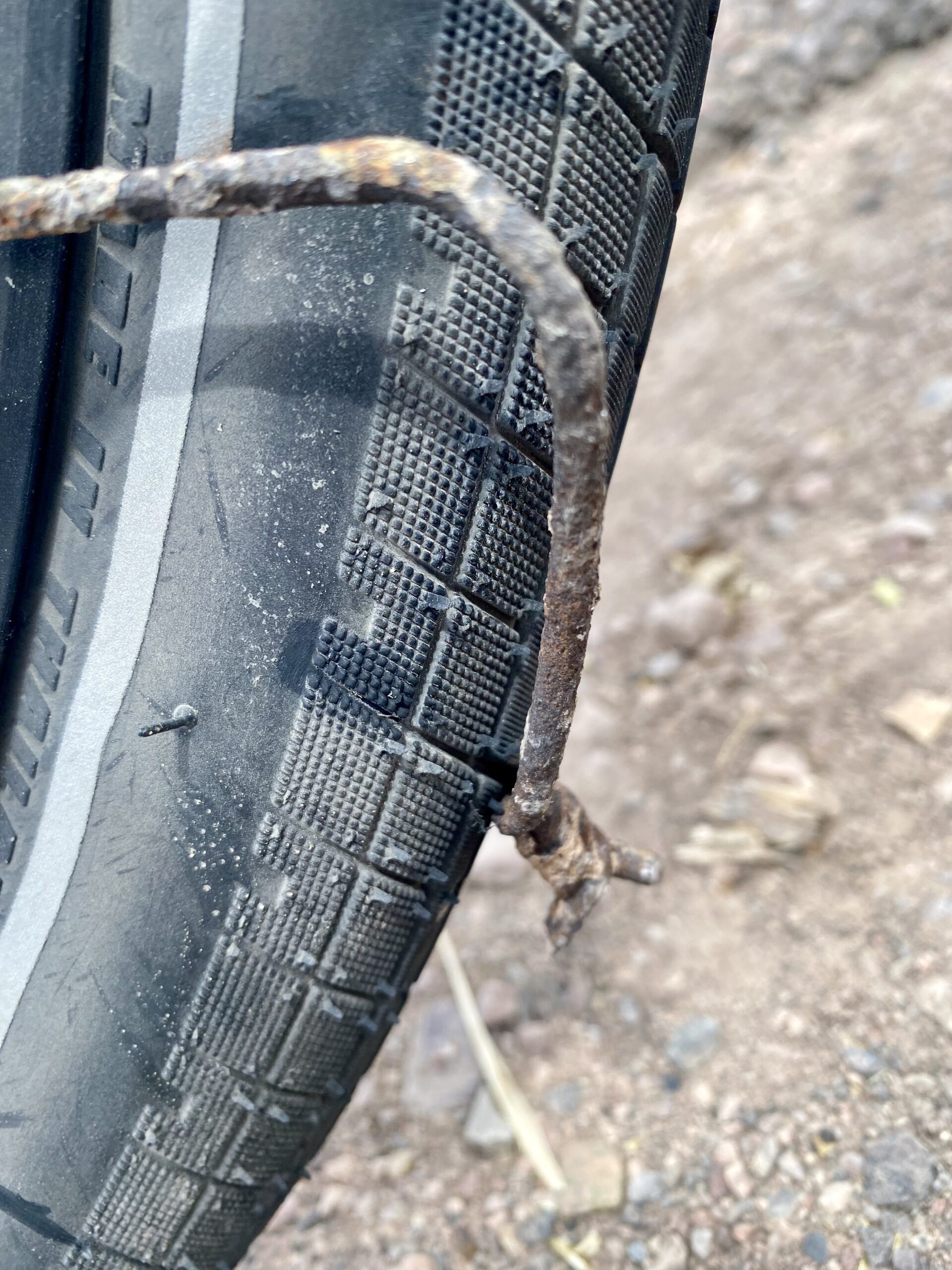
I thought, “I wonder what sort of metal they’re hoping to find here?” In that fucking instant, I did my own metal detecting, as a large cut-out section of rusty chain link fence pierced my rear tire – the one without the Tannus Armor** – and flattened my tire in about 10 seconds.
It was Thursday. My family and friends were all at work, or, if available, none had trucks. I received offers of help that were greatly appreciated, but the help I needed most — getting a non-functional 25-30 kilo eBike 17 km home without walking it — eluded me.
My first order of business was to take stock of my resources. I checked to see if there was a nearby bike shop that might repair the tire. The closest was 4 km away, in the wrong direction; the next closest was a bit further, but at least it was on the way home.
It was around noon, the sun was high in the sky, the temperature was just about to top 30º, and there were no trees or shade anywhere, but I had passed a park at 44th St. Hoping to find shade and tables there, I started walking my bike back the way I came. When I arrived, the park seemed about as far from human-friendly as it gets, presumably to discourage the homeless. Park tables that I used to sometimes eat lunch at were gone, and there seemed nowhere to get out of the sun and sit to take stock.
I sat on the baseball diamond dugout benches and pulled out my toolkit. I had the tire irons, patch kit, multitool, and pump necessary to repair the inner tube, but I had missed a piece of the reality of owning an eBike. While the front wheel has a quick-release hub, the motorized rear wheel has an old-fashioned bolted-on wheel, and I was not carrying a wrench.
Bike shop it was, then.
Adventures in Lunch
But first, lunch and some research. I was quite close to where I used to work. There was a sandwich shop just a block away. It used to be Blimpie’s Subs; now it’s Brooklyn Mike’s Subs, and I’ve never tried them. I carry very little (if any) cash when riding the bike, so when I reached their door, I was relieved to see the posted Apple Pay sign. I entered the small but empty shop and ordered a sandwich.
It’s a strange little place, with quite a few hand-written signs explaining that it was a locally owned store, which seemed quite important to them. While the woman prepared my sandwich, I saw the hand-written sign that says something to the effect of, “Because we’re a locally owned small business and rising prices, we don’t take any credit cards or debit cards, but we do take Apple Pay, Google Pay, Zelle, and Venmo.”
I thought, “That’s odd. Apple Pay is a credit or debit card.” My experience is that many small businesses make penny-wise but pound-foolish choices, and this just seemed like one of those small business owner quirks where they think they’re being clever.
She handed me the sandwich, and did not ask me to pay, so I asked, “do you want me to pay?”
“Afterwards, unless you really want to pay now.”
I was the only person in the store and was in no hurry to go anywhere, but I should have paid first.
The sub sandwich was delicious.
I planned to eat, use their toilet, rest, enjoy their air conditioning, and I’d do a little research on my phone about the Phoenix Metro bus system. Can I take an eBike on the bus? What are the weight and physical size limits?
There were some barriers. While it looked like my wheels would fit, it also looked like I’d have to remove my front fender. I could do that. I don’t find it very useful, and I’ve thought about it many times in the past. I had the tools to do it, but I’d have to carry the fender or throw it away.
There’s also a 50lb (23 kilos) weight limit, and my bike far exceeds that. I could take the battery out, take the lock off, remove the trunk bag, and get the bike under the weight limit, but I’d have to carry all that, plus the fender on the bus, and it felt like a desperate last-resort choice.
Bike shop it was, then.
Brooklyn Mike’s is a very small restaurant that seems to be run by a husband and wife couple. The man, who’d been out running an errand, returned, and he was one of those bigger-than-life proprietors who likes to talk to the customers. He got the opportunity, too, because 10 people walked into the shop moments after he returned.
They were from out of town, attending training at a nearby training facility, and I was now trapped. I hadn’t paid, and the couple were inundated with the new arrivals. None of them knew what they wanted, and the owner was more than happy to tell them everything about every sandwich, all the while learning about their life stories.
Charming, save for the fact that I was ready to leave, there wasn’t room to even get up from my table, and I hadn’t paid.
15 minutes later, I was finally free to pay. They seemed to have no cash register. The woman told me the amount, and I said, “OK, I’ll use Apple Pay.”
Instead of showing me the tap-to-pay terminal, she pulled out a hand-written note on a scrap of paper that said, “Apple Pay” and a phone number. “Here’s the phone number for Apple Pay.”
“What? Apple Pay doesn’t work by phone number.”
“Oh, do you have Zelle, then? Here’s the phone number for that,” she says, pulling out a different piece of paper with a phone number on it.
I wasn’t having my best day and was a bit frazzled, but my brain finally understood what was going on. They actually didn’t take credit cards, just cash transfers, such as Apple Cash. (To be pedantic, it is not Apple Pay.) Frankly, it all seemed pretty dodgy, but at that point, I didn’t care, so I fired up Apple Messages, sent a message to their phone number, and attached the cost of the sub.
Apple, bless their little hearts, screams at me, “You’re about to send money to someone not in your contacts! Are you sure you want to do this? You can never get this money back if you’re sending it to the wrong person!” I sent the money anyway. But then what was supposed to happen?
“OK, I sent it. Is that it? Are we done?”
“Hold on just a couple minutes,” she says.
The man goes into the back room, pokes around on (I think) his phone, then gives me a thumbs up, “OK, you’re paid, thanks!”
This was my weirdest restaurant experience in a long time, and it was just icing between the layers of the cake that was the day so far.
The Walk to the Bike Shop Interrupted
Back on foot, it was now over 30º on its way to a high of 35º. I trudged west along Oak St until I reached 36th St. Then I headed north, making my way toward Indian School Rd and the bike shop, which was now about 2.5 km away.
Walking a bike, especially a heavy one, is monotonous, and it’s easy to get distracted. Somewhere along this stretch, I managed to crash my leg into the bike pedal, drawing blood and giving me a pronounced limp for the rest of the walk.
I walked about a kilometer when I saw a vision rising from rippling heat waves in the air: A pickup truck with the words, “Rent me today for just $19 for 75 minutes.“
I heard the sound of heavenly angels singing.***
I had reached the Home Depot at Thomas Rd, and my salvation was in sight. I locked up my bike and made a beeline for the rental counter. “I’d like to rent a truck, please!”
“Can it be a larger van?”
“Smaller would be better.”
“Sorry, my pickup trucks are all broken.”
“Fine. I’ll take the van.” (Note: the van costs more.)
“OK, I’ll need your driver’s license.”
I hand it to him.
“Your credit card.”
I hand it to him.
“…and finally, your auto insurance card.”
Fuck, fuck, fuckity, fuck!
I carry my auto insurance cards in my cars, not on my person, and certainly not when I’m bike riding. This was going to be a showstopper; however, my Liberty Mutual policy information was in my Apple Wallet, and they were willing to accept it.
Now, I was on the 75-minute clock.
I stripped the bike of all heavy accessories, as I’d planned for the bus, and lifted the still not-insubstantial bike into the back of the cavernous van. I laid it on its side as there was no way I could see to secure it or pad it, and, hoping for the best, I headed home.
While I wasn’t speeding, I was moving with traffic, and I soon learned that the big, essentially empty van had a lot of bounce, as the first time I hit an irregularity in the pavement proved. I could hear the sound of my bike lifting into the air and smashing down onto the van’s floor. I slowed way the hell down to the consternation of the other drivers.
When I arrived home, with trepidation, I opened the back of the van, half expecting to find two or more pieces of bicycle strewn about the floor. Apart from the rearview mirror being smacked, it seemed reasonably intact. I won’t really know till I get the tire fixed.
The Bike is Home, But I’m Not Home Free Yet
There was no time for inspections. I needed to get the van back to Home Depot, which I did, with 2 minutes to spare.
It would not have been a problem if I’d had to pay for another time unit of rental, but I was so close that it would have been annoying if I’d gone over by a couple of minutes. I needed a “win” that day, and this was it.
As you can imagine, this whole caper was not meticulously planned out. When I pulled into the Home Depot parking lot, realized I was back where I was before: on foot, 10 km from home.
Without being saddled with the bike, I knew getting home was trivial; I could easily catch a bus in just a few minutes, but where’s the fun in that? I’d had a long, long day (I imagine you feel your day is going the same way if you’ve read this far), and I couldn’t be assed to put up with the bus.
I decided I was going home in a Jaguar.
But that story is for the Epilogue.
* Specifically Phoenix, but also including, in more or less regimented patterns, Glendale, Peoria, Scottsdale, Tempe, Mesa, Chandler, and Gilbert. (Did I miss any in the conurbation? If so, they suck, too. Take it as read.) ** See the Prologue. *** It was actually the sound of airbrakes on a large truck.
Thursday the 18th of April, 2024 was an adventure day – and not in a good way.
The blame for the adventure is mine; however, before I tell that story, context is needed to understand why this has been so enormously frustrating for me. It comes solidly on the back of me being angry and frustrated about my eBike.
Let me bring you up to speed.
That Fucking RadPower Bike Wheel Saga
I love riding bikes, or at least I used to.
I have 10s of thousands of kilometers in the saddle from the 70s/80s. Partially, perhaps largely because of this, 40 years later, my knees and neck are shot. My knees won’t accept much hard pushing*, and my neck will not allow me to ride “down” on proper drop handlebars.**
When I moved to the Phoenix area in ’82, the horrid bike infrastructure (and the theft of ALL THREE of my bikes) soon got me out of the habit of riding. While Phoenix has improved since then, the ravages of time have kept me away from biking.
eBikes have given me back the fun of riding bikes, but there are big differences between an 8.5 kg road bike with a 43 kg rider and a 25 kg eBike with a 95 kg rider (and not just 68.5 kg.)
It’s not all fun, though.
eBikes have a lot of mass, bigger tires, and move very quickly. This, in my experience, makes them more prone to road hazards. I’ve had more than my share on my RadCity 5+. When I was young (oh, so much younger than today), I road my combined three main bikes (A Centurion Super LeMans, a Fuji America [my favorite], and a Benotto that was stolen so damned quickly I never even bothered to commit the model name to long-term memory) over 45,000 kilometers with only two catastrophic flats. Yes, I had several slow leaks from all the damned goatheads in Tucson, but only two ride-ending, call-for-the-cavalry flats.
Including Thursday’s adventure, I’ve already had more than that in only 6,000 kilometers on my eBike.
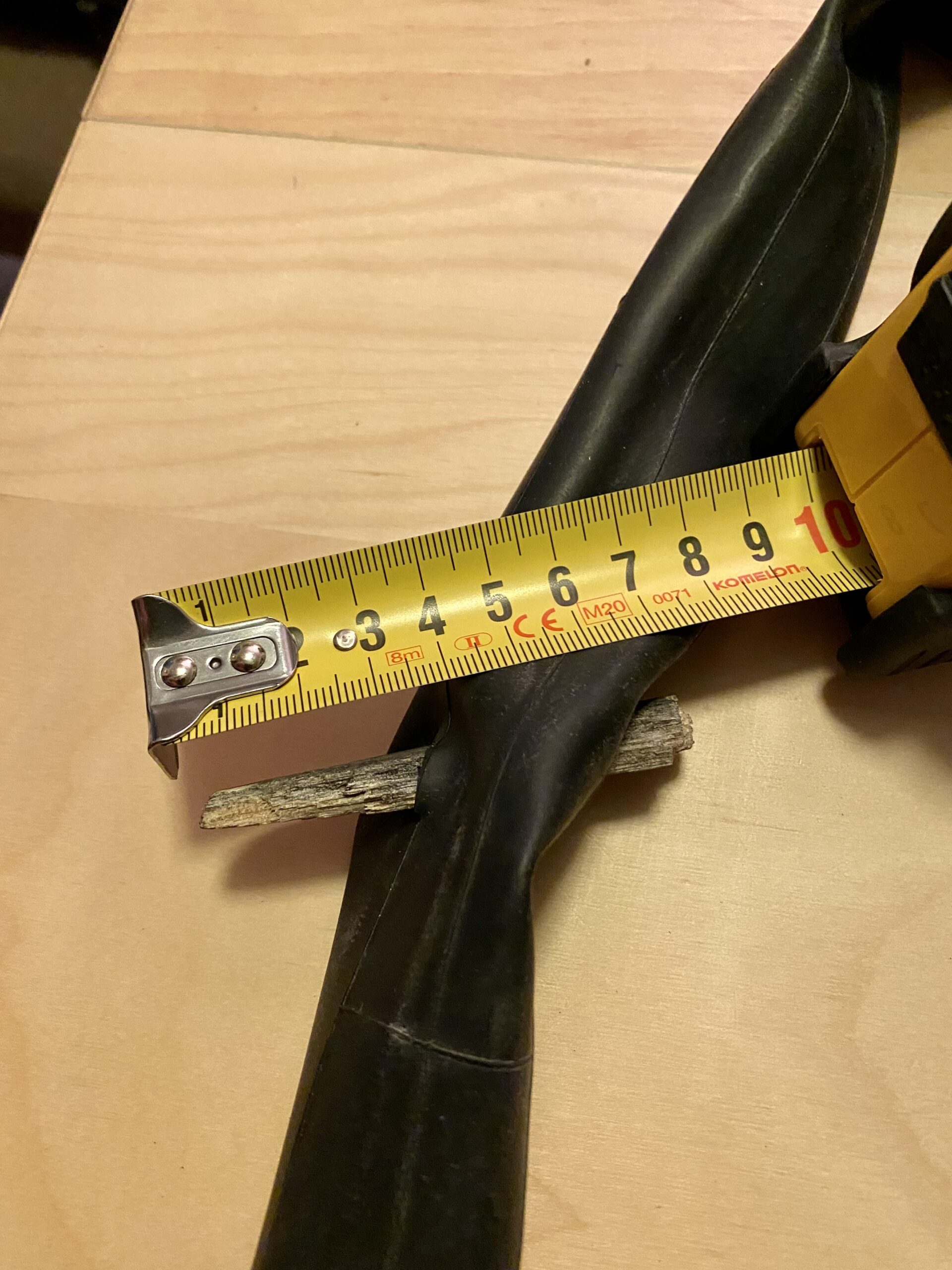
The first was a 7 cm long shard of wood that passed completely through the tire, into and back out of the inner tube, embedding itself invisibly within the tire. The tire went instantly flat, and the entry wound rendered the tire itself irreparable. After this fiasco, I had Tannus Armor installed.
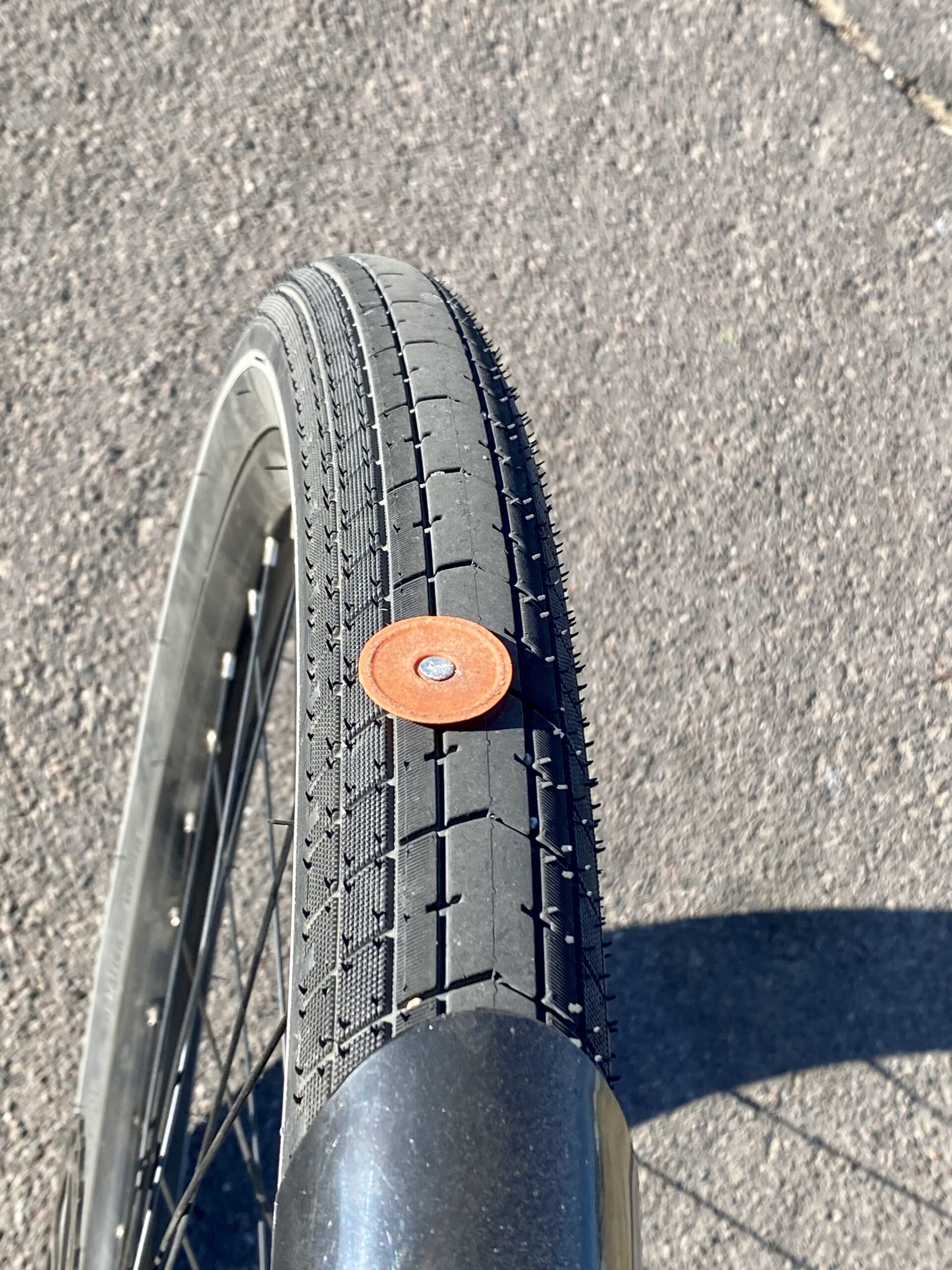
The second was more prosaic: I hit a roofing nail with my front tire. You know the nails I’m talking about: the ones with the large plastic caps that help hold the asphalt shingles firmly in place but serve double-duty as a way to make sure the nail stands point up when some fucking careless roofer dumps a box on the road.
Initially, I thought this was a triumph of Tannus Armor. I was riding down the road when suddenly, my front wheel started clicking on every rotation. I stopped to inspect it and found the roofing nail solidly embedded in the tire. There was no leaking. Hooray for Tannus Armor!
Then I got stupid.
Thinking the Tannus Armor had prevented the inner tube from being punctured and not wanting to ride on it and risk possibly driving the nail into the inner tube, I removed it. The inner tube’s sudden and rapid deflation followed. I should have known better. I trusted the technology too much. I walked the bike home and fixed the flat, and I’ll tell you, Tannus Armor is a pain in the ass to uninstall and reinstall. I never wanted to have to do that again.
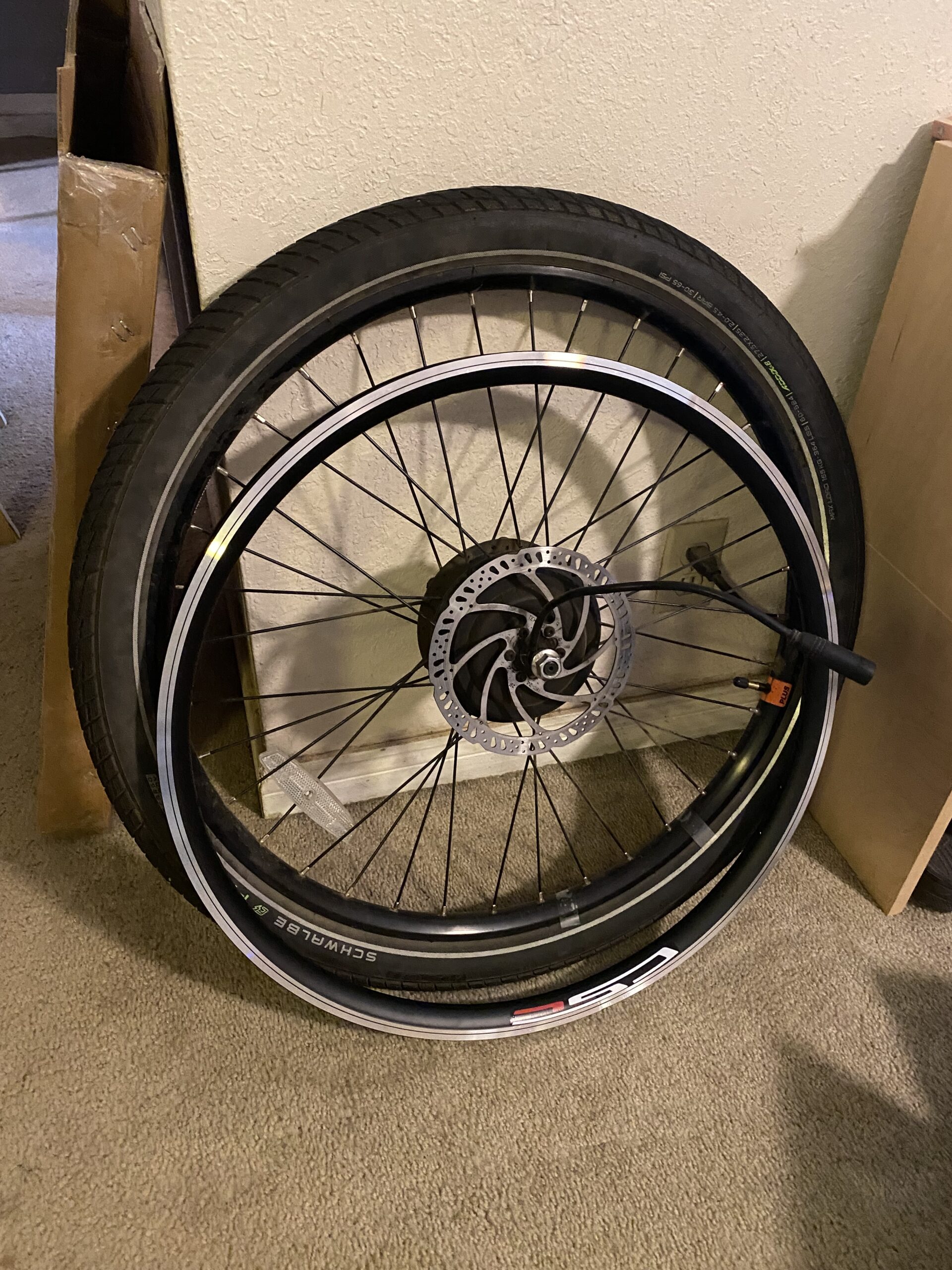
Then came the rim problem. The rear rim got bent. It’s an oddish-sized rim designed for eBikes. The LBSs “couldn’t” get them. (Or, I suspected, they couldn’t be fucking bothered to try.) RadPower won’t sell you a rim. They only sell the entire wheel assembly… tire, inner tube, rim, spokes, brake disc, and motor, for over $600 when you’re done with shipping and handling.
Sensing my ire on the phone, they gave me the “specs” for the rim so I could find one on my own. That took considerable time, but I finally found eBike-rated rims in China that were the “correct” size per the specs given to me by RadPower. It was reasonably priced, but shipping doubled that cost and took over a month to receive.
And, of course, it was wrong.
Rim diameter, check.
Rim width, check.
Number of spoke holes, check.
Distance between the rim bed and the exterior rim, off by 2 mm. (The dimension RadPower didn’t give me)
In this case, that means the existing spokes were too long and would protrude into the inner tube, causing flats. And, of course, finding the right-sized spokes seemed impossible, too.
It was at this point I said, “fuck it,” and ordered the entire wheel from RadPower.
When I finally got the wheel, I popped it on the bike to make sure it worked, and, to my amazement, not only did it work, but I got the goddamned hydraulic disc brakes aligned first try. That’s never happened before.
And then I got stupid.
I knew I should take the wheel off, deflate it, pop the tire and tube off, and install the Tannus Armor, but it’s such a pain in the ass, and I knew I’d never get the wheel on twice in a row without having to fight with the disc brake alignment.
I decided to put it off for a while. I was still disgusted with RadPower’s support options, which made me less inclined to ride the bike. However, I do love riding bikes, and I’d take it for a sneaky ride or two here and there, all the while knowing I shouldn’t do it until I put the Tannus Armor in.
Which leads us to Thursday.
[To Be Continued]
* The fact is, I seldom push my knees hard because of the way I ride; however, that is a tale for another day. It’s my neck that causes most of the problems. ** This is why I laugh at acoustic bike riders who sneer at my eBike as I whiz past them. Give it 40 years, and we’ll see how smug they are. (Unless they’re already old, in which case, more power to ’em.)
I pledge to use and internalize the Metric System in my own life wherever possible, so long as it does not impact safety. Further, I will not make it easy for others to cling to outdated measurement systems.
The Metric Pledge
Note: I wrote this post seven months ago, and it’s sat in my drafts folder since then. A post I saw on Mastodon today made me think it was time to finalize it.
We are nearing the end of the first quarter of the 21st century, yet we in the United States are still using the idiotic measurement system that we inherited from the British, and even they’ve moved on – mostly. It’s a disgrace. We look like morons for clinging to our outdated system.
I’m not here to look at the entrenched economic interests and short-sighted political reasons why we’re still stuck with an imperial dunce cap on our heads, but I am here to suggest that, in the absence of any present or likely future official efforts to make the change, we can start a grassroots process to make the metric system our de facto measurement system.
I am old enough to have been in grade school during the failed efforts in the 1970s to convert the US to the metric system, and whether it was by design or incompetence, it used a technique that was guaranteed to fail.
I will explain, but first, I must digress.
You’ve no doubt heard the old riddle, which weighs more, a ton of elephants or a ton of feathers? The answer is, of course, that they would weigh the same, but they would require substantially different amounts of cubic space to achieve equal weight – or let’s call it by its correct term: volume.
That leads us to this question: Which weighs more, eight ounces of flour or eight ounces of gravel? The answer, in this case, is it depends. It depends on if you mean an ounce of weight or an ounce of volume. That is why if for no other reason (and there are others,) ounces must die – along with all their ill-conceived and illogical imperial brethren. Think about that the next time you make a batch of cookies when the recipe calls for 8 ounces of gravel. (Also, think about getting a new cookbook.)
I can illustrate the abject failure of the 70’s attempted migration in three sentences that I was taught back then as part of the process. Those sentences are:
“There are 2.54 centimeters in an inch.”
“There are 1.61 kilometers in a mile.”
“There are 3.79 liters in a gallon.”
I remember these well, and you may ask, “If you remember them after all these years, how are they a failure?”
Simply, it’s useless information. It’s worse than useless because it perpetuates the imperial-first mindset. You think first in inches, miles, and gallons and then “do the math” to arrive at the metric. Let’s face it, lots of people suck at mental math, and even those that are good at it would probably rather not be bothered.
Now, I’m sure this technique was probably intended to ground the learning in the familiar. All it really did was take away any reason to bother to learn, and it turned the metric system from a system of measurement to be used into a chore to be endured.
What is a system that works?
To answer that, let me present the pre-eminent 1970’s imperial-to-metric success story. You may encounter it every single day and never give it a second thought. I am referring to the 2-liter soda bottle. Just by mentioning it to you, you already know how big it is, how heavy it feels in your hand, and roughly how many drinks you might get out of it. It is a known, familiar quantity, and it is utterly irrelevant how many ounces it is or how many it takes to make a gallon.
As a counter, you may have the exact same reaction if I said a “gallon milk jug.” That, too, is a familiar, known quantity. You juggle both of these concepts in your head, and you understand them without any need to understand their precise mathematical ratio.
You, no doubt, have any number of these internalized concepts of various measures in your mind: an inch, a yard, a mile, 5lbs, a cup, or 68ºF. The odds are, you don’t even have accurate measures in your head, just a general idea that’s good enough for day-to-day functioning. When you need precision, you turn to a measuring device.
My point is that the metric system needs to become second nature to us, and the only way to do that is to use it whenever possible. Here are some things I suggest:
Buy yourself metric measuring tools
A meter stick
A tape measure
Measuring cups, etc.
Convert your electronics to metric. Practically every electronic device sold internationally can be switched between metric and imperial – set them all to metric.
Your phone
Digital thermometers
Themostats
Workout apps
Your online mapping tools
Your scales
Live with those numbers
Don’t worry about how many days the temperature exceeds 100ºF; think in terms of days over 40ºC. (Arizona residents will understand that milestone.)
Know your weight and what your weight goals are in kilos if you’re dieting or bulking up.
Learn how you like your steak done in ºC. (I like my steak at about 55º.)
Learn what feels comfortable for you in your house in ºC. (My house is warmed to 20º in the winter and cooled to 27º in the summer. When I go outside when it’s 12º, I like to wear a light jacket. If it’s 0º, it’s time to move to Mexico.)
Convert your recipes. It may seem blasphemous to convert your great-grandmother’s volcano cookie recipe, but she won’t care.
Recipes can be a little bit tricky, though, because of things like “are you measuring dry items by volume or weight?” Luckily, there are people out there who have done this work for you. If you need to convert a cup (by volume) of flour, sugar, or chopped onions to grams, that information is available without you having to work it out yourself.
You might want to tweak some of the amounts. Many recipes are very flexible.
If you mathematically convert an ingredient to grams, and it comes up to 47.8g, you can probably round that to 50g without a problem.
Some recipes, especially baking recipes, can be very sensitive to exact amounts. Just be aware of that.
Another thing I suggest is not to be apologetic about using the metric system. Be out and proud about the metric system. If they ask you the temperature, tell’em in Celcius. If they don’t understand it, that’s their failing, not yours. They, no doubt, have a computer in their pocket that can do the conversion for them. Put the burden on them.
Finally, the Metric Pledge as written says, “…wherever possible, so long as it does not impact safety.” Those may sound like weasel words, but they’re not. If you live in the US, the imperial system is unavoidable; from the parts on an American-made automobile, through any number of types of nuts, bolts, fasteners, and machinery – you’re still going to need that 1/4″ socket wrench. If that’s what you need, that’s what you need – we live in an imperfect world full of compromises.
…and then there’s safety. There is one thing I do not recommend trying to convert: the dashboard in your car. Speed limits and roadway signs use miles and miles per hour. Don’t fight against that one. Operating a hurtling death machine is not the time to stand on principle.
We are not going to join the rest of the civilized world with a top-down decree forcing us into the metric system, we’re going to have to do this from the bottom-up.
Let’s try to put this all together in one last post, shall we?
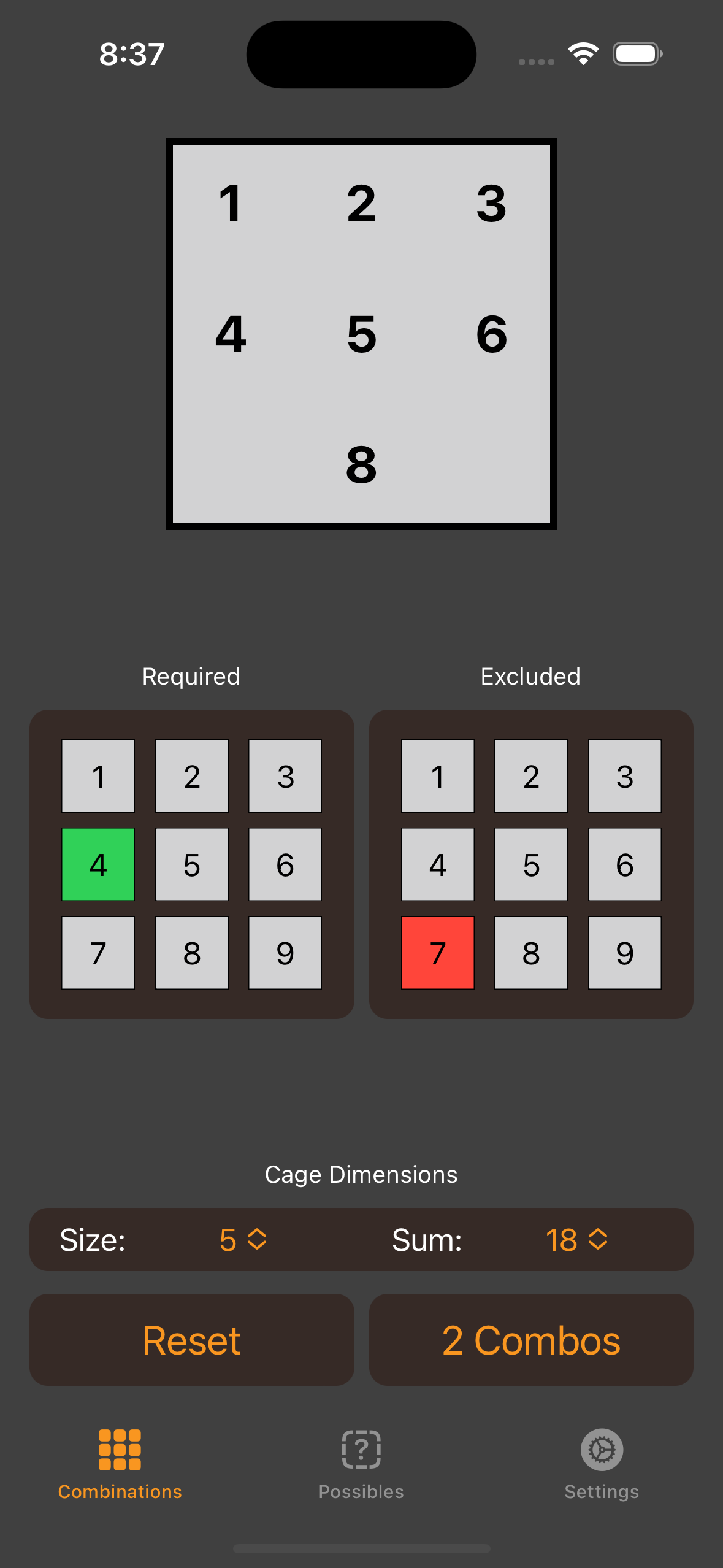
Killer Sudoku Aide is basically ready to go. The functional code has been locked down for weeks, but there have been weeks of tweaking the interface’s look, updating things to improve the accessibility, and getting ducks in a row to get it in front of beta testers. (If I can find any beta testers. Please? Someone?)
You need to maintain a surprising number of web pages to have an app in the iOS App Store. There are probably more than I currently know, but at least you have to have a support contact page and a privacy policy page.
Where to put them?
Because lonelocust.com had become all about me, I didn’t think it would be a good fit. Besides, I own other domains, just doing nothing. I plan to revive the Pizza Locust in some form. Spottings seems inappropriate. I know! Ninja Team! That’s a cool name no matter what you tag it onto, and ninjateam.com is mine – and has been forever. (In Internet years)
There’s just one problem. Somebody, in the intervening years, grabbed the (frankly, inferior) ninjateam.org variant of that domain name and set up a business. I’m surprised they never tried to buy ninjateam.com from me.
If they’d been an accounting firm, a sprocket manufacturer, a company that vacuums out portable toilets on construction sites, or practically any other kind of business, I’d just continue on with my plans and use my domain for my apps.
But, of course, they’re a software consulting company, and I don’t want to cause any unnecessary confusion, so I will leave it until I have some other project I can use it with.
My hubris for thinking businesses would honor the moral and ethical superiority of the .com domain and banking on that assumption.
…and that brings me back to lonelocust.com.
Which is why I’m re-organizing things here. I’m not ready to delete all my old blog posts, but I can play them down by moving them to a sub-page. And I can bury the old ones a bit by making an effort to have some more current content. (Like, for example, making a bunch of blog posts explaining why I’m making a bunch of blog posts.)
At this point, with precisely one app, and currently no plans or ideas for a second one, I don’t feel like playing the game of pretending I’m not just one guy writing an app, nor am I in any way ashamed of who I am. (Youth is the time to doubt yourself when you have yet to measure yourself up to the rest of the world, old age is the time to know and not to give a crap anymore.)
I do feel like I should do a little more long-form writing for a bit, so perhaps I’ll tell the story of the development of Killer Sudoku Aide.