Author: Eugene Glover

  • Plotlines

    I really did some soul-searching in preparation for my recent review of Doctor Who – Inferno.

    Most of the recent DVDs I’ve watched and reviewed were later episodes of the classic series and I’ve felt like I was raking them over the coals. (I also genuinely feel like they should have been raked over the coals.) Doctor Who is one of my 5 top favorite shows of all time* and after you watch a few clinkers you have to wonder, “why?” “Why do I like Doctor Who?”

    Was I looking at the older episodes through a haze of nostalgia? Was I forgiving them their mistakes while mercilessly picking on the others?

    In watching Inferno again, I remember why. Doctor Who was a great show, with a limitless, brilliant format**.

    The question then becomes, “where did it go wrong? What changed?”

    I sat down the other night with a friend of mine who is also a long-time Who fan and we started with Pertwee and went through the episode guide all the way through McCoy and we tried to recall our recollections of each story. We thought about our overall impression, things that were right, or wrong and tried to come up with some pattern.

    Generally, the Pertwee and early Baker (Tom) years held firm, going from strength to strength. It was only after Horror of Fang Rock and the new production crew at that time that the stories began to get somewhat silly. This is not to say that there hasn’t always been light-hearted material in Who, but the basic stories were generally serious, if far-fetched. There was still some great stuff, but the tide had begun to turn.

    With Baker’s final season (and the arrival of John Nathan-Turner as producer) the show took a turn back towards serious, but it also got more convoluted and there were longer backstories. Then we spotted the trend, and we were able to follow it to the bitter end. It even fit with interviews we’d both seen with Nathan-Turner.

    When Peter Davison took over, JNT had already set him up with 3 companions. According to interviews, JNT felt that having only one companion left room for only 1 or perhaps 2 story-lines. With 4 people onboard, you could always have 2 or more story-lines.

    And there’s the problem: You don’t need 2 or more story-lines! You need one good solid story. That story should be about the Doctor and his efforts. Right up to the last few stories, Davison’s Doctor was saddled with too many companions. His stories suffered from a lack of focus and his screen time as the Doctor was greatly diminished. The other flawed concept was that the companions should be more abrasive to create more dramatic situations. This failed because rather than create drama, they annoyed the audience.

    But it was these same concepts that made the stories for Baker (Colin) and McCoy even worse. Once they paired down to a 2-person TARDIS crew, they didn’t pair the story-lines down accordingly. These stories continued their multi-thread mode without the benefit of a regular character being involved in all the story-lines. This even further distanced the Doctor and his companion from the audience.

    Rather than being setup like a melodrama, the stories were executed like soap operas. When you’ve got a finite time to tell a story, it takes a gifted writer indeed to weave several plots into one story successfully.***

    Add to that some just genuinely awful story ideas and the Doctor’s fate was sealed.


    *For the record: Top 5 shows, no particular order:

    • Doctor Who
    • Blakes 7 (Where the heck are those DVDs in North America?)
    • Star Trek
    • Wild Wild West
    • The Avengers

    **I am referring strictly to “classic” Who, 1963-1989

    ***Probably the best example of a finite length story that needs to tie up perfectly would be a farce. A good farce brings all the comedic elements that have been laid on the table together for one great laugh at the end. I can think of no better farce writer at this time than Steven Moffat. His setups and payoffs for his series Coupling were brilliant, and his new Doctor Who work has been equally well executed, just for dramatic purposes rather than comedic.

    Technorati Tags: , ,

  • Doctor Who – Inferno – Review

    Inferno
    1970, Story 54
    Starring Jon Pertwee as the Doctor
    Caroline John as Liz Shaw
    Nicholas Courtney as Brigadier Lethbridge-Stewart

    They say that the majority of Doctor Who fans choose their first Doctor as their favorite.

    I can’t speak to the statistical validity of that statement but certainly, in my case, it is true. Sometime around 1975 or ’76 the NBC station (Channel 4) in Tucson began broadcasting Doctor Who on Sundays in the late mornings.

    My father saw the show first and let me know about it the next week. I started out watching part 2 of Dr. Who and the Silurians and was immediately hooked.

    Channel 4, bless their little hearts, apparently didn’t have a clue about what they were showing. Episodes were shown out of order, repeated and skipped. Sometimes, episodes from completely different stories were inserted. It was a mess. Before they gave up, I saw all (or mostly all) of The Silurians, Ambassadors of Death, Inferno, The Curse of Peladon and the Mind of Evil.

    Of those original stories that I saw, only Inferno has been released on DVD and it has been my most eagerly anticipated purchase to date.

    I was afraid I might be a little predisposed to “go easy” on this story in my review, so I watched it closely, with a critical eye, over several days. (At 7 parts, Inferno was not meant to be watched in one sitting.)

    Plot
    The Doctor’s exile on Earth continues.

    In an effort to try to get the TARDIS operational and escape his Time Lord imposed exile, The Doctor uses his UNIT connections to be assigned as an advisor on a project to drill through the Earth’s outer crust and tap into the pockets of Stahlman’s Gas expected to be buried beneath.

    The project director, Professor Stahlman, is particularly obsessed with finding his gas and will tolerate no delay in penetrating the crust, despite numerous misgivings on the part the other staff members and all the warnings from the computers.

    A mysterious green ooze starts coming from the drill head and anyone who touches it begins to devolve into murderous, green, hairy primords.

    The Doctor is actually using the project’s nuclear power generator to power his experiments. He has removed the console from the TARDIS and attempts to escape the Earth. Instead, he slips sideways in time and arrives at exactly the same place and time, but in a parallel universe.

    The Britain in this parallel universe is a fascist “republic” and the counterparts of the Doctor’s UNIT friends are members of the security forces, headed by the sadistic Brigade Leader Lethbridge-Stewart.

    Stahlman’s project in this new universe is further advanced, and the parallel Stahlman is just as obsessed with penetration. Could it be because he, too, has been infected by the green ooze?

    The Earth’s crust is penetrated and the forces unleashed are both unstoppable and inevitable in their consequences: The Earth will soon fall apart in a ball of expanding gasses.

    The only glimmer of hope is if the Doctor can convince the staff at Stahlman’s project to help him get home in time to save the Earth he came from. Before they can do that, the must battle Stahlman and the growing army of Primords.

    Analysis

    There were big changes for Doctor Who in Pertwee’s first season as the Doctor. The series was being broadcast in color for the first time and that added immensely to the cost. The Doctor’s exile to Earth was the first of the cost-cutting techniques. Basing the stories on Earth meant that fewer sets and special costumes needed to be made. Another cost-cutting technique was making 3 of the season’s 4 stories 7 part adventures.

    The 7 part format is a bit long, and in a few places in the story extraneous chases or other bits of filler were added to pad it out to 7 parts. In the case of Inferno, the padding isn’t too bad, but this could easily have been a 6 part story with no loss to the overall narrative or quality.

    Pertwee’s Doctor is in particularly fine form in this episode, whether trading barbed retorts with professor Stahlman, racing Bessie or saving the day. The Doctor is at once likable and condescending at the same time – everything that Colin Baker’s Doctor wanted to be and never quite managed.

    The supporting cast, especially Liz and Lethbridge-Stewart get an unusual treat in the story, getting to flex their acting a bit and playing their fascist parallel universe selves. Nicholas Courtney is particularly good at playing the Brigade-Leader as a cruel bully who is ultimately a coward at heart.

    The other members of the supporting cast are excellent, and Olaf Pooley, whom I’ve never seen before or since, was perfectly cast as the monomaniacal Stahlman.

    The parallel universe plot cleverly allows several scenarios to be played out twice, lengthening the story without being too obvious. it also allows the audience to be “surprised” by some of the primords returning at inopportune moments as they may have been killed in one universe, but not the other. The primords also provide a bit of excitement during parts that might have been flagging, although they are never properly understood.

    In fact, the primords raise more questions than they answer. The primords appear to be retrogressing into animals, but they seem to have a purpose. On infected, they to attempt to accelerate the penetration of the Earth’s crust. Having established that penetrating the crust will destroy the planet (and themselves), why do they want to do that? What drives them?

    The seventh episode is the most protracted. The Doctor returns, knowing that the world will be destroyed, and he cannot convince anyone, not even his old friends Liz and the Brigadier. This means more chases to fill up time and even a temporary coma for the Doctor. I’m particularly disappointed that the Brigadier didn’t just immediately back up the Doctor and force the project to be shut down. I suppose it was still early days in the Doctor and the Brigadier’s friendship.

    Inferno is considered a classic and it deserves the title. It has always been in my top 5 and nothing in this viewing has changed my opinion of that.

    The DVD
    I’m not as pleased at the quality of the DVD. Inferno, like Claws of Axos, had to be reverse standards converted to have color prints for their DVDs. While the BBC used the superior PAL color system for the original recordings and broadcast, they also produced NTSC format copies (which have fewer lines of resolution, but more frames per second) for sale overseas. Several of the original color PAL copies were destroyed, leaving only NTSC color copies to make the DVDs from.

    Converting from one standard to another causes the loss of quality and abnormalities in the playback smoothness. Converting it a second time is the kiss of death.

    The restoration team has come up with a clever system, using cutting edge technology to interpolate the NTSC’s lower resolution image and recreate the original higher resolution images. At the same time, it uses an algorithm to detect and eliminate the “extra” frames per second that needed to be added to operate in NTSC. The results on Claws of Axos were impressive. (The documentary on the restoration process is on the Claws of Axos DVD set) The results on Inferno are not as impressive, and the DVD quality, although certainly acceptable, is comparable to a VHS copy. It just isn’t as crisp as it ought to be. That’s a minor complaint, though, as the story is easily able to overcome the video quality.

    Extras include a making of documentary, with extensive interviews with story editor Terrance Dicks (who seems to have put on a jacket he picked up out of a second-hand store without cleaning it), producer Barry Letts and actors Nicholas Courtney, Caroline John and John Levine (Sgt. Benton). (If I haven’t mentioned it recently, John Levine (or John Anthony Blake as he’s also known) is a really great guy in person.)

    There’s a documentary on the UNIT characters (Lethbridge-Stewart, Liz and Sgt. Benton) and a 1970’s BBC visual effects department promo where they make the somewhat fanciful claim that their special effects can hardly be told from the real thing.

    Conclusion
    Buy this DVD!

    My “Buy this DVD” Doctor Who stories from the currently available bunch are: Tomb of the Cybermen, Inferno, The Green Death, Ark in Space, Genesis of the Daleks and Pyramids of Mars

    Technorati Tags: , , ,

  • Of Phasers and Photon Torpedoes

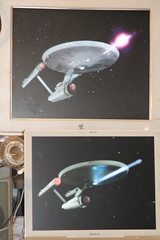
    Old & New Star Trek Enterprise Comparison

    For the occasion of Star Trek’s 40th anniversary (and for the benefit of Paramount’s pocketbook) classic Star Trek is being re-mastered in hi-def and stereo, complete with new CGI space sequences, and the occasional matte painting touch-up.

    I’m not completely against this idea, but I’ve been anxiously awaiting an answer to a question that’s bugged me since I first heard about the project. In fact, the whole idea has bugged me for… well… practically the entire 40 years.

    What’s been bugging me? Phasers and photon torpedoes. In many of the episodes (particularly the earlier ones) the Enterprise would “fire phasers” which were obviously more torpedo-like. Later in the series, phasers would be continuous beams of light, similar to a laser.

    Would the special effects folks change the phasers and finally make them into beams? They cannot change the terminology, so they’d have to change the picture. That, too, raises a dilemma: The sound effects. Do they change them, too?

    I grabbed this screen capture of the same shot from the original DVDs and the trailer for the new releases, and, I’m quite pleased with what they did.

    The old photon torpedo sound is intact, but the phaser shot has been changed subtly. The new phaser shot is like a pulsed phaser beam, allowing it to “match” with the torpedo sound, but still obviously be a light-beam weapon.

    Bravo! If the special effects had to be re-done, that was a good choice.

    Technorati Tags: , , ,

  • Faster than a speeding… Welshman?

    BBC => Doctor Who – News

    If you can get your ears wrapped around this rapid-paced interview with Russell T. Davis, you’ll get some spoilers for The Runaway Bride and season 3.

    Technorati Tags: , ,

  • Anniversaries of World Shattering Events

    IMG_2730.JPG

    It’s hard to believe that just 7 years ago today, the shape of the world as we know was changed forever.

    On September 13, 1999, the day the Earth’s moon was blasted out of orbit due to man’s careless disposal of radioactive waste on the moon’s far side.

    Who doesn’t remember the desperate hopes of the world that there might be some hope for the 311 men and women who manned our international Moonbase Alpha? Or those desperate days afterwards where the worlds largest government-contract construction project got kicked off to build the replacement artificial moon we have now?

    913 – A day that will live forever in the hearts of all mankind.

    Technorati Tags: ,

  • Macbook Down

    %&$%^&#$^%&^E^*^%*#$&^$%

    The new mainboard is starting to fail.

    Technorati Tags: , , , , , , ,

  • A Good Sandwich

    I took the family to Boston Market yesterday for lunch.

    As far as I’m concerned, BM chicken is not bad, but nothing particularly fantastic, and their stuffing has too many crisp chunks of celery and carrot in it for my taste. Still, it’s a credible alternative, and we go there once a month or so.

    Lately though, BM has had roasted sirloin and it is pretty good, but way too expensive. I usually have it anyway.

    Yesterday I noticed that they had added a Sirloin Dip sandwich, using the same roast sirloin they serve as a dinner. I figured that adding bread to the mix would make it more filling, and therefore cheaper. I’m not normally a fan of french dip sandwiches, though.

    The sandwich arrived, toasted with melted cheese on a sub roll. I noticed immediately that the sirloin had dried out in the toasting process. I tore off a piece and tried it: dry and flavorless. Things were not looking good.

    Once I tried an actual bite of the sandwich things were quite different. It was, without doubt, the best french dip sandwich I’ve ever had. I would highly recommend it.

    Technorati Tags: , , ,

  • Doctor Who – The Curse of Fenric – Review

    The Curse of Fenric
    by Ian Briggs
    1989, Story #158
    Starring
    Sylvester McCoy as The Doctor
    Sophie Aldred as Ace

    According to the Doctor in this story, the universe was once nothing except light good and evil. Then came the beginning, the Big Bang and the two forces were shattered and spread out into the Universe as echos of good and evil. The Doctor has come to 1940’s England to battle, once again, with that evil.

    Plot
    WWII, somewhere on the coast of England, Russian soldiers arrive for a secret mission, so too do the Doctor and Ace.

    The Doctor quickly infiltrates a top secret naval facility where a scientist is working on the Ultima machine – a German code-breaking “computing machine.” Something is amiss, people near the water are being killed. The local legends say it is the norse Curse of Fenric.

    The ancient runes in the local church seem to hold the answers and while everyone else struggles to make sense of what’s going on, the Doctor knows more than he is telling.

    In deciphering the runes, the British release Fenric from his 17 century imprisonment. They also unleash his “wolves”, humans mutated into Hemovores. In a word: vampires.

    Apparently, the Doctor is the one who imprisoned Fenric 17 centuries ago, using only a banana… no wait, sorry, that was a different Doctor. Fenric was imprisoned with a chess game. Now the game is on again and Ace manages to give the answer to Fenric, allowing him to defeat the Doctor… or does he?

    Analysis
    This is the second to last episode of the original Doctor Who series. I don’t think there’s anyone who wouldn’t agree that it was time for retirement for the venerable Doctor. In particular, McCoy’s final year saw a push to make him “more mysterious” again. When he started out back in 1963, we knew nothing of him, but by the time McCoy’s years had come along, more information than you could have wanted to know about the Doctor and the Time Lords was available. By this point, I think the Time Lords were guest hosting game shows and we’d been told so much about the Doctor’s background you could figure out what color poo was in his diapers back on Gallifrey.

    These efforts to make him “mysterious” again failed miserably. The Doctor would arrive somewhere and seem to know what was going on. He’d walk around amidst the chaos as if he was setting up the pieces of a game, and then, he’d pull the rabbit out of his hat at the end. (A rabbit that was obviously hidden there since the before he arrived) Crisis solved. This didn’t make the Doctor so much mysterious as it did annoying. Where’s the sense of suspense if it’s obvious the Doctor is just following a well-planned and orchestrated plot? I can tell you where the “suspense” comes from. It comes from Ace screwing things up because the Doctor hasn’t told her what’s going on. That’s just bad writing, if you have to bring along your own plot complications.

    Nonetheless, this is probably McCoy’s finest episode, he has some of his finest moments as the Doctor along the way.

    A few things do bear worth mentioning:

    • Fenric. A variation on a Norse god name. In this case, meaning wolf. He’s bad, therefore, he’s the a Bad Wolf. Coincidence? The continuing Bad Wolf theme from Eccleston’s season was never properly resolved, just swept away like an inconvenient plot point in Parting of the Ways.
    • The Doctor explicitly says good and evil existed before the universe began. Why then was the the 10th Doctor having so much difficulty that the “evil” in the Satan Pit came from before the universe began?
    • The Doctor explains you gotta have faith, absolute faith, in something and you can put up a psychic barrier to drive back the hemovores. The Doctor has no difficulty putting up a faith barrier – an extremely strong one – but, what does he have faith in?
    • Ace is given a lot of importance in this episode. We’re finally given an explanation for the ridiculous “time storm” that swept her from Perrivale to Iceworld and subsequently into the Doctor’s care. She’s been a pawn in Fenric’s game all along. On top of that, the Doctor appears to have known this all along.
    • Far from powerless during his imprisonment, Fenric apparently can conjuring time storms and influence people’s minds. He used a time storm to place Ace in the Doctor’s path and she used one to bring a hemovore from Earth’s distant future into the past for no apparent reason exceptt to make more hemovores. Why couldn’t he escape sooner, then?
    • What’s with this Earth’s future where everyone is turned into a hemovore? Hasn’t Ian Briggs seen any of the other episodes of Doctor Who? The Earth and humans always prevail. It didn’t end that way for mankind.

    Bonus material on this DVD includes the re-edited “movie” version of the story, which has been enhanced in a variety of ways, and several documentary pieces, some old, some new. The one with writer Ian Briggs really reveals someone who is just a little too obsessed with sex in his writing. There’s no actual sexual activity in this episode, it’s just that the writer says it’s all about sex from the water and swimming (everybody wants to come into the water) to wheelchairs (homosexuality). Methinks somebody wants his works to be considered more “serious” than they really are.

    Conclusion
    If you’re going to watch just one of the currently available McCoy stories, make it this one. (Not that many are available.)

    The Future
    Good news: I ordered Web Planet, Inferno and Ghost Light (2 out of 3 ain’t bad) and they should arrive on Wednesday.

    Technorati Tags: , , ,

  • Three Seasons!

    The Sun => Tennant to return as Doctor

    How come the Sun always gets the Who news before the BBC?

    DAVID Tennant has signed for his THIRD Dr Who series in a £1million deal, we can reveal.

    But the Scots actor, 35, is not expected to stay on after that as he is being flooded with film offers.

    Technorati Tags: , ,

  • Seriously, it’s just a job…

    The Sun => Billie’s so silly over new girl

    The actress, who played Tardis traveller Rose Tyler, says she threw a tantrum when she saw Freema, who plays Martha, on the cover of the Doctor Who fan magazine.

    Billie, 23, said: “I hurled it across the room. I wanted to scratch her eyes out

    OK, It comes from the Sun, so… treat accordingly, but, seriously, Billie, if it’s true: grow up. It’s just a job. You didn’t expect them to cast a badger to replace you, did you?

    Technorati Tags: , ,