Category: General

  • New theme – mobile theme

    If you’re using an iPhone or other mobile browser (are there really any others?) you may have noticed I’ve installed a new mobile theme for the website – and over at pizzalocust.com, where it is probably more useful.

    If you encounter any problems with it, please do let me know.

  • BBC (in) America(?)

    The Telegraph is reporting the merest hint of a possibility of the glimmer of a chance that the BBC iPlayer might be launched internationally via a partnership with Google.

    Now all they have to do is work out all those nasty international rights issues. Still, I’ve said it before and I’ll say it again, I’d be willing to pay a fee for proper BBC access.

  • Cricket kills Pigeon


    This is a few days/weeks old, but I don’t feel like writing much and, apart from the unfortunate pigeon, this is somewhat amusing.

  • Primeval – Series 3, Episode 9 – Review, Spoilers

    Well, New Zealand are out of the World Twenty20, so it’s time to review this episode of Primeval I overlooked. (OK, I intentionally overlooked it the first time around.)

    Synopsis

    We open with a peaceful, pastoral countryside, suddenly disrupted by horrifying freaks of nature: A camp full of young people with ATVs. But there’s more than just modern horrors in the woods, there’s also embolotherium. A prehistoric rhino-like creature. In fact, there’s a whole heard of them and they don’t half make a mess of a guy on an ATV.

    Meanwhile, Danny Quinn is following up on the mysterious woman from the future who was captured by Christine Johnson’s military. Despite Lester’s warnings, Quinn breaks into Johnson’s facility after he sees the woman being held captive inside.

    Under interrogation, the mystery woman reveals that, in the future, everyone is dead. Killed by the predators, but she doesn’t know where they came from. She also reveals that anomalies are rips in time, and that they are “everywhere”, but that some of them are invisible. She indicates that she knows how to find them, but she must talk to the people at the ARC. She is also in possession of a device which she refuses to explain.

    Danny breaks her out.

    At the campsite, the rest of the team go through the typical plot complications trying to get the embolotherium back through the anomaly, which closes before all of them are through.

    Danny arrives with the mystery woman just as a stampede causes the embolotherium to thunder towards the unsuspecting campers. Just as all looks lost, the mystery woman uses the device to open an anomaly right in front of the camp and sends the herd through.

    Dumbstruck, Danny takes her to the ARC, but not before stealing her notebook and giving it to Sarah to decode. The mystery woman, in turn, steals a gun.

    Johnson hasn’t been taking Danny’s intrusion sitting down, and is at the ARC serving Lester with a warrant for Quinn’s arrest and the surrender of the artifact.

    Danny arrives and is arrested, but then the mystery woman reveals that she is Helen Cutter using future disguise technology. She explains that she had to kill Nick Cutter to save the world, but that it didn’t work, and so she has to make sure it works next time. She kidnaps Johnson, takes the artifact and heads back to Johnson’s headquarters and her private anomaly.

    She tells Johnson that she specifically is the civil servant that caused the entire destruction of the world by the predators, and she takes her through the anomaly, where she’s killed by a future predator. Helen also closes off Johnson’s anomaly after she’s dead.

    Danny Quinn vows to chase Helen to the ends of time to stop her.

    Analysis

    I purposely didn’t write this one up because there’s so little to recommend this episode.

    The episode adds a new piece to the equation: That there are lots of anomalies everywhere, but that they are somehow invisible/inaccessible. The device Helen has seems to be able to locate and open them. Also, for the first time, there’s some indication that Conner’s anomaly detectors experience some form of crude interference when near a closed anomaly. There’s never been any mention of this before and they’ve been standing next to several closed anomalies in the past. Even still, when the interference is introduced into the show, it’s not very clear what it is or why it is important. It’s not used or mentioned again.

    It’s somewhat interesting that, when Helen killed Cutter in an earlier episode, she blamed the ARC for the release of the predators and the destruction of the world. In this episode she blames Christine Johnson. Is she just guessing? If she was right, did she create a new kind of time paradox by taking Christine into a future that she created and killing her there before she could create that very same future? Is Helen just bat-shit crazy?

    Perhaps it will all make sense in the next and final episode? (Don’t hold your breath.)

  • Death of Economical Writing?

    For those who don’t know, I’m supposed to be in England this week, getting ready to watch the ICC World Twenty20 Final on Sunday, but I’m not and therefore I’m in a grumpy mood, so rather than take it out on England’s mostly rubbish performance (Seriously, they lost a cricket match to the Netherlands?) I’m going to continue to pick on Primeval for a while.

    ITV, the people who commission and broadcast Primeval, are loosing money. Ad revenues are down, and Primeval is an expensive show, even though its ratings are good enough to deserve a renewal. ITV has decided to concentrate on “post watershed programming”.

    For Americans who read my blog, the watershed is a curiously quaint British television concept. Before the watershed is time for family programming – cute furry animals, Doctor Who and lots and lots of gardening shows. After the watershed, which I believe starts precisely at 8:23PM each night, they are allowed to talk dirty and show naked women’s breasts in the shower with water erotically cascading off their nipples. (Hence the origin of the term, “watershed”.)

    (In America we solved this problem by evolving a television industry that never makes any program than anyone would ever want to watch.)

    If ITV wants to concentrate on post-watershed programming we can conclude one of two things. People are more likely to be home and watching TV later at night, or more people like to watch women in showers. (You can decide that one.)

    Primeval, being pre-watershed, doesn’t make was much money as ITV would like. They could solve this problem in one of three ways (or a combination of all three.)

    • They could have kept Jenny (and/or Claudia) and write in plot devices that would involve herself taking more showers, thereby forcing a move to post-watershed scheduling.
    • They could write high-quality and compelling scripts to increase viewership.
    • They could learn to write economically.

    I’m going to address the later, because the other two are self-evident and before anybody says, “You’re not a scriptwriter, you don’t know what you’re talking about”, I’ll just interject the disclaimer, nope, I’m not a professional scriptwriter, but I have studied the craft of scriptwriting and I’m paraphrasing the words of people who do know what they’re talking about.

    Writing is an art. Scriptwriting is a craft. This is because scriptwriting is a part of an overall production, be it stage, radio, TV or movies. If the script is not produced, it is a failed script. Part of being able to write a produceable script is to understand the limitations of the target medium and write accordingly.

    Prolific scriptwriters learn this and turn in scripts that producers read and say, “I can make this on my budget.” Producers, in turn, remember this and come back to those same writers for more work.

    Part of the writing process is for the author to take a critical look at each and ever scene of his/her own script and ask if it really advances the plot, and, even if it does, will it be difficult to produce. When a producer receives that script, he’ll do the same thing – or he ought to.

    I contend that the writers of Primeval could easily produce a few episodes (not back to back) which did not have an incursion by an expensive CGI creature from the past or future, or even an open anomaly. They had a ensemble cast and an overarching mystery. Time could have been spent on those issues. An episode of Primeval without an anomaly should be much easier than an episode of Doctor Who without the Doctor – and the Who production team pulled that off with varying degrees of success.

    In one episode of Primeval, they appeared to cut cost corners by not showing the anomaly being locked and unlocked, despite the fact that it made for an awkward scene without the visual. Yet repeatedly, they waste their FX budget on Conner and Abby’s adopted prehistoric animals, which virtually never advanced the plot in any meaningful way. If they needed a pet for comic relief, get a dog. They’re much cheaper.

    I’m not saying that a program like Primeval doesn’t require expensive FX. It does. It simply wouldn’t work without the credible threat of time-traveling creatures, but the judicious use of them could have helped save the show from extinction.

  • Which way?

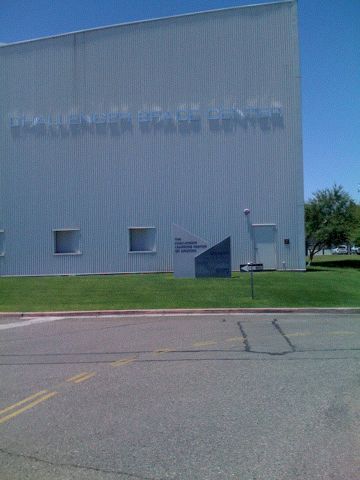
    We took the kids to the Challenger Space Center yesterday. It’s an odd building nestled inside a high school’s campus.

    Every car that entered had to pause to contemplate this.

    Do you follow the clear markings on the road guiding you right or do you follow the equally clear sign directing you left?

  • Primeval – A Tale of Three Cliffhangers

    Cliffhangers. The bane of modern television and the province of hack writers.

    Oh sure, cliffhangers have been around for a long time, they go back at least as far as the Saturday-afternoon movie series of the 30s. Cleverly designed stories intended to get the kids back each week to spend their hard-earned cash.

    Did it go back further? Did cliffhanger vaudeville shows exist? What about live theatre? DId Shakespeare ever write a cliffhanger?

    When is a cliffhanger an important plot device rather than a cheat to the audience that forces them to return to get the rest of the story?

    Even if you didn’t pay money, you’ve invested your time. At what point were you cheated out of your time by the writer stopping in the middle of a story and saying, “See ya’ later!”?

    Rarely did this used to happen in “real” movies. The first I can recall, The Empire Strikes Back, was a horrible cheat. The story had no resolution at all and was nothing more than a setup for the third and final movie. Given the choice, I would have preferred to wait and watch both at the same time, rather than waiting years between them.

    TV series began this sort of thing sometime back in the 80’s (As I recall, anyway). Presumably as a means to get viewers to write the networks and demand their show be renewed. Cliffhanger? Artistic statement or cynical attempt to manipulate the public?

    As you may have ascertained, I’m of dual-mind on the subject. When I know, in advance and with my own agreement that a story is a cliffhanger, I have no problem with it. When there’s a four-part Doctor Who, I know parts one, two and three are going to end of a (sometimes horribly lame) cliffhanger, but I also know the story will completed and the end of part four and that my investment of time will be rewarded. (Horns of Nimon, notwithstanding.)

    So, let’s look at Primeval. I gather that Primeval is taking a week off and next week will be back with the series’ finale. I also gather that DVDs of the third series are already “in the wild” and you only need do a few minutes research on the net and you’ll know what happens next week. For the sake of disclosure, I might through this discourse reveal spoilers about the finale, as it’s been spoiled for me.

    Let’s start at the beginning with series one.

    Anomalies started forming, strange creatures were getting through. Paleontologist Nick Cutter accidentally (or through the intervention of his missing wife) gets drawn into the story. Also, Stephen his assistant, Conner a student and Abby a zoo worker are drawn in. They get bound up by the Official Secrets act and start working with Lester and Claudia Brown. In the first episode, with an anomaly open to the Permian, Cutter goes through and finds a dead human skeleton and a camera. When the pictures are developed, they are of his missing wife, Helen.

    We have a mystery – several actually. What are the anomalies? Who is the dead person? What does Helen know?

    Through the series, we learn nothing about the anomalies. They are, as best we can tell, freak natural events with no rhyme or pattern. We do learn, slowly, that Helen knows something about them and that she has some connection with Stephen.

    We learn that there are “junction points” of anomalies, where multiple anomalies exist, which Helen seems to be able to navigate.

    Finally, a terrifying future predator comes through the Permian anomaly (apparently another anomaly exists in the Permian which leads to the future.) Cutter, along with Helen and military backup take some orphaned (Cutter thinks) baby future predators through the anomaly in an attempt to find the future anomaly, but they escape in the Permian.

    Cutter realizes, too late, that this second Permian anomaly isn’t exactly the same as before. It now leads to an earlier point in the Permian. One of the team is killed (leaving the human skeleton that Cutter found previously (in the past’s future) and Cutter also takes the photos of Helen that they retrieved from the camera.

    Escaping with lives, Helen and Cutter return to the present, not realizing that baby predators were left behind.

    In the present, Helen reveals that she plans to continue exploring the anomalies and drops the bombshell on Cutter that she had an affair with his trusted friend and confidant, Stephen, then escapes into the closing anomaly.

    Only then does Cutter learn that Claudia Brown has ceased to exist and no one remembers her except himself. End of series one.

    Let’s look at that cliffhanger a little in regards to the context of the series.

    There were really two mysteries in the first series. One was the anomalies themselves and nothing really was learned about them at all. They started for no apparent reason, appeared with no apparent pattern, and had no apparent one-to-one relationship between time and space. They were presented as almost a force of nature – one that is not understood, but cannot be avoided. It’s the mystery that is not to be solved. Perhaps it has no solution.

    But there was a mystery or two that could be solved: Who was the dead body, and what was Helen doing having her picture taken in the Permian? These mysteries were cleared up. The writers gave us the answers that they had been promising. The cliffhanger, with Claudia Brown being going and time being changed was new, unexpected and a teaser. I can’t say I liked it, but it was a surprise new mystery.

    In the second series, once again, we’re presented with a series of mysteries. The anomalies continue in pretty much the same fashion, albeit with the added factor of Conner’s anomaly detector telling them where they are.

    In the second series, we wonder who is the traitor at the ARC? When we learn it is Leak, we wonder what’s he up to? Will Stephen be fooled by Helen? Will he betray his friends? How dumb can Conner be about his girlfriend? Who is the mysterious “Cleaner” who dies in the first episode but shows up again and again?

    By the end of the series, all these questions have been answered, with the possible exception of the identity of the Cleaner. At least we are informed at the end that he is not one indestructible person, but an army of identical individuals. There’s not much of a cliffhanger in series two. It’s more Helen pointing out that time can be changed and that, perhaps, she’ll be bringing Stephen back. No cliffhanger is really needed, because after the first series started airing, Primeval was guaranteed two more series production.

    Now we come to the third series. Ratings have been steadily declining, but the series is still popular. Ad revenue is down, but the cost of the show is high. The fate of Primeval is uncertain.

    This year we start to learn something about the anomalies. They’re been around forever. (Well, obvious really, since know they go back at least as far as the Silurian.) More than that, they’ve been around throughout human history, undetected. They can be predicted, first by Cutter’s model, then by the mysterious future ARC artifact. They can be controlled with a proper (again future ARC) device. There is another government conspiracy aiming to use the anomalies for purpose or purposes unknown. They can be captured and moved using magnetism. They can be locked down. They have something to do with a mysterious government project from before the second world war. Finally, at last, the mystery of the anomalies is beginning to unravel.

    Helen’s back, and she’s got a new mystery. She has seen the future. Mankind has been destroyed by the future predators. For some reason, she blames the ARC and Nick Cutter for unleashing the predators on the world. She has a crusade to save the world and she is so fanatical she kills Cutter to prevent the future she has seen. It doesn’t work. The mysterious artifact from the future has some purpose, but what?

    So how do we fare by the end of the third series? In, we learn nothing about the cause of the anomalies. Do the mysterious future devices create them or simply open and close existing one. Looking at episodes 9 and 10, it seems in episode 9 they can open one anywhere, but in 10 you have to seek them out – and they clearly can’t be opened to just any point in time and space. We learn nothing about the pre-war project, in fact, the team ignore it completely. We know nothing of Christine Johnson’s military project. They do nothing with the ability to move anomalies. We learn that, in the future, the ARC has the technology to map and to open and close anomalies, nothing more. From episode 9 to episode 10, Helen’s plan to save mankind from destruction at the hands of the future predators suddenly becomes a plan to save the big, beautiful Earth from mean old mankind instead. All she had to do was look at the future without man to realize that the world didn’t need saving, it took care of it itself. Her madness dies with her at the end of the series. So, with the exception of Helen attempting to stop… something, all the mysteries in series three are left unanswered. On top to that, they strand Danny in the Pliocene, and Abby and Conner up a tree in the Cretaceous.

    This is a series’ ending designed nothing more than to irritate people into demanding another series of Primeval, but perhaps they’ve forgotten the most important thing. If you shit on your audience too often, they don’t always come back.

  • Radiant Heat Barrier

    Summer is on us again in Arizona.

    This year we’re not going to be doing home improvements but we did get some radiant heat barrier similar to what we installed in the attic two years ago to install in our laundry room.

    We have a back room which was added onto our house many years ago. The room has a western exposure and is entirely lined with windows. The room has no heating or cooling so during the summer the room builds heat like no one’s business.

    I’ve now barriered the windows and the temperature has been held down to 95 degrees. A huge improvement.

  • Adventures in Objective-C – Part 2

    On the subject of the Stanford University (iTunes U) iPhone Programming class.

    I had a professor at university who walked in the door on the first day, slammed a book on the podium, and in a loud Germanic accent bellowed, “There will be no stupid questions in this class! The only stupid questions are the ones you don’t ask.”

    To my young, impressionable 17 year-old mind, it made so much sense that I thought it almost profound.

    The problem is, youthful idealism can be rapidly eroded away.

    There are stupid questions. The ones that used to particularly annoy me were when a fellow student would ask the professor a question that had just been covered or had just been asked by a different student and answered by the professor.

    I remember sitting in class thinking, “Pay attention next time. You’re wasting my time.”

    These unpleasant memories all came flooding back to me during the first few videos of the Stanford iPhone class and I really thought I might have to give the whole endeavor a miss. When I was 17, I didn’t have to take blood pressure medicine.

    Fortunately, within the first few classes either the offending students were gone, or they’d gotten with the program. Since then, it’s really been invaluable to my study of iPhone programming. Typically, books have never worked well for me hen learning a new programming language/paradigm/whatever.

    Hands on is what works for me but even that needs some “seeding” with some information. The iPhone developing environment/community was stifled for some time. Apple’s (some say) draconian non-disclosure agreement for early developers prevented source code and discussions from appearing on the net. It even prevented books on the subject from being printed. Thorough as Apple’s documentation is, it’s better as a reference than as a starting point. There hasn’t been a whole lot out there until recently.

    I’ve completed plowing through “Beginning iPhone Development: Exploring the iPhone SDK” (Dave Mark, Jeff LaMarche) and am most of the way through initial development of my first iPhone application – more on that another day – so I’m not coming at this class completely cold. Nonetheless, it has helped me resolve numerous logical problems with my in-development application. This is not because the detail or content of the course is far-reaching, but simply because…

    Let me digress for another moment.

    Here’s another thing that I learned very quickly at university. Not all professors are created equal. In the Computer Science Department in the College of Engineering they had two kinds of professors. They had staff professors who carried a typical teaching workload and they had professionals who worked at some of the local companies who came in and taught the 7:20AM classes and then nipped off to to their real jobs.

    You could guarantee those 7:20 classes were the best. In Computer Science knowledge and theory are essential but there is no substitute for solid, real-world experience. The professors who had both were awesome.

    So back to the class. The two lecturers, Alan Cannistraro and Evan Doll, both Apple employees working in iPhone development, really demonstrate their knowledge of the subject. It comes across best when they’re answering some of those (good and/or not-so-good) questions from the class. More than once, when they switch over to do some code on-the-fly or respond to something that’s just askew from their prepared lecture I have those, “A Ha!” moments that get me closer and closer to understanding.

    I feel this class is really a good example of what iTunes U can do. While I’m not exactly sure what the incentive for universities are to put things in iTunes U, this has convinced me to check out some other courses.

    I read yesterday that the Stanford iPhone class has had over a million downloads. Impressive. Of course, if that represents 1 million viewers, (which I doubt it does, but we’ll just use that number for giggles) that still means that at least 900,000 will do nothing with what they learn. That leaves a 100,000 who will try and 90-95% of the them will probably have to go buy Macs to do Xcode development on. I can see why Apple seems happy to share its employees in this project.