Today was the day we celebrated Michelle’s birthday. In the morning, we gave her a present to tide her over, and took her out to the park to play.
By the time we got out, 10:00AM or so, it was swelteringly hot and humid. We lasted for the better part of an hour and headed out for lunch. (Dinner celebrations had been planned by my in-laws.)
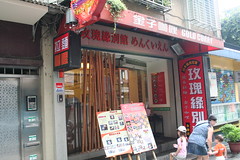
We ended up back at the Rose Garden restaurant, which I reviewed earlier. Once again I had the curry katsu – this time at full hot and spicy – and it was delicious. I can’t recommend their curry sauce enough. This time I paid closer attention to their URL, which I had written down wrong before. Their URL is www.oisiiyo.com, and while the site is in Chinese only, I was able to get Irene to read up and get better information.
They are not a Japanese chain as I previously stated. Their story is that a Japanese citizen, living in Taiwan, missed his Japanese Ramen, and so went to Japan and convinced the winner of the best ramen in Japan award to share his recipe so that he could set up a shop in Taiwan. That was a success and later, he went back to Japan and got the recipe for curry from the winner of best curry in Japan.
I love the traffic lights in some cities in Taiwan. They have a countdown timer that shows exactly how long both the red and the green lights last. (Not sure about the yellow light.)
I’d like to think there’s no negatives to this scheme, but, of course, some jackass will use the knowledge of when the light is changing to speed up and run the intersection in a dangerous fashion.
An easy walk, even in the rain, from Taipei’s one Long John Silver’s is Dunkin’ Donuts.
What could be better than finishing off a nice fish meal with a tasty chocolate-frosted doughnut?
On my last visit, Mr. Donut had recently opened in Taipei, and the lines were horrific. Nonetheless, we had to try them and we were very disappointed. Perhaps that is the way they like ’em in Japan (and/or by extension, Taiwan), but doughnuts devoid of most sugar aren’t really doughnuts. That’s why I was looking forward to the introduction of a good, sweet American doughnut to the Taiwan market.
Dunkin’ Donuts prohibits photography in their establishment, but this being Taiwan, I decided to ignore that prohibition. It’s a flippin’ doughnut for cryin’ out loud! Why can we not take pictures?
OK, to the doughnuts. First, disclaimer. There are (or were) three major doughnut chains in my part of the US. Dunkin’ Donuts, Winchell’s and Krispy Kreme. To me, Winchell’s was the bast because it was the least sweet of the three. (But still far sweeter than Mr. Donut.) Krispy Kreme being at the ultra-sweet end of the spectrum.
I went with two basic types, chocolate frosted (which would be called Chocolate Raised back home, to differentiate from cake doughnuts) and Glazed (Glazed Raised back home.) Both were pretty close to the “originals†with a couple exceptions. Both were drier, which could possibly be a slight change in formula or they were a bit old. Second, the chocolate was distinctly less sweet, more of a bitter-sweet chocolate, but still good.
Maybe Krispy Kreme will move in and, adjusting the sweetness down to local taste, might be the best of all.
If I get the change, I might stop by for more Dunkin’ Donuts, but I won’t be high-tailing it out to Mr. Donut anytime soon, despite the fact that they’ve cropped up like cold sores all over Taipei.
I admit it, I’m a long-time patron of Long John Silver’s. My family used to eat there in Tucson at least as far back as 1974. While it’s not completely 100% authentic English Fish & Chips, it’s not too far off the mark, and it’s been very consistent for the last 30+ years. (Remember, I live in the desert, seafood is not the specialty of the region.)
Long John Silver’s has recently opened up in Taipei and my curiosity is too much for me. I was looking forward to eating fish & chips, especially since the apparent demise of the Frying Scotsman, this was my only opportunity. I was also quite curious to see how they’d “adapted it for the local market.†(Which is usually a euphemism for “screwing up the food.â€)
The restaurant was bright and clean, and more upscale than in the US. The food was served on real dishes and silverware! Swanky!
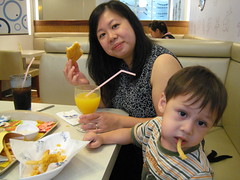
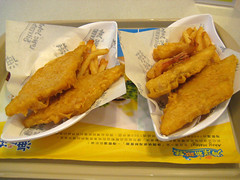
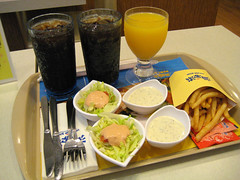
The combos didn’t appear to come with fries, so we ordered some separately. Then it turned out that the combo did come with fries, so we had far too many. My combo was two pieces of fish, fries (chips), a salad and an American-size soda.
My wife’s combo was one fish, one piece of chicken, two shrimp, fries, the salad and the drink.
I tried some of both my fish and my wife’s chicken. Here’s the verdict.
Salad: Well, this just isn’t a US item, so I have nothing to compare it to, save that it was lettuce with some Thousand Island dressing. (Thousand Island is the ubiquitous salad dressing of Taiwan. Taiwan must be one of the thousand islands.). Edible, but tiny. Thousand Island had an unusual hint of something like horseradish in it.
Fries: Absolutely typical LJS fries. I’m not a fan of them, but they were spot on.
Chicken: I noticed no difference between this and the domestic version.
Fish: The cut of the fish, the batter, the look and the feel were all exactly right. The fish was well-cooked and fresh. One thing – I’m not sure it was cod. Domestic LJS uses cod, which of all of nature’s fish has been bestowed the ultimately gift: It doesn’t taste like fish. Except, once in a while, you get a piece that turns a darker color towards one end of the fillet. Then, it starts to get a fishy flavor. This fish, from start to finish, has that fishy flavor without being the darker flesh. It’s not terribly strong, but it is distinct.
Because of that taste, I preferred to eat the fish with sauce. Something which we presumed to be an odd-looking tartar sauce was provided, but it turned out to be something like a cross between Ranch dressing (minus the buttermilk) plus garlic and sugar. We ordered an extra side of Thousand Island dressing (NT$ 5) which was closer to tartar sauce. I didn’t see malt vinegar or salt anywhere.
I had a similar experience on my first trip to Taiwan. At the time, I ate a lot in MacDonald’s because everything tasted exactly like back at home. It might not be good, but it tasted like home. Everything, that is, with one exception: The Filet O’Fish sandwich. That tasted fishier than the real thing. I’ve always wondered, is the difference based on the supply chain or an adaptation to the local taste?
Still, LJS was enjoyable and they seemed to be doing a fair amount of business. Perhaps they’ll survive until my next trip here.
Honestly, I really do have a brother-in-law, he’s not just a comic fabrication that I use to add levity.
He’s got a girlfriend – the same one he had last time we were here. We haven’t figured out why they’re not married yet. Then again, maybe it isn’t that hard to figure out why they’re not married yet.
Batrina (That’s the girlfriend. Don’t ask me where she got that moniker.) is going to England to study at Leeds for 1 year.
The picture here is a nice new piece of luggage/backpack that was on the floor when we got home from Alishan. It’s Johnny’s. It hasn’t moved for two days. He’s got no reason to use it. Why did he buy it then?
My wife got the story from Batrina. She bought it for Johnny. Long-term girlfriend going away for a year to a foreign country, buys her boyfriend a new piece of traveling luggage: It doesn’t take a rocket scientist to figure this one out.
Johnny’s response: “Oh, you wasted your money. I don’t need luggage.â€
I’m going to buy him a shirt that says, “I am a cartoon character.â€
One of my favorite pastimes in Taipei is to drop into the subway system, pick a station I’ve never been to and go there to explore. Since most of the stations are subterranean it’s impossible to have a feel for where you are.
Each station has a map showing what’s around it. Maddeningly, they’re oriented in a random fashion. North is almost never up, which makes it more difficult to visualize.
I chose Yongning station because of three reasons: (1) I had no idea where Yongning was (2) It’s the terminal station on the subway’s blue line, and (3) It’s a new station, completed since the last time I was here.
When I arrived, the map provided with with little hope, the major landmarks in the area were a cemetery, a waste water treatment plant and a cement factory. No parks, museums nor shopping complexes.
When I popped my head out of the station, I noticed that I was near one of the perimeter mountains around Taipei, that it appears to be an industrial area and that it was beginning to pour rain again. With my trusty umbrella in one hand, GPS in the other, I headed out in a direction that turned out to be South-West. The most distinct landmarks were the cow statues in the middle of a street. No clue what that was about.
What a bleak area. Double-stacked freight trucks plied up and down the streets, honking at each other constantly. Packs of wild dogs roamed the streets, following people menacingly and the inhabitants just stared at me like they’d never seen a foreigner. This area certainly seemed off the beaten path for tourists.
About 1.5 to 2 Km out from the station, I decided I’d had enough. The storm had turned into a proximate lightening storm, and I’m not comfortable walking in the lightening with an umbrella/lightening rod. I needn’t worry about that for long, for the wind started picking up, blowing at almost gale force. At one point, while crossing a street, the wind caught my umbrella and shredded it. The metal stays tore through the fabric like a big metal spider. One of them latched into the back of my shirt and tore a hole in it, effectively locking the remains of the umbrella around my head. I had a hairy, blind moment or two as I fought the monster off.
I was glad I visited, but I was equally glad I’ve “checked off†Yongning station and aren’t likely to need to return.
This trip to Alishan and Fenchihu happened to be about the same duration as our 1998 trip. We arrived at Alishan late on the first day, took the train down to Fenchihu mid-day the next, returned to Chiayi mid-day the next. On our trip in 2005, we really took the time to explore the Alishan completely, but bypassed Fenchihu.
Fenchihu is a small town, but due to tourism, has more than one hotel. We decided to stay in the same hotel we stayed in last time, but this time we upgraded from a “wood†room to a Japanese tatami room. (In Taiwan, which gets most of its tourists from Japan, it’s not uncommon to have hotel rooms designed specifically for them.) I’ve just always wanted to try a tatami room.
It was a nice room, with a full computer-controlled environment system and 42“ wide-screen hi-definition TV. On that 37†TV we have over 60 channels of the worst reception I’ve ever seen in my life. If nothing else, at least I got to watch an episode of Primeval.
Being in the middle of the week, there were no other guests in the hotel at all.
Apart from being a pleasant escape from the city, we didn’t find much of anything in Fenchihu the first time, but we also felt like we must have missed something. In preparation, I did a flickr search for all photos tagged with “fenchihu.†(I also searched for those tagged with the proper name in Chinese and a couple alternate romanized spellings. What I found were a lot of pictures of the same four or fice things: The railroad tracks, the old steam engines, bian dan, the ticket station, some landmark. There were other things, but the majority of people posting pictures didn’t get beyond 100m from the train station.
This time I decided I was going to make a photo collection of the “real†fenchihu.
Up before anyone else, even most of the locals, I was out on the streets taking pictures. One of the things I like about Taiwan is, when you get to these small towns, if you can get past the broken-down garbage dump nature of a lot of the places is that everything looks so lived in and make do. (I think it’s the look they’re going for with the inside of the Doctor’s TARDIS, although perhaps without so many old plastic bags.)
I personally wouldn’t want to live this way, but I find it fascinating to observe.
As with most things along the Alishan Forest Railway, Fenchihu owes its existence to the lumber industry and the train that brought the lumber down from the mountains. In the old days, Fenchihu was the spot where the trains would switch engines. The next leg of the journey required more powerful engines and when the train arrived in Fenchihu, the stronger engine was up to steam and ready to go.
More recently, the town has erected a museum, of sorts, to bring more railway tourism. The museum, which costs nothing, contains a couple on the old steam engines, a few pieces of the machinery used to work on the engines and lots of pictures. Our hotel provided us with a free tour (Chinese only) which included a lecture on the background of the trains.
Once a year or so, they trot out the old steam engines, which were used from 1912 up until the 1980’s, for the railway buffs. This might or might not be a secret: none of the steam engines work, so they’re retrofitted the inside of one with a diesel engine so it can move around.
The second thing that apparently brings people to Fenchihu is the bian dan. One place in particular is the most famous. As it happens, this also happens to be the hotel we stayed in. The owner is wily old bird. His picture can be spotted in several places around town. Not just his photograph, but professionally done advertisements of the old man, sitting like some old zen master chef contemplating his creation.
Too bad the food didn’t live up to the expectation. The bian dan I got the day before on the train was better.
There are also some (typically) quite steep hills with trails (read: mountain staircases) in the area. The tour guide took Irene and me up a short on the evening we arrived, and I explored another before breakfast.
After we left our room we tried another path that was equally as vertical, this time with the kids. By the time we returned to the train, I was really feeling the pain in my calves.
Cold and miserable, I went to sleep very early. As a consequence, I woke up very early also. The sun wasn’t quite up, but the sky had lightened and everyone else was asleep. While not cloudless, it was clear and pleasant, so I got out for a walk before the others awoke.
Recently, I upgraded to Photoshop CS3, which has a dramatically improved photomerge capability. Most of the time it produces excellent panoramas, and today I planned to give it a real workout. One of the problems with Taiwan’s mountains is that everything is so dense and the hills so steep that everything is “in your face.†With the widest lens I’ve got, I can’t take pictures of most of the “sights.â€
This time, I’ve burned through a massive number of photos designed to be stitched together, which I’ll do before I post them to flickr. I’ve put together a flickr set of my panoramas. I’ve put this together partially because Flickr’s thumbnails are cropped to fit, so it’s not always possible to tell the photo is a panorama unless you look at it.
Not all of the “panoramas†are really left-right widescreen affairs, either. They’re technically “photomerges.†Sometimes I used to capture vertical scale, such as towering trees, and others just to compose a fairly ordinary photograph that I couldn’t capture with a single shot.
After my walk, I returned for the all-you-can eat breakfast which is included with the price of the room. At the hotel’s coffee shop, a cup of hot black tea costs NT$ 100 (over US$ 3), but at breakfast, it’s included free. I made sure I got US$ 20 of tea with my breakfast.
Our checkout was at 11:00, but the train to our next destination wasn’t until after 1:00PM. We walked around the hills in the morning, checked out and went into town to have lunch and caught the train to our next stop, Fenchihu.
This was a very short trip to Alishan, cut even shorter by the rain when we arrived. It’s such a pleasant place, but there’s not a lot to do once you’ve seen the sights, which are just in a very small area. I’m actually more jazzed to explore Fenchihu more completely. Our first trip there was very short and confusing, so I’m hoping to get a better chance to explore.
The four-hour train ride up the Alishan Forest Railway was entirely in a torrential downpour. It’s a slow, rough, precarious train ride on ancient narrow-guage tracks, originally put in at the turn of the last century by the Japanese. The train is short on amenities, but at least it has a toilet. (The first time I road this train, back in 1998, the toilets just dumped right onto the tracks. There was a general prohibition from using the toilet when passing through the small towns.)
In many ways, the train itself is part of the tourism draw of the area.
I’m going to cut corners and glean info from my previous trips’ narratives rather than repeat myself. In 1998:
From Chiayi we took the “world-famous†Forest Railway, an old, small gauge train built by the Japanese in 1912 that winds it’s way up the steep and beautiful mountains from 31 meters at Chiayi to over 2000 meters at the town of Alishan.
I was repeatedly told that the Forest Railway is world-famous, but have yet to meet a non-Taiwanese person who has heard of it. It’s quite impressive, nonetheless.
The entire journey begins in a tropical rain forest, and takes you through semi-tropical forests and then finally into a temperate forest where ancient pines grow.
Shrouded in clouds, the mountains around Alishan (including Alishan, which is also a mountain) are eerie. The small clouds crawl across the surface of the mountains like living creatures. At anytime, these roving amoebae-like monsters might swallow the ground you stand upon.
Nothing has changed except the toilets. Nine years later and I’ve still never met anyone who’s heard of it, unless they’ve been to Taiwan. I would think it would be more well-known among railroad buffs… and perhaps it is.
The railway is precarious, there’s no other word for it. At times, looking out the window it is impossible to see anything below you except a several hundred meter drop. It’s been hacked into the sides (and right through) the rugged mountains by brute force, without an inch of tolerance.
In 2003, the train slipped off the tracks killing 17 people. It’s easy to see how these sorts of things can happen.
The ground in Taiwan’s mountains is prone to liquefaction resulting in frightening mudslides. Several people are killed each year during heavy rains. That thought was passing through my mind the whole time we travelled up the rails in the downpour.
At one point on this journey, the train slammed suddenly to a stop, while the engineers got out and inspected the tracks ahead. It as impossible to see what was up there, but after a few minutes, we proceeded slowly without further incident.
The final stop, Alishan, is one of those landmark “highest in the world†railways stations, but I don’t remember what the disclaimer on that one is. Highest in southeast Asia, highest narrow gauge rail station, highest station built by the Japanese between 1900-1920… I just don’t remember. It’s not the highest in the world, but it is some sort of highest station.
The grade and terrain is so difficult that the engineers of the railway had to create a unique solution to get the train to the top. They were forced to build switch backs into the rail line, allowing the train to work back and forth up the last stretch of the mountain.
When we reached the halfway point, the town of Fenchihu, it was raining cats and dogs. The town is “famous†for its bian dan, the Taiwanese version of the Japanese bento lunch. At the stop, which is about 3 minutes, vendors rush onboard the train selling them. Considering our luck with food so far, we figured the rain was so hard they’d just stay home. Luck was with us and, rain or shine apparently, they brought us welcome salvation in the form of food. Of course, bian dans are frequently pork chops, but I didn’t care. (I believe in this part of the country, they’re made with wild pigs that run in the mountains rather than slopped by Taipei’s garbage.)
The meal also featured something that I think was sausage, a chunk of something I think was ham and something that Irene says was fish cake, but I’m inclined to believe it was another sausage made entirely of pork fat. I didn’t care, I was at the point of starvation.
When we arrived at Alishan, if anything, it was actually raining harder, and it was cold – something like 12ºC (54ºF), which was a far cry from the temperatures of 32º (90ºF) in Taipei. Once soaked, wearing clothes appropriate for Taipei, it was bitterly cold.
The first time I came there was a train station. The next time, which was 2 years ago, the train station was gone (possibly lost in the 921 earthquake) and a new one was under construction. Instead you disembarked at a “temporary†station, which is just a platform. You then have to pay to get into the Chaoping Park, which is what the area is actually called.
The new station still isn’t built. According to my father-in-law, it was finished and failed building inspection. It had to be torn down and started again. Sounds to me like somebody didn’t grease the inspector’s palm enough. Obviously, that story could be apocryphal, too.
So we disembarked at the “temporary†station, which they’d thoughtfully put up small canopies so you could hide under, but the choke point at the pay station was crowded and everyone got soaked. Then you have to walk down a steep hill with all your luggage to a bus which will take you to the hotel.
The rain never let up and we were stuck indoors for the rest of the evening. A check with the front desk revealed that, with the weather being what it was, no one had been seeing the sunrise or the sea of clouds, so we decided to sleep in and hope that the morning would be clear for getting out and hiking.
I love the high speed train, and don’t want anything to sound like a negative, that’s why this is a different post. It’s not really about the high speed rail, but it is related.
The High Speed Rail station in Chiayi is ultramodern, efficient and even has both a 7-11 and a MOS Burger. (MOS has really moved into this country whole hog. They even have a concession location at the National Concert Hall.)
Here’s the problem: While the HSR arrives at the Taipei Main Train Station in the center of town, the stops along the way tend to be outside town – way outside town. We arrived “at†Chiayi exactly on time, but we were literally nowhere. We had to take a shuttle bus to the main train station.
It was lunchtime and we hadn’t eaten, not even breakfast. I thought about stopping at the MOS Burger in the station but, when we asked how long till the bus arrived, were told it was “any minute.†As it happens, I know that there is a MOS Burger within 2 blocks of the Chiayi Rail station that we’d be catching the next train at. We decided to wait rather than risk missing the bus. The connection time wasn’t tight, but it wasn’t leisurely, either.
As the bus arrived (after 15 minutes) so did the torrential rains, again. Perhaps it is because Chiayi is in the tropics, but the rain was even worse than in Taipei. The time ticked away and the bus slowly made its way through the rain. This bus driver was apparently the only one in Taiwan who won’t run scooters off the road or fudge through red lights if no one is looking. We hit every red light and at one point were stuck behind a scooter who was literally weaving back in forth (in the torrential downpour) in front of the bus – as if he was trying to slow us down.
When we finally arrived at the station, we only had 2 minutes, and there is only one train up the mountain each day. We started running across the station, which, like most stations in Taiwan, there are tunnels under the tracks, so we had to run up and down the stairs. Irene and I were both packed down with very heavy backpacks, but she had to pick up James (26 lbs) and I had to pick up Michelle (40 lbs) and run at full speed.
We just caught the train. I was so winded I thought I was going to pass out. Fortunately, the train up the mountain is 4 hours, so I had plenty of time to rest. Too bad I was still without food.