Episode 004 – Doctor Who: Amy’s Choice
We’ve put out the latest episode of the Fusion Patrol Podcast. This week we discuss Amy’s Choice.
Posted using ShareThis
Episode 004 – Doctor Who: Amy’s Choice
We’ve put out the latest episode of the Fusion Patrol Podcast. This week we discuss Amy’s Choice.
Posted using ShareThis
Summary
The Doctor decides that Rory needs to go on a date with Amy and so he picks him up at his stag night and whisks the two off to Venice in 1580. They encounter a mysterious Countess who runs a school for pale, slightly creepy girls who hate the sunlight. They are, of course, not really vampires but alien crayfish refugees intent on sinking venice and repopulating their race.
Analysis
No matter how hard I try, I just could not care less about this episode. I don’t actively hate it (like Love and Monsters – go on, read my review of that, at least I had some emotions about it) but I am completely and utterly apathetic about it. It killed the better part of an hour and little more.
…and… that’s… about… it.
Oh, surely I can come up with something to bitch about.
This reminds me a lot of Toby Whithouse’s other Doctor Who script, School Reunion, which was mostly enjoyable only for the return of Sarah Jane Smith and not for the imaginative story-telling. He’s got a thing for vampires and faux-vampires, though. Next thing you know, he’ll probably be writing a series about them…
I’m sick of the low-level perception filter gimmick. Let’s get back to aliens that either look human or look like guys in rubber suits.
The Doctor is completely trying to be Jerry Lewis in this episode. I hate Jerry Lewis.
Ben and I discuss this story on Episode 3 of the Fusion Patrol Podcast.
You can listen to it here
We’ve heading into uncharted territory now. Historically, I’ve reviewed most new Doctor Who episodes right here on the blog, but now that we’re doing the Fusion Patrol Podcast, I’ve been letting it slip.
The fact is, we’re not really doing reviews at the podcast. I’ve likened to a book club discussion, although, not having attended a book club, how would I know? Basically, we’re just having a discussion about what we think about the episode – so, maybe it is a review. In any case, I’ll try to synthesize some of that down here as my “review.”
Summary
In Time of Angels, the Doctor is re-united with River Song, the archaeologist from the Doctor’s future, first introduced in Silence in the Library. River has cleverly arranged for the Doctor to answer her call and come to her assistance, where she is helping a crack military squad of clerics to neutralize a Weeping Angel: a bizarre quantum-locked alien species that can only move when they’re not being observed. The starliner Byzantium was carrying the angel, but it crashed on a planet, releasing the angel.
As the clerics attempt to work their way through catacombs towards the wrecked ship, Amy is unwittingly infected by one of the angels. The clerics are being killed off one-by-one and only too late does the Doctor realize that all the statues in the catacombs are angels, and they are being brought back to life by the energy from the wrecked starliner. Surrounded, and trapped in a cave just meters below the wrecked ship, things look very bleak indeed.
In Flesh and Stone, the Doctor manages to get the survivors aboard the ship, but the angels are aboard, too. As they make their way through an artificial forest inside the ship, the mysterious crack from Amy’s bedroom wall puts in an appearance, threatening to swallow everything.
Amy must keep her eyes shut to stay alive, and she is left in the care of the cleric, but one-by-one, they are swallowed by the crack and cease to have ever existed. Amy must pretend to be able to see, to fool the angels into leaving her alone, and navigate blindly through the forest to reach the Doctor and River.
Can the Doctor stop the angels and close the crack which threatens to devour the entire universe?
Analysis
From my point of view, this two-parter was an exemplary episode of Doctor Who. While it’s still fresh in my mind, I’d almost say the best episode since the series returned in 2005.
In pacing, it is unlike any new series episode to date. Even though it maintains suspense from end to end, it is slower than most new series episodes. Midpoint during each 45 minute episode, comes an almost perfect “cliffhanger” point – as if this story was written to be four, 22 minute episodes ala the classic series. I much prefer this pacing and really wish Steven Moffat would convert all the stories into two-parters. That said, the resolution to the problem of both the angels and the crack did present itself rather quickly and conveniently right at the end and wasn’t really any of the Doctor’s doing. In effect, his cleverness just kept them alive long enough for them to get lucky. That was probably the most dissatisfying part of the whole story to me.
We (the audience and the Doctor) are meeting River Song for only the second time, but from her timeline, she’s met the Doctor many times before, and knows about his future. Last time, we learned that she was someone very, very important to the Doctor in his future and that he trusted her with enough knowing his real name. This time, which is much earlier in her timeline, we learn that she is a murderer and is being held in prison for that crime. She has only been released so that she can help the expedition, “control” the Doctor and try to earn herself a pardon.
During the first episode, it’s not revealed that she’s a prisoner, but it is revealed that the Doctor might not help her if he knew “…who and what [she is]…” At that point, I began to suspect that a beautiful piece of plot contrivance on the Grand Moff’s part would be to have had River die in the first episode that the Doctor meets (which she did) and for the Doctor to die the first time River meets him. That idea was bolstered in my mind when she stated that she had “pictures of all his incarnations” which is only possible if she’s in a timeline after the Doctor is dead. That she was his killer also fit with the “who and what” comment, in that what she is is his murderer. Logical to assume that he’d not want to help her under those conditions.
I thought I was being particularly clever reasoning that out in the first episode, but then they started beating it over our heads in the second episode. Revealing that she was in prison for murder, they she’d murdered a great man, a hero to many. She herself even tells the Doctor, when confronted, that she killed the greatest man she’s ever known.
In slippery Grand Moff style, though, the crack in time has put the idea in the Doctor’s head that time can be “unwritten” and he seems oddly comforted by that idea. Perhaps he thinks he can unwrite River’s crime, or, on a bigger scale, perhaps he can unwrite the Time War, the rise of Rassilon and the destruction of Gallifrey.
On the other hand, if he tries something that big, perhaps he causes the crack himself?
I would like to point out that, while I don’t really give a toss about season-spanning story arcs, I am pleased that this seasons story arc at least appears to be playing out meaningfully during the season, rather than just being a series of catchphrases badly interjected into the scripts with no bearing on the stories. The Bad Wolf syndrome has a been a great, dead albatross hanging around the nexk of the past four series, and I hope it’s gone forever.
Amy, in this episode, is both playful, brilliant and somewhat useless in equal measures. The later is not really her fault, as she’s blind, about to die, all alone in a forest full of angels and terrified out of her wits. Who wouldn’t be useless under those conditions?
All-in-all, one of the best episodes for a long, long time.
No review of this episode would be complete without discussing the final scene, set in Amy’s bedroom, on the night before her wedding (also the night she left with the Doctor.) In no uncertain terms, Amy, having just been terrified for her life, tries to get a leg over on the Doctor.
Prudish I might be, but the tone and content of the scene just felt wrong to me. It didn’t really have a place in a program aimed (partially) at such a young audience, but this is a criticism I’ve had ever since the series returned in 2005. This was just the single most overt expression of it yet.
While I didn’t like it, it was logical. It’s the logical extension (at least in the TV world) of Amy’s lifelong obsession with the Doctor, her fears about marriage and her very near brush with death. It was a accurate portrayal of humanity.
What I did appreciate, though, was that the Doctor clearly felt the same way: This is a totally inappropriate Doctor/Companion interaction, and he puts a stop to it. My hope is that this is the Grand Moff telling us that, “…we’ve pushed the issue to it’s logical conclusion and there’ll no more of that going on in the TARDIS while I’m at the helm.”
I’ve got no real to make a blog post this morning, I just feel like I’ve been neglecting the blog lately.
Ben and I have put out three episodes of the Fusion Patrol Podcast and we’ve got over a hundred subscribers, which boggles my mind. Pretty good considering we’re just rambling on about Doctor Who.
I suspect that the statistics don’t account for unsubscriptions, but that could just be my pessimism in action.
Recording via Skype is both remarkably simple (w/extra software) and incredibly frustrating, as there’s no obvious way to “balance” the various inputs. We’ve been swapping microphones and I think much of the problem is in the microphone input. If I could get two identical mike/headsets, it might work.. That wouldn’t address the possibility of bringing in a guest host in the future.
After the current series of Doctor Who, we’ll be moving on to the classic series, Sapphire and Steel. It’s a real weird one.
Last week, Ben and I put together our first podcast.
I’ve decided to revive Fusion Patrol in a slightly different format. Originally, Fusion Patrol (made for public access television) was intended to be a community affairs type program for the science fiction community. It was supposed to be news and events and a showcase for local talent. As these things happen, it evolved quickly into more of a science fiction comedy skit program. Such is life.
The new Fusion Patrol Podcast isn’t any of that. It about TV and Movies (science fiction, mostly, of course). I’ve always enjoyed watching a program and then sitting around with similarly inclined people and picking it apart discussing its merits and shortcomings. In that respect, I rather like the recent fad of book clubs, I just want to make this into a different media form.
We’re picking the low-haning fruit for the next 8 weeks ago and we’re watching and reviewing the new episodes of Doctor Who as their air, but after that, we’ll be launching into old classics like Space: 1999, UFO, The Star Lost and The Prisoner.
The podcast is now available in iTunes, or you can find it at podcast.fusionpatrol.com. You can also interact with us on twitter. We’re @fusionpatrol.
No, this isn’t my review of the first half of the two part story that started thus week with the Time of Angels.
I’ve been toying with the idea of doing a podcast on science fiction/fantasy TV shows and, while we’re experimenting, it looks like we’ll get our feet wet with podcasts on the remaining episodes of the year’s Doctor Who.
More details soon.
This is really going to me more about the Daleks than this week’s episode of Doctor Who, but we’ll do both.
Victory of the Daleks is the Moffat-era reboot of the Daleks, and they desperately needed a reboot, but will this really be an improvement?
Summary
Winston Churchill calls the Doctor to the Cabinet War Rooms during the London Blitz to introduce his new secret weapon against the Nazi’s, the Daleks – although he doesn’t know them as Daleks, but instead as Ironsides, created by Prof. Bracewell.
The Doctor goes F-ing crazy to try to prove they’re nasty little alien Daleks and when he finally confronts them face-to-face proclaiming himself to be the Doctor and they to be the Daleks they get all happy and leave, but not before revealing that Bracewell is an android they created as a cover story, but he thinks he’s a real boy.
Back on the Dalek ship, they use the recording of the Doctor to prove they’re really Daleks and start the Progenitor device: A Dalek gene-bank to create a new army of Daleks. The Daleks threaten to destroy the Earth, the Doctor saves the Earth, but the Daleks escape.
Analysis
This first non-Moffat story of the Moffat-era is entertaining, but ultimately empty. It’s nothing more than a vehicle to unleash the Daleks into the Who-universe once more. The Dalek plan seems nearly hare-brained, the plot device that says the genetically-imperfect Daleks can’t activate the Progenitor device is ridiculous to begin with (wouldn’t it be better if anyone could turn it on with the right passcode?) and the resolution of just having the Doctor admit they’re Daleks being good enough to overcome the lockout beggar’s belief.
Before I go on about the Daleks, let me take a moment to talk about the rest of the episode. Spitfires in space, fighting Daleks, yeah, Ok, that was fun. Winston Churchill, not much of a key player, looked a little fatter than I remember. Amy did a nice job, but then she’d brighten any scene she’s in. Prof. Bracewell as the misguided android did a nice job. (And he likes girls.)
But let’s go back to the Daleks.
Do you know what it takes to make a genuinely mediocre episode of Doctor Who? Answer: The Daleks.
Confined in their metal city on Skaro, in a claustrophobic setting, they were a credible threat. Unleashed on the universe, they’re a joke. I’m sure the writers of the original Doctor Who knew that. Just look at the Dalek stories starting in the Pertwee era. They are absolutely the most unconvincing villains ever created, but they’re popular with the punters and they just had to keep bringing them back. Even back then, their master plans were idiotic. Hollowing out the cores of planets, running their own funeral parlor, etc. The power of nostalgia overcomes people when thinking about the Daleks.
Then a funny thing happened, Russell T. Davies, an admittedly massively nostalgic fan of the original series, came along and he wanted his Daleks to be menacing – like he remembered them in the misty, poorly remembered corners of his mind. (Keep this in mind, They were never menacing, it’s just his memory failing.) So, during his reign, the Daleks were brilliant and massively powerful. One single Dalek could wipe out an entire city. They’re really, really dangerous.
Problem is, if they’re so smart, that might be able to learn and adapt and become peaceful, even productive members of the universe. Not to mention that, but, if they did take over the universe, what would they do with it? Really, they’ve got no good motivation, either. Can’t have that, let’s make them insane too! It doesn’t matter how dumb the idea, right up to and including destroying reality itself, they’re up for it. They’re crazy, the audience will buy anything they want to do.
No, we won’t.
The Daleks should never have been made so smart and all-powerful that they could destroy all of reality, no more than the Time Lords should have been made powerful enough to destroy all of time itself. When you get villains that big and powerful any plot you come up with just gets dumber and dumber and the resolution more insane.
The Daleks desperately needed a reboot (as do the Time Lords). Perhaps these new Daleks, unaware of what’s transpired, will be closer to the older Daleks. Big enough of a threat to take over whole planets, subjugate whole races of people, launch intergalactic wars. but not big enough to contemplate the total destruction of the fabric of reality. Let’s give the Doctor something I can believe he could defeat using his wits.
So with this story, let’s all wish on the first star we see tonight and send Stephen Moffat some psychic messages. If we can’t have “no Daleks, ever”, then at least let’s wish for “sensible Daleks.”
A lot of ire has been spreading across the ‘net regarding the look of the new Daleks. I can take it or leave it. Since they barely ever looked menacing, I don’t think the new ones are much of a departure. They’re bigger, they’re colorful, they’re still laughable.
Not a review of Victory of the Daleks but does contain a reasonably small spoiler.
Something extraordinary happened in Victory of the Daleks that really made me feel like Russell T. Davies is finally gone.
As the Doctor and Amy tried to bring out Prof. Bracewell’s humanity, Amy asked him if he’d ever fancied someone he knew he shouldn’t. Bracewell admitted that he had and that the person had been… a woman!!!
I hate to apply generalizations, but you know damned good and well if RTD were in charge it would have been a man.
I’ve been doing some testing today on the iBook e-reader that Apple provides for the iPad. I’ve not-so-much been testing the reading experience, but testing the capabilities for outside material.
You can, of course, buy books directly from Apple’s iBookstore and they even have a selection of free e-books – of exactly the kind you’d expect from Project Gutenberg – but you’re not limited to e-books strictly from the iBookstore. Apple has chose to use the epub standard. so I thought I’d give that a test.
First, I went to epubbooks.com and downloaded a free book. By simply dropping it in iTunes, it transferred to my iPad on the next synch. No glitches.
Next, I was working on a programming project and I needed to consult the online, PDF manual. Of course, I could have easily brought the PDF up on the iPad, but I remembered that some people used software to convert PDFs to epubs. I downloaded a piece of software called Calibre and soon had my PDF document converted to epub. The results were passable, although the PDF conversion didn’t always get the pages or pictures formatted correctly.
I also used Calibre to convert and RSS feed into an e-book with mixed results. My own blog came out near picture perfect, but a friends apparently upset the applecart and the whole thing came out an unreadable mess.
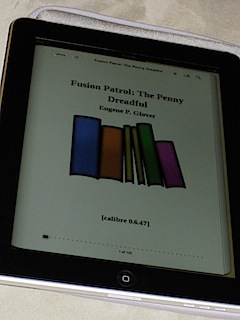 Finally, I took a Fusion Patrol novel I started writing last year and converted it to an e-book. Like some many other writing projects, I made it about a third of the way through and got distracted from finishing it. For a lark, rather than just checking out how well it had formatted, I decided to read it end to end.
I don’t know how other people interact with their writing, but for me, writing is somewhere between a torturous chore to a matter of necessity. There are times when I just must write, but then as the steam wears off, it becomes painful to continue.
Then comes the second-guessing phase. After a certain period of time, if I go back and re-read my earlier works I usually find (A) typos and (B) that I hate what I wrote.
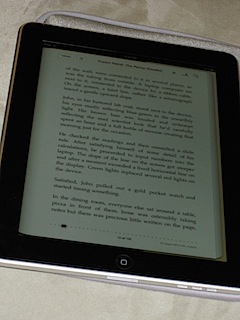 But every once in a while, I look back and I say, “Hey, that’s not bad.” and so it was with Fusion Patrol: The Penny Dreadful (working title). I actually like what I wrote.
It looks good as an e-book, too. Consider this to be a “sample”.
Now I have to finish it.
It seems that most of the feedback about the new Doctor Who series is positive, save for one thing – the new credits and the new music.
Now, I must admit the new music was immediately a huge letdown for me. It grows on you a bit, but overall I’m not impressed. I decided that I might be prejudiced against it because it was new and different. I decided I needed to listen to it – a lot. The other day, I put that version on the iPhone, hit repeat one song and let it fly during my entire commute. I contemplated every note, every sound, every voice and internalized them.
Then, by way of comparison, I put all versions of the theme music (sans the 8th Doctor telemovie) into a playlist, put them on random and did much the same on my next commute. I’m now ready to pronounce judgement.
First though, let’s standardize our frame of reference. The Doctor Who theme consists in four basic parts: There’s the opening beat, that, thinking back to the Tom Baker years, represented the opening of the time vortex, which follows the main theme itself, which is the sort of howly bits, then there’s the fanfare, which I believe Murray Gold called “the middle third” and was absent from Eccleston’s theme music but added back for the Christmas Invasion. This bit was also usually missing during Tom Baker’s era and only showed up on six-parters that required longer end credits. Finally there’s the ending which is mostly a rehash of bits of the main theme repeating out sometimes ending with a sting.
Taking this new theme apart, I dislike the intro. Gold has added a new theme that isn’t Doctor Who at all overlaying and overpowering the proper parts.
The main theme could be good, perhaps great. It starts well with something similar to the original electronic version, but they discordantly crashes into something orchestral with little high-pitched noisemakers that set my teeth on edge. They’re probably flutes or piccolos or something. Get rid of them. On the other hand, he also uses a small, discreet bit of choral music which works well, and makes it sound darker. best of all, it’s just a little bit, not like his overpowering choral Dalek tunes.
The fanfare suffers the same problem, good foundation, damaged by high-pitched squeaky wind instruments. Some points for some very subtle wobbly sound effects that sound like things flying off into space.
Finally the outgoing part is mostly fine, gone are the obnoxious instruments, leaving us with the pleasant version, but all too soon, it’s over. Here’s hoping next year they’ll try again and learn from this mistake.
It used to be that there were “Science Fiction Theme Song” albums where various artists where Neil Norman, Jeff Love or some orchestra would cover Sci-Fi theme songs. Universally, Doctor Who did not make the translation well. Particularly bad were the orchestral versions, for precisely the reasons I’ve outlined here. The pitch isn’t suited for an orchestra. It shocked the heck out of me when Gold was able to pull the Eccleston/Tennant version off using an orchestra. I think part of the success was lowering the tone and not hitting those high notes.
Still, it’s not the worst “official” version of the Who theme tune, that honor goes (as with so many other “worsts” in Doctor Who history) to the Sylvester McCoy version.
It’s all subjective, but here’s my countdown.
So there it is. I’ve been meaning to rank the theme songs for years now and I’ve finally gotten around to it. Let the complaints begin! 🙂
*Edit 2014-09-20 – edited to properly reflect the guilty and clear Mark Ayres name!