Blog

  • New MacBook Pro – Initial reactions

    Haunted MacBook Pro By now you all know the sad tale of my home being burglarized last month and the villains getting both my wife’s laptop and her iMac. Luckily, my old laptop was with me, or it I have no doubt would be gone, too. My wife decided she didn’t need a desktop and a laptop and opted to get just a replacement laptop. And so, as a consequence, I’ve decided to sell my MacBook, which was getting a bit long in the tooth and replacing it with a newer, bigger model. Effectively, we’ve been reduced by one computer.

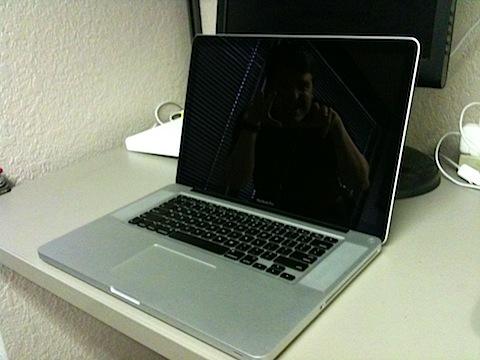
    My new laptop is a MacBook Pro 15″ model, with the 2.66 GHz processor. (Shown in the picture with a phantom in the screen).

    Like many people, I had to play the “should I buy or should I wait?” game. Rumors have been flying for weeks that a refresh to the MacBook Pros are due and while I doubt the prices would go down, certainly specs would go up, but in the end, I decided I’d rather have a nice, stable model, which already has plenty of horsepower.

    So far, I think it’s pretty fantastic. I was put off by the unibody, sealed battery design, but in my first test, I got five full hours of near continuous use. Not quite Apple’s estimated seven hours, but by far the longest I’ve ever seen a laptop run on a single charge. There is a noticeable difference in the battery drain when using the high-energy consumption video subsystem, and after the first hour, I switched that off.

    In comparison to my old MacBook (first generation) here are the things that really stand out:

    1. The LED backlit screen really pops.
    2. It’s obviously much faster
    3. The backlit keyboard is really nice in a darkened room, but at an angle, makes the whole computer look like a xmas tree because of light spilling out from under the keys.
    4. The light sensitive display takes some getting used to. The brightness will adjust if someone walks in front of your light source. It’s very quick and distracting.
    5. The larger speakers make for better sound
    6. The SD card reader… I haven’t used. The bastards stole our camera, too.
    7. The no-button trackpad is great – once you get used to it. After only one day, it’s hard to use the old MacBook’s pad because I forget I have to click the button. It’s cool to be able to write Chinese by just drawing the character on the pad, too.
    8. I’m not sure I like the feel of the aluminum. I almost feel like it’s always going to slip out of my hands.

    So after one day, it’s thumbs up all the way. For now.
  • Neil deGrasse Tyson on Science Fiction Movies


    I just don’t give my blog enough love lately. I always seem to be posting videos and links to Facebook instead of here, so, here’s a good one.

    Neil deGrasse Tyson is one of the most articulate and entertaining scientists and skeptics out there. Here he is talking about one of my favorite topics: Technical inaccuracies in motions pictures. 🙂

  • A light in the tunnel for Simon Singh?

    I think I’ve been neglectful about reporting on Simon Singh’s case. I suppose it’s too late for me to go into a comprehensive summary of the case, but let me hit the high points as I recall them.

    Simon Singh is a science writer in the UK, he wrote a critical article about chiropractors and their lack of reliable, objective evidence demonstrating efficacy of some of their claims, particularly with regards to certain childhood ailments and asthma. He used the word “bogus” and, having read the original piece myself, I think it was quite obvious the word “bogus” meant “ineffective” rather than “fraudulent”.

    The British Chiropractic Association sued Singh under Britain’s laughingstock-of-the-free-world libel laws. The initial ruling was determined by a judge that Singh meant fraudulent and allowed the suit to proceed. In the face of enormous legal bills and with the support of skeptics, scientists and writers from around the world, Singh continues his fight in the hopes of causing much-needed reform of the English libel laws.

    Meanwhile, the BCA has been unable to provide any real evidence that their claims are true, and have been caught instructing their members to remove such claims from their websites. (Nah, they don’t sound like they know their treatments don’t work, do they?)

    Today, they were at a pre-trial hearing, and things are, for the first time, sounding good:

    Presiding at the appeal court in London today in a pre-trial hearing on the meaning of words in a 2008 article by Singh criticising chiropractic treatments, Lord Chief Justice Lord Judge said he was “troubled” by the “artificiality” of the case.

    “The opportunities to put this right have not been taken,” Lord Judge said.

    He continued: “At the end of this someone will pay an enormous amount of money, whether it be from Dr Singh’s funds or the funds of BCA subscribers.”

    He went on to criticise the BCA’s reluctance to publish evidence to back up claims that chiropractic treatments could treat childhood asthma and other ailments.

    “I’m just baffled. If there is reliable evidence, why hasn’t someone published it?” [From Index on Censorship » Blog Archive » Judge ‘baffled’ by Simon Singh chiropractic case]

    Update: You can learn more about the “problem” with English libel laws here: The Libel Reform Campaign

  • Fusion Patrol on Vimeo

    I’m experimenting a bit with Vimeo instead of YouTube. So far, quality on Vimeo looks much better.

    This is the first in a probably endless series of videos put together from years of all the junk we shot for Fusion Patrol.

    Alternate Fusion Patrol Titles (1995, Unused) from Eugene Glover on Vimeo.

    Originally shot in 1995, this is one of several attempts to revamp the opening titles for Fusion Patrol.

    This footage was deemed unusable, largely because of the awful quality of the performances and pacing, and was never edited together.

    Subsequent improvements in video editing software availability made it possible to digitally trick this into something… meh… but much better than possible using the old, finicky analog linear editor we had at the time.

  • Charlie Brooker on Psychics and Creationism

    I’ve only recently heard of Charlie Brooker, when one of his videos concerning how news reports are made went viral (or at least viral in the circles I follow.)

    Since then, I’ve been “catching up” with his series, Screenwipe and Newswipe where he has a very refreshingly incisive view of television and the news.

    Here he is in the newspaper, too, waxing very sensible about psychics (and creationism, too):

    I mean, if you want to believe in psychics, fine. You’re a dangerous idiot and I wouldn’t trust you to operate a spoon without putting an eye out … but fine. Your choice. Delude yourself silly. Your world is probably more fun than the real one. There’s no death, just an afterlife filled with magic spirits who like to communicate with eerie, ugly, otherwise-unemployable bottom-of-the-barrel “showmen” back on Earth.

    But don’t accuse anyone with the temerity to question your sad supernatural fantasies of having a “closed mind” or being “blind to possibilities”. A closed mind asks no questions, unthinkingly accepting that which it wants to believe. The blindness is all yours.

    From The Guardian – When it comes to psychics, my stance is hardcore: they must die alone in windowless cells, by Charlie Brooker.

  • OSX Time Machine – Brilliant or Bust?

    Aren’t backups a wonderful thing?

    As an IT professional, I can tell you that most people never backup their computers.

    Organizations are a bit different. Most recognize the need for backing up, but fewer actually test their backups.

    In OSX Leopard, Apple recognized that people don’t backup their computers. Further, they recognized that, increasingly, our lives are recorded on our computers – from our personal documentation to our priceless photographic memories. In Leopard they introduced Time Machine, an automatic backup and recovery system designed to make the process painless and automatic.

    I’ve used Time Machine since it first came out and, like most most people, I’ve had no real reason to need it.

    Oh… I’ve restored the occasional file, but it’s never been critical… until now.

    When we were burglarized two weeks ago, they took, amongst other things, my wife’s iMac. We know that the burglary occurred between 10:30 and 11:30AM because at 10:38, her iMac made one last Time Machine machine backup across the network. If there was any positive thing to take from this it was that we had a full and complete backup of her machine in Time Machine format. But how well would that work when we went to restore it onto a new computer?

    For starters, we had some data that we needed immediately. Part of the Time Machine enhancements in OSX Snow Leopard is the ability to open other machine’s backups, so we were able to use my laptop to open and verify her backup, plus grab some important files right away.

    Now that her replacement computer has arrived, it was time to put the backup to the real test: Restoring her entire old computer backup onto a new computer, with a completely different hardware configuration. The old computer was a 24″ iMac with 350Gb of disk – 200Gb used – the new one, a new model MacBook with 250Gb disk.

    The first thing I did after the burglary was to backup her backup – before I started trying to restore files from it. Time Machine backups are stored in a single file and I copied that file from the network backup drive onto a spare external drive. I had hoped that I would be able to use the external drive to restore the backup as that would be faster than pushing the entire restore across the local network.

    When the new MacBook arrived, I plugged in the external drive and fired up the machine per the instructions. When you setup a new Mac, it allows you to copy your data from another machine – a real timesaver if you’re migrating from one machine to another. One option is to copy from a Time Machine backup.

    Unfortunately, this didn’t work. It simply failed to recognize the external drive as having a Time Machine backup.

    My remaining option was to try to restore from the network. I joined the local network and the MacBook instantly spotted my Time Machine drive.

    That’s when the next problem occurred. The drive I use is a terabyte drive, partitioned into 4 different drives, each containing the Time Machine backup for a different computer on my network. The MacBook spotted and reported all four drives. I selected the one associated with the iMac and it asked me to log in. It went into a never-ending wait, displaying simply the word “connecting…”

    While that continued on for half an hour (before I gave up), one of the other drives almost immediately popped up stating “1 Time Machine Backup Found.” This was worrisome. Could it be that Time Machine was too confused by having four different drives? Certainly, I didn’t wish to restore the drive it was indicating was available. All the while, the “right” machine was failing to complete its connection.

    I tried several times, using both my wireless connection and a hard-wired connection, with no difference in result.

    Eventually, I decided that I’d see what happened if I selected the “wrong” Time Machine backup. Lo and behold, it presented a backup that was for the right computer. It somehow was showing me the backup for my wife’s computer on the Time Machine for my computer – probably because I had opened her Time Machine with my laptop to restore those files right after the burglary.

    And so I began preparing for the restore. There was just enough room to restore everything and after it thought about the backup for about 10 minutes, I let me select everything at start the backup.

    Estimated restore time over the gigabit LAN: 5 hours 10 minutes.

    Here I am, six hours later and it has just finished.

    And what’s the verdict? It was slow, a bit problematic to get going, not entirely intuitive, disappointing in that it couldn’t see the external drive with a copy on it but ultimately absolutely brilliant!

    I am looking at an almost exact copy of my wife’s computer, intact and catching up on back e-mail and a few system updates.

    Time Machine really saved our bacon on this one!

  • Twenty20 Cricket – A Guide For Neophytes

    I’ve got several friends coming over tomorrow to watch last week’s final of Australia’s KFC Big Bash Twenty20 cricket final; however, they basically know little or nothing about cricket.

    I was going to mail them this guide, but why should I waste pages of writing that I can blog instead? 🙂 So here it is… warning, some of it might be apocryphal.

    Introduction

    Cricket is an internationally-played sport, with strong support amongst mostly former-British colonies. The major cricket-playing countries are India, Australia, South Africa, New Zealand (Go Black Caps!), Pakistan, The West Indies and Sri Lanka. I’m told England is a major cricketing nation also, but all their best players are South African


    In part because of the enormous population of India and the relative rabidness of several of the nations involved, cricket is the second most popular sport in the world by some measure. (I don’t know what that measure is, though.)

    There are three basic formats of cricket: First Class, One-Day and Twenty20.

    First-class cricket has been around the longest, quite literally hundreds of years, and has been a major influence on the English psyche. The next time someone says “they’re bowled over” or “they’re stumped” you can reflect upon how cricket has invaded the English language. (It’s not just phrases like, “That’s a sticky wicket, old boy” or “I say, that’s just not cricket!”)

    First-class cricket is also the only form you’ve probably heard about if you’re the average American. With it’s all-white, antique uniforms, leisurely play and restrained, politely clapping audiences it’s the image American’s most associate with the game and the eccentric English. It’s a game that plays all day, for 3 to 5 days, includes lunch and tea breaks and often ends in a resultless draw. The international form of first-class cricket is known as Test Cricket.

    While first-class cricket really does offer the opportunity for teams to plan and execute strategic campaigns and for players to really exercise all their skills and endurance, it also encourages slow, conservative play. As such the game is best (IMHO) only watched in 30 minutes highlight reels at the end of the day of play. I can appreciate the Mona Lisa, but I wouldn’t have wanted to watch Leonardo painting it stroke-by-stroke.

    One-day cricket was developed in the 1960’s-1970’s as a way to overcome testing the endurance of the audience at first-class matches. One-day cricket is also known as limited overs cricket, and in it’s most common forms are 50 or 40 overs per side. This effectively puts a time limit on the game, making it last only one (full) day. One-day cricket is played both domestically and internationally. (One-Day Domestic [ODD] and One-Day International [ODI])

    One-day cricket will be dead and buried in 10 years in favor of Twenty20 (again, IMHO) as it no longer fills a meaningful niche.

    Finally, Twenty20 (or T20) cricket, started in 2003, is the newest form of the game, designed for the era of working people and television audiences, neither of whom can devote even a single day to come out to watch a match.

    T20 is also a form of limited overs cricket; this time capped at 20 overs per side (hence the name) which, combined with time penalties for delaying the game, gets the match finished in 3 hours – consistent with most other televised sports. Unlike first-class cricket, T20 can be played under stadium lights and is more suited for matches to be played in the evenings on workdays.

    T20 is often criticized because, without the luxury of days for playing, players are forced to accelerate their game and take “excessive” risks for the sake of scoring or entertaining the audience. Critics argue that many of the more subtle skills developed over the centuries are being lost.

    Perhaps they are, but all I can say to those critics is, “evolution is a harsh mistress,” and “say ‘hi‘ to the stegosaurus for me when you get there.”

    New skills and tactics are being developed rapidly in T20, and the old ones still have their uses, plus, T20 is bringing in new and larger audiences. Young audiences that are encouraging kids to take up cricket again. T20 is the future of cricket.

    Things common to all three forms of cricket.

    The ball

    • The ball is just a hair larger and heavier than a baseball, and is of a similar construction.
    • The ball as a single, raised seam around the circumference of the ball. This seam is used by the bowlers to control the ball’s behavior.
    • The ball is red (the traditional color) in 1st-class cricket and white is limited overs cricket. This is because limited overs cricket can be played at night and the visibility of the red ball is difficult.
    • The white ball also has visibility problems, particularly as it gets dirty, and they are experimenting with other colors, such as a pink ball.

    Teams

    • Each team consists of 11 players and a “twelfth man” who brings the tea. (These days, it’s gatorade.)
    • The twelfth man is also the substitute player for an injured fielder but not for an injured batsman.
    • A team consists of a mix of four types of players, “batsmen”, “bowlers”, “all-rounders” and a “wicket-keeper” Except for wicket-keeper, these are not formal positions but are considered the players specialty.
    • Batsmen bat, bowlers bowl, all-rounders do both and wicket-keepers perform a task equivalent to a catcher in baseball – although any and all players may be called upon to do any particular job.
    • There is also a captain (often called the skipper) who is usually a senior player. The skipper, not the coaching staff, makes all the decisions on the field during play.

    The Field

    • A cricket field is called “an oval”
    • The oval is an irregularly shaped field (roughly oval) with a boundary rope approximately 55-75 meters out from the center.
    • Boundary ropes are placed closer to the center in T20 matches to encourage higher scores.
    • There is also a marked “inner circle” which is an oval measured 30 yards from the “stumps”
    • In the center is the “pitch”. The pitch is a 20 meter strip of hardened surface that most play takes part on.
    • At either end of the pitch are the “stumps” – three wooden poles, with small cross-pieces on top called the “bails”
    • The stumps are also called the “wickets”, but so too the pitch is sometimes called the “wicket”. This is a little confusing.
    • The bails are placed so that the slightest disturbance of the stumps will cause the bails to pop off.
    • There are two lines painted perpendicular to the pitch just in front of the stumps. These lines are “batting crease” and the “bowling crease”
    • The bowler must deliver the ball from behind the bowling crease.
    • The batsmen must be safely behind the batting crease to avoid being “stumped” by the wicket keeper.
    • The creases represent the “safe” line for batsmen who are making runs between the stumps.

    Play of the game

    • A cricket match consists of two or fours innings.
    • An innings is considered one side’s turn to bat (unlike baseball, in which an inning consists of both teams getting to bat once.)
    • A team bats until ten wickets have fallen or the captain “declares” his team’s innings to be finished or, in limited overs cricket only, the total number of overs has been played.
    • An innings is broken down into “overs.” An over is a unit of play in which one bowler bowls six balls from one particular side of the oval.
    • At the end of an over, the bowler must change, and play shifts to the other side of the oval. In other worlds, they go over to the other side of the pitch.
    • As each over is bowled by a single bowler in a single direction. This means that if batsmen hits the ball and runs only a single during that over, the non-striker becomes the striker and vice-versa.
    • At the end of the over, a new bowler must take over and bowl from the opposite end but the batsmen stay in their current place, therefore the striker becomes the non-striker.
    • An over consists of 6 legal deliveries. Certain types of throws are not allowed and if the bowlers bowls an illegal delivery, one run is given to the batting side and the ball must be bowled again.
    • A coin toss determines which team captain gets to pick if they wish to bowl or bat first.
    • This decision is usually based on the weather, the perceived characteristics of the pitch and a team’s general preferences.
    • The first side batting’s total score is called “the target” In 1st class, the target is the sum of their two innings. In limited overs it is their score from their first (and only) innings.
    • The second side batting must then “chase the target”, attempting to exceed it by 1.
    • A game stops immediately if the second team surpasses the target.

    The Batting Side

    • Two batsmen must always be on the field, which is why there are only 10 wickets available. Once the tenth man is out, there would only be one batsman left on the field.
    • A batsmen bats until his wicket is taken (AKA, he’s out)
    • A batsmen stands at the crease, generally in front of his stumps, defending his stumps. (In cricket, the batting side is considered the defensive side.)
    • A batsmen can only defend the stumps with his bat. If he uses his body to prevent the ball from hitting the stumps, he looses his wicket. (This is called “Leg before wicket” or “LBW”)
    • If a batsman hits the ball, he and the other batsman on the field (called the striker and the non-striker, respectively) attempt to “run between the wickets (stumps)” – that is, they try to exchange places, scoring one run each time they change ends.
    • Runs can be scored by hitting the ball in all directions. The field of play is 360Âș.
    • If a batsmen hits the ball that lands anywhere inside the oval and then rolls or bounces outside the boundary rope, they score an automatic four runs without having to run. (A score of four in this way is also called a “boundary” – again, a bit confusing, so often just called “a four”.)
    • If the ball is hit directly outside the boundary without touching inside the oval, six runs (a “maximum”, “maximum boundary” or “a six”) is scored.
    • Unlike in baseball, a ball hit into the audience must be returned. A single ball is used during an innings and the gradual breakdown of the ball during play and the different play characteristics of an old ball is part of the strategy of the game.
    • If a fielder catches a hit ball on the fly, the batsman looses his wicket.
    • If the bowler can strike the stumps (dislodging the bails) with the ball while the batsmen is defending, the batsmen looses his wicket.
    • If a batsmen running between the stumps fails to reach his crease before the fielding team can dislodge the stumps with the ball, the batsmen looses his wicket.
    • In T20, in most instances, the 20 overs are bowled rather than all 10 wickets being taken.
    • For a batsman, significant milestones in scoring come at 50 runs (a “half century”) and 100 runs (a “century” or a “ton”) in a single innings.
    • Few half centuries are scored in T20, perhaps less than 1 per match, and centuries are very rare and represent a major achievement. In 1st-class cricket, some of the all-time greats have managed to score triple centuries.

    The Bowling or Fielding Side

    • Bowling is an overarm, straight elbow throw, usually bounced on the pitch before it reaches the batsman.
    • The ball can be thrown anywhere within a fairly large area, roughly from the ground up to the batsman’s head, and from just behind the batsman’s legs to a point about bat-length in front of him. (A batsman typically is standing perpendicular to the bowler so “in front of” or “behind” really means left and right of the batsmen, depending on his left or right-handedness.)
    • In cricket, bowlers will attempt to hit the batsmen with the ball, which is completely legal in most instances. They do this to intimidate them, incapacitate them or to get them out LBW.
    • Bowlers are broken down into two major categories: “Seam Bowlers” and “Spin Bowlers”
    • Seam bowlers rely on speed (reaching 90+ MPH speeds), swing (a curve in the air before the ball bounces) and seaming (the ball bouncing unpredictably when it hits the seam of the ball against the pitch.)
    • Spin bowlers are much slower, but use a variety of finger and wrist techniques to put English on the ball, causing the ball change course as it hits the pitch. The greatest spin bowlers can get the ball to deviate 30 degrees at times.
    • The bowler (and the side’s captain) can control the field positions at will, and depending on what the bowler plans, they will set the field and try to force the batsman to hit the ball to a fielder.
    • In T20, a bowler can only bowl a maximum of 4 overs in a match, therefore a team must have 5 bowlers, minimum.

    T20 Specifics

    • A ball being bowled is called a “delivery” (That’s not specific to T20)
    • In T20 there are 20 overs per side, therefore (20 overs * 6 balls per over * 2 teams = 240 deliveries per game.)
    • There is a 75 minute per innings time limit. This limit is imposed on the fielding side.
    • The umpire can also penalize either team for excessive delays
    • In T20, there must be a winner. If the scores are level at the end of the second team’s innings, a “Super-Over” is bowled. Each team picks three batsmen and one bowler and a single over is bowled for each team. Highest score in the super-over wins.
    • In T20, as well as other forms of limited overs cricket) there are certain “fielding restrictions” – that is, certain rules regarding where a captain can position his fielders.
    • The first six overs of a teams innings are called the “Powerplay”
    • During the Powerplay only two fielders are allowed outside the inner circle – this encourages batsmen to play riskier shots to hit the ball over the heads of the in-fielders.
    • Teams have colorful uniforms.
    • T20 has cheerleaders, loud music, wild crowds and often fireworks while 1st class cricket audiences are expected to be quiet, with only clapping. No music or other distractions is allowed. It’s not unheard of for an audience member to be asked to stop talking on their cell phone.

    Finally


    • Umpires will not call a player out unless asked for a ruling by the bowling side, therefore, in any instance where the bowlers think they’ve taken the batsman’s wicket, they will scream an appeal at the umpire, usually the phrase “how is that?” – often shortened into “HOWZAT?!?!?” or something even less intelligible.
    • Batsman, in keeping with the traditions of “playing cricket” are expected to “walk” off the field if they know they’ve lost their wicket without the need for the umpire to give a decision.
    • Fielders, in the same vein, are expected to honestly report if the failed to catch a ball or prevent a boundary.
    • That’s considered “cricket” however, in these days of television-assisted umpiring, it’s not uncommon for a player to wait until a final call has been made.
  • Security with Frickin’ LASERS…

    IMG_0121I’m not the most “glass half-full” person in the world, but I do try to pry some minor comfort from a situation that can only really be called a “loose-loose situation.”
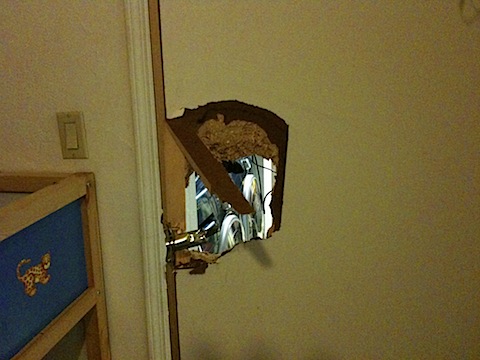
    Last week, our home was burglarized. I can tell you, it’s quite an unusual feeling to come home on a normal day, start about your normal home-arrival routine and start to notice that “…things are amiss.”

    After the obvious almost-physical impact of discovering our Wii, all the games, two computers, iPods, jewelry and other sundry items missing, there’s days more of stumbling across little things, like a pair of headphones or a knife missing. Each time you stumble across something it drives home again that… no matter what you do, you cannot fully protect against this sort of loss and it is an enormous invasion of your personal space.

    So what’s the positive side? Well, it’s hardly a positive side, but I’ve spent the better part of the week re-enforcing the home defenses. New deadbolts, metal re-enforcing plates, new doors, surveillance systems, alarms and most importantly… and this is the part I like… a security system with frickin’ lasers.

    Expensive? Yes.

    I only wish I could have worked sharks into it somehow.

  • iPad… is there a gap to fill?

    IMG_0139I’ve been shying away from reading commentary today about the iPad, mostly because I wanted to form my opinions in a vacuum (like I always do 🙂 ) on the device.

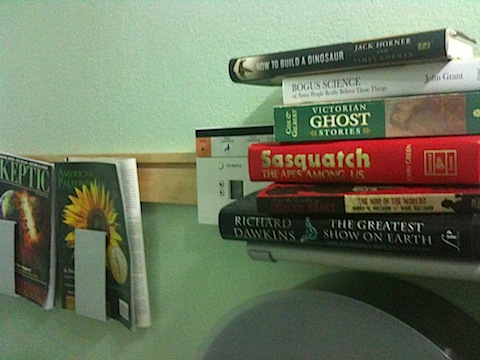
    I’ll say in retrospect that I am one of those people who thinks a tablet computer is generally a bad idea… at least as a mass-produced consumer good. Apart from specialized vertical markets, I’ve just not been convinced that I’d have a reason to use such a device…

    …and then there’s the e-book reader.

    I can’t get thrilled about e-book readers, either. Certainly, I read enough books (see my pictured current bathroom reading stack) that I ought to appreciate the idea of a single, compact reading device, but I just like books. Equally certainly, I read a heck of a lot of material on a computer screen, so I’ve not got an aversion to screen-reading. The Kindle and the Sony ebook reader both leave me flat. As a small electric device, it will never be where I want it to be, while books are scattered about my house, ready for me to pick up and start reading.

    So, given that I don’t like tablets and I don’t like e-books, will the iPad change my mind?

    Maybe… but only just.

    My iPhone, which I’ve now had nearly two years, was a game-changing device. Most of my e-mail correspondence is done on it. 20% of my blogging, nearly 100% of my Facebooking and 60-70% of my daily news reading is done on it.

    I do these things because it’s on my hip or at least within arm’s reach most of the day from the time I get up until the time I go to bed.

    I heave learned to rely on it being at hand. No more do I have to get up and toddle into the computer room to look something up or to kill some time reading news. Some might call that laziness, but I call it convenience. I also find that, with constant access, I look more things up. In short, I use more internet time now that I have the iPhone.

    Given that, I can say that it would be nice to be using a larger screen, so, provided that the iPad becomes the world’s most expensive coffee table book and I keep it constantly next to my sofa… I might just find it a useful and cool device.

    I’ll likely not be running out to the buy one any time soon.

  • Snow Day!

    No, not in Phoenix.

    We decided – and when I say, “we”, I mean the collective Glover family unit as a democratic whole, not necessarily as a unanimously united gestalt – to go to Flagstaff so that the kids could experience a natural and wholly unpleasant phenomena known as “snow.”

    I can tell you that, growing up in Tucson, it snowed twice, both times perhaps only an inch or so and, I can recall being excited before going out into it. In Oracle, where I lived for a brief three-year period, it snowed with monotonous regularity – once a year. Since I’ve lived in Phoenix, it’s a joke to say that it “snowed” twice here. At best, it could be called a light dusting. Insufficient to stick or last even more than an hour or so, and not at all since the kids have been born.

    Because of the outrageous number of times I’ve been subjected to snow, I can safely say that it is nature’s blanket of misery upon the world. I’ve had enough.IMG_1511

    Nonetheless, Saturday, I found myself, along with Irene and the kids, plus another couple and their child, bound for Flagstaff for the weekend.

    Temperatures in the proceeding week had been around a low of 0ÂșF to a high in the upper 20s, but conditions were clear. Although there was a warming trend forecast for the weekend (a balmy 40Âș) I hoped it would be cold enough that the kids would learn to want to avoid snow like the plague.

    We arrived in Flagstaff at about 10:30AM and the temperature was already 51Âș. Traffic through Flagstaff was horrific and we had to abandon the idea of going to the designated snow play area north of town, instead we found a place on the NAU campus where others were sledding and making snowmen and we decided to join them.

    I should digress for a moment and comment on how rubbish Google Maps were on this trip. I was mostly navigating on the drive up and, although I had the GPS in the car aimed at the hotel, I also had my iPhone and Google Maps doing the same. Although they both navigated us easily to Flagstaff, (Big deal! Get on I-17, head north), Google Maps turned us completely the wrong way once we got off the freeway and left us on a dead end road and an empty field.

    Later, when we were trying to get of the log jam that was main street Flagstaff, Google Maps again led us on a goose chase through NAU. Often taken us to unmarked (in Google) one-way streets and even to places where Google clearly showed a road, but reality clearly showed a sidewalk or a building. I was not impressed with Google Maps on this trip.

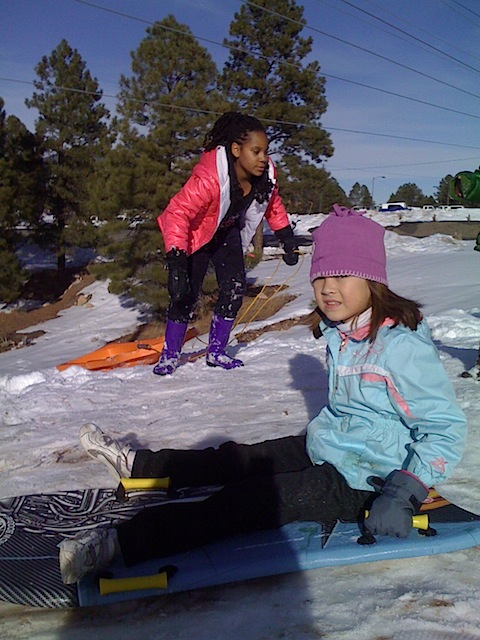
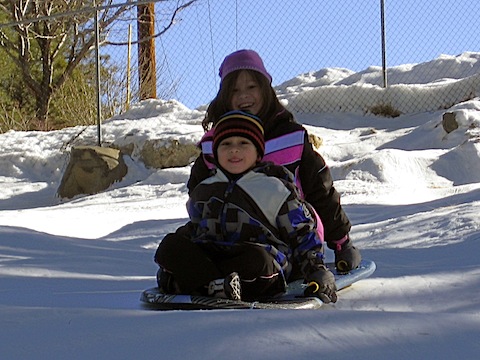
    The kids had a lot of fun playing in the snow, but it was enormously tiring and rather hot underneath all the cold weather gear.IMG_0139

    We had purchased two, two-person sleds, expecting the kids to need help, but once Michelle got a taste of sledding, we could barely get a sled away from her.

    That night (after a nap), we went to Black Bart’s Steakhouse (and Musical Revue), a place which, as best I can tell, employees the entire student body of the NAU theatrical department.

    I had the Buffalo New York Strip Steak and brain fart. I couldn’t for the life of me figure out why Buffalo, New York had their own cut of steak. How was it different from just ordinary New York Strip? Oops, make that “A New York Strip made from a dead Buffalo” – much clearer.

    It was actually pretty good, although, even though I had it cooked medium rare, it tasted rather more like medium well beef. It was absolutely the leanest cut of meat I’ve ever eaten.

    During the night it got down to 2Âș, and it was only 12Âș when we headed out for breakfast and to play in the snow before returning to Phoenix.

    Funny thing about snow, when it reaches 55Âș the day before and then freezes again during the night, the snow turns into something a lot more reminiscent of ice than snow.IMG_7018

    While the kids had just as much fun on the harder surface, I took a couple knocks – first one to my tailbone which is still giving me grief and another instance where I slipped sideways and cracked my hip, shoulder and head against packed ice. Not fun.

    Back in Phoenix for dinner and a nice soaking bath….

    Pity, though, the kids enjoyed it so much, they’re going to want to do it again.