The Doctor and Martha meet William Shakespeare and trio of nasty witches. Does this, the series’ most expensive episode mean we’ll be treated to two “Love & Monsters†type episodes to pay for it?
(more…)
Blog
-
Doctor Who – The Shakespeare Code – Review
-
New MacBook Battery, At Last
After a particularly short battery-run on my MacBook monday morning, I decided that there was nothing left but a call to AppleCare. Surely they’d replace my faulty battery.
(more…) -
First Weekend with Apple TV
My family and I have given the Apple TV a heavy weekend of testing, here’s what we’ve discovered.
(more…) -
Doctor Who – Smith and Jones – Review
Doctor Who
Smith and Jones
by Russell T. Daviesstarring David Tennant as the Doctor
and Freema AgyemanIs a smarter, more analytical companion going to ask the Doctor a lot more tough questions about the holes in Russell T. Davies’ scripts?
-
Apple TV – Now I’ve kicked one around a bit
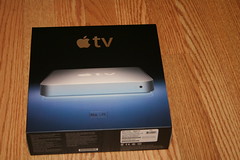
Just in time for the Big Day, March 31, I bought an Apple TV.
While I’m really enjoying the convenience, my experiences have not been as glowing as most of the other reviews I’ve read. I’ll explain more later, but first, a bit of background…
(more…) -
Xgrid to the Rescue!

In the lead-up to today’s grand experiment, yesterday I was conducting some preliminary experiments using Xgrid.
I’ve got a lot of video I’ve recorded digitally that I would now like to have in an iTunes-friendly H.264. VisualHub, which is the program I generally use for conversion does a nice job of it. Further, it does it rather fast (at least on my MacBook), rendering down 30 minutes of video in around 20 minutes.
One of the things that’s always intrigued me about VisualHub is that it is Xgrid-enabled. Xgrid is a nifty little Apple technology that clusters OSX computers into a distributed computing platform. I’ve completely ignored this feature of VisualHub because everybody knows you need an OSX Server to control an Xgrid cluster, don’t they?
-
Digital Life
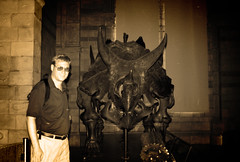
I’ve been scanning photo negatives this evening.
In no particular order, I’ve stumbled across the photos from our 2000 trip to the UK. It’s really remarkable how digital cameras have changed the way I take pictures. (No, the haven’t gotten any better.)
When I’m done it’s going to come out less that 100 photos for the entire 2 weeks. With my dSLR, I’m as likely to snap a 100 photos of the on a slow afternoon.
Looking back at the photos taken of me, I’d be surprised if there’s 200 of my entire childhood.
Never in the history of mankind has there been such a complete visual record of the triviality of life as there is today. It’s not hard to imagine a time when every moment of a life might be recorded, but what will happen to those of us from before the digital revolution?
Will we be forgotten photos on the wall of a TGI Fridays?
Technorati Tags: Blog
-
Apple TV – gosh, I touched one.
I stopped by the Apple store today and got a good look at the Apple TV. They had 3 on display for playing with in addition to one in the front window.
It was generating a fair amount of traffic and the Apple associates were certainly willing to bend anyone’s ear who was willing to listen.
I wasn’t willing to listen and they left me alone, but I got to overhear what they were telling others. It was nothing that you haven’t heard before about what it does and how it works, etc.
I did run the unit through its paces and… well, for what it is – an iPod for your TV – it appears to be well positioned as a real consumer electronic device and not a geek-only lash-up like previous attempts have been (and still are.)
The menus and, in particular, photos from iPhoto were gorgeous. Music from iTunes was about as exciting as watching an album cover. I’d much prefer the iTunes visualizer. (The Apple TVs in the store were not hooked up to audio.)
The videos were… not so good. I watched some Battlestar Galactica and Pirates of the Caribbean, both of which looked like something one might download from a bittorrent site and not something you’d paid good money for. That’s an area I think that iTunes really needs to improve before people will widely accept this. I’m not a video snob and the quality was very noticeably pixelated. On the other hand, if you’re used to looking at digitized videos of that quality, it’s just fine.
The hack sites on the Apple TV are running wild and it looks like there’s lots of “innovation†going on with the product only being out a couple of days.
Looking at what I’ve seen so far, I wonder if the following is possible:
- Replace HD with larger unit
- Implement SSH and SFTP
- Get Java running
- Install Azureus
- Configure Azureus to monitor a designated torrent directory, auto-download those files and place them in a designated outgoing directory
- Enable Automator or AppleScripting
- Building a script or action to auto-convert XVIDs to H264
- Incorporating those items into the Apple TV side of the synced files, bypassing the need to put them in iTunes.
With a configuration like that, one could SFTP a torrent file onto the Apple TV and it would eventually show up automatically on the Apple TV ready-to-watch.
Technorati Tags: Apple, Blog, Computer, iTunes, Mac, OSX, Technology, Television, Video
-
It’s time!
I’m not going to apologize for this totally geek moment. I found this article about time fascinating. I’ve always wondered why we used 24 hours and 60 min/sec increments, but never bothered to research it.
I can remember as a child spending hours trying to develop a workable metric time system. 10 hours a day? Too few. 20? (10 day, 10 night) Not really metric. 100? Ridiculous.
Thanks to documented evidence of the Egyptians’ use of sundials, most historians credit them with being the first civilization to divide the day into smaller parts. The first sundials were simply stakes placed in the ground that indicated time by the length and direction of the resulting shadow. As early as 1500 B.C., the Egyptians had developed a more advanced sundial. A T-shaped bar placed in the ground, this instrument was calibrated to divide the interval between sunrise and sunset into 12 parts. This division reflected Egypt’s use of the duodecimal system–the importance of the number 12 is typically attributed either to the fact that it equals the number of lunar cycles in a year or the number of finger joints on each hand (three in each of the four fingers, excluding the thumb), making it possible to count to 12 with the thumb. The next-generation sundial likely formed the first representation of what we now call the hour. Although the hours within a given day were approximately equal, their lengths varied during the year, with summer hours being much longer than winter hours.
I also found it fascinating about the Egyptian duodecimal system.
Back in the 70’s when Schoolhouse Rock was airing, they had a multiplication segment on base 12. They posed that we use base 10 because we have 10 fingers but that an alien with 12 might use a base 12 system (inventing 3 new numbers to replace 10, 11 and 12, which they called – if I recall correctly, “douâ€, “dec†and “el.â€)
What’s interesting is that it firmly fixed in my brain the notion that it was basically impossible for primitive humans to have naturally developed a non-decimal system. Yet, here we have those clever Egyptians and a base-12 system. I could see how they easily could have had a base-8 system instead if they’d only used the two knuckles actually on the fingers and not the one at the base. Would naturally using an octal system have made the development of digital computers simpler? I wonder.
-
Escape from Prescott
The grey weather continued again today and by the time we’d eaten, cleaned up and gotten packed, it was nearly lunchtime. We had to check out and, not wanting to leave computers and cameras alone in the car, we decided to have lunch and return home.
We made another go at Kendall’s Famous Burgers & Ice Cream. Well, it was OK, I suppose. I tossed caution and insurance company warnings to the wind and asked for my burger to be medium-rare, despite the warnings that it would increase my chances of food-borne illness.
I can only say, if my burger was medium-rare, the ordinary medium ones must be charcoal briquets. The meat was overdone, and therefore flavorless and the buns weren’t particularly fresh. It was just a run-of-mill, garden variety hamburger.
We were considering going up into the woods and walking around a bit, despite everything being muddy, but, once again, as we left Kendall’s, the temperature was dropping rapidly, indicating another storm front was moving in.
We just decided to go home.

Prescott is an interesting little town. Perhaps it’s not so little anymore. The center of town is the only genuine Victorian settlement of any size that remains standing in Arizona and it’s charming. Unfortunately, what was once a small town in moderate climate, is now a sprawl incorporating Prescott, Prescott Valley and Chino Valley. Of the three, only Prescott has any charm. The other towns are sprawled out across the dull, empty plains surrounding Prescott.
Meanwhile, the land in Prescott has become so desirable, many of the houses for sale were pushing a half a million dollars.
There’s also a curious phenomena and one that does not bode well for Prescott. There were block watch and security system signs everywhere. Typically, I expect to only see that in neighborhoods that have problems with crime. Considering the look of many of the teenagers running around Prescott, I can imagine they’re a bit of problem.
I guess I’ll have to start looking for a different town to retire to.