Tag: Five Interesting Things

  • Five “Interesting” Things About Me

    Once in a while, I’ll get drawn into one of those things going around social media where somebody does a thing, then challenges everyone who sees it to do the same. Recently on the Fediverse someone posted such a thing where you describe five interesting things about yourself.

    Considering that I have always had a raging ego and have had six decades to do interesting things, I was surprised of how I could not think a single interesting thing about myself.

    I realized maybe I should try to rise to this particular challenge, if only for my own self-aggrandizement.

    I’ve chosen to stick with things from my first 20 to 30 years. This list has taken me days and, perhaps, says more about me than I originally expected.

    Whether anyone else finds these things interesting remains to be seen.

    In no particular logical order:

    1. I Read the 1954 Encyclopædia Britannica Cover-to-Cover
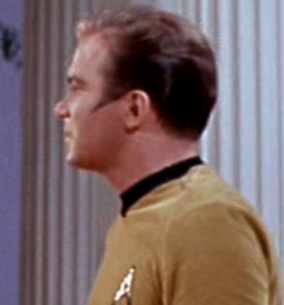
    2. My Moral Compass (and My Sideburns) Were Shaped Almost Exclusively by Star Trek
    3. I Wish I’d Adopted the Metric System Earlier Because My Knees Might Be Better Today
    4. I Owe My Career to Greenbar Fanfold Paper, BBS Software, Dumb Luck, and Because Snow Sucks
    5. I Hate Writing
  • “Interesting” 5: I Hate Writing…

    …but once I get started…

  • “Interesting” 4: I Owe My Career to Greenbar Fanfold Paper, BBS Software, Dumb Luck, and Because Snow Sucks

    Since there was no practical way I would ever be a starship captain (my preferred career path) I spent a fair amount of my childhood with no clue or direction on what I wanted to be “when I grew up.” (Arguably, I’ve gotten around that by never growing up.)

    By the time I reached high school, I had begun to get an idea what I wanted to be, or at least I had narrowed it down to three things.

    Foremost, I wanted to be a forest ranger.

    When I was younger, we spent a lot of time camping, and I always had good interactions with the rangers. They gave nature talks, were usually friendly and helpful, were paid to be camping, and seemed to enjoy what they were doing. And they got to spend all summer in the pine forests. Who wouldn’t want to do that?

    That idea got nixed when I discovered a few things about the job. Not all forests are pine forests, rangers have to help fight forest fires, and they have to stay in the forest when the winter snows1 come.

    Forest Ranger was a no-starter. Snow sucks.

    Second, I wanted to be a vertebrate paleontologist, and I was particularly fascinated by pre-Holocene Cenozoic and Permian life. (Yeah, I got that fascination from reading the Encyclopædia Britannica.) I mean, what’s not to love? Spending all your time camping in places almost invariably called “the badlands” and digging in the dirt. Most importantly, you can’t really do that in the snow. (Probably, I hoped.)

    Then I learned the brutal reality of paleontology. We don’t live in the United Federation of Planets. Science isn’t funded or valued by our society, and paleontology isn’t even near the top of the sciences that get funded.

    Only a handful of paleontologists were actually out doing digs in the 1980s, and even those were often punctuated by long gaps of years between expeditions. Paleontologists spent all their time teaching at universities or sometimes curating at museums.

    I have the most tremendous respect for anyone who takes up teaching as a profession, but y personality makes this an absolutely unsuited career for me. Paleontology fell by the wayside.

    This left only my third and least-preferred choice: computer programming.

    You might think I got my interest for programming from Star Trek, but I did not. I don’t know if you’ve noticed, but the computers kind of suck in Star Trek, and are often, for want of a better word, evil. Think M5 or Landru.

    No, what got me interested in computers was a full box of wide-carriage, green bar, fanfold paper that my dad was given by someone, which he, in turn, gave to me. I may have been wasting too much paper trying to draw the USS Enterprise, and this would be a lot of big paper that I could waste that he didn’t have to pay for.2

    Instead, I found it endlessly fascinating.

    Sure, it was great to draw on, but why was it all stuck together? Why were there holes on the sides? What a cool idea these micro-perforations are to make it easy to tear! Isn’t it cool to tear those end pieces off in huge strips and use them for art projects? These green stripes are fantastic for drawing straight lines! I fell in love with that paper.

    My fascination with computers started there, and I was able to parlay that enthusiasm into convincing my dad to buy me a Radio Shack TRS-80 when they came out. (No printer green bar printer, though.)

    I taught myself to program, first by getting books and magazines with TRS-80 programs in them and later by doing the same with Apple II programs and porting them to the TRS-80. (That wasn’t always possible.) I went to university to earn a degree in Computer Science. Then, things went wrong.

    I’m going to partially (and probably unfairly) blame Star Trek for this, too. Perhaps being a little too invested in a fictional world that embraced post-scarcity economics may have caused me to be a little less than frugal with my savings when I moved out.

    My first IBM PC cost me $5,000, or about 20% of my savings at the time. I bought it to use it as a terminal so I could dial into the ASU data center (at 300 baud) and do my homework. ASU school work was done on a series of multiuser mini-computers, like PDPs back then. I also had ambitions of learning to program it.

    (ASU had two or three rooms with DecWriters for doing computer classwork, but it was virtually impossible to get in and do work during daylight hours. Until I bought the computer, I often went in at 3:00 AM to get a terminal and work in peace.)

    There were other less practical expenses, such as my quite impressive collection of albums on cassette tape and repairs to not one, but two Triumph TR7s that I owned.

    I wasted my savings.

    Nonetheless, I had a reliable, steady income from the United States Government in the form of my mother’s Social Security Benefits. And then that fucking fucker Ronald fucking Reagan eliminated those, and I was incomeless. (It’s more complicated than that, but let’s leave it there for this narrative.)

    Feeling that I was only partway through my degree and, in my mind, probably unemployable in the computer trade, I got a break from a friend who helped get me a job alongside him at an electrical contracting company. It was manual labor, but it paid (barely) the bills.

    The good thing for me is that electrical wiring is just the simplest, most rudimentary form of programming, so I was able to pick up and understand what the journeyman electricians were doing in days. I was able to study the electrical code book at home, and then move from one contractor to another (lying about my experience along the way.)

    Meanwhile, I had that “fancy” IBM PC (with dual double-side floppy discs, no less!) and what it was doing was… being used as a terminal to log onto local BBSs. Based on some of the sysops that I encountered, I thought, “If those people can do, I certainly can,” and began my preparations.

    I cannot remember why I chose the Fido BBS software. Maybe it was because I could run it on a dual-floppy PC, maybe it was because of the chatter amongst my online friends. Several of us were setting up to run Fidos, but there were still obstacles, not the least of which was that there was no room at the inn.

    FidoNet, the interconnected messaging system between Fido BBSs, had a programmatic limit of 2503 nodes… and they were all taken.

    John Kerr was the local sysop who had one of the actual numbers, and he was a really nice, helpful guy. He knew that “coming soon” Fido would be expanding to a Net/Node configuration that would allow new BBSs and he worked to coordinate with locals who wanted to get in on FidoNet.

    When the day came and Phoenix’s network, FidoNet Net 114, was born, John doled out node numbers in no particular order that I’m aware of. I was officially 114/12 The Crunchy Frog BBS – a discussions-only BBS, with a bent towards Monty Python’s Flying Circus.

    That’s the unimportant part, though. The important part is that the collective sysops of Net 114 interacted and networked with each other and became friends. There was a sysop who was formerly of Texas Instruments and became my roommate, and I learned how to tear apart my PC and rebuild it from him. There was a sysop who was a higher-up electrician at the Palo Verde Nuclear plant; he got me a better electrician’s job through his connections (not at the nuclear plant.) Then, there was the sysop, who ran a computer company selling electrical estimation software to contractors. When the contractor I was working for ran out of work, I started helping at the computer company. I knew computers, I knew programming, I knew how to troubleshoot computers, I understood how electricians worked and knew the electrical building code, and I fucking knew how to fucking talk to fucking electrical contractors because I was one of fucking them.

    That’s when I realized how much I actually knew about computers and PCs in particular.

    Once I understood that my computer knowledge and experience were practical (because universities hadn’t caught up to PCs yet) and marketable, I moved onwards and upwards. First, doing technical support and networking jobs4, then programming, and finally, project management and upper management. (Free tip: Don’t do upper management. Upper management sucks.)

    While in management at my last employer, I oversaw the surplusing of our last wide-carriage green bar printer. I almost shed a tear.


    1I hate snow.

    2I couldn’t draw then; I can’t draw now.

    3My memory of what was going on at this point could be better. I feel like something else was going on, and the Wikipedia article didn’t really clear it up for me.

    4Remind me to tell you someday about when I went to work as a network support tech but caught their programmer defrauding the company on my first day. By 5:00 PM I had his job and a raise.
  • “Interesting” 3: I Wish I’d Adopted the Metric System Earlier Because My Knees Might Be Better Today

    This is actually about bicycles, not the metric system. I’m not going to drone on about my position that we should just all say, “fuck it,” and start using the metric system exclusively and damn the retrograde cavemen all to hell if they can’t keep up.

    My dad and I shared a love for sports cars. We used to have many books on them, talked about them a lot, and went to car shows to gawk at them. Despite that, as I moved into my high school years, I had little or no desire to learn to drive a car. (When I finally learned to drive, it was on a 1963 Porsche 356B. Take that, mudanes!)

    I had read somewhere that the bicycle was the single most efficient machine for converting human energy into motion, and considering how tiring it was to ride my AMF Huffy 10-Speed to school, I had my doubts, but then I learned that there were differences in the quality of bikes. I convinced my dad to take me to a large bike store in Tucson.

    After a good hour or so of talking with the “bike guy” at the shop, I convinced my dad to buy me a Centurian Super LeMans, a decent starter roadbike.

    I never rode it to school because I was afraid of bike theft, but if the days were long enough (and it didn’t conflict with Star Trek reruns), I’d always get in an hour’s ride after school and several hours on weekends and school holidays.

    There were no satnavs to measure distance in those days. You either installed an odometer on your bike, which reduced efficiency, or you worked it out on a map. I soon wanted to know how far I was riding, so I began to come home from my rides, measure them on the map, and then log them.

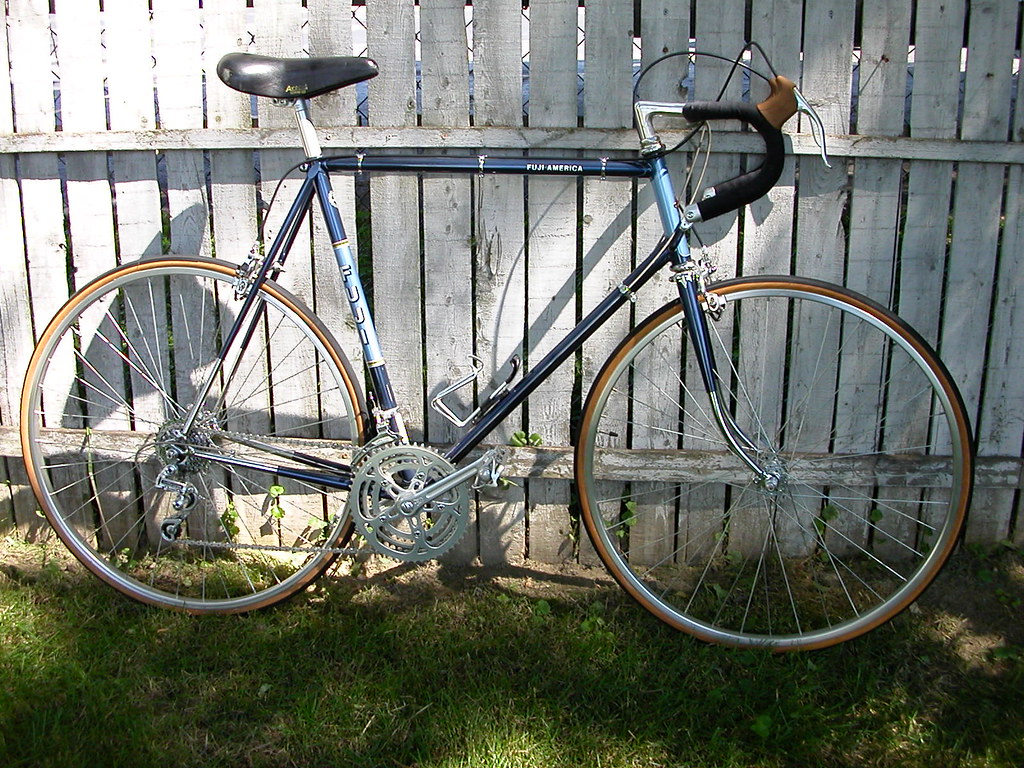
    Not my Fuji America, but appears to be the same model and color.

Blue road bike, light blue highlights, with chrome around the stays.

    In my first full year, I hit almost 8,000 miles or about an average of 21 miles a day. This was actually enough to convince my dad that riding bicycles wasn’t just a passing fad for me, so he helped me buy a newer, better touring bike. My new bicycle was a beautiful blue, hand-detailed Fuji America, which was still manufactured in Japan in those days. It was a dream to ride, and an absolutely perfect frame size and geometry fit for me. It immediately increased my average speed with the same amount of work, increasing my daily distance.

    And then I got a crazy idea. If I can do 8,000 miles in a year without really trying on a lesser bike, why not set my sights on an even 12,000 miles per year? (I picked that number because 1,000/month appealed to my sense of aesthetics and nothing more.)

    I wasn’t in training for anything. I didn’t have any goals or ambitions. I just really enjoyed being alone with my thoughts on the road. I hit my numbers, but it was tough, and it had its toll on me. I couldn’t get enough miles on weekdays, so I had to make it up on the weekends. I would frequently be out all day, and summer temperatures in Tucson were no picnic, even back in the 80s. Sometimes, I’d have to make up a month’s shortfall in the next month… or even the next.

    Even after a year of it, I would come home absolutely exhausted. I drank a lot of Gatorade. I hate Gatorade now.

    As I’ve gotten older, I’ve noticed the parts of me wearing out first are my knees and my neck, consistent with where the strain was riding my bike back then.

    If I had been using the metric system all along, that first year would have been roughly 12,500 km (because I was using a map to estimate). I wouldn’t have decided I needed to hit a higher goal, and if I did, it probably would have been an aesthetically pleasing 15,000 km, or only 78% of what I actually did.

    I regret not switching to the Metric System earlier. The Metric System saves knees.

    My knees hurt just thinking about this.

  • “Interesting” 2: My Moral Compass (and My Sideburns) Were Shaped Almost Exclusively by Star Trek

    I suspect this list shall bear witness to the fact that I can be both obsessive and compulsive. In first grade, my dad received a quarter-end report card with a note from my teacher saying, “Gene1 could be a fantastic student if he could just not fixate on Batman all the time.”

    It’s true. I was obsessed with the Adam West/Burt Ward Batman series, and it wasn’t even on TV anymore! I got banned from all things Batman over that one.

    I switched my attention to Star Trek.

    Younger readers may not be able to grok the concept that when I say Star Trek, I mean Star Trek proper — the series that the young’uns today improperly refer to as “TOS.” There was no other.

    As Star Trek reached the point where it was airing every single weekday, I was there for it every single time. I have no concept of how many times I’ve watched every episode of Star Trek. A hundred? Maybe. Maybe more.

    I knew them line for line and word for word, backward and forward.

    Star Trek was more insidiously invasive on me than Batman. It showed me what the world should be. In many ways, particularly in my pre-teen years, I think I believed it was the way the world really was. If nothing else, I thought it was what everyone was striving to achieve.

    Star Trek indelibly imprinted my baseline moral compass on me without me realizing it. It may be simplistic and pollyannaish, but I believe that science and exploration are good, the search for knowledge makes us better and more prosperous, wars are bad, violence is only justified in defense, men and women and people of all colors and races (even Scotsmen!) can live and work together without prejudice, bad laws should sometimes be broken (I’m looking at you Prime Directive), and that you should never turn weapons over to a super-computer.

    Looking back on Star Trek from the 21st century, there are still many problematic things in its depiction of the world that were a product of its time, but that’s true for everyone’s view of things if you live long enough. We must all grow, but I think Star Trek provided me with a pretty solid foundation.

    Oh, and sideburns.

    I am oblivious to fashion unless it rises to the level of the absurd. I don’t see it, and I don’t care; however, I would be lying — no, I would be deluding myself — to say I am not, at least subconsciously, influenced by the things around me.

    In the mid-80s, I was quite poor, languishing in my ambitions to work in the computer field, and surviving by working manual labor as an electrician. I’d been on the job for six months to a year (and had learned how to curse really fucking well by then), and one day, we were sitting on a job site, having lunch from the roach coach, when one of the guys made a light-hearted crack about my “pointy-assed Star Trek sideburns.”

    I had no clue what he was talking about until I looked around at everyone else there and, indeed, every other man I saw after that point. None of them had neatly trimmed pointy sideburns. Clearly, the world was mad.

    When I started shaving, I had just simply adopted what I had seen and normalized a thousand times before and trimmed my sideburns like the crew of the Enterprise. I had no clue that was an affectation for TV to show that hairstyles in the future were different.

    I didn’t go home and shave them off that day, but I did, slowly over the course of a couple weeks, continue to trim them at a less rakish angle until they were “normal.”

    A little bit of joy and individuality2 died in the world that day.


    1My name of record is Eugene. My parents called me Gene, so the schools and whatnot also called me Gene. I always disliked it. When we moved to Oracle, AZ, in 1975, I just started going by Eugene from that point forward.

    2Arguably, that’s not individuality since I was copying someone else. You decide.

  • “Interesting” 1: I Read the 1954 Encyclopædia Britannica Cover-to-Cover

    A 1950s vintage Encyclopædia Britannica set, within a bespoke bookshelf.

    When my dad returned from the Korean War, he used the GI Bill to attend university, first studying Geology and then switching to Law. As a “Going to University Present,” my grandparents bought him a complete set of the 1954 Encyclopædia Britannica1. It was a bookshelf-worth of books (in fact, it came with a bookshelf, a giant Atlas of the World, and several “Book of the Year” updates for a few years).

    After he left university, he was a bit footloose, carefree, and not at all bogged down with personal possessions. He prided himself on not having more possessions than would fit in his Triumph T3, so those books went back to my grandparents. After my mother died in the late ’60s, my grandparents moved in with us. Those books and that bookshelf came with them and ended up in my room, where they remained until I moved to university in the early ’80s.

    Sometime during elementary school, I decided I needed to absorb that knowledge (It’s what Spock would do), so I got myself a bookmark and started from Volume 1, Page 1. Slowly, day by day, I worked through every volume, article, and plate. I can still feel that curiously thin paper between my fingers, the thick, glossy photo plates, and I can still smell those books.

    It took years to complete the task. It’s not a gripping read.

    The author(s) didn’t manage to weave together a coherent plot and huge swaths didn’t interest me at all. Many subjects that did interest me were boring as hell, I’m sure there was much I read and didn’t absorb, and much of it was horribly out-of-date, but it was knowledge for knowledge’s sake, which was good enough for me (and Spock).

    I don’t claim to have an “encyclopedic memory,” but I have a legit leg up on one. Did I do myself a disservice by reading an encyclopedia already at least 20 years out-of-date? I’ll never know.


    1I’m not exactly sure what “year” you’d call this set. 1954 is an estimate. The Fourteenth Edition of the Encyclopædia Britannica was published from 1929 to 1973 and had what they called a “continuous revision” policy. This set would have been roughly current when my dad went to university in 1954, and we had several Book of the Years going up to 1957 (IIRC).