Tag: Hsinchu

  • Hsinchu – I Am in You

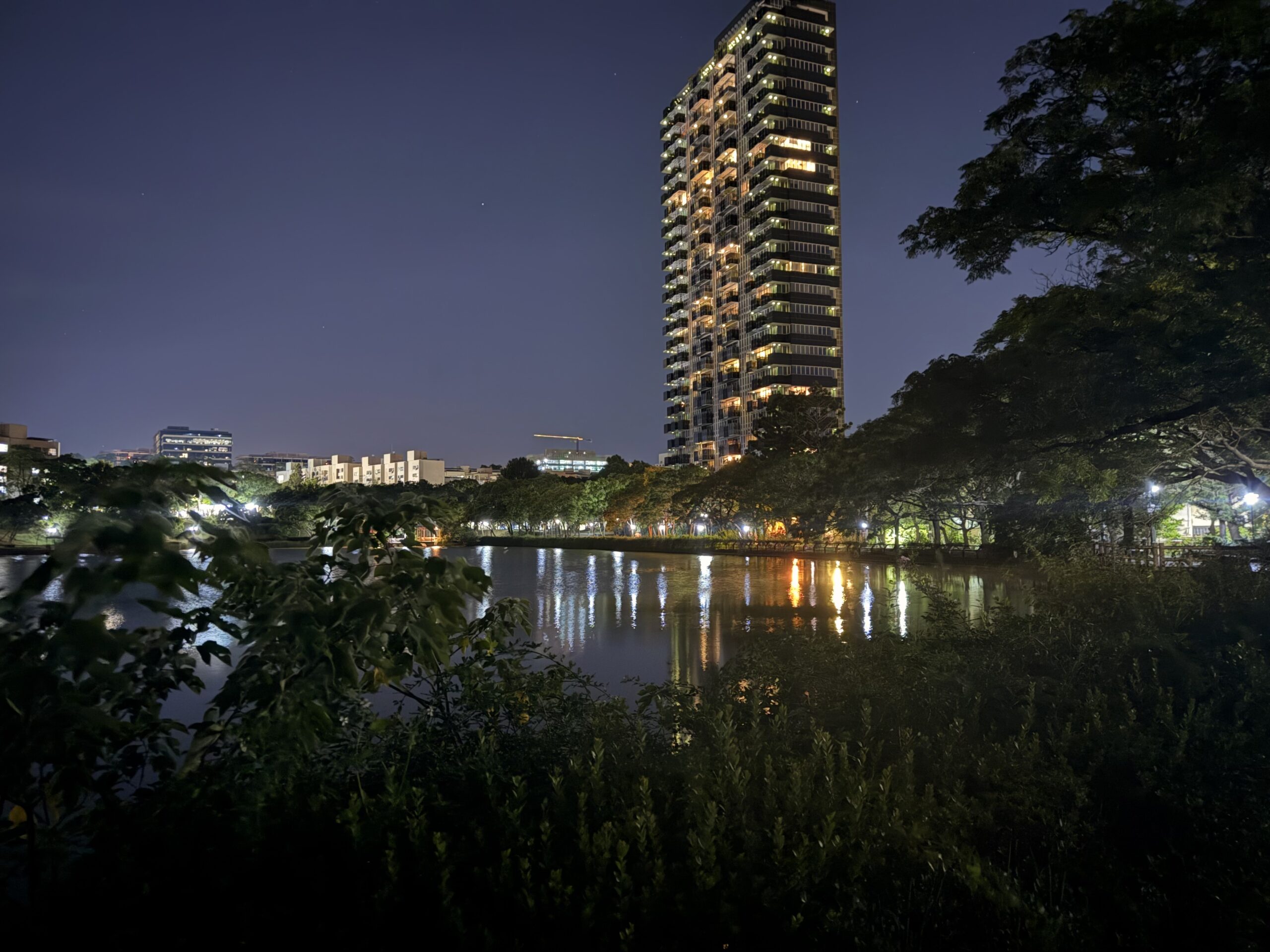
    A small lake, at night, lined with darkened trees, but illuminated along the surrounding path.  A tower block looms in the distance.  The lights are reflected in the water.

    It has been a chaotic couple of weeks, and my efforts to keep track of what has happened have been hampered by circumstance, but things are settling down, and this is my first stab of coalescing my thoughts.

    But let’s start at the beginning, because, if you’ve subscribed to this blog and forgot it existed and this little gem just pops up at random in your RSS feed, you don’t know what’s happened.

    Short version: My wife, Irene, and I have moved to Taiwan. She has a two-year contract to teach at a highly-rated school here in Hsinchu City. She’ll be teaching in her capacity as a United States degreeded and credentialed elementary teacher.

    I, on the other hand, am still just retired and am along for the ride. I’m hoping to finally achieve basic incompentence in speaking Mandarin. Two weeks so far and, as usual, no magic bullet. it’s not just the language, its the social norms — but that’s a topic for another day.

    We spent our first two weeks in Taipei, staying with my mother and father in law. It’s great to have a place to stay, but for various reasons, there is no place for me to sit and work at a computer in their home. Writing, podcast editing, and video editing just weren’t practical.

    The time was not wasted, though. It gave us the opportunity to get time-synced with Taiwan — although this was by far the easiest time I’ve ever had getting over jet lag in all my travels. Perhaps it’s because I’m old now and have to get up to pee every couple of hours during the night, so, I’m not really on much of a regular sleep schedule anyway.

    It also gave Irene time to catch up with her parents, and for us to get back in the groove of Taiwan. On the downside, we also got back into how ridiculously convenient Taipei is.

    “Convenient.” That’s a word you’ll hear a lot about Taiwan, but is it true? I’m going to come back to that in a later post, but lets just say that its convenient in some ways, and oh so much harder than it needs to be in other ways.

    Now, without too much detail, Irene’s offer in terms of pay and bonuses was competetive (in real, not relative dollars) with teachers’ pay in Arizona, and in relative terms, the total cost of living in Hsinchu is roughly 33% less than Phoenix. Hsinchu is actually quite expensive compared to many other places in Taiwan because of high housing prices. But here’t kicker:

    In addition to the pay and bonus package, the job also supplies housing, but we knew almost nothing about where we were going to live until we set foot in the front door except that it was 2-4 bedrooms.

    Hsinchu is a much smaller city than Taipei about 30 minutes by High Speed Rail (HSR.) (For reference, the HSR are actually Japanese-built Shinkansens, and they travel at up to 300 kph up and down Taiwan’s west coast.)

    Irene grew up in Taipei, and is not very familiar with Hsinchu, although her father grew up here. Everywhere in Taiwan seems to adopt a character, but Hsinchu is the city that has nothing but high-tech workers. It’s a foodie desert, it hasn’t got culture or night life, and public transit is poor. What it has got is Taiwan’s highest-paid workers. Hsinchu is Taiwan’s Silicon Valley, chances are the key components of the device you’re reading this on were made within 2 kms of where I’m sitting.

    I had done some internet and AI-assisted sleuthing and actually correctly nailed it down to the next building over from where we are. We’re in the same complex, just next door.

    But guessing where you think you’re going to live and knowing are two different things. No knowing was stressful.

    We were only given the exact address the night before we needed to give that information to our van driver who brought us down from Taipei.

    When we arrived, he was impressed. When we pulled into the neighborhood, he started going, “wow!” To be fair, it is a gorgeous neighborhood. We’re situated near a lake, the streets are all lined with tall trees, and the grounds are all parklike. And while it was built (estimated) in the 1980s or early 1990s and is beginning to show some age, some might argue it’s old enough to begin to have character.

    There’s a story to be told about this complex, and I only know parts of it, but it is government housing, and it was designed for “important” government officials with families. It does not look like typical Taiwanese homes. Apart from certain decorative flairs, such as several moon gates, these look like American townhomes. It’s stirkingly incongrous with typical Taiwanese housing, and yet so obviously is.


    Time Jump! I should have finished writing this a week ago, but I was thrown a curveball. We thought we were moving down here just 7 days before my wife started work full time, but that was just a few days of basic orientation for new foreign teachers, but then there were two more weeks for the teachers to get settled in to their homes.

    I thought I was going to have these last two weeks to myself to pursue my various creative outlets, but instead, we’ve been setting up house.

    Despite all the online (actual government info) to the contrary, and the troubles we had at TECO LA, the school has come through and both of us have our residency and ARCs sorted out, with our National Health Insurance (NHI) enrollment being processed now, and expected in a few days.

  • Second Act

    I was in a board meeting for Camp Quest Arizona shortly after I retired from my day job, when one of the other board members (whom I respected quite a lot) asked me, “What are you going to do for your second act?”

    I’ve didn’t have an immediate answer, and, to that point, I’d never actually heard retirement called a “Second Act” before. Surreptitiously, I looked the term up on my phone.

    second act noun
    1. Figurative. A later stage of life or career, especially following retirement or a major career change, characterized by renewed purpose, exploration, or reinvention.?
    Example: “After retiring from teaching, she began her second act as a travel writer.”

    I’ve never viewed retirement as any thing other than the opportunity to do whatever the hell I wanted on any given day, but since that day, I’ve thought about it. I’m OK with living day to day. I’ve always been able to keep myself amused without clear direction.

    With our looming move to Hsinchu, Taiwan, I’m contemplating that idea of a Second Act more.

    Oh, I’m not thinking about getting a “regular job” or pursuing the dream of “opening my own business” — although, there are a few western food items that have not really caught on in Taiwan that, I think, just the right marketing campaign might launch to success, but that is not for me.

    I’m just thinking of how I can take the things I enjoy and “taking them up a notch.” In no particular order, and with no assertion that I’m any good at any of them, I enjoy hiking, biking, writing, podcasting, and making videos.

    It practically screams YouTube channel, doesn’t it?

    The fact is, I’ve recorded dozens, if not hundreds, of hours of video in Taiwan, but I’ve done very little with it. Partially because of a lack of purpose. On my first few trips, my impressions are overwhelmingly about how it’s different. That is an unsustainable model, as with time and familiarity, the remarkable becomes the unremarkable.

    I have been watching various YouTubers in Taiwan for several years now, and there are some very depressing lessons to be learned.

    Your Audience is Domestic

    YouTubers in Taiwan regularly confront the harsh reality that, no matter what the target audience is, the vast majority of viewers will be within Taiwan. If you think you’re telling the world about Taiwan, you’re probably wrong. You’re telling Taiwan about Taiwan.

    The audiences seem to have a fascination of hearing what foreigners think about them, and, by and large, they want to hear good things. This feels like some form of self-validation, perhaps because Taiwan doesn’t have a lot of curb appeal for the rest of the world.

    I have no doubt that almost any country can be fascinating for a visit, if you haven’t got your sights set on something specific. (For example, a surfer hoping to catch some big waves in Czechia is likely to be disappointed.)

    Don’t get me wrong. I love Taiwan. I find it a fascinating place, but it just hasn’t got the mindshare that other countries like Japan, France, Italy, or Australia have.

    But if people aren’t thinking about Taiwan, they aren’t looking for it on YouTube, and YouTube isn’t serving it up as part of the algorithm. Taiwan is making some tourist destination inroads, but it’s slow progress, and the local tourism industry seems very geared towards domestic (or at least Chinese-speaking) tourists.

    Given that a significant portion of the audience is local, and Mandarin is the lingua vernacula. Subtitles are essential — that means putting my wife to work on my hobby.

    And, the click-through ad revenue rates for Taiwan are lower than North American or European countries. Not that ad revenue would be my goal, but who would say “no” to money?

    Everything is About Food

    There’s a game you can play looking at YouTube channels focusing on Taiwan. Look at the number of views, then look at the thumbnail/title. If you see an odd jump in the number of views, there’s very good odds that the video is or appears to be about eating.

    The Taiwanese love to eat. Their days seem to revolve around eating. Their holidays revolve around eating. Their tourism is about going to places and eating. Places go out of their way to have some “famous” local dish to draw in tourists.

    …and they seem to love watching YouTubers eat food. Taiwanese food. A foreigner choking down stinky tofu is video gold. And you damn well better like most of it.

    That’s going to be a problem for me. I’m a picky eater at home in the US. On my first trip to Taiwan in 1998, I nearly starved. I could not adapt my palate to what was on offer. McDonald’s kept me alive in Taipei, but when we were outside Taipei, I had some rough, hungry days.

    In the interveneing three decades, I have developed a repertoire of foods in Taiwan that I can not only tolerate, but genuinely enjoy, and I anticipate learning to eat more things.

    For example, on my next trip1, I’m going to be searching out hu jiao bing (???) or a “black pepper bun.” It looks good, but for every one dish that looks good to me, there are dozens more dishes that don’t appeal to me at all.

    It’s almost a joke watching many “foreigner in Taiwan” YouTube channels that it doesn’t matter what the topic of the channel is about, they will stop for food. You gotta give the punters what they want. I don’t think I can do that.

    What Do I Want to Do?

    Do I have a story to tell? I feel like I do. Is YouTube the way to do it? I don’t know. I enjoy the technical challenge of shooting and editing video. I gravitate towards that idea.

    In a weird way, I also enjoy writing. That is, when I don’t hate writing. I vacillate between equal measures of enjoying and hating writing. Should I write books instead?

    What story do I want to tell?

    One thing I’d like is to open the world’s eyes about Taiwan. It’s a nice place. I wouldn’t be moving there if it weren’t.

    Unfortunately, unless they massively overhaul their immigration system, it’s not going to be a emigration destination for most people, so Taiwan as a tourist destination is it.

    What about telling my story as I try to integrate?

    Oddly enough, I think I’ve already passed many of the “culture shock” moments that make up the bulk of the “I’m new here and just learning my way around” stories out there. But perhaps there’s still a story there to be told.

    Life is going to be very different for me this time.

    I’ve spent months “living” in Taiwan, in a Taiwanese home, which is something most tourists don’t get to do. But that was in Taipei, the most populous and most developed (and dare I say Western-friendly?) place in Taiwan. Also, while I frequently spent my days exploring entirely on my own, my wife was always available to go do things and navigate the “difficult” day to day interactions.

    Living in Hsinchu is not going to be the same. For starters, my wife will be at work all day. That means 8-10 hours a day, 5 days a week, I’m on my own. It’s going to be sink or swim on my Chinese language learning.

    Hsinchu also is much, much smaller than Taipei, and while they do have most of my favorite restaurants, there aren’t as many and they’re not necessarily close to where I’ll be living.

    And then there’s transportation. No subways, no light rail, and a bus system which has been described as “infrequent, at best, and rarely on schedule.”

    Also, I’ll be living inside the Hsinchu Science Park, which, despite the name, is an industrial park. Convenient if you want to walk to a wafer fab, less so if you want to walk to a 7-Eleven.

    In the plus column there is a local train line or two that seems to run regularly, is inexpensive, and spans several areas I’m likely to go to, plus there’s the U-Bike bike share program to get me to the stations and out to my final destination.

    There will be hardships. Perhaps there’s a story to be told there.

    Two Wheels Good, Four Wheels Bad

    Maybe there’s a biking angle? Taiwan makes some of the best bikes in the world, and I’ve got my eye on a couple gorgeous Giant eBikes that I cannot get here in the US, but how much “fun” will that be on the crazy city streets of Hsinchu? I’d much rather get the hell out of town.

    What would be best would be if I could hop on a train and take my bike, but that gets complicated, unless you have a bike that folds and you can carry easily.

    Some trains have spaces for bikes, others do not, some subways do, but only during certain hours of the day, or only certain routes. Even the High Speed Rail (HSR) that goes through Hsinchu and connects with most of the rest of the island has restrictions.

    I’ve found exactly one bicycle that folds small enough to be taken on, as far as I can tell, any train at any time to any destination. That’s a Brompton — a bike not even made in Taiwan! There are a couple Brompton knock-offs made in Taiwan, but they still don’t fold small enough to get past every size limitation.

    I’m seriously considering getting a Brompton, even though it seems like a compromised ride over a proper road bike or an eBike.

    Or I can have both.

    Conclusion

    I haven’t got one.

    I started writing this post mostly to put my thoughts down and hopefully organize them, but it didn’t help.

    I just don’t know what my Second Act will be.


    1. “…on my next trip…” Who am I kidding? My next trip will be when I move there. ↩︎