Tag: Travel

  • Taiwan (2024) – Data Only Mode

    My last trip to Taiwan was in 2019, the year before the pandemic. I owned an iPhone X, and the only option I had to get inexpensive local phone/data service was to secure a physical SIM card from a local carrier and swap it out for the one in my phone. That system worked, and had been working for several years, going all the way back to my Motorola RAZR.

    But times, they were a’changing. Back in the early days, you’d pop into any 7-Eleven in Taiwan, and purchase a prepaid SIM off the rack. On later trips, you could still buy them at 7-Eleven, but they were behind the counter, and they recorded your identity information before they could sell you one.

    On yet a later trip, even that option was gone. Too many people bought prepaid cards as burners for criminal activity — and this is why we can’t have nice stuff. Our only choice was to go to a local telco outlet, and this was a pain in the ass. My wife was able to (relatively) easily get signed up, she has a Taiwan identity card, but I don’t, and they weren’t really equipped to deal with foreign passports.

    They suggested the best way was to get a SIM at the airport when you arrive — not much help since we were already in the country, AND the booth that sells SIMs was on the outside of immigration and customs. We got it sorted out, but, we knew what to do next time.

    Unfortunately, as with almost every flight I’ve ever arrived in Taiwan on, it was somewhere in the 1:00AM-4:00AM area, and the booths were closed. It was back to the Telco outlet for an entire morning getting setup.

    When Apple put an eSIM — as a secondary line — in iPhones starting in 2018, I was ecstatic at the possibility of getting a line digitally. Unfortunately, in 2019, I still didn’t have a phone that supported eSIM, and, as it turned out, carriers in Taiwan weren’t yet supporting it anyway — or at least they claimed they weren’t. Adoption of eSIM was a bit slow because carriers really didn’t want to adopt them, it helped overcome some of the sweet, sweet lock-in that they loved so much. Fortunately on that 2019 trip, the booth was open and we got physical SIMs in the airport upon arrival.

    But I was looking forward to the day when I all had to do was scan a QR code.

    All that is prologue to this post. It has been FIVE LONG YEARS till I’ve had the chance to try out eSIMs on foreign travel. Just days prior to the trip I got an iPhone 16 Pro, which supports 8 eSIMs (although only 2 can be active at any given time.) Mine doesn’t even have a physical SIM slot anymore, so I got my first eSIM from Verizon when I got the phone.

    The “good” thing about waiting so long between trips is that eSIM support is now widespread, and there are various services that allow you to purchase them right from your phone before you travel — although that comes with a caveat. We’ll come back to that in a minute.

    My eldest child has “moved” to Taiwan, or at least is on an extended study program for 6 months to a year at NTNU in Taipei. Because they were planning to be there for some time, and because they have family, they got added onto my brother-in-law’s family plan, so they have a local phone number and data plan.

    Now let’s come to that caveat. As far as I can tell, these online travel eSIM sites sell data-only local eSIMs. You will not have a phone number locally.

    Do you need a phone-capable one?

    Nooo…? Maybe?

    Internet wisdom says, “no,” rather decisively.

    Back in the pre-eSIM days, your choices were probably limited. If you wanted to stay connected and have data locally, you had to swap out your SIM, meaning you got a local number and you lost your home country number for the duration. In a case like this, Google Voice would probably be perfect.

    I don’t know if its “perfect” or not. I never get or make phone calls.

    People who know me know not to call me, unless there’s an emergency like, for example, arterial bleeding. In which case, I say, “Fine. That’s a good reason to pick up the phone and call… fucking 911. After that, text me.” So for that reason, I never needed my home country number and I never needed the local country number, either. All I ever got on that were calls in Mandarin for presumably wrong numbers or sales/scam calls.

    For me, “texting” has become Apple iMessage almost exclusively, and as a fall back there’s half a dozen other services that offer Instant Messaging. Plus the fact that my phone supports two active lines, I don’t even have to swap out my US-based Verizon line, I could just temporarily de-activate it, and, in an emergency, turn it back on and let the roaming charges be damned. (If you have Verizon’s travel program activated on your phone, answering or making a call, sending a text message, or using cellular data incurs a $10 charge, but you are then free to use roaming without further charge for 24 hours.)

    The long and short of this is that Internet wisdom says, “no,” and I was 100% onboard with that idea.

    My wife: not so much.

    She felt she needed a phone to keep in touch with family and friends while in Taiwan. I asked her some simple questions:

    Q: “You call your parents every week. How do you call them?”
    A: “Facetime or Line.”

    Q: “When you talk to your child, how do you call them?”
    A: “Facetime.”

    Q: “When you talk to your brother, how do you call him?”
    A: “Line.”

    Q: “What about your friends, Nora, Phoebe, and Judy?”
    A: “Line.”

    Q: “Why do you need a local number?”
    A: “I guess I don’t, I just feel like I should have one. Maybe. Maybe not?”

    At first, we compromised. I would use Holafly (one of the eSIM services, and I’ll come back to why I chose them in a minute) and Chuwan would purchase a local eSIM with local phone service. That isn’t what happened.

    Why Holafly?

    So far as I knew, no one I had personal contact with had used any of the eSIM services, although on various podcasts, I had heard of people with satisfactory experiences with Holafly, Airalo, and Saily. Holafly had one thing going for it that the others did not: Unlimited Data. You know how that goes — actually limited high speed data, falling back on lower speed unlimited, which I felt would be OK given that WiFi is also quite prevalent in Taiwan, but I though that would be better than being stranded high and dry if I exceeded one of the limited plans.

    Just before the trip, Chuwan realized that we’d be arriving during the “cell phone booth closed” window at the airport, and the fact that Holafly had a steep discount for purchasing a second eSIM for a friend or family member, convinced her to go with data-only.

    Install and Setup

    The transaction was painless, and installation was easy, and well-documented.

    A couple caveats that they will warn you about, and I recommend you heed: You must have internet service to install the eSIM. Don’t wait till you need it to try to get it. Install it in advance, and just keep it turned off.

    Holafly’s instructions, which are very clear, documents how to turn off your local carrier’s data, and turn on Holafly’s data service. Following their configuration, you local line is still active. Whether you want that to be the case is up to you. In my case, I just deactivated the Verizon eSIM.

    Note, this actually caused problems with Apple iMessage, which was tied to my phone number, and I had to futz around with that for a while to get it to be primarly email-based. If I’d left the line on, this wouldn’t have happened.

    When our plan took off from San Francisco, we turned off our Verizon eSIMs, and when we arrived in Taipei, we turned on the Holafly eSIMs. It was smooth, except for the iMessage glitch, which didn’t manifest right away.

    Performance
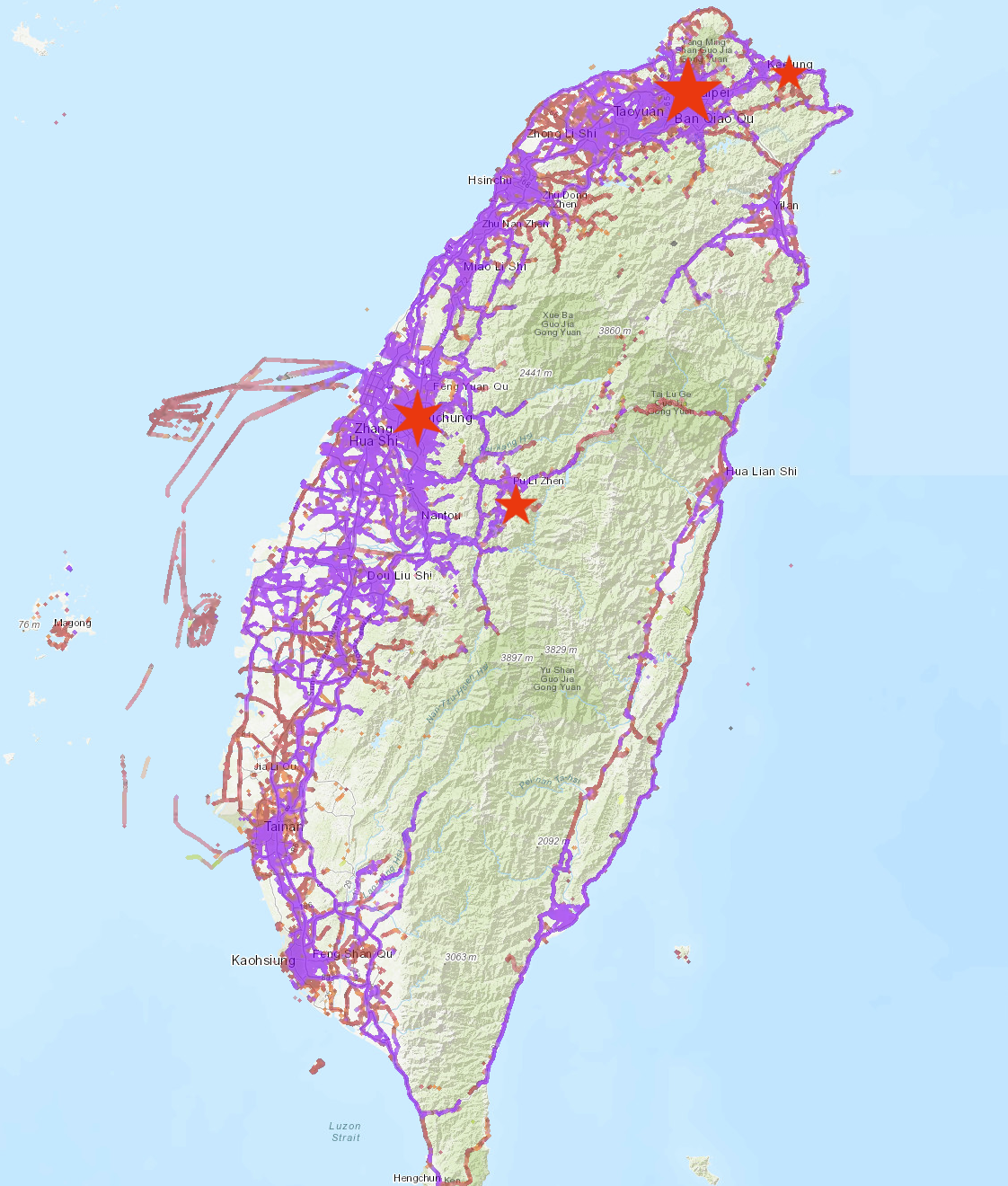
    Chunghwa telecom map of coverage in Taiwan.  The western side of the island is coveraged, the central area, not much, and another stretch along the eastern seaboard.

    Everything worked great for the first 2 and a half days in Taipei, but then we headed south into the central part of Taiwan. Holafly used Chunghwa telecom, and this image is Chunghwa’s network coverage. The stars represent where we spent time. Taipei is the capital of Taiwan and, with it’s environs, the largest city. As you would expect, coverage is excellent.

    Taichung is another major city, with excellent coverage, and, per the map, the entire space between the cities has excellent coverage. In fact the western seaboard contains the bulk of coverage.

    For a quick geography lesson on Taiwan: The western coastal plains are the best, most arable land. It’s flat and relatively easy going. it is were most of Taiwan’s population lives. The central mountains, are absolutely brutal, almost uninhabitable, and they plunge straight into the eastern coast. Still, some towns and cities cling to some of the better spots on the east, and there’s a nice rift valley that’s also inhabited. There are only three roads that can get you across the mountains. (There’s a fourth, but it really skits the mountains rather than crosses them.) I’ve traveled across all three. One is no fun. The second was the most frightening road I’ve ever been on. That is, until I was driven across the third, which is the kind of road that probably fills a lot of pants with shit. After that crossing, we all vowed to never travel on that road again. Two of them have been significantly damaged and closed (and, in cases, re-opened, re-closed, etc.) by earthquakes and typhoons. The bottom line is, there’s not much up there except beautiful scenery.

    The one place on the map towards the center of the island is Puli, and nearby Sun Moon Lake, which is in the mountains, but the area isn’t terrible for human habitation.

    Our cellular service was great until we got a ways up the highway to Sun Moon Lake. At the time, I was certain it was spotty coverage, but looking at the coverage map, the roads to Puli and Sun Moon Lake have solid coverage. The behavior was exactly like you’d expect on a moving bus moving in an out of cellular range. Signal-no signal-signal-no signal-signal-no signal, ad nauseam.

    But when we reached Sun Moon Lake, the problem didn’t go away. Yes, it wasn’t as frequent, perhaps just a few times per hour, but it clearly wasn’t because we were moving.

    And this is the way it stayed for the duration of the trip.

    What happened? I don’t know. I can only speculate. Did our problem begin because we were on the bus? Or was that a coincidence? Should we have rebooted our phones once we returned to Taipei? (I wish I’d thought of that at the time!)

    Did we both hit our high-speed data cap at around the same time, and the slow speed data was so pathetic as to be nonexistent at times? I don’t think it’s this one because it wasn’t just a case of the data being slow, the actual signal disappeared — no bars.

    Here’s my best guess: Network traffic shaping. Services like Holafly contract with a local carrier, in this case Chunghwa Telecom, to provide service. In much the same way that Mint Mobile in the US uses T-Mobile’s network. I don’t know what type of service guarantee their contract with Chungwha has, but you can bet that they’re second-class citizens compared to Chunghwa subscribers.

    [Content note: It’s now been months since I wrote the previous portion of this narrative, and it has languished in “Drafts” from that time, forgotten and unloved. I’m picking up the story here in probably much less detail because the details aren’t as fresh in my.]

    Above I stated that it remained this way for the “duration of the trip.” I don’t mean for the duration of the trip to Sun Moon Lake, it remained that way for the entire trip to Taiwan. What had been fantastic service when we started out, degraded into just useable to not-at-all-useable at times.

    It felt as if we had hit some barrier, and we were permanently second-class citizens.

    As we got to the last two or three days, I considered dumping the Holafly eSIM and grabbing one from Airalo or Saily to if the problem went away, but in the end, I opted to activating the data on my Verizon international roaming and pay $10/day for it.

    That worked great, once I remembered to switch the “primary” mobile data designation from Holafly to Verizon.

    Next trip, I’ll try a different eSIM provider, and go with shorter duration service and purchase multiple eSIMs to cover the trip – perhaps even alternating providers to compare them.

    …and, I’ll remember to use my Verizon data when necessary.
  • Taiwan(2024) – Day Twelve – The Elephant in the City

    October 16, 2024

    Last full day in Taiwan!

    Tomorrow, we must leave at 8:00 AM to get to the airport, so there will be nothing but the business of travel.

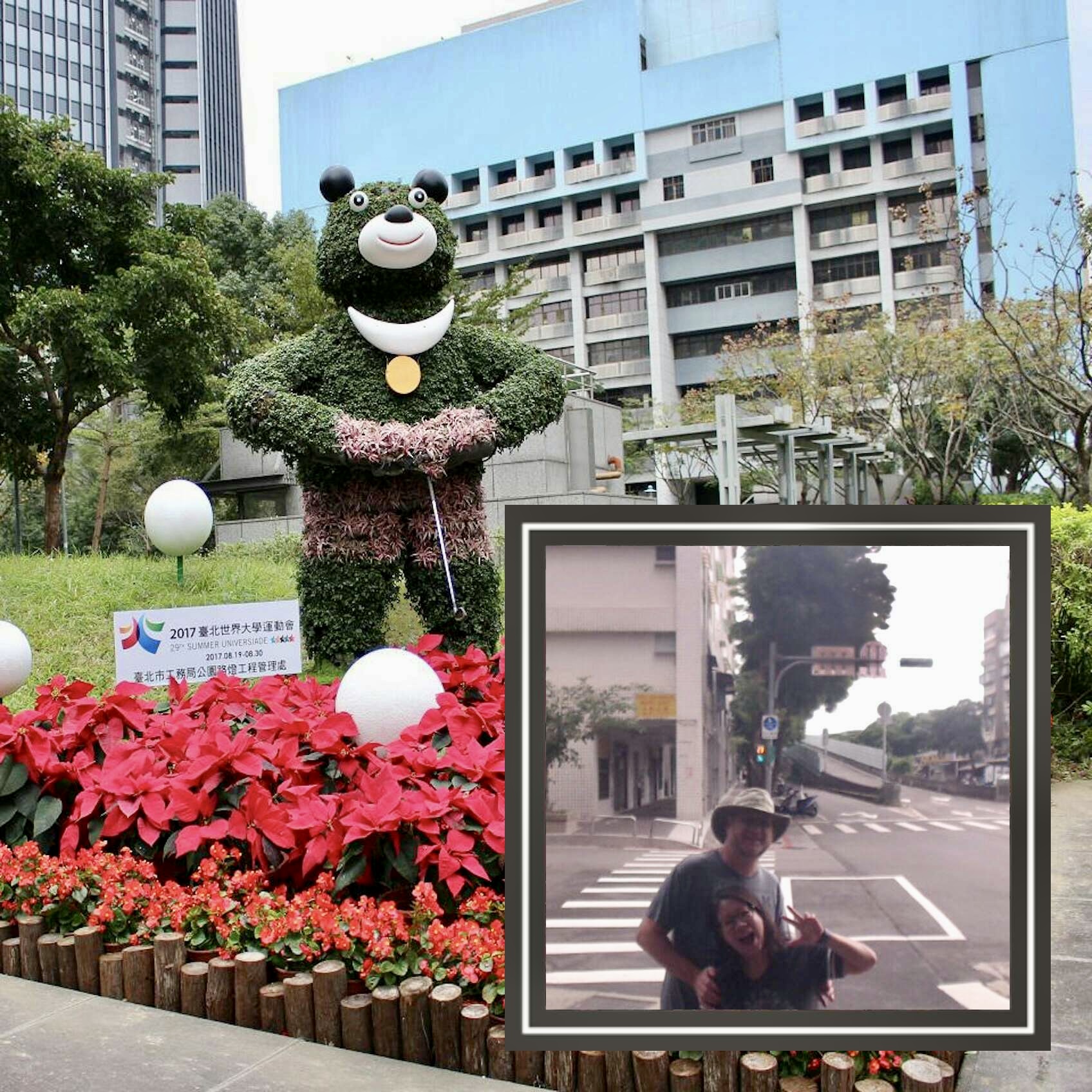
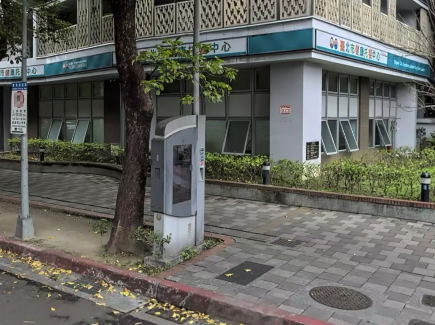
    An informational kiosk on a street corner

    Chuwan and I got out reasonably early and had breakfast at WMD. Near the restaurant, there’s a little kiosk-like thing at the corner of Jiankang Rd & Baoqing St. If I recall correctly, it’s been there since at least 2019, but I didn’t know what it was. It looks like an informational kiosk in Chinese. (The picture included here is lifted from Apple Street View.)

    Today, I was casually looking at it and realized it had a camera on it, and even though Chuwan reads Chinese, she still wasn’t sure exactly what it was for.

    Nonetheless, we had it take a picture of us, and it gave us a QR code, which allowed us to download this picture of us on the street corner. The picture is superimposed on top of an image of a topiary bear mowing the lawn.

    Us, superimposed over an image of a topiary bear mowing a lawn

    We have absolutely no clue where that bear is — it’s not anywhere in sight of where we took the picture — nor why they would want to superimpose us over that bear. We now have this picture as a memory of the bear we’ve never seen.

    Taiwan is a quirky place.

    Chuwan left to meet with Melz and go to the textile trade show, and I was left contemplating my list of things I wanted to do.

    Although my back hurt yesterday, I didn’t take any pain medicine until bedtime. I hoped my luck would hold out again today, and so I hatched what might be the worst possible plan for the day: To climb Xiangshan.

    Xiangshan means “Elephant Mountain,” and if you’ve ever seen a panoramic skyline view of Taipei, it was probably taken from Xiangshan. It is situated within the city and very near the upscale area that boasts Taipei 101.

    Guidebooks will tell you it’s a short (they sometimes even use the word “easy”) walk to the top, made more “accessible” by stairs. If you are unfamiliar with Taiwan, you might not realize that all the mountains are steep as hell. I knew that, but I still didn’t have any clue what I was letting myself in for.

    I arrived at Xiangshan MRT station, the nearest to the trailhead, at around 11:00 AM, and a new wrinkle was added to the equation — for the first time since we arrived in Taiwan, it was going to be a rainy day. The clouds were moving in, and the sprinkling had begun.

    I don’t know how long the Xiangshan Trail is. Various places give it lengths from 0.7 to 1.5 km and a height of only 183 m. I suspect the length variance depends on if you start at the park near the MRT station or at the first set of steps on the trail as you leave the road.

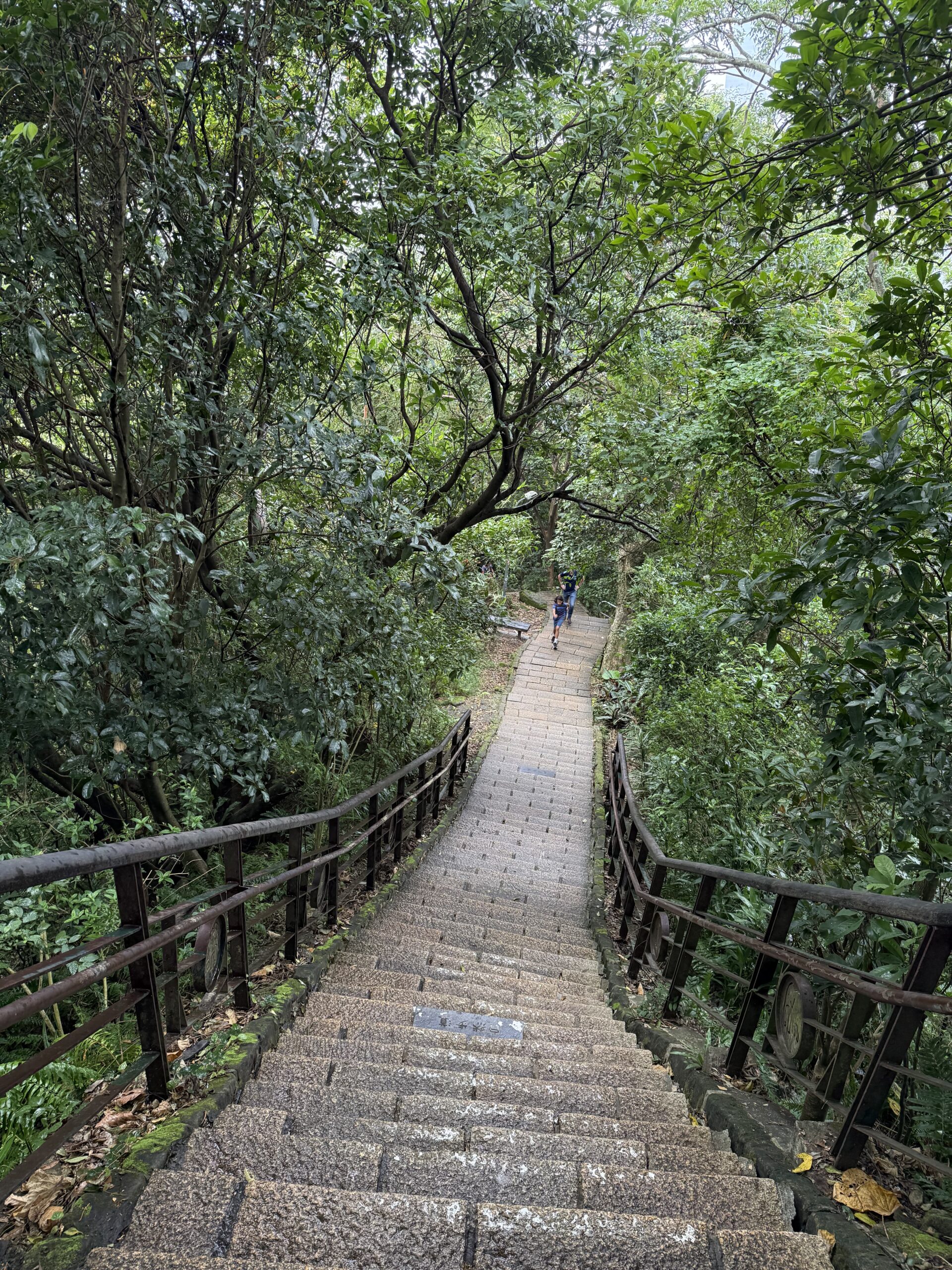
    “Trail” is a misleading word. It conjures up images of winding paths amongst shady trees and nature’s splendor. In Taiwan, and, indeed, at Xiangshan, “trail” means rock stairs leading up the side of a steep mountain. I counted one flat section of the trail that was longer than 3 m. Any other flat areas were just landings.

    Narrow, steep, wet, and mossy stairs climb through the jungle, and in most places, it is impossible to see anything except the trees immediately surrounding you. It was dumping down rain now, too.

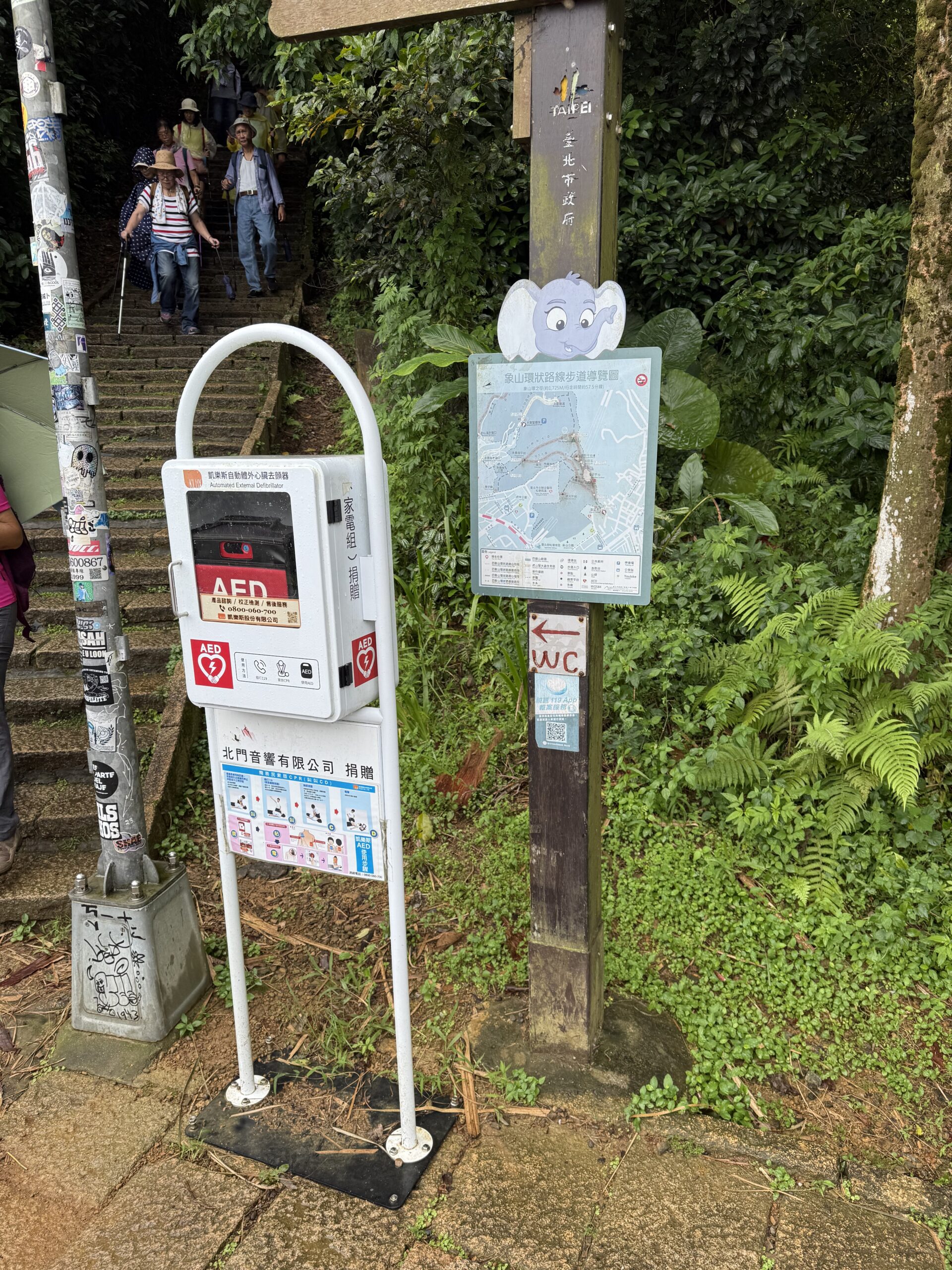
    AED machine along the trail

    It took 45 minutes to reach the top, and along the way, I passed two AED machines positioned along the trail. I’ve never been on a trail where the managers felt defibrillation was required before. If it’s meant to be reassuring, it isn’t. It’s downright scary.

    By the time I reached the top, my Apple Watch had registered that I had climbed 34 flights of stairs. I felt every one of the steps in both my back and my knees.

    At one point, when I reached the first photography landing, two young Americans came along and asked me to take their picture, which I did. As they continued on up the mountain, I thought to myself, “I did those guys a favor, and in return, they might have to carry me down off this rock.”

    I rested a few more minutes, then started out again. Soon, I caught up with them again, and just about the same time, an Australian woman came down from above.

    Seeing our tired and defeated faces, she said, “Hang in there, guys, you’ve almost made it to the top.”

    It was what I needed at that moment because I was on the verge of admitting defeat. I probably wouldn’t have quit, but it was crossing my mind in that moment.

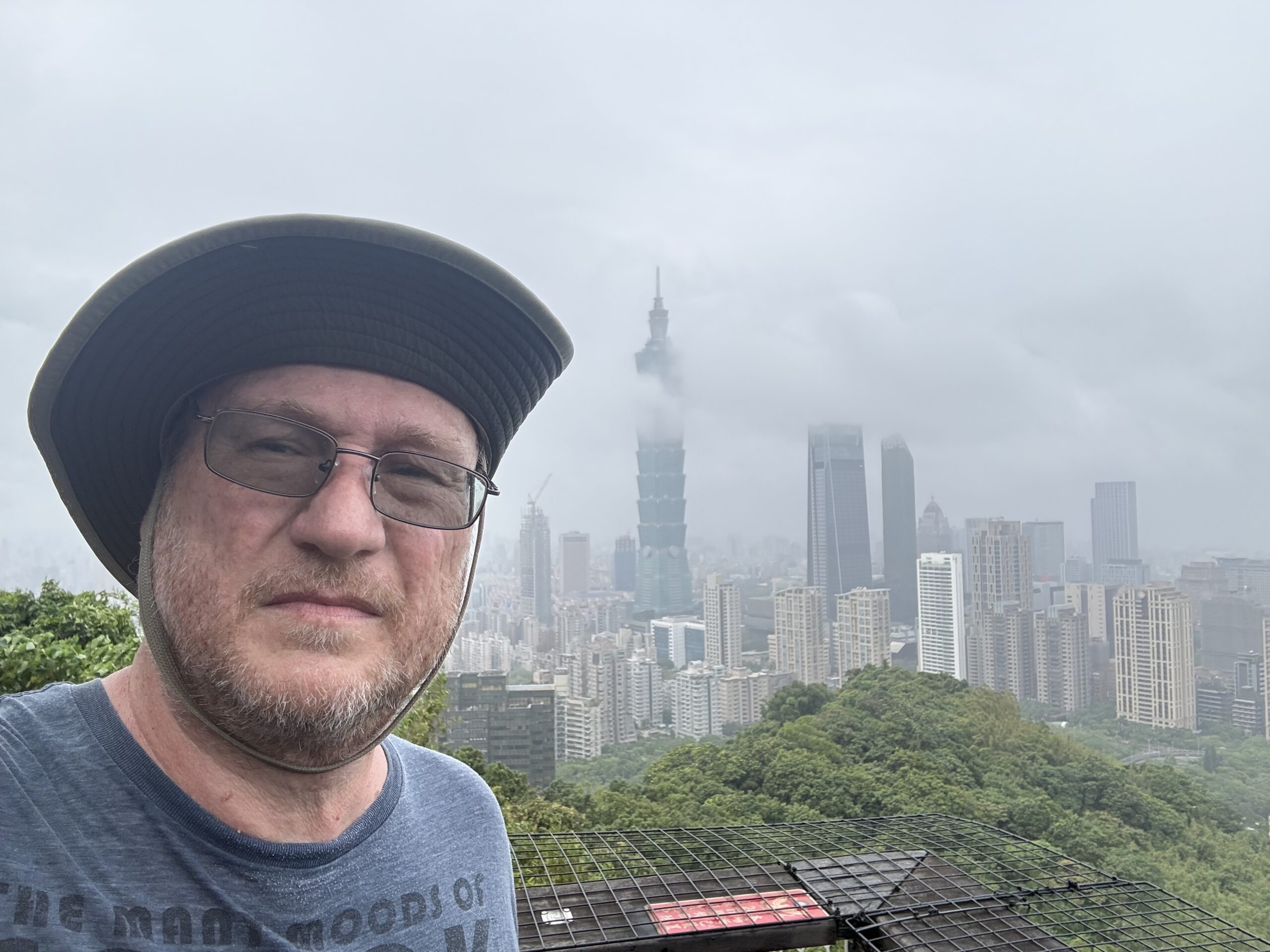
    Me, at the top of Xiangshan, Taipei 101 can be seen behind me in the clouds.

    The view from the top was good, but the weather wasn’t cooperating. The rain was driving, the wind blowing, and the clouds were obscuring much of the skyline.

    The pictures I took from the lower landing were better because the clouds were only wafting about Taipei 101 then, making for a more dramatic photo.

    The climb down was much worse. My knees were not cooperating at all, and I found myself side-stepping down, one stairstep at a time, while clutching the railing — when there was a railing.

    Stairs looking down

    I witnessed a curious phenomenon twice on the stairs. Whereas most people were taking sensible and cautious steps down the mountain, I saw two different women, at two different times, walking backward down the stairs.

    You couldn’t pay me to walk backward down those stairs. Madness.

    It took another 45 minutes to get down the hill. The going was tougher, but I didn’t have to stop and rest. Also, the rain had stopped, making it a bit easier.

    It was now late for lunch, and I was starving, but I was faced with the daunting (to me) task of trying to navigate the purchase of food. There’s always 7-Eleven, but I have been trying to stretch my Mandarin and get outside my comfort zone.

    That didn’t stop me from contacting Chuwan to see if they were done at the trade show. I thought they might want to meet up for lunch, but they weren’t ready, and I would still have to find my own.

    I’m always happy to take the path of least resistance, so I hatched a plan. Taipei 101 was nearby, is in a more affluent area, and hosts several international companies. It has a shopping mall in the lower levels and, below that, a food court and grocery store that caters to a more global clientele. It’s likely one of the most English-friendly places in town. I was still going to try to use Chinese, but a reliable fallback was appealing.

    The food court was absolutely packed. I circled the entire area several times, and there wasn’t any available seating. Crowds of people with trays of food circled like zombies searching for brains as they looked for a seat, and I hadn’t even negotiated to get food yet.

    I was also a bit embarrassed by my appearance. Typically, I don’t give a flying fuck what anyone thinks, but Taipei 101 was loaded with men and women dressed professionally, down from their offices on their lunch hour. I was dressed down for hiking, drenched in rain and sweat, looked like death warmed over, and I would certainly have to share a table with other diners. Even I thought this was over the line.

    I bailed out and caught the subway back to our home base area, hoping to spy something or try my luck at Yoshinoya or Sukiya.

    Lu•Rou•Fan (braised pork scrapings over rice) is a beloved Taiwanese dish. I’ve nibbled at it a couple of times on past trips and was neither offended nor impressed with it, but it was always served to me as a side dish to something else (like a pork chop or a chicken leg) and in very small quantities — like someone sprinkling a light garnish on rice.

    Although I never wrote it down on my “to-eat” list for this trip, I had decided before we left to go somewhere and try it properly.

    Formosa Chang Logo

    Independent of this decision, a restaurant chain caught my attention over my last few trips. Featuring distinctive artwork of an Asian man with an unusually prominent full beard, I had begun to notice their distinctive signs, which had risen above the noise of all the signs assaulting my senses. In English, the name is Formosa Chang, but I had jokingly started calling it “Beardy Chang.”

    It didn’t appear particularly foreign-accessible, and I’d never really gotten close enough even to know what they sold. There was one near our Airbnb and I asked Chuwan what it was. “They’re famous for their bian dang (That’s “bento” for people more familiar with the Japanese term, or a boxed lunch, usually taken on the train) and their luroufan.”

    “Oh, really?” I thought, and packed that away for future use. Today might be the day.

    Another little tidbit I learned is that in Chinese, their name isn’t “Formosa Chang.” It’s “Bearded Chang.” Since I’d been calling him Beardy Chang in my head for years, this amused me no end. That is good logo design!

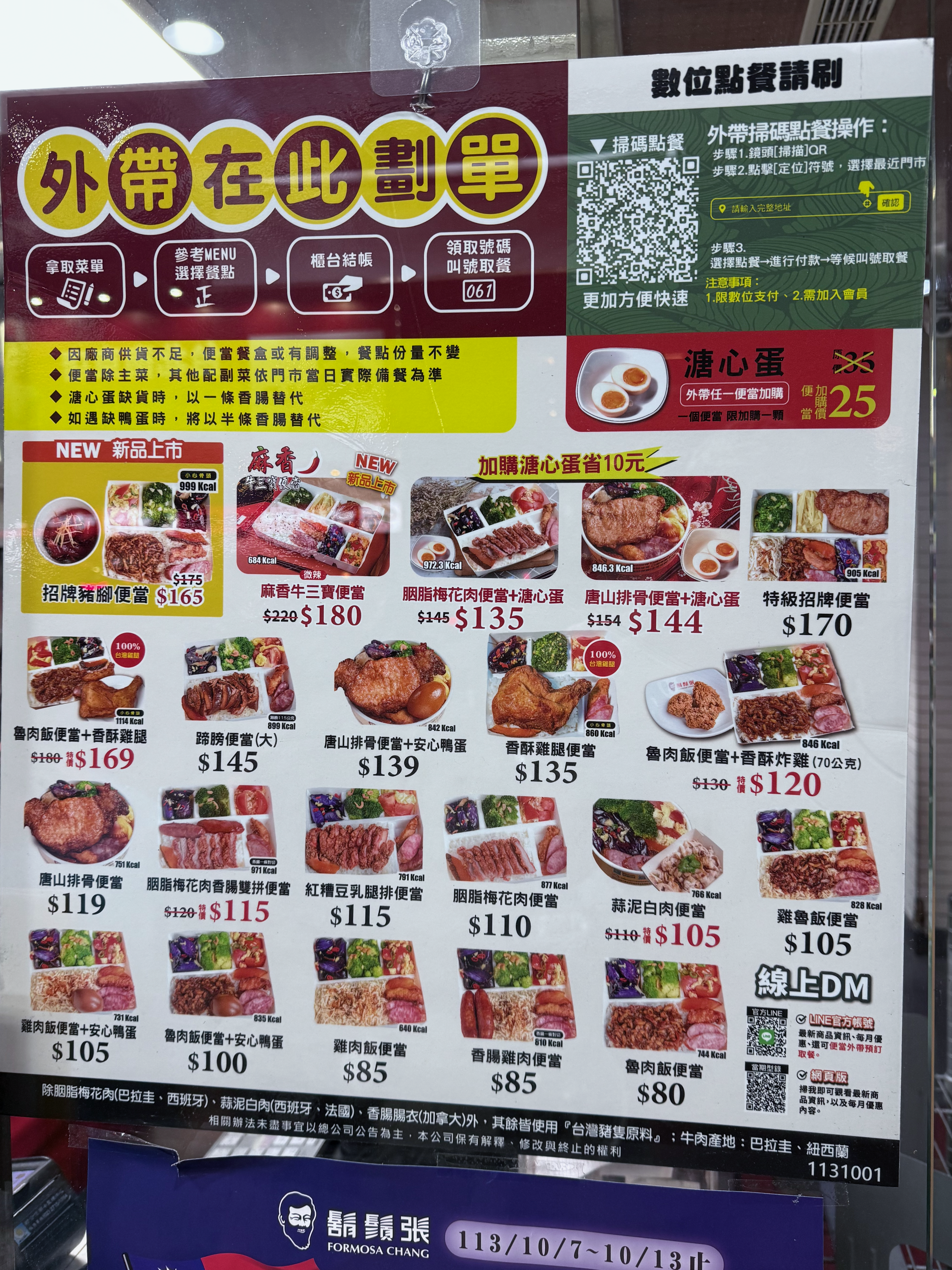
    As I passed, there was no one there — no customers, and, more importantly, no obvious employees. Sideling up from the blindside, I approached the posted menu. It was in Chinese, of course, but it was a picture menu.

    Chinese-language picture menu for Formosa Chang

    Nothing was obviously a serving a luroufan, and it seemed to be a boxed meal menu. That wasn’t a problem, I was very hungry, and would have eaten a chicken leg or pork chop, but I was hoping to find a meal that featured, as its main course, luroufan. There were a couple that looked possible, but I don’t know the character for “lu” and I was hesitant.

    …and then the employee spied me.

    She immediately came to the window to help me. Realizing that I was looking at the menu, she pulled out a laminated menu and handed it to me. “Oh, excellent, they’ve got English menus!”

    Nope. It was the same as on the wall. I was committed, and I was going to go for it; I would try to communicate in Chinese. “Nimen you mei you luroufan?” (Do you have luroufan?)

    You a,” (We have it) she replied, thankfully realizing I was not conversant and keeping her answers simple. I expected her to point out which of the likely meals was the luroufan, but instead, she reached into a drawer and rummaged around for another menu. She took the other menu back, handed me the new one, and then pointed to a picture of a bowl of luroufan.

    OK, let’s do this. “Xie Xie. Wo yao yige wan.” (Thank you. I’d like one bowl.)

    Again, all props to her, she kept it dead simple. “Yao xiao wan haishi da wan ma?” (Do you want a small or large bowl?) (She also pointed at the prices for the large and small bowls as she asked.)

    I had no concept of how big these bowls would be, nor if I would like the food I was buying. Erring on the side of caution, I went small. “Xiao wan.” (Small bowl)

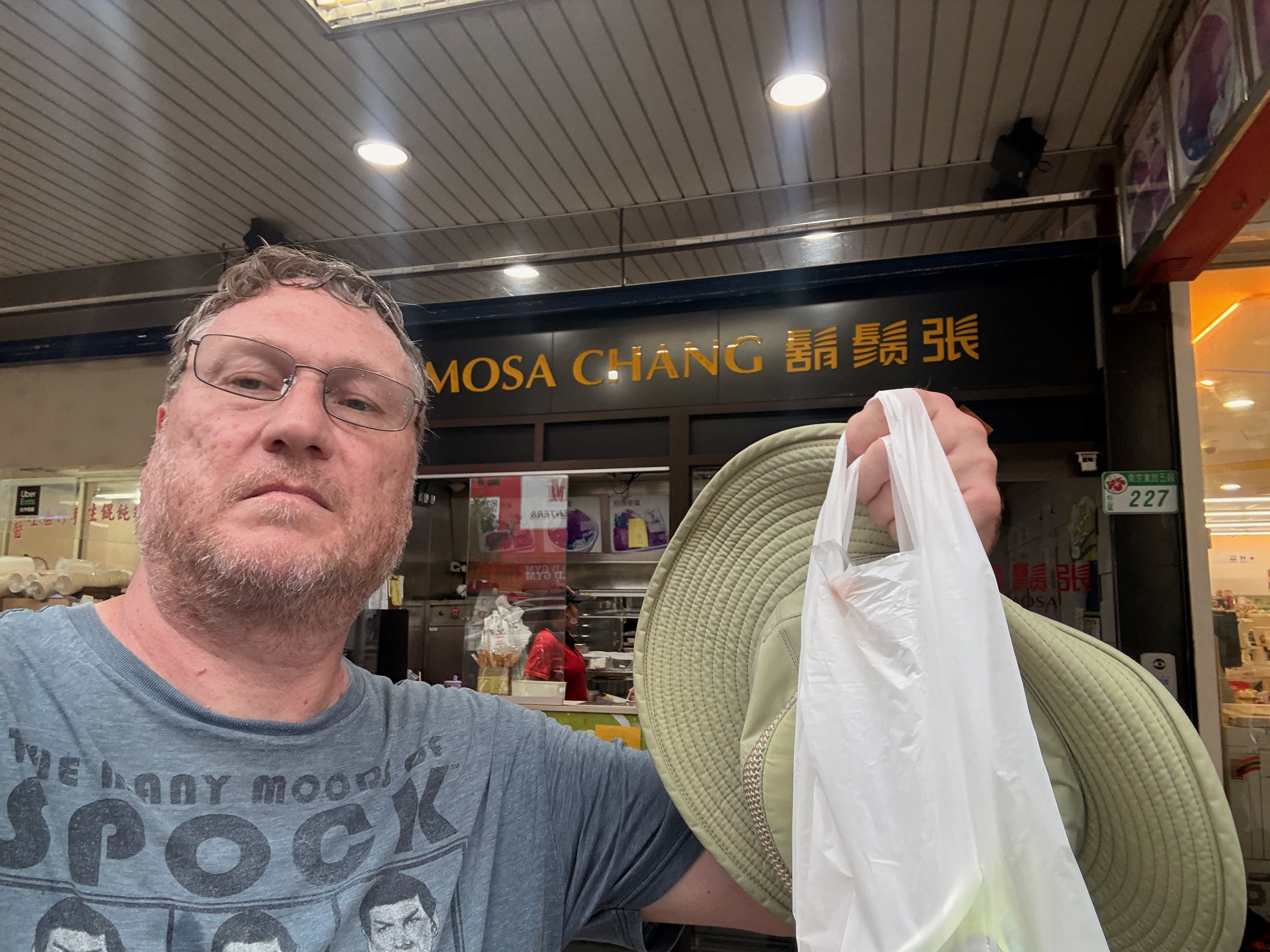
    Me with a bag of food in front of Beady Chang's

    This was the first I felt like I’d made a misstep, because she looked at me oddly for a moment, and then countered with, “Yao dan ma?” (Do you want an egg?) While she pointed at the eggs on the menu. I’m not sure if it was a tea egg or a century egg, but I wasn’t feeling that adventurous.

    “Bu yao, xie xie.” (No, thanks)

    She told me how much it was, which was not much, I paid, and she gave me a bag of food, and off I went back to the Airbnb feeling pretty damned self-satisfied with myself.

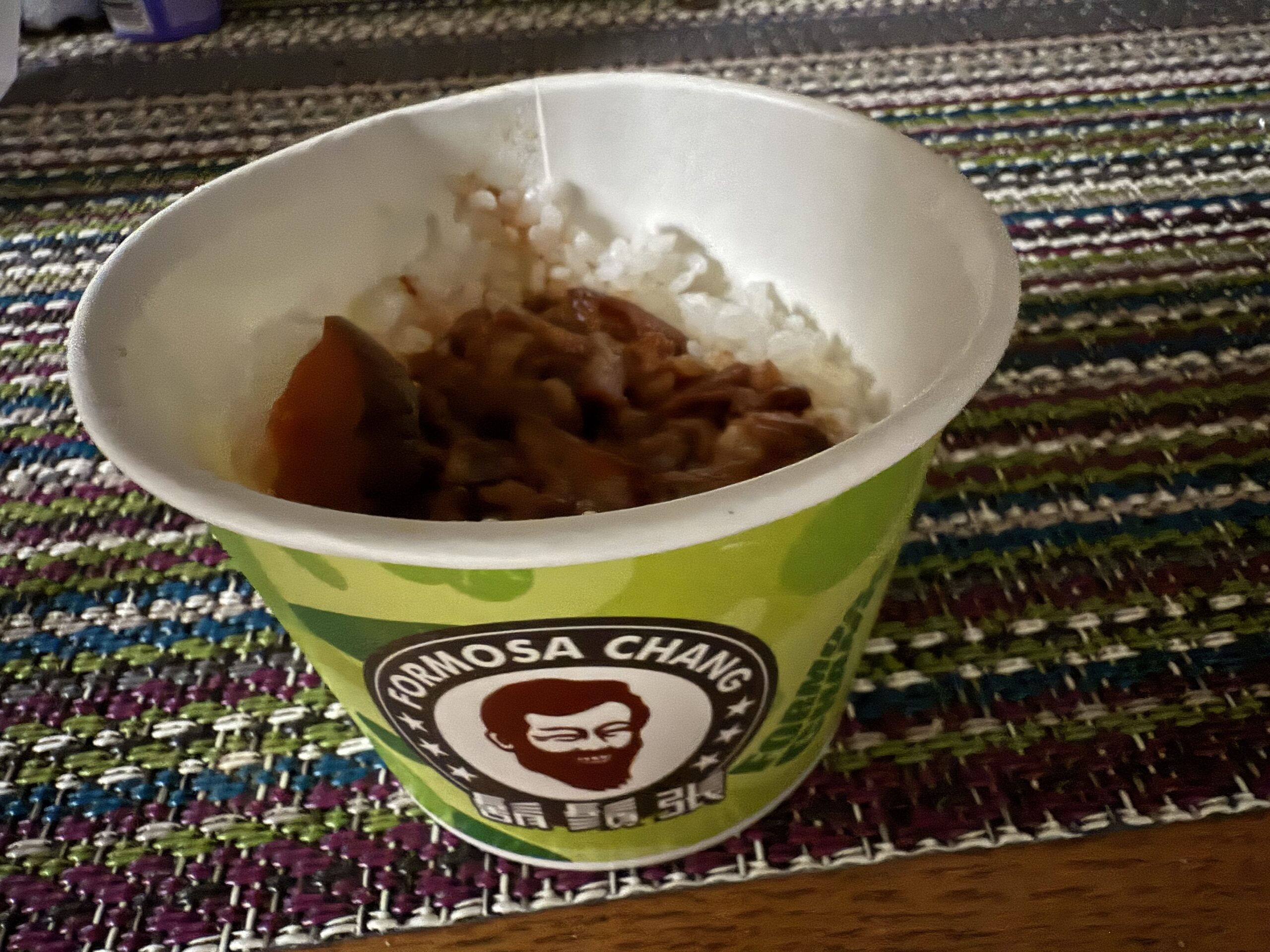
    a small bowl of luroufan

    Back at the Airbnb, I figured out what the misstep was: A small luroufan is very small—definitely a side dish item rather than a main dish. I devoured it because I was hungry and also because it was very good. I enjoyed every bite of it except for one weird meat-colored vegetable (seen on the left side of this picture) that was absolutely revolting.

    I would eat luroufan again, but ensure I got a larger portion next time.

    When Chuwan and Melz returned to my in-laws’ place, I was called over. It was time for one last family dinner. In consideration of me, the family would go to a nearby Japanese/Tonkatsu restaurant for dinner.

    That is until I got there and found out that my mother-in-law did not want to go, so they ordered tonkatsu for takeout instead. They don’t actually have enough table space in their house to support nine people, so that was a bit comical.

    Was it good? It was OK. Was it tonkatsu? No. How can it be tonkatsu without tonkatsu sauce? It was yet another Japanese-style pork cutlet, like we had at Sun Moon Lake.

    It’s the thought that counts, right?

    Tomorrow morning will just be a short farewell in the morning before we head off to the airport, so there were lots of tears this evening. These trips always seem to end in tears. I wish there were something I could do or say to ameliorate it, but human emotions are not subject to logic.

  • Taiwan (2024) – Day Eleven – Eating Away at Vacation

    October 15, 2024

    Eagle-eyed readers may have noticed that these “daily” blog posts are coming out about six days after the actual date. I won’t lie. I’m back home and finally getting around to “polishing up” my daily notes, which are incoherent to anyone but me. As an exercise in style, I try to retain the author’s point of view at the end of the day about which I’m writing and maintain the mystery of what is to come.

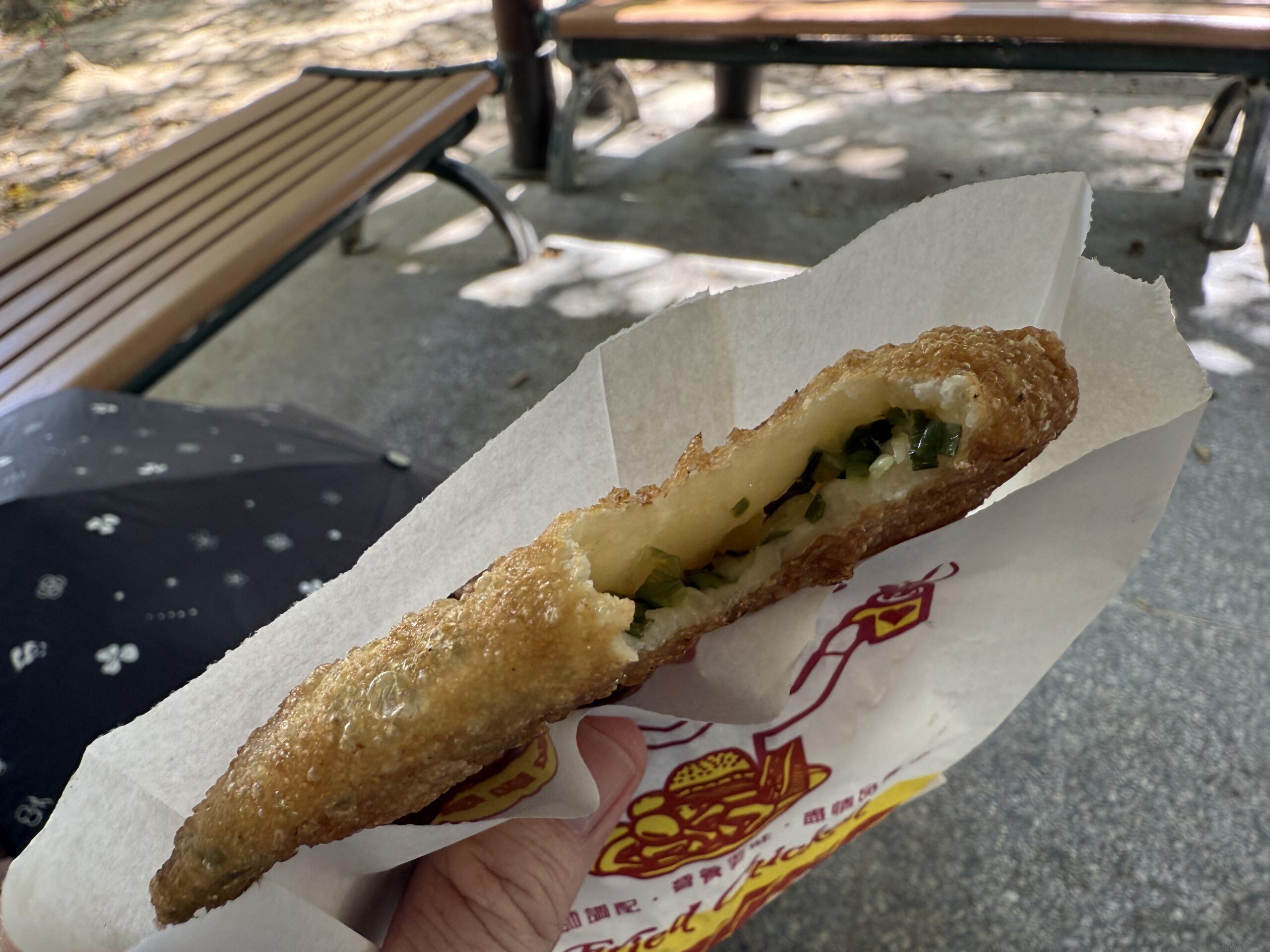
    Cong You Bing (Scallion pancake) with a bite out of it
    Cong You Bing

    It’s coming down to the wire now, and while it’s been fun, it’s also been a disappointing trip so far.

    I cannot express how angry I am at United Airlines. We’ve never flown an American carrier across the Pacific Ocean before, and we never will again. It was horrible. The food was terrible, the leg space was as bad as a domestic cattle car flight, and the seat I was crammed into absolutely wrecked my back.

    Not only has this back problem hampered many planned activities, but now, as it finally gets better, the specter of the return flight looms large in my mind. Will I be screwed up for another two weeks upon my return? If spaces were available in Steerage Plus, it would set us back another $600 for the return flight. It’s something to consider, but it feels like highway robbery for another 2 inches of legroom. (Or perhaps, Skyway Robbery? See what I did there?)

    While in Taipei, I had expected that my wife would spend a significant amount of time with her parents and nephews, Melz would be in school half the day, and I would be free to explore on my own or with Melz in the afternoons, but I’ve spent at least half each day resting my back, and when not resting, I’m moving more slowly than I typically do and planning jaunts that involve less walking or standing.

    In addition to wandering freely, I had a short list of sights to see that, over the years, I’ve somehow missed. Like The Four Four South Village, The Lin House, The Leaning Mailboxes, and Elephant Mountain. None of them are earthshaking, but I had compiled a list and so far managed to see exactly none of them. Elephant Mountain, in particular, galls me because it’s the one I want to see most, and it would be a considerable hike; I cannot see myself possibly feeling well enough to attempt it by tomorrow and convincing either Chuwan or Melz to go with me seems unlikely.

    There are also a number of food establishments that I wanted to get to that I had not, including Ichiran Ramen, Mr. Long’s Chicken, and Lao Dong Beef Noodle. Considering that my wife’s plan was to cook for her parents tonight, that meant I had only breakfast and lunch to be a bit adventurous. The language barrier still makes ordering difficult.

    Naturally, I wanted to get up early, get breakfast, and get out of the Airbnb. Chuwan, however, just wasn’t feeling it, and it took me till 10 AM to get her out and on the street. I guess jet lag truly is over for us. Just in time to leave.

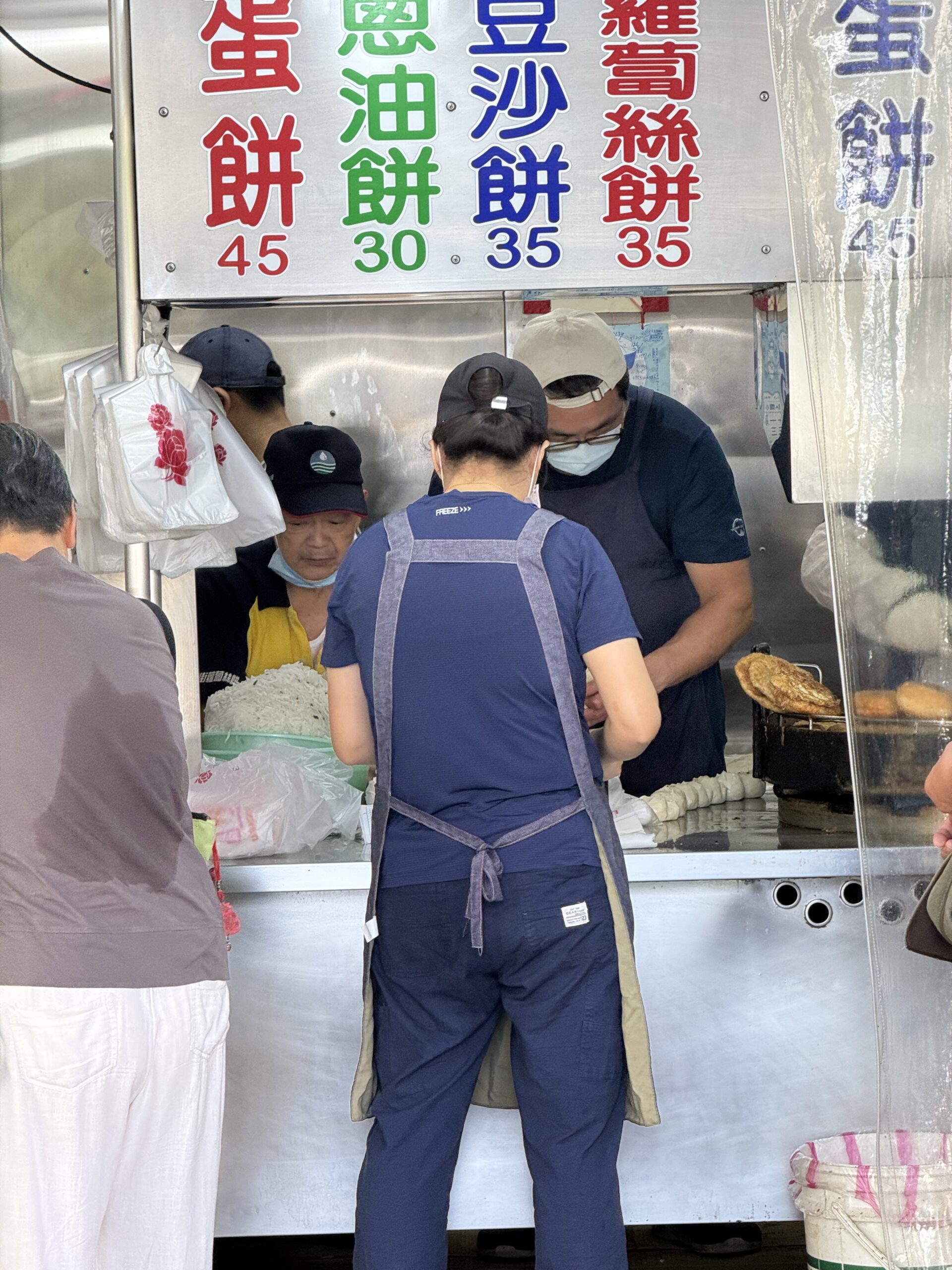
    Wenzhou Street Scallion Pancakes storefront

    This morning, I had another must-visit food stand, Mr. Cong You Bing. That’s not his name or the name of his establishment*, and honestly, it isn’t even what he’s famous for. For years, he was just a couple blocks away from my in-laws’ old house. I’d walk there every day and fuck up my order every day. It was my morning humiliation (except when I could convince Chuwan to come along and do the ordering), but the food was so good!

    In English, Cong You Bing is alternately called a “green onion pancake” or a “scallion pancake.” It is dough infused with green onions and fried. The name pancake is misleading. The “pancakes” are savory, not sweet. Most are fried on a griddle, but Mr. Cong You Bing deep fries them in oil.

    A few years ago, he moved further away from my in-law’s old house, and he’s even further still from the new old house and their current new house. He is, however, fairly close to NTNU, where Melz is attending class.

    Since it was so late, we contacted Melz to meet us there, and after a couple of false starts, we got that coordinated.

    Mr. Cong You Bing has never been a young man since I’ve been going there, and I was really pleased to see him still making the pancakes this morning.

    I decided that today, I needed to knock off a couple of items on the “to-do” list. Based on ease of access, we opted for the Four Four South Village.

    Background: In the 1940s, Chiang Kai-Shek’s forces retreated to Taiwan with their tails between their legs after being dragged by Mao Tse-Tung’s People’s Liberation Army. Two million soldiers, plus various other family members/refugees, including my wife’s grandfather, her grandmother, and their infant son, my father-in-law, retreated to the island.

    Chiang’s delusion was that he would muster his forces on Taiwan and take back the mainland “real soon now.” Taiwan had just been liberated from being a Japanese colony for the last half century, and the natives weren’t really thrilled with the invasion by Chiang’s army, but that’s a story for another day.

    Chiang needed to house 2 million soldiers and their families, so they built “temporary villages” all over the island. These were crude, temporary structures because they were going to take back the mainland “real soon now,” but as “real soon” dragged onto “someday” and finally “never,” these became permanent homes.

    They have since been mostly torn down.

    I actually got to visit a “real” one, still inhabited, in Hsinchu in about 1999 — the one that my father-in-law grew up in. His mother still lived there, and we went to pick her up. I have never seen a smaller home in my life. It was all cement, and the height of the doorway was as low as my chin. I had to bend over to stand in the house.

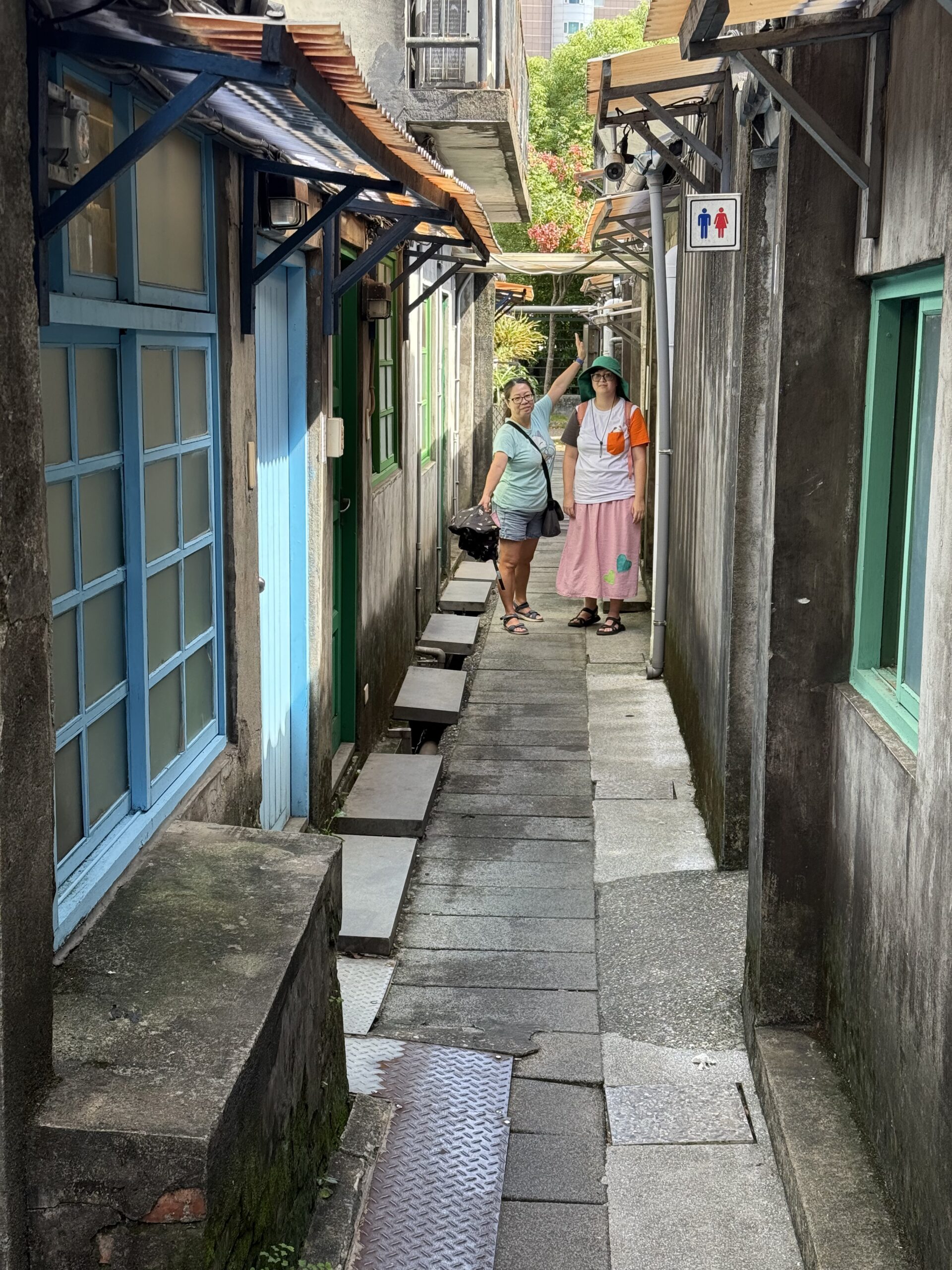
    Narrow alleyway at Four Four South Village. Two humans stand at a distance for scale.

    The Four Four South Village is one of these military housing projects that has been preserved as a historical site. I was interested to see how they preserved this piece of history.

    It wasn’t particularly impressive and didn’t seem nearly as tiny as the one I had seen. If you’re in the area, stop by; it’s free, but I wouldn’t make a special trip for it.

    In the interest of full disclosure for things that might be of interest to others (but not to me) they do have a brewery there that sells Taiwan Head beer, and they also have a place that, according to several sources online, sells the “only real bagels” in Taiwan. That’s probably apocryphal, but I did see the bagels, and they looked real.

    Four Four South Village wasn’t as interesting as I’d hoped, but it was not very far from Ichiran Ramen, which, like the Din Tai Fung we visited yesterday, was also in Shin Kong Mitsukoshi building A11.

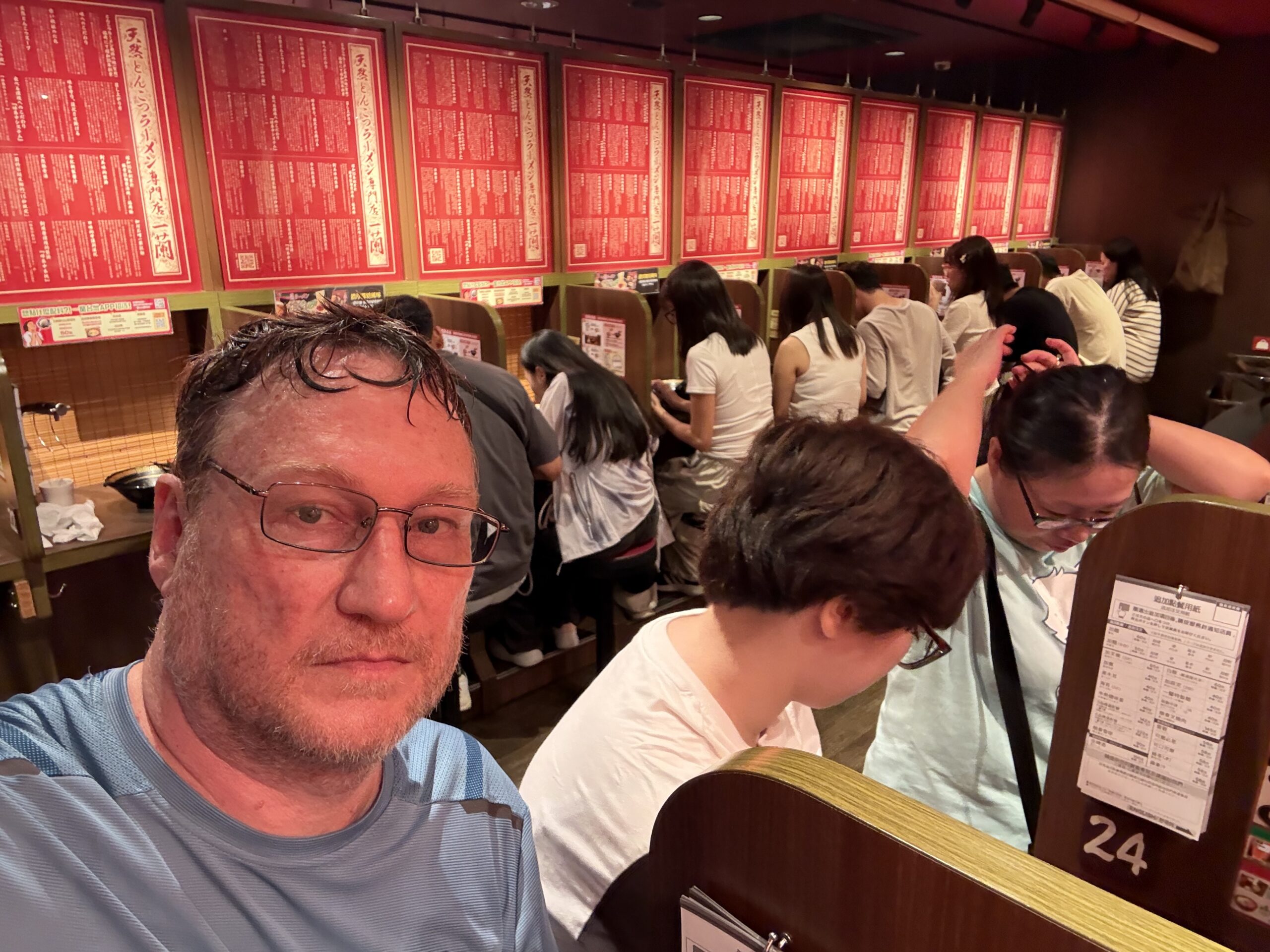
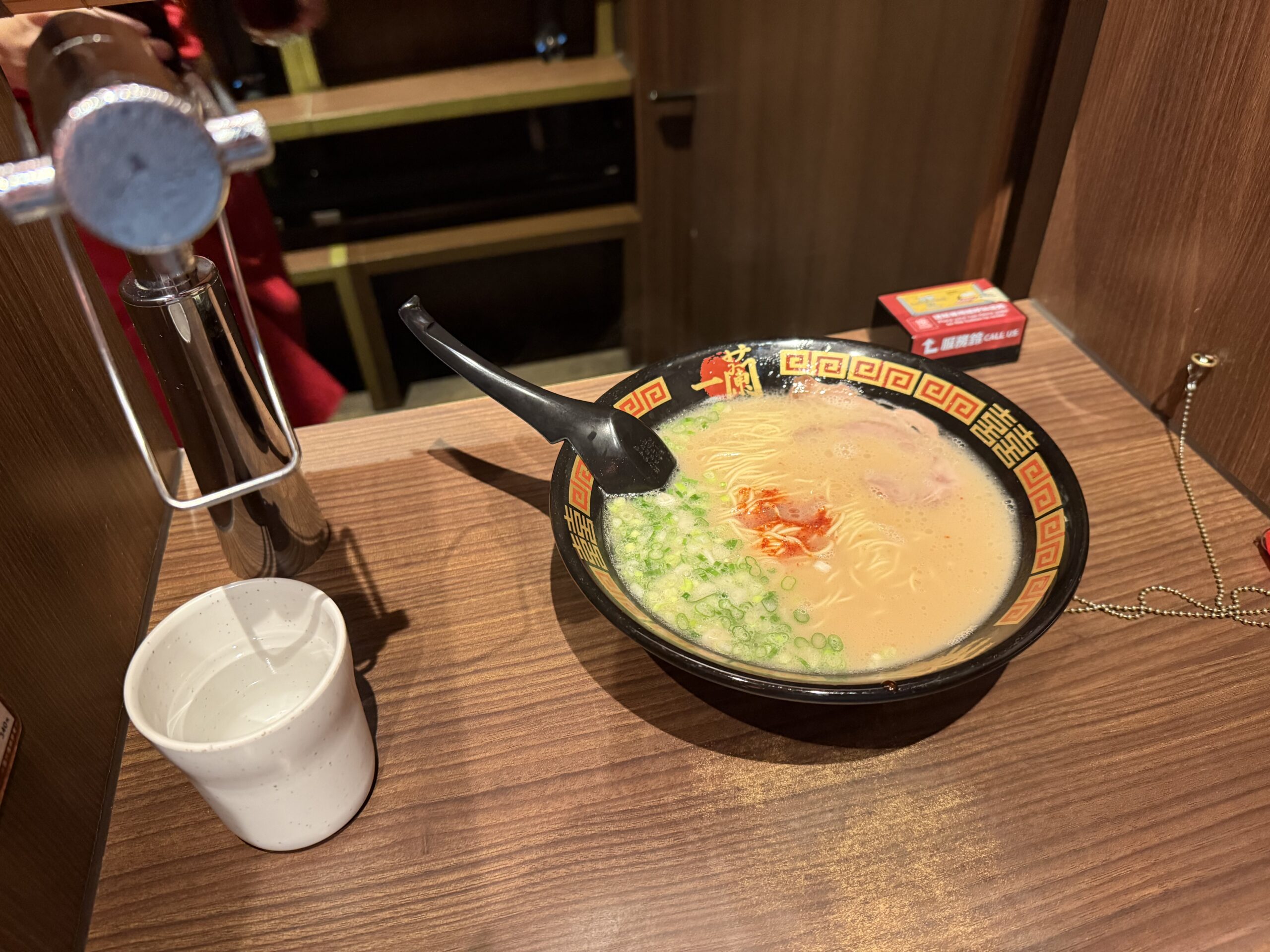
    The three of us at Ichiran Ramen

    Ichiran is a major Japanese Ramen chain. One of the things that makes them unique is the distinctive dining style they have adopted. In an effort (I guess) to mimic the close-quarters style of eating at a ramen cart, Ichiran restaurants feature everyone sitting side-by-side in small private cubby holes. You are, essentially, dining alone, even with a group, crammed into a small counter.

    The three of us were placed side-by-side in our private dining stations. Each station has a water tap for unlimited drinking water and a curtain in front of you. You’re given a form, which you fill out, you press a button, and they take it. The custom ramen is delivered moments later, the curtain closes, and you are left to eat alone. There is a mechanism for ordering additional food, such as more noodles. You never see the face of your server.

    a bowl of Ichiran ramen

    Despite never having eaten at Ichiran before, I’ve been a fan for years. You can get Ichiran ramen kits through Amazon in the US for about $6/bowl. I don’t eat a lot of ramen, but it’s my ramen of choice, and compared to the outrageous prices you’d pay for a bowl of ramen in Phoenix at a restaurant, it’s still economical. These are the same kits they sell at the door of Ichiran as you’re leaving. (For just under $5/Bowl.)

    But now I can decide if it tastes like the real thing.

    The dining experience is more of a novelty than an attraction to bring you back, and the booths aren’t designed for large foreigners. I was a bit hemmed in, with less than comfortable legroom, but it does encourage you to eat and get the hell out quickly.

    The ramen itself was delicious but a bit unfair compared to the boxed version. When I ordered mine, I was able to add a chunk of chashu pork, spring onions, and fresh garlic — things you don’t get in the box. Taking those things out of the equation, I’d say the boxed ramen is very close to being the same. That makes it one of the few things I can get in Phoenix that actually tastes “authentic.”

    Lest you think Ichiran Ramen in the store is somehow cheap, it isn’t. My bowl and a glass of Coke cost $11.52.

    I’m still going to write up my experiences with Holafly eSIM service at some length, but suffice it to say that we’ve been having some issues with sporadic service. That shouldn’t happen in Taiwan, let alone Taipei, which is massively saturated with cell service.

    My carrier in the United States, Verizon, offers an international roaming “deal” of $10/day for “unlimited”** calling, texts, and data. Essentially, if you make a call, send a text message, or use cellular data, you’re charged $10, and your 24-hour period begins.

    I wanted to test the service compared to Holafly, and also I just wanted to see the novelty of two eSIMs active at the same time on my phone. I’d had the US eSIM turned off completely for the trip, but I slipped it on today while we were at the Four Four South Village.

    I noticed no obvious difference in my data speeds or availability; however, when I was in Ichiran, I suddenly got a barrage of text messages from Kamala and Democrats all over the United States begging for money. In theory, I would not be charged for that (apart from the $10 fee that I believed I had incurred but turning the line on.) I tried the data connection again, and there was no apparent difference. I also received notification of a couple of voicemails that had come while I had the line off. I left them unread because they were junk. I was not that impressed with the service so far.

    After Ichiran, I returned to the Airbnb to rest my back. Chuwan and Melz went to the in-laws’ house where Chuwan would be making them dinner.

    Around 5 PM, I was contemplating how poor my data service from Verizon seemed to be, and then I realized that I still had Data Roaming turned off on the line. The instant I turned it on, two things happened: My data speeds popped up to where they should be, and I got a notice that my 24-hour period had begun.

    Aha! I could have had the line turned on the entire trip without incurring charges as long as I’d kept data roaming off and not answered the phone or responded to text messages. It’s a working hypothesis, and when the next bill comes in, I can hopefully confirm that. In the future, that could mean I could always have the availability of my US-based line if I needed it without having to switch it on whenever I thought it was necessary.
    Melz slipped out of dinner at the in-laws’, and we met up for one last pizza and Dr. Pepper before I leave Taiwan.

    Late at night, when Chuwan returned from her parents’, she stopped by the Mr. Long Chicken stand near the Airbnb and picked up a snack. It was excellent chicken.

    There’s been a last-minute change of plan for tomorrow. Taiwan is a large player in the textile/fabric industry, and they have one of the major trade shows in the world starting tomorrow. Chuwan’s friend has direct connections to the industry and has gotten Chuwan and Melz passes to attend the trade show. Melz has recently graduated with a degree in textiles and fabric, and the show seemed too great an opportunity to pass up.

    What it means, though, is that I will be completely on my own after breakfast for my last day in Taiwan.


    *His actual business name (in English) is Wenzhou Street Radish Pancake, despite the fact that he hasn’t been on Wenzhou Street for years. And his specialty is a big, fat, deep-fried bun (too thick to be characterized as a pancake, but they do nonetheless) stuffed full of shredded radish. If radish is your thing, it’s what he’s famous for, and there’s always a long line. Scallion pancakes are just his sideline.

    **Of course, there are actual limits.

  • Taiwan (2024) – Day Ten – Biking for Food

    Monday, October 14, 2024

    I’ve said it before, but I think this one will be a short one!

    Today was a bit of a “down day” after yesterday’s excitement. Melz was back in school, and Chuwan and I had no plans for the day.

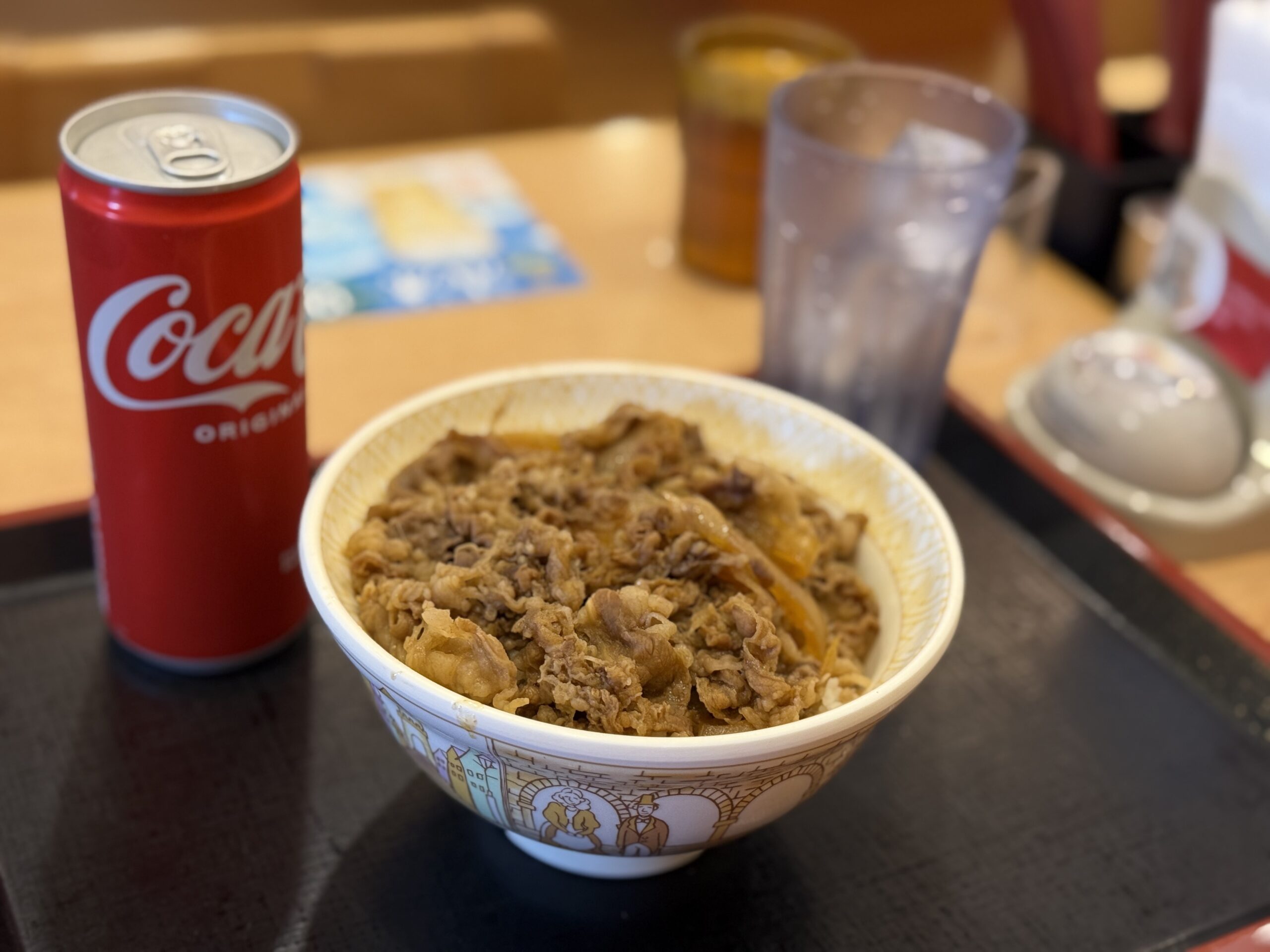
    We rented YouBikes and headed out for breakfast. We stopped at Sukiya for breakfast. Now this was a necessary stop. I’m a big fan of Yoshinoya, and I love gyudon. Gyudon is workman’s food. Cheap and filling.

    A bowl of gyudon

    The few places selling gyudon in Phoenix treat it like it’s a rare gourmet dish from Japan and price it accordingly. The one place remotely near me in Phoenix sells it for $14 bowl. A standard bowl in Taiwan equates to $3.40.

    I go to Yoshinoya every time we go to Taiwan, but this is the first trip I’ve noticed Sukiya, which is a competing Japanese chain to Yoshinoya. I’ve never tried them or even heard of them until this trip.

    On Day Three, I went there for the first time, but in a fit of uninhibited craziness, I didn’t try the plain gyudon. I went with gyudon with cheese. It was interesting, good even, but it wasn’t a fair comparison to Yoshinoya. It was absolutely essential that I go to Sukiya and try the plain gyudon before we left.

    Chuwan was happy to go along and have a full Japanese-style breakfast with fish and a variety of small plate items. It was all under $10 between us, and I had a larger portion of gyudon to boot. I put it as neither better nor worse than Yoshinoya, but it was delicious.

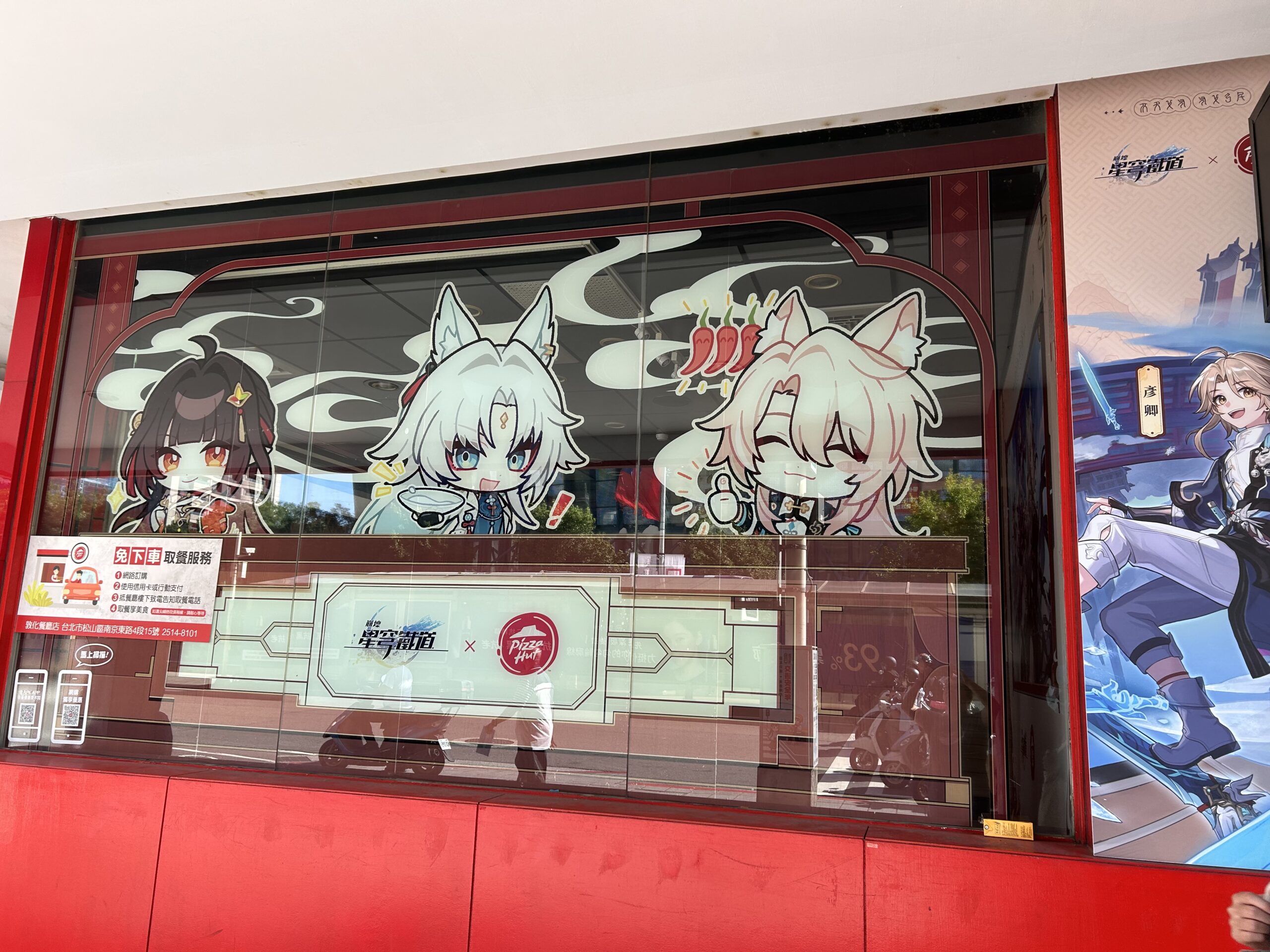
    Honkai Starrail artwork on a Pizza Hut in Taiwan

    After we ate, Chuwan had what she called a “crazy idea” (and it was.) She plays a game called Honkai Starrail, and Pizza Hut Taiwan is currently running a cross-promotion with the game. Chuwan proposed that we ride the bikes to the nearest Pizza Hut where she could take pictures of Honkai Starrail decorations on the restaurant.

    Crazy, but harmless, and an excuse to ride the bike more, so I went along.

    After she snapped her pictures, we continued until we came back to Hung Rui Chen (see also Day Three) and bought some more sandwiches to stick in the fridge at our Airbnb. Plus, it gave me an excuse to ride the bike more.

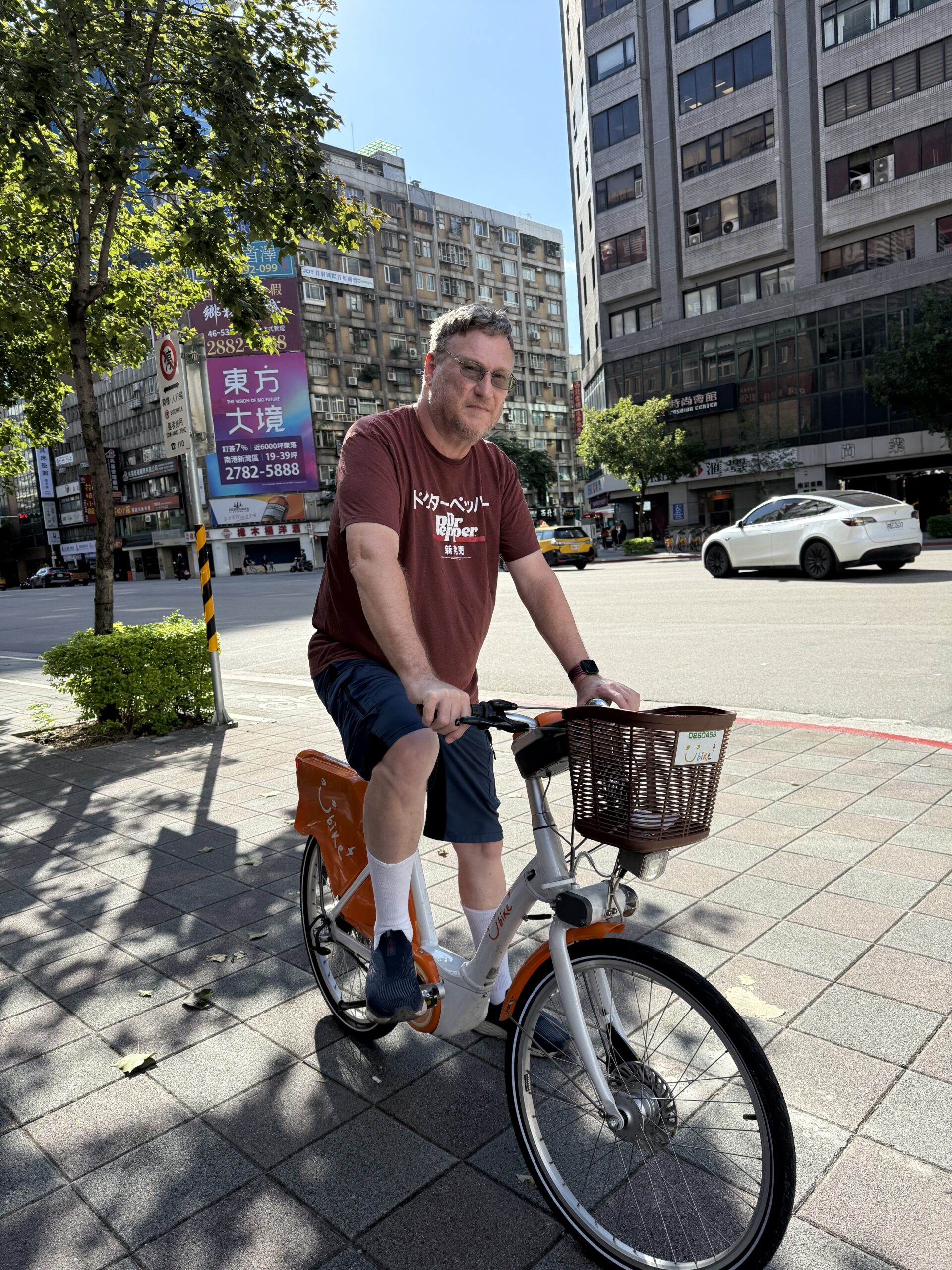
    Me on an eBike

    Aware that we had not yet managed to eat at Din Tai Fung, Chuwan had been monitoring the average wait times at the various locations. She had decided that the Din Tai Fung in the A11 Building of Shin Kong Mitusukoshi was the one that usually had the shortest wait time.

    We contacted Melz to see if they wanted to meet near the restaurant.

    Buses in Taipei are frequent and go pretty much everywhere. Historically (for me, that means in the years I’ve been going to Taiwan), they’ve also been illogically routed, with multiple different buses going to the same place via different routes. The routes are circuitous. There are multiple different bus companies. They drive like maniacs. A single bus stop can have as many as ten or more different bus routes servicing it, and, of course, the signage was entirely in Chinese characters. The buses also don’t seem to run on any meaningful schedule. They follow extended loops but don’t have scheduled times to be at the stops. They just get there when they complete the next loop. Depending on the route’s popularity, there may be more than one bus on the same route, cutting the interval time down.

    It was virtually impenetrable for a visiting foreigner. I avoided buses like the plague unless Chuwan was leading the way.

    But things have changed for the better.

    Many of the bus stops now have digital signs showing how long until the buses on all the routes arrive next. You still need to know which bus routes will get you where you want, but that is now solved by the fact that Apple Maps now has public transit routing info for Taipei (Google Maps does, too, but it’s Google, so fuck ’em!)

    To get to Shin Kong Mitsukoshi A11 we decided to take the bus because the subway would require three trains and two transfers. One of those transfers would have been at a bitch of a station, where you get off the train two or three stories underground, then transfer to a train that requires you to go three stories above ground, and then back down underground on the next transfer.

    I decided today was the day I would figure out which bus to take!

    Apple Maps also had the bus arrival times, presumably fed by the same data feed that updates the digital signs at the bus stops. Because the bus routes are so plentiful and follow many different routes but cross over many of the same destinations, this leads to the weird situation where if you ask Apple Maps for a route now, it may walk you to bus stop A and then tell you to grab bus X, but if you wait a minute or two, it may tell you to walk to bus stop B and catch bus Y. A minute later, it will be different again.

    That lead to more than a little anxiety on my part because, there is one thing certain about Apple Maps routing directions: If they tell you it’s a 9-minute walk somewhere, it most certainly is not a 9-minute walk. But if the best route is so contingent on timing down to a minute or two, will you be catching the best bus?

    I decided to wait till we got to the bus stop before asking what the best route was. That worked perfectly. The buses have also upped their automated “announcements” of stops game, often including English when appropriate.

    I knew which bus to get on, and I knew when to get off, and I could double-check it by following along on my phone. Perfect.

    Note to visitors to Taiwan: I just watched a YouTube video where a family tried to catch a bus, and they were mystified as to why the bus just drove past them when they were at the stop. They speculated that the bus was out of service. They probably did not know that the buses won’t stop unless they’re letting someone off or you flag them down.

    All hail the bus!

    There was a wait at the door of Din Tai Fung, even though we arrived as they opened, but it was only about 5 minutes, and the food was excellent, as always. I really could eat here every day, but they’re not cheap. There’s one opening in Phoenix next year, and I fear what it will do to my budget.

    Honeybee the robot

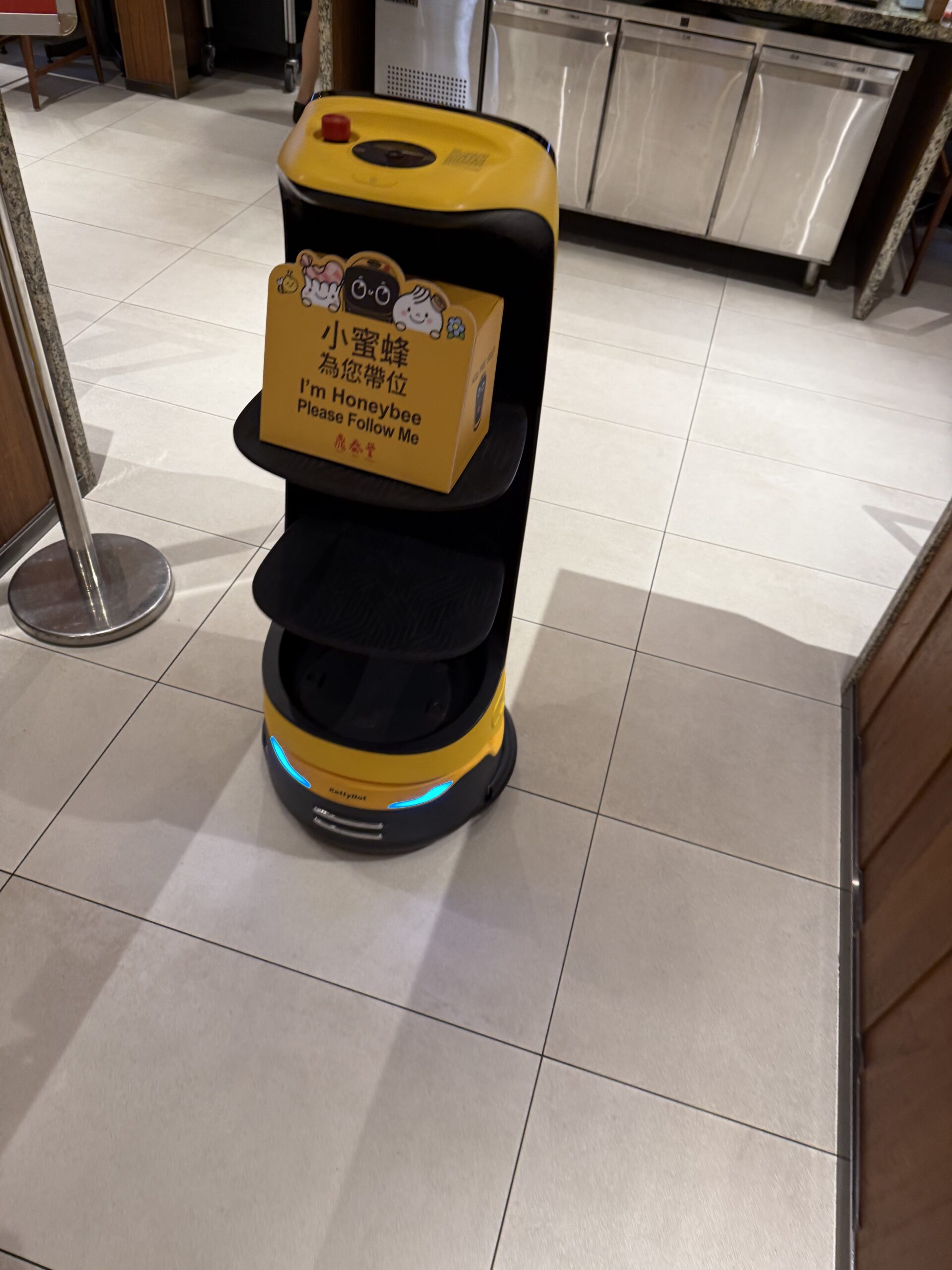
    This location had a little robot that showed us to our table. This is the same type of robot used by Kura Sushi to serve drinks. One wonders why Din Tai Fung uses it for a different purpose than what it has clearly been designed to do. (In the picture, you can see the “I’m Honeybee, please follow me” sign on the tray where you place food or drinks for delivery.)

    After lunch, there was a temporary(?) Pokémon store in the complex, so we went there at my wife’s and child’s insistence.

    I had a bit of a sad moment while wandering the Pokémon store. I overheard a man explaining to a woman that these Pokémon they were looking at were Taiwan-exclusive products.

    It was a sad moment because I have been working very hard on learning my Mandarin lately, and I have been trying to listen to people on the streets and the trains and pay attention when my in-laws are talking, and I am making some progress; however, this man wasn’t speaking Chinese. He was obviously Taiwanese but spoke rudimentary Japanese to the woman. I picked up more Japanese than Chinese.

    For 26 years, I’ve been exposed to Chinese and have been trying to learn it (admittedly, most of that time, not aggressively). I haven’t taken a Japanese course in over 27 years, but I still picked up more Japanese in that one conversation that I can after several hours of listening to the Taiwanese people. Disheartening. My brain has clearly ossified.

    We took a break for the afternoon.

    My dinner plan in a nutshell was: God dammit, I’m going to eat at a fucking McDonald’s, and they’re not going to stop me.

    I’m not even a big fan of McDonald’s; it’s just been shitting me that every time I try to go, they’re too packed to have a seat.

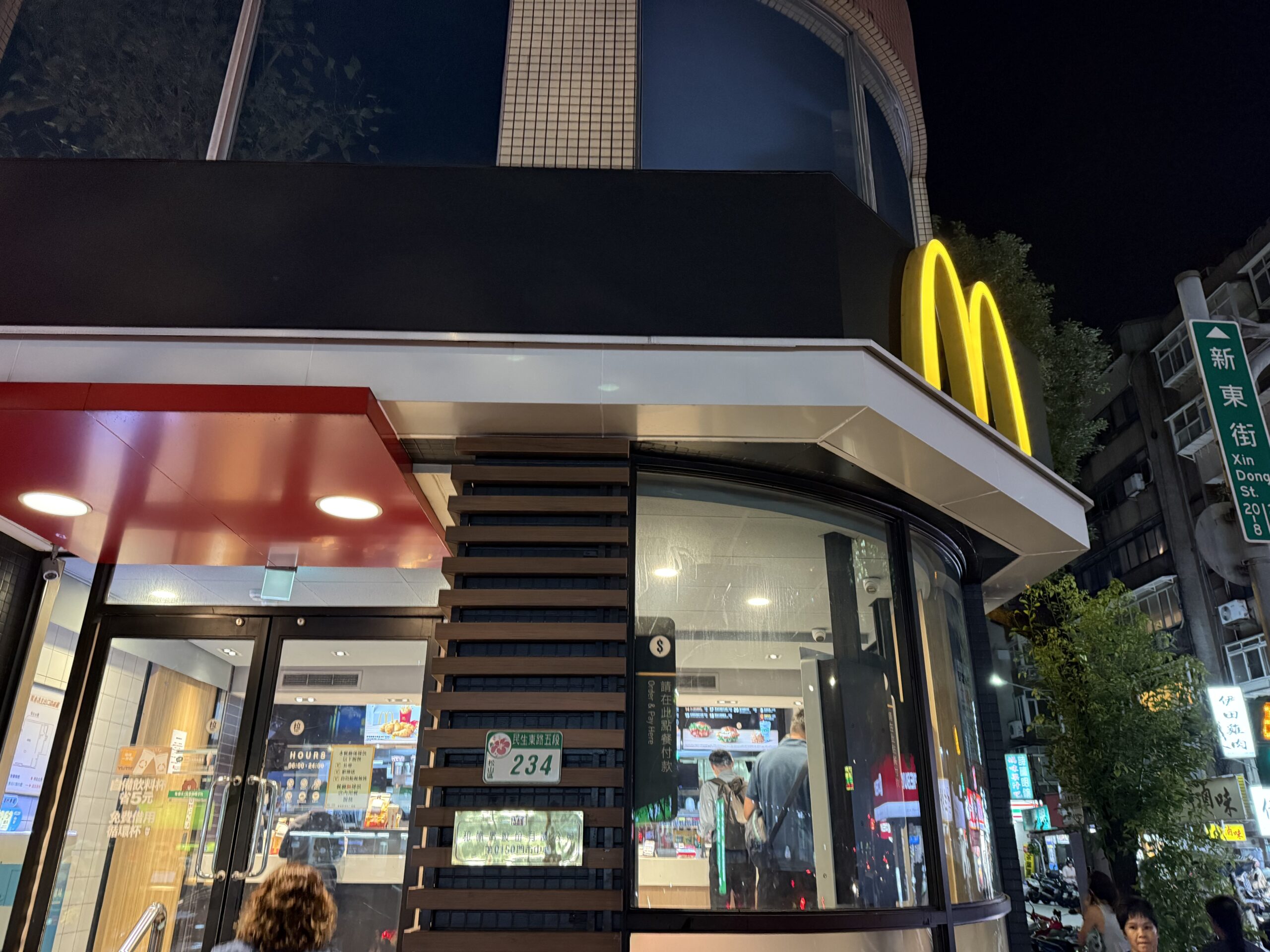
    McDonald's restaurant at night

    Melz was up for it, and Chuwan suggested a plan. We rented YouBikes and rode to McDonald’s near her parents’ old new house. It was a two-story restaurant that we used to go to for breakfast with some regularity. It was neither near a subway line nor any major urban nexus points.

    When we got there, they had eliminated the second story and converted the location to take-out only. The pandemic has much to answer for.

    Melz located the next-nearest McDonald’s, and we continued riding into the night.

    The next one was about 1.8 km away along a major road, but when we got there… it was 9:00 PM and packed but, by sharing a table (common), we were able to get three seats to eat.

    My aim has been to have the fried chicken at McDonald’s. On previous trips, it was pretty damned good, although, on our last trip, everyone felt the quality had significantly declined. Hoping that was just an anomaly, I wanted to try again.

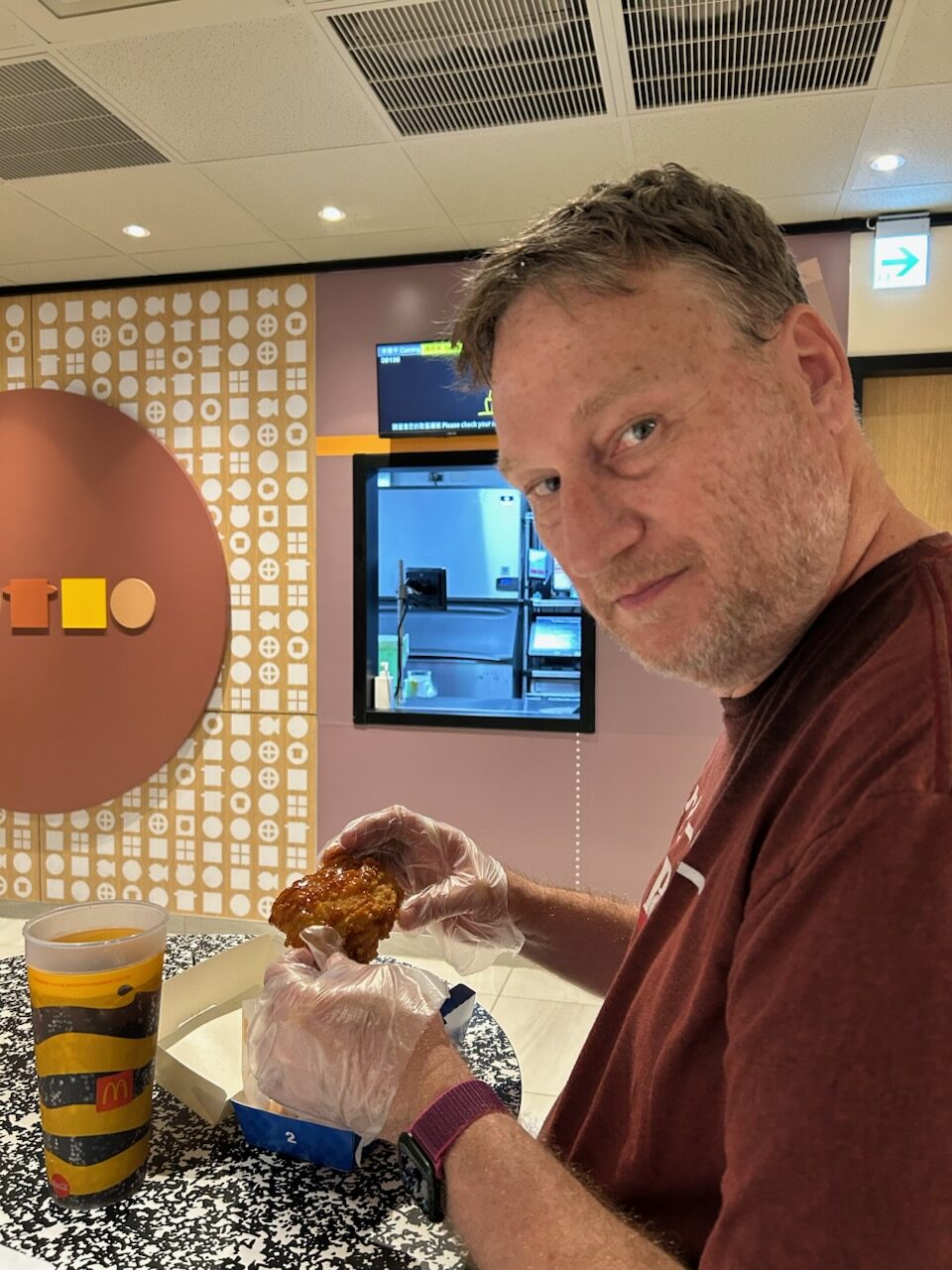
    Me, wearing plastic gloves, eating messy fried chicken in a McDonald's

    And then my brain went haywire when I saw they were selling “K Chicken,” which was Korean-style fried chicken. I ordered that instead. You know you are in trouble when they serve you your food with a pair of complimentary plastic food service gloves.

    It was messy and it wasn’t good, and it seemed that the underlying chicken wasn’t very good either. It was a lot of effort for a very disappointing meal. If there’s one thing you can say about McDonald’s, it’s that it’s not supposed to be a lot of effort.

    We ended the evening walking to the nearest subway station and returning home, sadder and a little wiser.

    Only two more full days are left in Taiwan, and we have no plans for either day.


    *Google Maps is far more prevalent in Taiwan than Apple Maps, and you’ll end up using it from time to time whether you like it or not. Google Maps also has one obvious and very helpful advantage over Apple Maps. Google and Apple will both show you where the YouBike stations are, but Google Maps will tell you how many bikes are available and if there are any open spaces to dock your already-rented bike.

  • Taiwan (2024) – Day Nine – The Day We Lost My Father-in-Law

    Sunday, October 13, 2024

    Yesterday’s post was long because lots happened, even though nothing really happened. Today, lots happened. Full stop.

    Let’s dive in.

    My brother-in-law planned a “family day” for today. My father-in-law used to plan these packed excursions, but my brother-in-law has taken over the duties. He learned them well, too.

    Today’s plan was to take us (in two vehicles, one hired, with a driver) to three different places in Yangmingshan Park, then back in Taipei to the Grand Hotel for Peking Duck (A favorite of Melz,) then head out to Jiufen and Jinguashi. That is a busy day by any stretch of the imagination. Let’s see how we got on.

    We had to meet at 8:00 AM when the driver was scheduled to show up. On the way, I grabbed a green onion pancake with an egg. They’re more filling that way, and I had a feeling I was going to need the extra protein.

    At 8:00 AM, the plans changed almost immediately. Johnny planned to take his wife in his car while Chuwan, I, her parents, and his kids rode in the hired van. The “van” turned out to be a small school bus that easily fit the entire family and carried my mother-in-law’s wheelchair.

    My understanding of the original plan was that Johnny would use his car to take my mother-in-law home after lunch and then return. The hired driver was, as best as I can understand, trying to say that it was unnecessary to take two cars and, perhaps, not a good idea. In the end, we all went in the van.

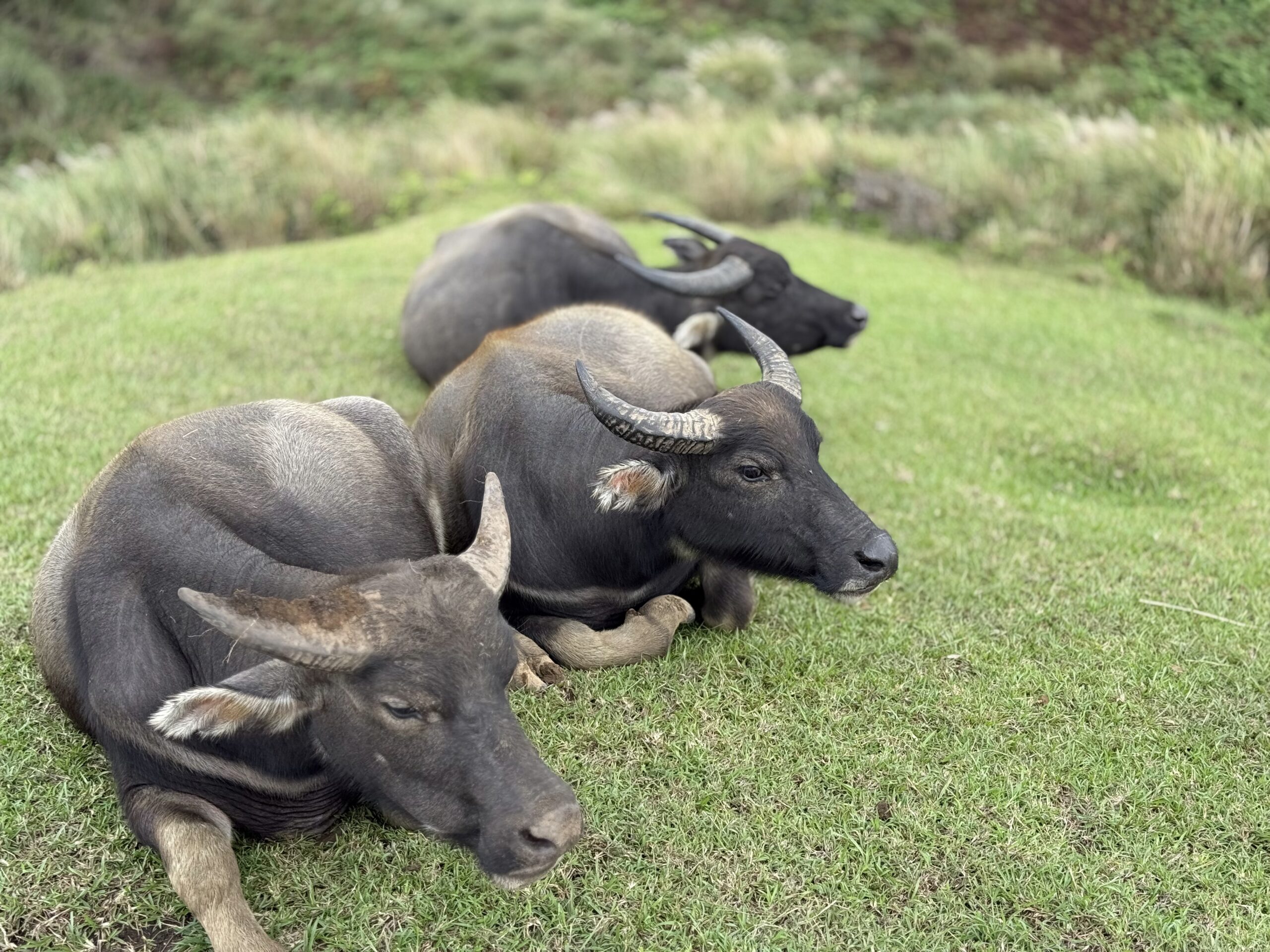
    Water buffalo

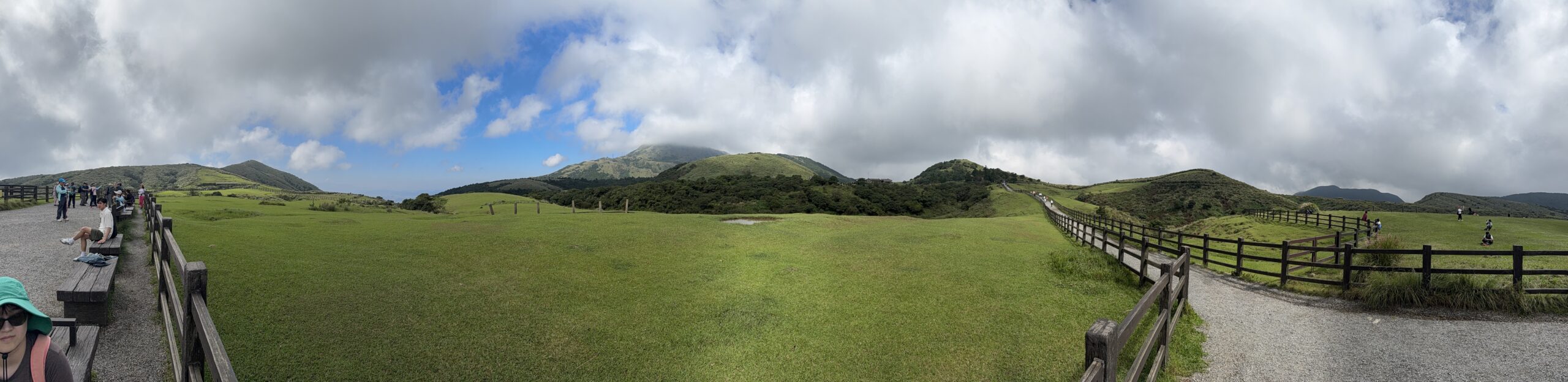
    Our first stop was Qingtiangang in Yangmingshan. They’ve been taking me there since my first trip to Taiwan. It’s a grassland area with a population of water buffalo. It’s pretty, and it’s very popular. There is something perverse about it to me. They go into the mountains to see an empty grassland. Mountains, to me, mean forests and trees. It just feels wrong to my sensibilities.

    It also took us a long time to get into the parking area at Qingtiangang. The number of parking spots it limited, and access is tightly controlled, like an airport parking garage. There is a gated entrance and a big sign indicating how many spots are available. The number of available spaces was zero, and the line of cars to get in was about ten deep. As one car would leave the parking lot, the gate was opened to allow one car in. We waited 15-20 minutes. Then, the driver had to find that one available spot and fit a small bus into it. He was a pro, but it took a few tries.

    It was probably a good idea to take only one vehicle, but even with only one, if we were going to have to wait that long at each stop, we might be pressed to visit all three places in Yangmingshan.

    What can I say about Qingtiangang that I haven’t already? It’s a grassy area with water buffalo in the mountains.

    Panorama of Qingtiangang
    Qingtiangang

    Our next stop was the Erziping Visitor Center. The road up to it was winding, passing through dramatic forests and gushing water. Now that’s what I call the mountains! The “visitor center” was little more than a toilet. High up in the hills, on a narrow, winding road, the parking lot was absolutely packed with bike riders, and they were sporting some mighty fine looking bicycles.

    Of more practical interest to me was the 1.8 km Erziping trail. In my mind, the only logical thing to do is to go see where that trail leads. Considering how awesome the ride up had been, whatever lay at the actual Erziping must be awesome. I assumed we came to a trailhead to walk the trail, so Melz and I set off.

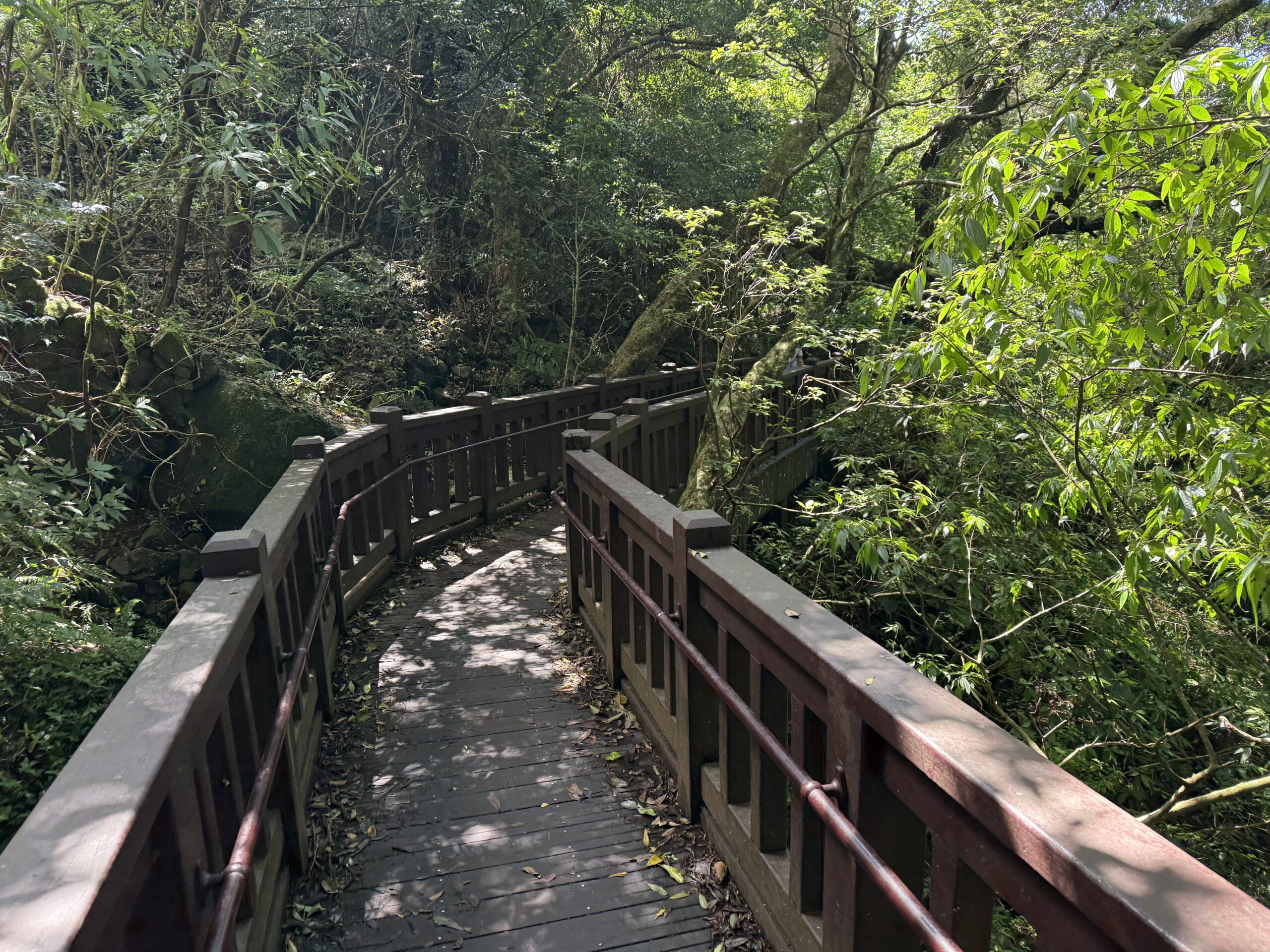
    a bridge along the Erziping trail

    Although he still wouldn’t speak English (or anything) to me, this was the first time my 8-year-old nephew seemed to take an interest in me, and he followed along, although he was mostly following Melz. Chuwan and my father-in-law followed up from behind, although he dropped out and returned to the visitor center shortly after.

    The trail wound through the forest, or perhaps I should call it the jungle. It’s a bit of both, really. It wasn’t particularly steep, but it was wet, muddy, and slippery.
    I could tell I wasn’t doing my back any favors, and I also suspected that they hadn’t really intended for us to walk the whole trail, but there’s a certain stubborn perverseness to my nature, and suspecting that made me want to finish the hike all the more.

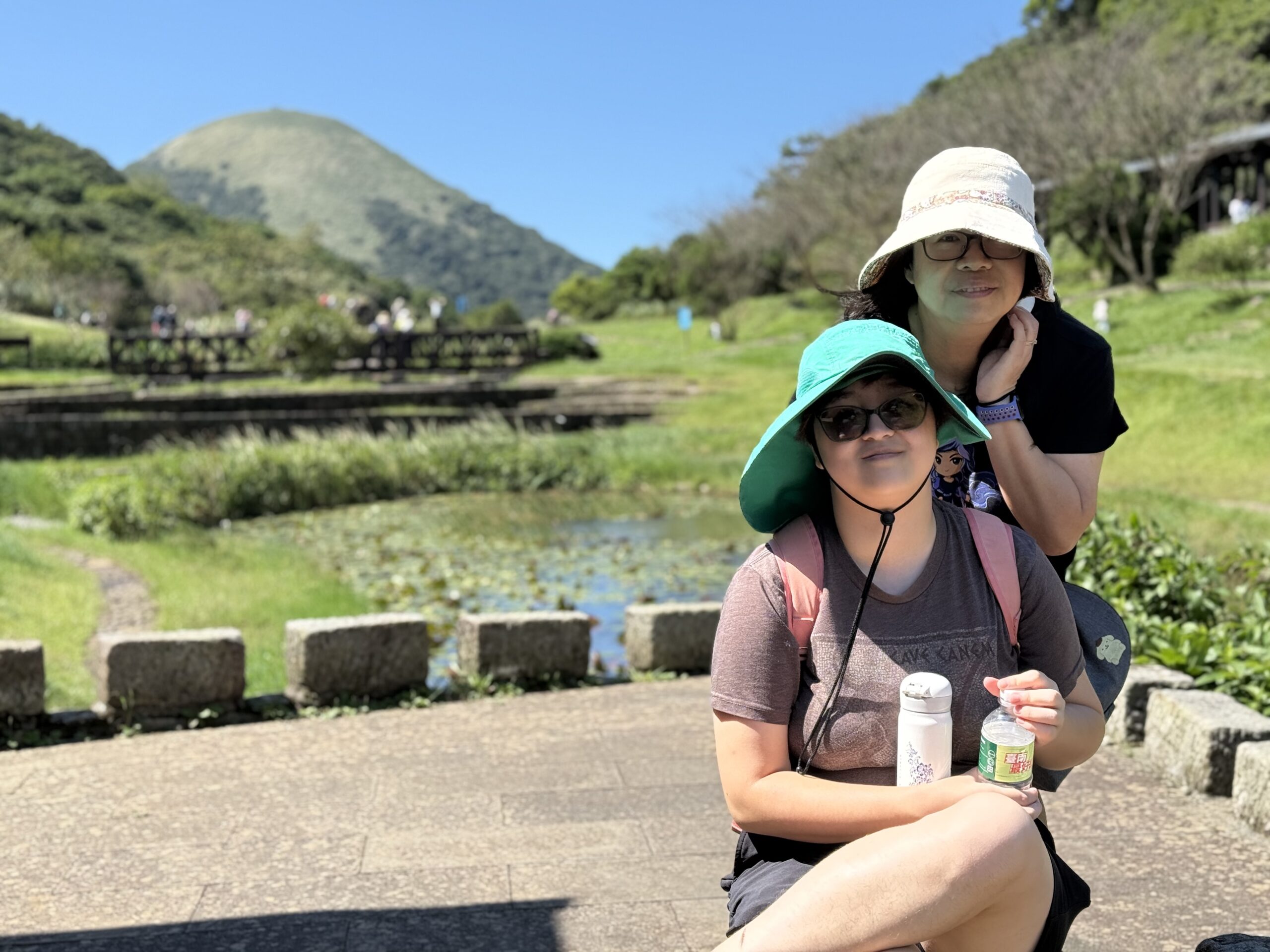
    Two humans and grassy hills behind

    And when we got to Erziping, I finally learned what it was: Another fucking grassy area.

    At least this one had a little lily pond and was, overall, more picturesque, but it certainly felt a bit anti-climactic.

    Whatever the third stop had been planned to be, I knew that the parking delays and my hike to Erziping had put an end to that idea. It was probably the flower clock. It’s always the flower clock.

    We had to make our way down the mountain for our lunch reservation at the Grand Hotel.

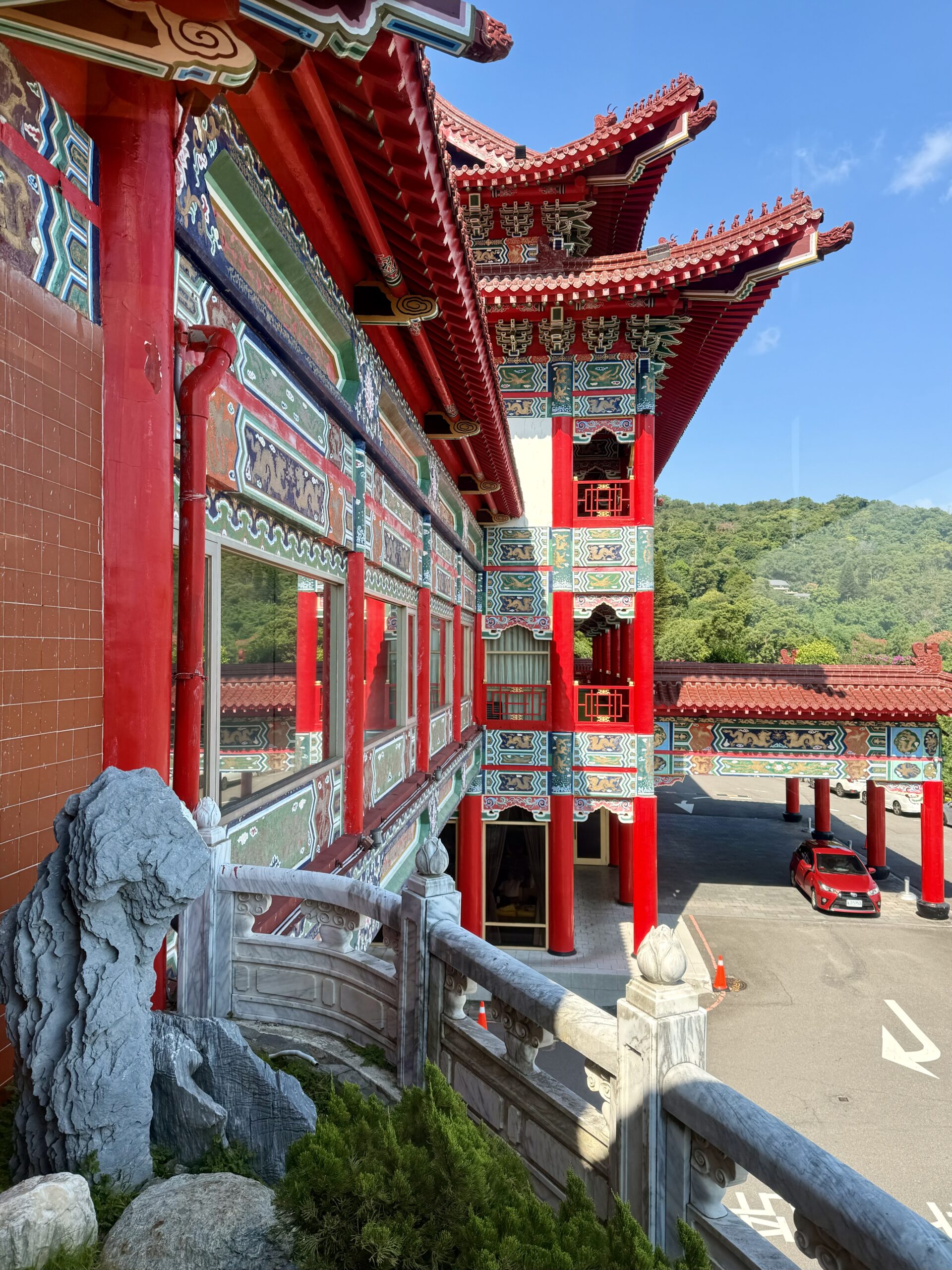
    Side view of the Grand Hotel

    The Grand Hotel is a major landmark in Taiwan, and I’ve never been there. As it is nothing more than a Chinese folly hotel, I’ve never been interested in going.

    “Chinese folly” might be unfair, but it’s my opinion. Wikipedia says it’s one of the largest Chinese Classical buildings in the world, but let’s face it, it was built that way to satisfy Chiang Kai-shek’s need to assert that Taiwan was the last true outpost of China to foreign dignitaries. One definition of a folly (in architecture) is: “A building in the form of a castle, temple etc. built to satisfy a fancy or conceit, often of an eccentric kind.”

    All boxes checked.

    The Grand Hotel has hosted notorious war criminals and monsters such as Richard Nixon, Ronald Reagan, Margaret Thatcher, and the Shaw of Iran, plus, I imagine, a few other people who weren’t so awful. The building dominates several views of Taipei and is quite imposing, so imagine my surprise when we entered the Grand Hotel through the Family Mart in the lobby.* Cue trumpet wah wah waaaaah.

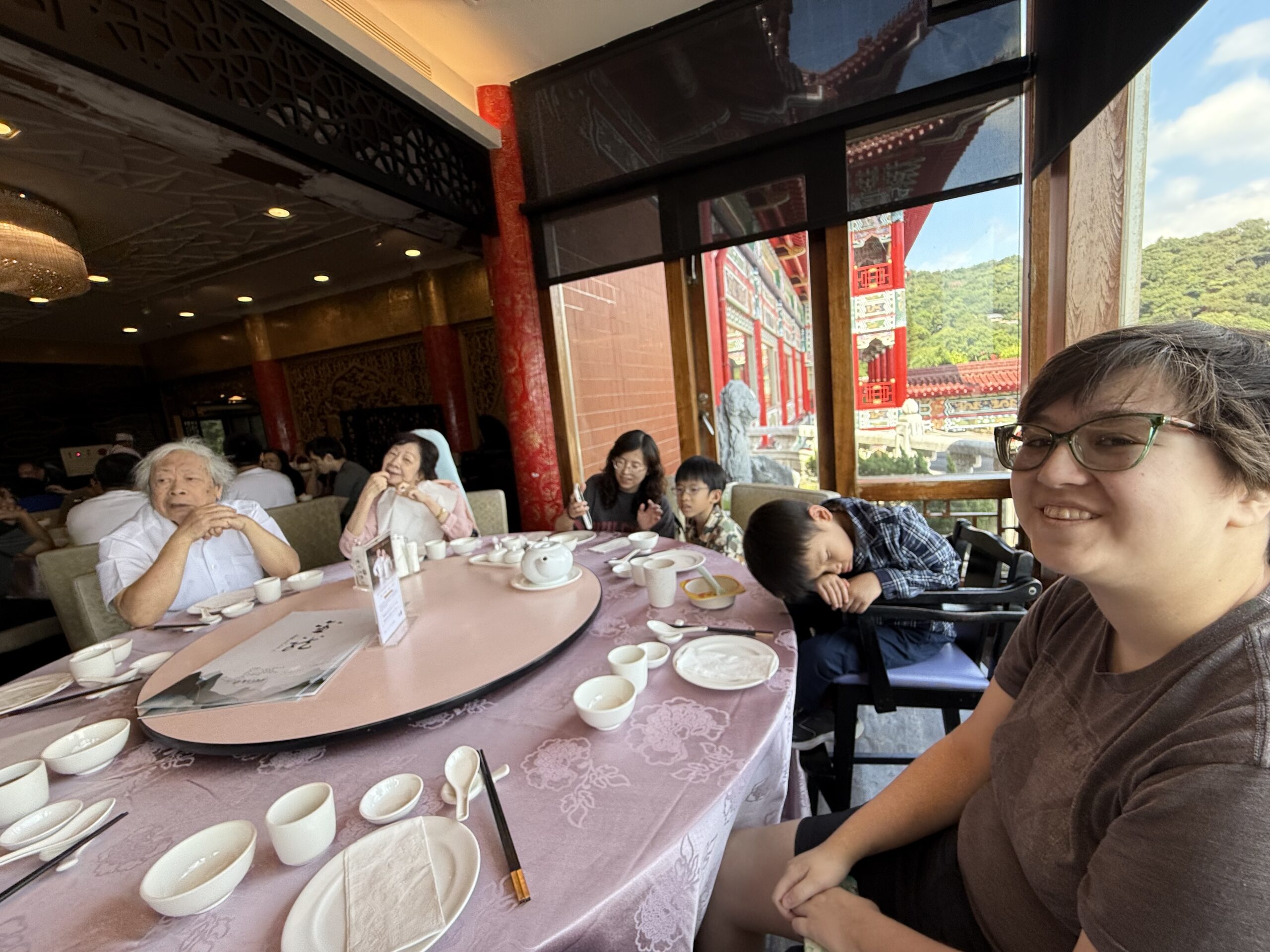
    Several people around a round table

    Lunch was the aforementioned Peking Duck (which has to be ordered in advance), plus the usual banquet-style Chinese meal. This means that the family picks out several dishes which are shared amongst the diners. They try, often without success, to pick some dishes to accommodate my decidedly Western taste, and they also usually hand me a menu to select one or two dishes that appeal to me.

    The Grand Hotel’s menu was very Chinese and more than a bit froufrou. I did find one dish that sounded interesting, but the Grand Hotel was out of it that day. Cue trombone slide.

    I’ll spare you (most of) my commentary on the food, save that they serve perfectly good-looking meats ice-fucking-cold, and that duck is one of the most overrated, fatty, greasy birds ever to grace a plate.

    Typically, my wife and I have an understanding that after a giant family banquet, she and I go to McDonald’s so I don’t starve. That wasn’t possible today because the magical mystery tour wasn’t over yet! Starvation might still be on the menu.

    Our first stop was back to my in-laws’ home to drop off my mother-in-law, but then, in a surprise, unplanned move and over the protestations of my nephews, my brother-in-law, and his family also dropped out of the rest of the tour.

    A greatly-diminished pack of only four tourists departed for Jiufen.

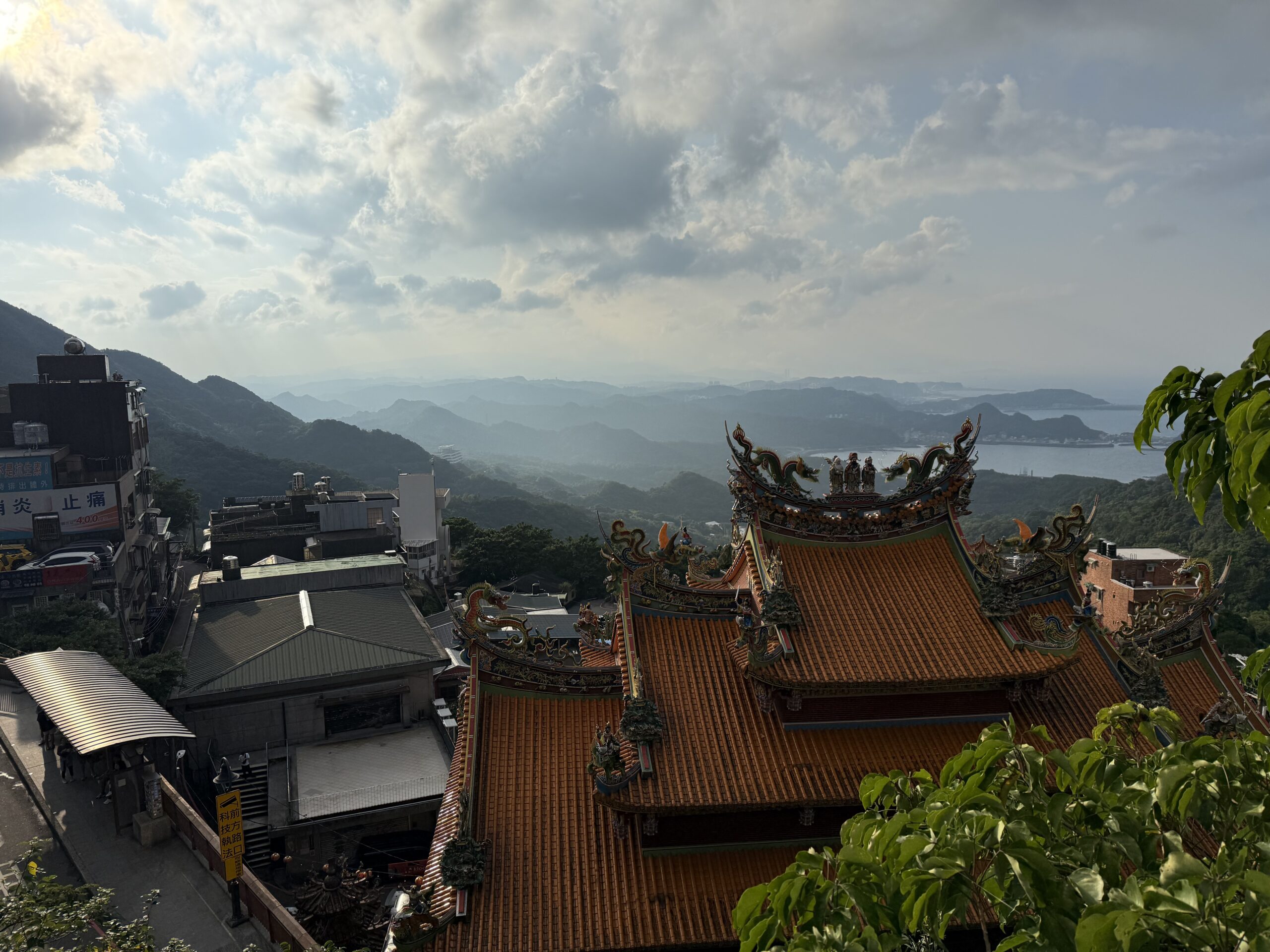
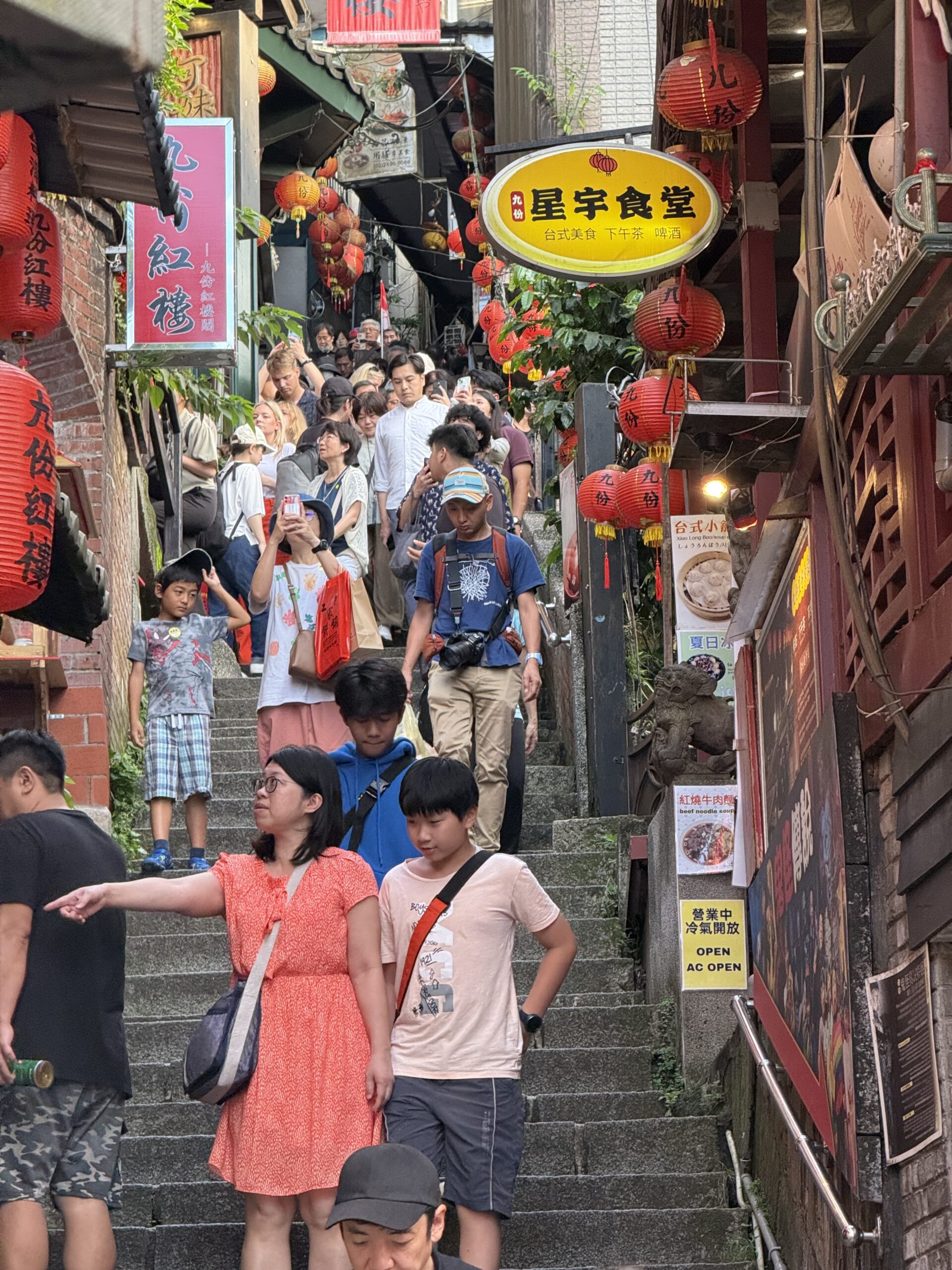
    Looking down from jiufen to the ocean. Temple in the foreground

    Jiufen was a gold-rush town of the 19th and 20th centuries. It sits precariously on a mountainside that slopes right into the ocean on the north side of Taiwan. The gold in the mountains is long tapped out, but the modern gold is tourism.

    Jiufen is frequently featured by travel bloggers and vloggers in Taiwan because of its quaint, cramped, mountainous streets, which are often compared to scenes from anime. There’s another thing they are on the Sunday of a holiday weekend: packed.

    Our driver, who was very experienced in taking tourists around, suggested that the best way to experience Jiufen was for him to drive us to the top and drop us off. We would then walk to the bottom and call him for a pickup.

    None of us wanted to be walking up the stairs of Jiufen, so we readily agreed.

    Maybe I’m getting jaded, but I have been to Jiufen more than once before, and with the extra-thronging crowds, it reminded me of nothing more than a diagonal night market. There might have been interesting stuff to see or even some food to eat, but what I wanted was to get the fuck out of the crowd.

    Being a major tourist destination, there were public toilets along the way. They’re not particularly nice toilets and they don’t offer much privacy. For example, the urinals are close together and either have no screens between them, or the screens are very, very small, like 15 cm. But you just have to acknowledge that you’ll never see the other humans next to you ever again and go on about your business. Also, as a foreigner, they aren’t going to talk to you.

    At one point, I decided it would be prudent to use the restroom, but to get there I had to walk down a very narrow side passage, which came into a small central area that had two more small passages and a larger street. It was here that the restroom was.

    Packed and shoulder to shoulder, I went about my business, and then my father-in-law was standing shoulder to shoulder with me. We acknowledged this slightly awkward moment with a slight grunt and head nod and I finished and left.

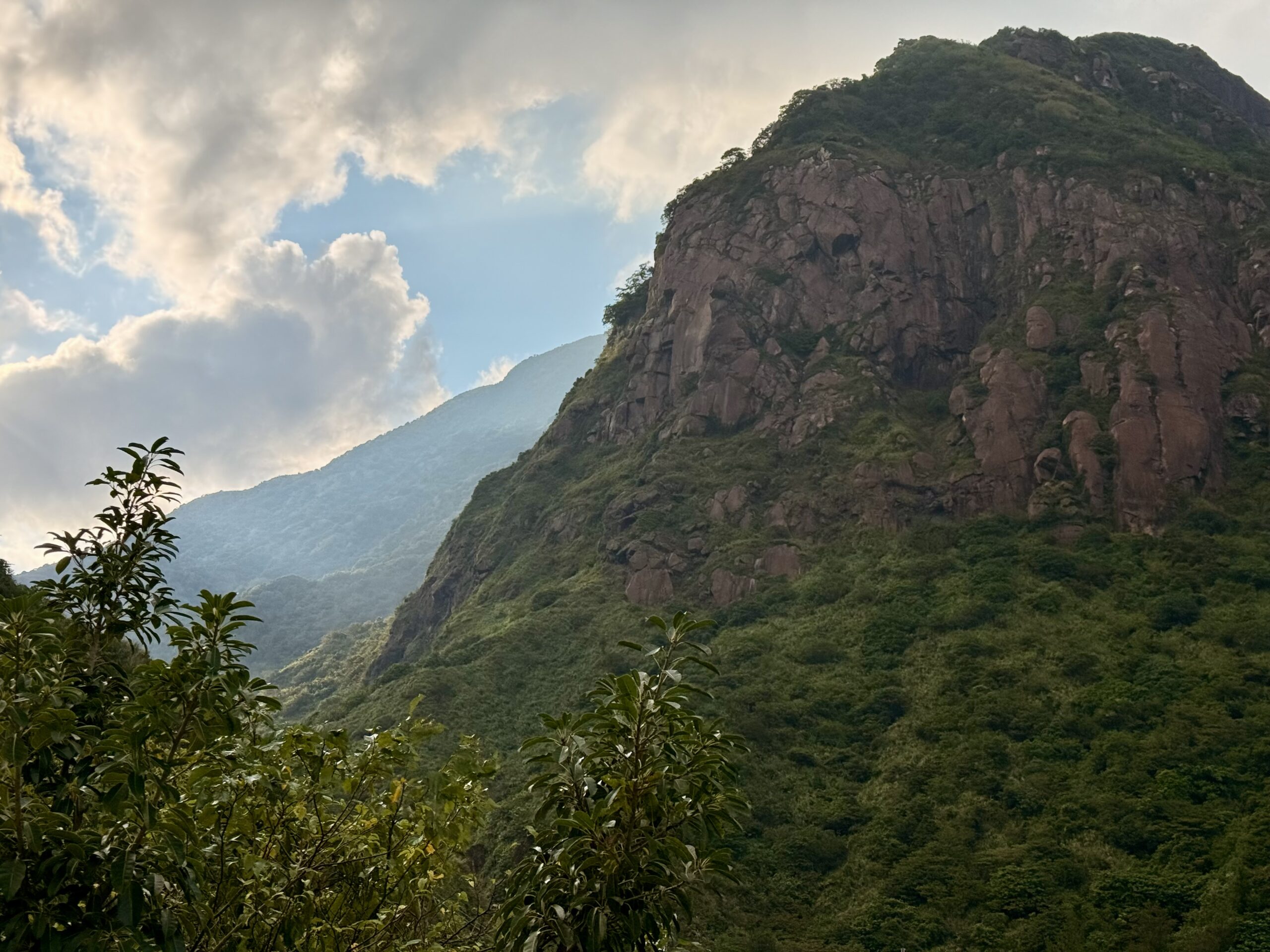
    Jiufen mountain

    I returned down the narrow passage and rejoined Chuwan and Melz, and we waited for Chuwan’s father.

    …and we waited, and waited, and he didn’t return.

    I returned to the restroom, he was not on the path to it, nor in it. I even satisfied myself that he was not in a stall. I stepped out into the 4-way junction and started looking down each path. The narrow ones were empty. The larger street was packed with people, but there was no sign of my father-in-law.

    I reported back to Chuwan who was now (rightly) concerned.

    “Don’t worry,” I said, “everyone in Taiwan has a cell phone. Just call him.”

    “My dad has a phone, but he usually leaves it at home.”

    “Of course he does. Try anyway, just in case he thought, ‘I’m going on a trip today, I might need my phone.’”

    No luck. And, of course, even if he borrowed someone’s phone, Chuwan and I don’t have callable phones, and it’s doubtful he’d memorized Melz’ number, and he won’t be able to reach the driver, either.

    Now we’re freaking out. There are thousands of people here and the whole place is rabbit warren on a steep mountain. Chuwan calls her brother to let him know (Line call) but there’s not much he can do.

    Chuwan is thinking, “Let’s split up and look for him.”

    Melz and I are, “Hell no we’re not splitting up! Then we’ll all be lost!”

    Our plan was to meet at the bottom of the hill, so in the end, Melz and I continued to the bottom, hoping that he’d think to meet at our rendezvous place if we got seperated. Chuwan continued to search the shops and streets.

    No father-in-law at the bottom of the hill.

    Crowded streets in Jiufen

    There were two thing at the bottom of the hill: a police station, and an emergency PA system. After Chuwan finally gave up and came down the hill an hour had passed. She went to the police and reported her father missing.

    The police alerted the other officers in town, and also broadcast an announcement. Chuwan’s father heard the announcement and about 10 minutes later we spied him coming down the stairs. He had thought we were meeting at the top of the hill where we’d been dropped off. He returned there and sat down in the 7-Eleven waiting for us.

    Everyone was much relieved, but he needs to start carrying his phone with him.

    No time to visit Jinguashi.

    It was a long day and a long drive back to Taipei.


    *It turns out we entered through the side lobby. The main lobby was much more dignified.

  • Taiwan (2024) – Day Eight – Little New York

    A Toast logo. A alligator peeking out from a sandwich.

    Saturday, October 12, 2024

    Taiwan loves cute things, and, even though I’m not an afficiando of cute, per se, there’s a certain charm to how enthusiastically they throw themselves at it.

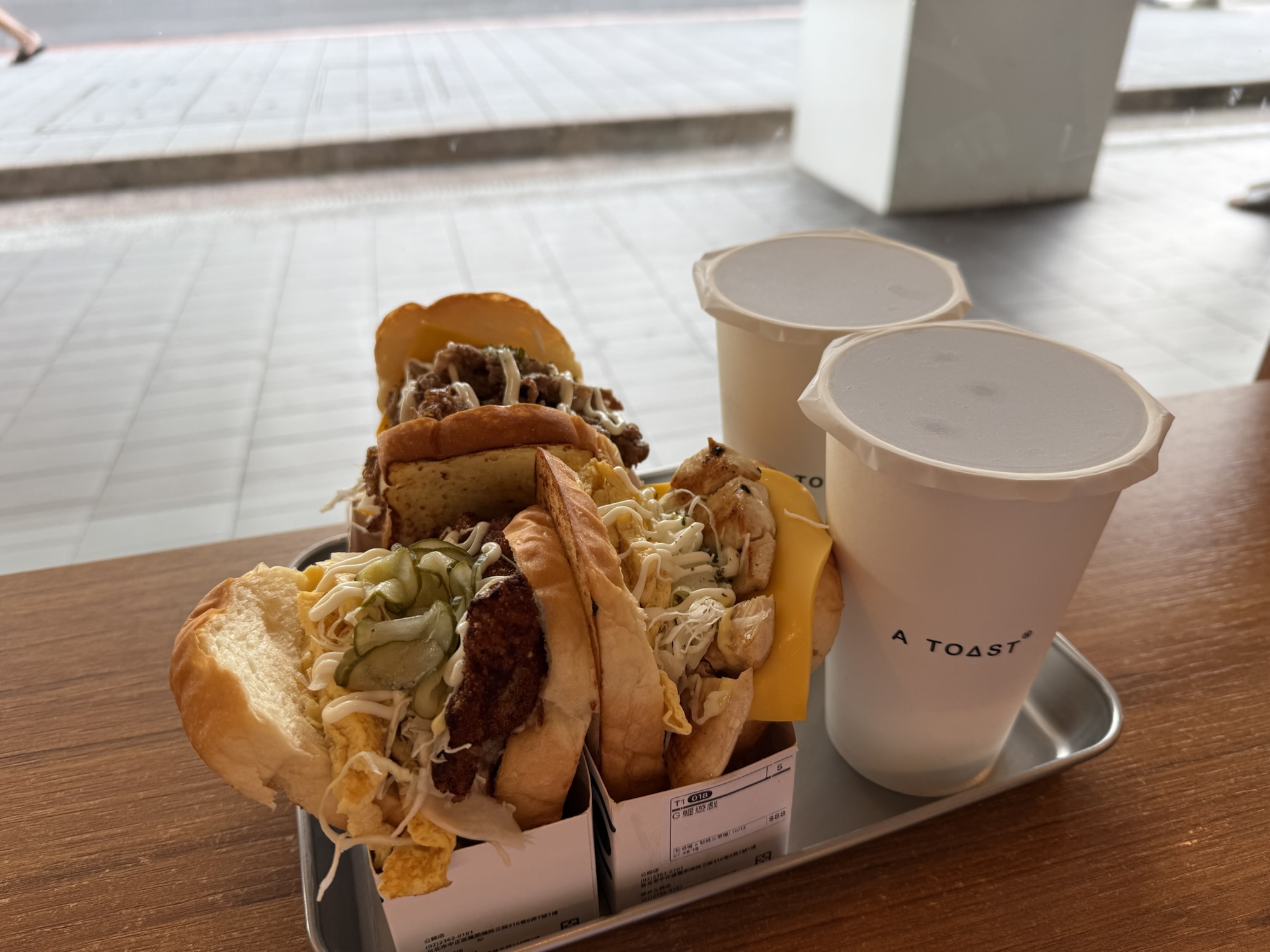
    For days now, we’ve been walking past a breakfast/brunch place called “A Toast.” Its logo is a cute little alligator poking its head out from behind a sandwich.

    In Taiwan, this could mean one of two things: They thought it was cute, or they serve alligator sandwiches.

    A tray of three sandwiches and two drinks

    A quick search online suggested to me that they just thought it was cute. As it was Saturday, we arranged to meet Melz there for breakfast. I had a chicken sandwich, Melz had a pork chop sandwich, and Chuwan had a beef sandwich. They were all pretty good. Would eat there again. No alligator was to be found on the menu.

    Tomorrow will be a circus (more on that tomorrow) so today Chuwan wanted to spend most of the day with her parents, leaving Melz and me to our own devices in the afternoon.

    One thing Chuwan has been promising to do is make spaghetti sauce. We have an awesome spaghetti sauce recipe (not a family secret, just one we once found online and adopted as our own) and Chuwan’s brother, in particular, has been asking for it to be made.

    The thing is, the ingredients for spaghetti sauce aren’t all common grocery store items like they are back home. The local supermarkets, including the little Carrefour Market, didn’t have what she needed, so we opted for a trip to a full-sized Carrefour.

    Carrefour is a French store chain and in the Battle to Conquer the Taiwan Market, Carrefour won out over most of the competition. Their big stores have a lot of imported and harder-to-find items. They just aren’t necessarily convenient to where we are staying.

    We decided to use the YouBikes to ride to the store and get “rare” items like tomato paste, Italian sausage, and parsley (plus a few others). This time, I managed to score an eBike. Most YouBikes are yellow acoustic models, but there are a few orange electric ones. They don’t seem to be too popular, but they apparently cost twice as much to rent.

    Apparently, the fees are considered exorbitant because the eBikes cost 20NTD per half hour to rent. That’s $0.62/half hour or $1.24/hour. The acoustic bikes are only 10NTD per half hour.

    Both models are three-speed, with adjustable seats—although the handlebars do not adjust and can be a bit low if you’ve got the seat at the max level, making the bikes a little unsteady. They’ve got very low step through frames, and all have a front basket, and a built in locking mechanism for securing the bike while you go into a store. I’ve never tested the locking mechanism because it’s always been easy enough just to return the bike at a dock and stop the meter from running.

    The eBike does not have adjustable PAS levels, but it supplies just enough juice to pick up speed quickly. I couldn’t test it at flat-out speed because there is nowhere safe to try that; however, it easily picked up to 20kph.

    We rode the bikes up to Carrefour, and did some shopping. We found “British-style” Italian sausage, wich sounds like an oxymoron, and all of the ingredients except parsley. We also discovered that Carrefour stocks Dr. Pepper, which is annoyingly rare in Taiwan. We discovered they stocked it, not that they actually had it in stock.

    Chuwan’s spaghetti sauce would go ahead today, with British Italian sausage and no parsley.

    While Chuwan (voluntarily) slaved in the kitchen, Melz and I decided it was time for more pizza for lunch. On my last two trips to Taiwan there was a pizza place called Xiao NiuYue. (Little New York)

    (Sorry, in an earlier post I attempted to use Chinese characters and my WordPress install rejected it out of hand. The fix was something that I wasn’t willing to undertake while on vacation, so we’re stuck with Pinyin for now.).

    Little New York was a small hole-in-the-wall pizza place that made a credible effort to recreate New York-style pizza in Taiwan. (Remember what I said earlier about the ingredients for spaghetti sauce?) Now, there appear to be two locations for Little New York, which seems a positive development. We went to the “new” one.

    The new location feels much larger than the old one and more upscale, as is often the case when a restaurant grows beyond its humble beginnings. We arrived for a very early lunch at a nice but mostly empty restaurant. Maybe 20% of the tables had customers.

    We were promptly greeted by an employee who asked us the nearly universally-asked question of “ji wei?” (“How many people?”) to which Melz… record scratch… she actually said, “you ding wei ma?”

    Melz was reduced to an ignorant “ummmm” in response (as was I.) The employee seeing our discomfort switched to near-perfect English, “Do you have a reservation?”

    (A reservation?!? Damn, this place has gone upmarket.)

    Let’s digress for a moment because I love a good digression!

    For better or worse, I have been using Duolingo to study Mandarin. It’s far from perfect, starting with their insistence on only using Simplified Chinese Characters, as opposed to the Traditional ones used in Taiwan. I completed the entire course from beginning to end, which took a very long time, partially because of a lack of dedication and partially because they kept changing the damned app along the way.

    Many of the lessons bear no resemblance to any realistic situation I’ll ever be in, but you learn the patterns and the grammar.

    One such lesson is making/breaking reservations in a restaurant. I know those lessons backwards and forwards despite the fact that I don’t go to restaurants that require reservation (as a general, but not hard and fast rule.)

    And here’s the damned thing about learning Mandarin, at least for me, this employee spoke only four clear words, two of which I do always know when I hear them (“you” for “to have” and “ma” to indicate this is a question). The other two words (“ding wei”), which I’ve passed countless tests/quizzes on, in this very context, I also know, and yet… “derrrrrr” was what my brain did.

    It’s so damned frustrating!

    Melz hasn’t been taught “ding wei” yet, so that’s their (legit) excuse.

    From this point forward, our server spoke to us in English. Nonetheless, we still had to do the damned QR code ordering.

    I used this opportunity to explore an idea that’s been nagging me. The internationalization of code has become much more common. Could it be that these online menus might support alternate languages? Scrolling far to the bottom of the page, I was rewarded with a choice between Chinese and English.

    It was like magic.

    Actually, it was like a really crap magic trick.

    In Chinese mode, the page had tabs across the top, labeled in Mandarin. In each tab, names of menu items, followed by a short paragraph describing the item.

    In English, the tabs and the names of the menu items were now in English, but the description of the item remained in Mandarin. Now you might think, “What’s the problem? If you know the name, you know what it is!”

    Tell me, wise one, what’s a Hell’s Kitchen Pizza? Or a Broadway? Or an Ellis Island?

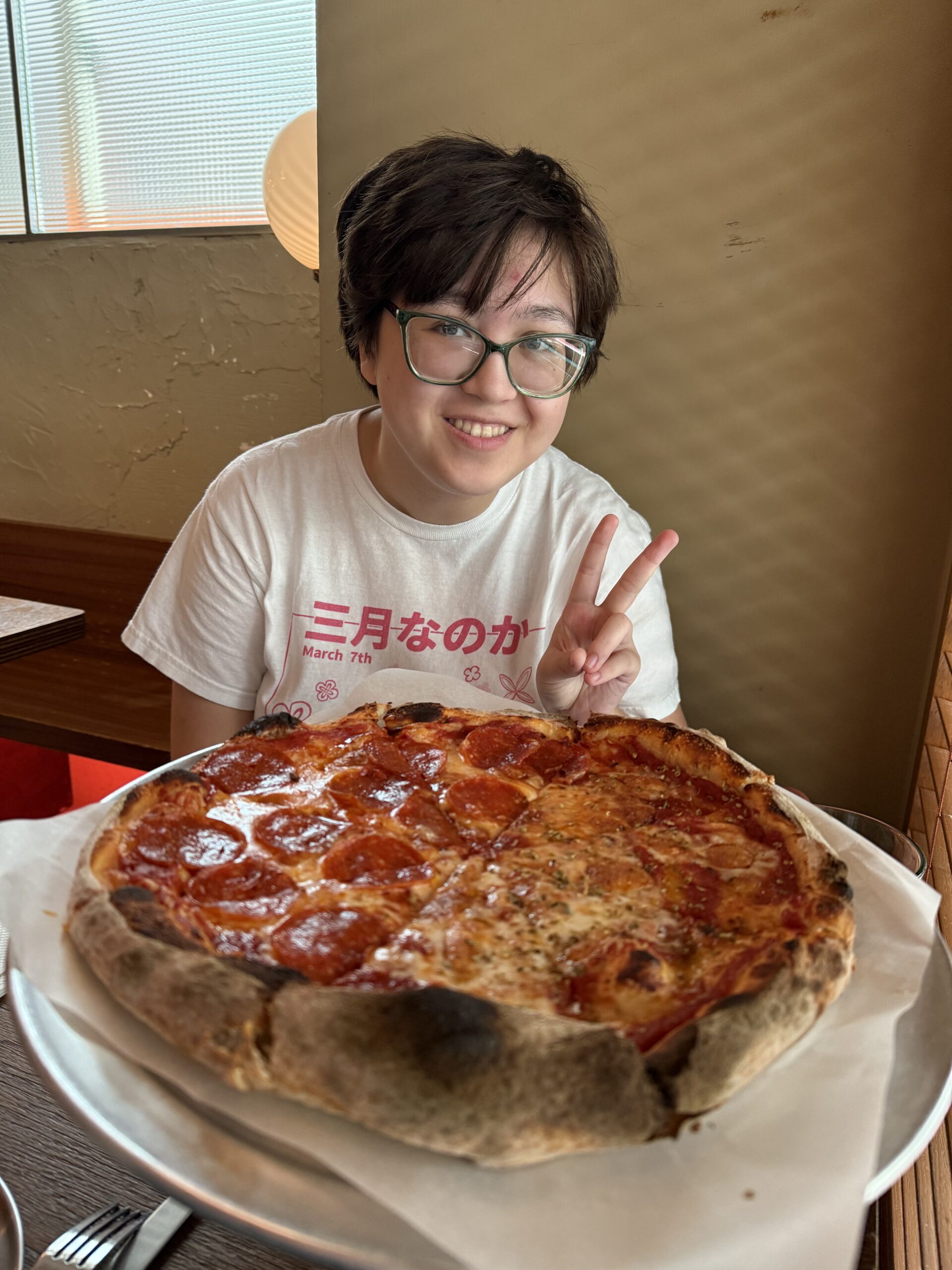
    My child giving the ubiquitous V-sign at a pizza.

    Melz, meanwhile, was muddling through ordering us a pepperoni pizza. (That’s a New Yorker, BTW.) But as as it seems with all restaurant orders in Taiwan, there were lots of questions after they’d picked the item. What we got was a half New Yorker, half cheese pizza. We still don’t know how that happened.

    We also got some garlic knots. It was all very good. I’m rooting for Pizza Rock as the up-and-coming challenger, and I enjoyed their pizza the other day, but Little New York is better. It’s a decent pizza, and I don’t mean “considering it’s in Taiwan.”

    Let me tell you a little aside about receipts in Taiwan. Little food stall aside, they’re really aggressive about giving receipts at stores. These aren’t just any receipts; they’re tied into a government receipt-accounting system. If you get a receipt, the tax has been recorded and reported to the government. Many years back, Taiwan implemented what I consider to be a clever system to prevent under-the-table sales. Every receipt is essentially a lottery ticket. Periodically, the government holds a drawing, and, if you’re holding the receipt drawn, you get… some portion(?) of your purchase price back as a prize.

    This system means people want their receipts, and vendors are obligated to produce them (and therefore collect taxes.) (Certain street vendors do not issue receipts, and I do not know why they are exempt. Probably because it doesn’t make much sense to have a receipt-generating computer on a food cart.)

    I love this system, but it means you collect a lot of paper receipts, which isn’t very green. Sometime since my last visit, they’ve implemented some form of App-based eReceipt system, and if you speak Mandarin, they’ll ask you if you want an eReceipt. Luckily, they just look at my white face, hand me a paper receipt, and be done with it.

    Usually.

    The staff at Little New York spoke excellent English, but with an accent.

    As I paid the bill, the cashier asked me, in English, if I wanted an eReceipt, but the way she pronounced it, I didn’t get the “e” part because it just sounded like an oddly-accented pronunciation of “receipt,” so I said, “yes” and the dance began, because then she started asking for information I didn’t have or understand.

    We sorted it out, but we were both flustered, and she didn’t give me my 400NTD change. (I did get it, but there was more embarrassment as I pointed out the error.)

    Min Yao was nearby on the map, so I convinced Melz we should go there.

    Taiwan is dominated by Japanese department stores like Sogo, Shin Kong Mitsukoshi, and Dayeh Takashimaya. To my knowledge, the only local Taiwanese department store is Min Yao. For a variety of reasons, I haven’t been to Min Yao for the last few trips.

    Min Yao was a gutted shell of what it used to be.

    The Japanese department stores truly are departmentalized. There are brand shops within them; you cannot just take an item from one department to another and pay for it there. (OK, maybe you can in 2024 since we didn’t buy anything this trip to test that, but historically, you cannot because they are different entities.) Even still, the stores are still branded as the name of the department store. It feels very much like the departments are either run by the store or sublet to a third party as their agent.

    Min Yao used to be like that, too, but it was a shell of its former self. In the multi-story building, only one floor was branded as Min Yao, and the rest were different stores like Uniqlo or Daiso. Melz found stuff to buy, anyway, but I felt a little sense of loss for the once-plucky contender against the Japanese mega-department store forces.

    I think my back is slowly getting better. I’ve been able to go longer each day before having to rely on painkillers, but nonetheless, by this point, my back was done. I went home for a nap in anticipation of the evening’s spaghetti dinner.

    Here’s another thing you need to know about Taiwan: Table salt isn’t a thing. If you want salt on your french fries, even at McDonald’s, you’d better bring your own. I’m sure this is a healthy thing for them (perhaps offset by soy sauce) but it can mean even prepared items can be less salty.

    Chuwan made her spaghetti sauce, following the exact recipe she always does, with two exceptions. We could not obtain parsley flakes, so the recipe was a teaspoon shy of parsley, and the Italian sausage was “British-style” (whatever that means) and made in Taiwan. (So, not even actually British.)

    Where am I leading with this? The sauce didn’t taste right. Whether it was the sausage, the lack of parsley, or any of the other ingredients that might not be the same as back home, the sauce just wasn’t right. (My money is on the sausage.)

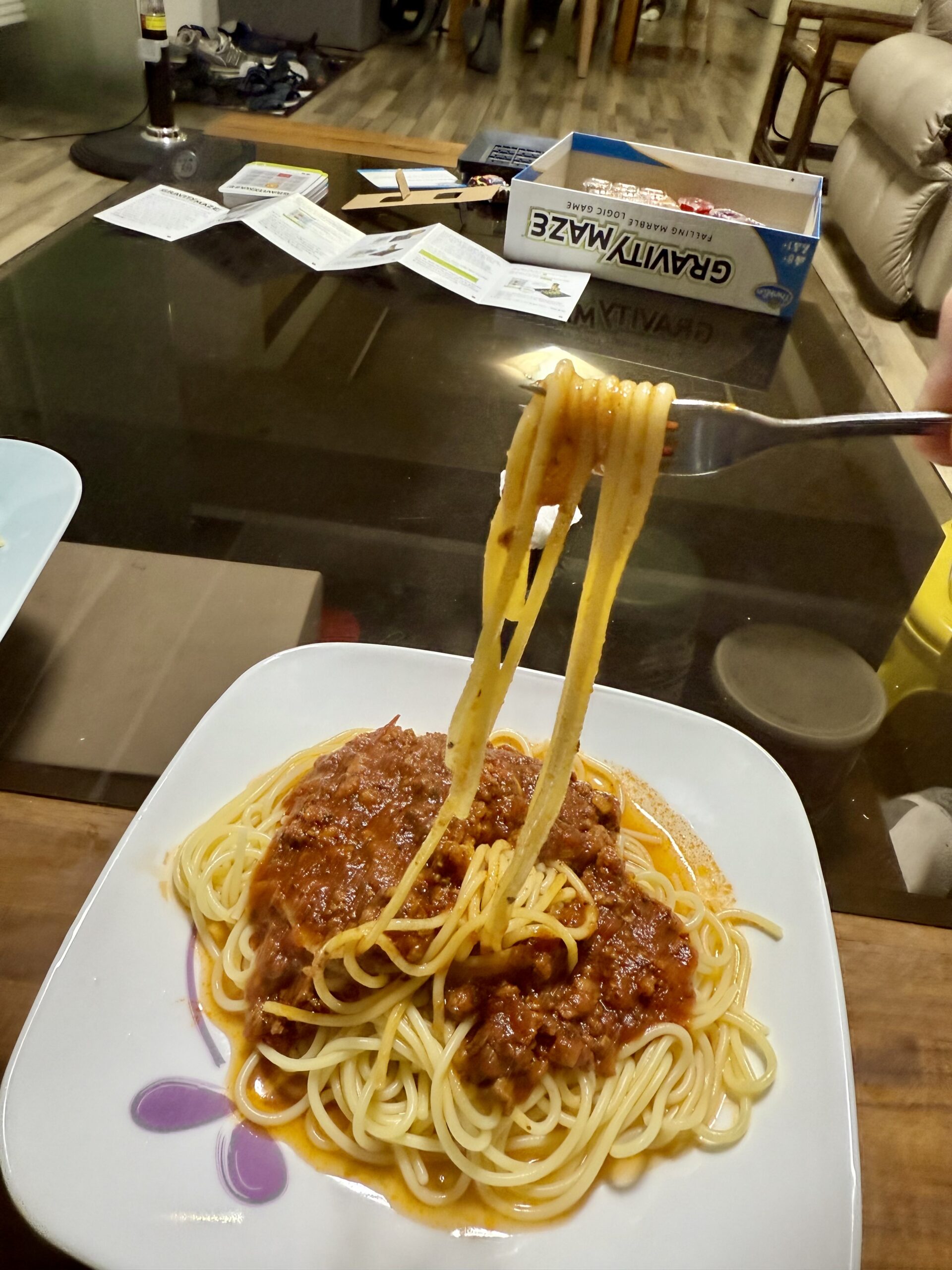
    Spaghetti on a dessert fork

    Melz and I spotted it immediately, but the family, not knowing what it was supposed to taste like, were in ignorance. Melz grabbed the salt from the kitchen, and we tried adding it to our food, and it helped a lot. What was really strange was when my brother-in-law came over and took the salt and said, “it could use some salt.”

    That was not a phrase I ever expected a Taiwanese person to ever say.

    On a lighter note, despite my wife’s great efforts in getting the ingredients, she forgot to consider the dining environment at her parents’ home. They don’t own forks! It was spaghetti with chopsticks!

    Actually, they did own a fork – a tiny dessert fork – and I used it just stage the photo op.

    Now we come to the tricky part of the evening. My wife made plans to go to the Ningxia night market with her friend Nora. Several times during the day she asked both Melz and me if we wanted to go along. For my part, the answer each time was, “It will depend on how my back feels.”

    I hadn’t been to a night market this trip and wanted to go, especially since it was one I’d not been to, but walking a crowded, slow-moving night market can be a strain on my back at the best of times.

    After dinner, Chuwan asked us one last time, and we decided to go.

    “You don’t have to go if you don’t want to,” she immediately says.

    Perhaps I should have picked up the undercurrent in that statement, but after asking us several times, neither of us caught that she didn’t actually want us to go with them.

    We go to the night market, and meet up with her friend at a nearby MRT station, and head out on foot towards the market.

    Night markets have tons of portable, walk-and-go-type foods. It’s common for people to snack their way from one end to the other. Some restaurants own the shops along the sides that offer sit-down dining, and sometimes, there will be a collection of plastic tables and chairs for people to sit and eat messier foods.

    We didn’t actually make it to the night market before the problems began. Chuwan and Nora immediately hopped into a line at a storefront order window for something. Melz and I didn’t know what, and they didn’t bother to tell us.

    “You want to stand in line with us?”

    “No, we’ll just go sit over there and wait.” and we did. And they were in line for a long time, and right after we saw them ordering, they disappeared on us. We were fucking fuming. Where the hell had they gone?

    In a bit, we get a text that says, “Are you coming?”

    Our conclusion: They walked away from us and didn’t even try to catch our attention. My mood is rapidly going from bad to worse.

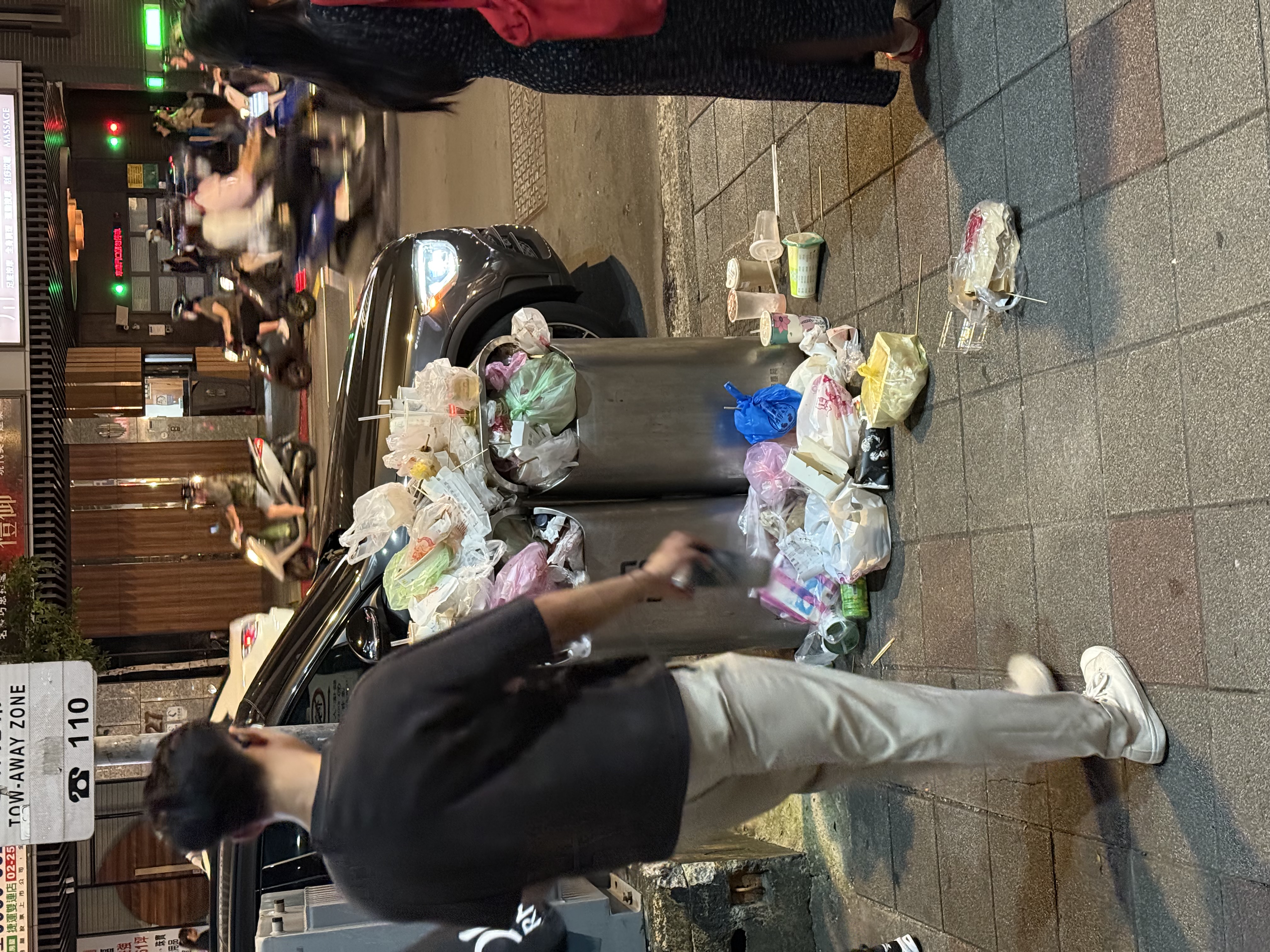
    A charming view of an overflowing garbage can on the streets of Taipei.
    This is the lovely view we were staring at while waiting.

    There are very few public garbage cans in Taiwan. Near night markets, this is what happens.

    But I’ve got faith in my wife (but not her friend), and I just couldn’t believe she’d completely ditch us. It occurred to me that sometimes, these little storefronts that look like their to-go only have a small back area for eating, not always obvious. Sure enough, I found them sitting in the back of a cramped hole in the wall eating whatever it was they’d bought. I didn’t go in, but went back to report to Melz, who thought this rude.

    I’ve give Melz this: They sent a message to Chuwan saying, “Are you eating at the place?!?!? Well that’s rude. I think you owe us some spending money for ditching us.” I’m more of a quiet-anger person in situations like this.

    Melz went in and got 1000NTD from Chuwan, and we left them and went into the night market, which turned out to be disinteresting, and we went home.

    I’m not making any excuses because this was unacceptable behavior under any circumstances. Still, afterward, we learned that Chuwan had apparently sent the message “Are you coming?” to have us follow them into the dining area and sit with them. However, what they were doing was poorly communicated, and we were having internet issues, so the message wasn’t sent until they had already gone inside, so it came across to both of us in the worst possible way. It’s the only time in 26 years of marriage that I remember being lividly angry at my wife.

    Earlier in the day, when we were at Carrefour, when we’d found the British-style Italian Sausage, it was in a red English phone booth-styled freezer, along with a number of other frozen “British” products with the Churchill brand. Amongst those was a beef and onion pie. Our Airbnb has a toaster oven, so I thought I’d give it a shot.

    (It pains me to say you virtually can’t get a beef and onion pie in Phoenix.)

    I decided I’d give it a try tonight. First snag: The recipe calls for cooking the pie at 180ºC for 45 minutes. I hadn’t previously looked at the toaster oven, and it was now that I discovered that it didn’t operate via temperature control. It was controlled by wattage. There were four different wattages, and each one operated different heating elements. For example, the highest setting operated both top and bottom elements, and the lowest, only the bottom.

    None of that information was helpful at figuring out what setting I needed to use to cook the pie.

    Sixty minutes of cooking later, and it didn’t turn out great, but I got the filling heated, so I ate it. It did not taste like a beef and onion pie. It tasted very much onion, and it tasted like something else I’ve eaten in Taiwan, but I couldn’t pin it down.

    But not a beef and onion pie.

    Much later, when Chuwan returned, I had cooled down a lot, and expressed Melz’ and my upset over her behavior. She was oblivious. She said, “I told you didn’t need to come. I thought you got the idea.”

    “You invited us several times, and Melz and I thought you wanted us to go.”

    We’re good. It’s in the past, but it is a lesson in better communication.

  • Taiwan (2024) – Day Seven – A Day

    Friday, October 11, 2024

    Sometimes, I look over my notes for a day, and I think, “This was a nothing day. I can bang out this narrative in 500 words or less.”

    Let’s see how that goes, shall we?

    Double-Ten may have fallen on a Thursday, but that doesn’t mean everyone gets a four-day weekend, at least not government workers and students. Melz was back in class from 8 – 11 AM, so Chuwan and I were on our own for breakfast.

    There were several breakfast places right around the corner from the in-laws’ old house with some decent breakfasts, and I suggested we go there. One place, in particular, had a good spaghetti breakfast. (I can get behind any place that serves spaghetti for breakfast. I do not believe that your stomach can tell time, and chafe at the notion of restaurants having a special limited breakfast menu.)

    Chuwan knew which restaurant I was talking about and led the way… right past the restaurant I was talking about. Chuwan tells me I’m confused. We got the spaghetti breakfast at Lane Toast, which is two or three doors down from My Warm Day – two restaurants with such generically unmemorable names that I honestly could not remember either’s name. What I could remember was the very distinct corner building in which we had spaghetti.

    Chuwan seems to think they swapped locations. Who knows? Maybe they did. It seems a little strange, but maybe they did. We went to Lane Toast.

    And all they had was fucking QR code ordering, and we couldn’t get internet that was fast enough to open the menu. We got up and left in disgust.

    Now, my guess is that if you asked, you could probably order the old-fashioned way, which is to write your order on a pre-printed order sheet, but I wasn’t up to asking a question like that, and Chuwan wasn’t having it. I’m not sure if she’s more fed up with QR code menus or the somewhat questionable internet we’ve been experiencing since we returned to Taipei.

    Hash browns, a wrapped sandwich, two cups of tea, some soup and lumps of something.

    We went to Weapons of Mass Destruction—er, sorry, My Warm Day, or “WMD” as it’s branded all over the place. They also had QR code ordering, but they also had the obvious ordering menus as you walked in the door. Chuwan grabbed one on the way in. They also had free Wi-Fi, which, if you think about if you’re going to use QR code ordering, you should ensure the infrastructure is guaranteed for your customers to use.

    So, they had spaghetti, but neither what I remembered, nor what I wanted, so I had a chicken croissant, and some decently-made hash browns that would have been great if they’d had any salt in the place.

    Apart from breakfast, it was a slow morning where we did nothing.

    At lunch, the plan was to meet up with Melz after school and have lunch (because, yes, apparently all one does in Taiwan is bounce around from one meal to the next) at Din Tai Fung.

    We met Melz at the National Taiwan Normal University and grabbed YouBikes. I’d armed myself with the necessary info (and preparation work) on YouBike rental that I was able to use my US credit card and check out a bike.

    We rode to Din Tai Fung, which had an hour’s wait for a table. Melz and I both said, “fuck that. We went nearby for an Emperor’s Happy Pork Chop, which was delicious, as always.

    Not to complicate things, as I’ve already given you my in-laws home arrangement, but prior to their old home they actually had another home which was supplied (more or less) to them by the Catholic Church because of the charitable organization they ran. This is actually where my wife grew up, and where I’ve spent most of my trips to Taiwan, also.

    This was an opportunity to wander down familiar streets, and one of those was Yongkang Street, which is a famous tourist destination for (you guessed it) food.

    Sign saying Yong Kang

    I had noticed this trend last time, but it was much worse this time. They whole area has been overrun with businesses selling crap, and many restaurants have been pushed out and moved. Honestly, you know you’re in trouble when you have to start with the branding. This Yong Kang Street sign is new.

    I think everyone experiences that feeling when you return somewhere that you thought of as home, and it just doesn’t (can not) feel the same because it’s changed. Taiwan has never been my home, but I’m getting that feeling in spades. I can only image how it’s hitting my wife.

    (As an aside, the other day when we were doing something that made no sense to me, she turned to me and said, “I’m as much a foreigner here as you are.”)

    Chuwan then suggested we go to an area where she’d seen a bunch of toy stores. Melz was up for that, and I always love a good toy store, so we headed off.

    Taipei has, or had, a habit of clustering similar businesses along certain streets. There were obvious things like restaurants, camera shops, wedding photography places, and computer things, and then there were the less obvious ones like tool vendors, bed makers, screw and fastener shops, and miscellaneous plastic items.

    Three people at a table

    Chuwan lead us into an area that seemed like one of those themed streets, but much less coherent, and amongst the illogical assembly were several toy stores. I broke down and bought one one souvenir: a complete box of Ultraman cards. I’m saving them till I get home.

    My back was reaching its limit, again, and so we sought out a place to sit down and relax. We found the Q 21 Cafe. Interesting place, but they had a chocolate smoothie for me, and a comfy chair for a while.

    Chocolate smoothie

    I returned to the Airbnb and slept, while Chuwan and Melz spent the evening with the family.

    Much later, Chuwan and I went out to McDonald’s and… dammit… they were packed, with no room. WTF, McDonald’s?!? We went to a nearby KFC instead.

    They appeared to be taking orders via kiosk only, but you cannot complete the transaction without entering a phone number. Chuwan just go snarky and entered our landline number in Arizona. A number that’s been disconnected for over a decade.

    The reason they want your number? They put the food in little locked cubby holes and text you that the food is ready and the code to open it. When it became obvious that our food was waiting, Chuwan asked and they gave her the food.

    So far as I know, back home KFC doesn’t have “spicy” chicken, so I tried that. It was not good. McDonald’s has much to answer for. And I shall defeat them and eat in their restaurant!

  • Taiwan (2024) – Day Six – Double Ten

    Taiwanese fighter jets in formation spreading multi-colored smoke

    Thursday, October 10, 2024

    We could have stayed in the mountains longer or moved to a different location, but history dealt us a problem. On October 10, 1911, the Xinhai Revolution overthrew China’s Qing Dynasty, and with the fall of the last Emperor arose Sun Yat-Sen’s Republic of China.

    People can argue all day about the accuracy of the name, the legacy of that government, its legitimacy, its crimes, its accomplishments, and a hundred other things. The simple, undeniable fact is that the R.O.C. is the ruling government of the island of Taiwan, and October 10 (or Double-Ten) is a national holiday, which fell awkwardly on a Thursday this year.

    We didn’t want to be anywhere near tourist spots on Thursday, nor did we wish to be traveling outward from Taipei on Wednesday, so our trip outside of Taipei was bookended by Melz’ school schedule on one side and the annals of history on the other.

    Because it was a holiday, the family plan was to get together again for lunch at their house, and then later, my brother-in-law, his wife, and the kids would go to the park, rent bikes, and ride around. My plan was that Melz and I would go out on a day excursion, which included finding our own lunch, then meeting up with them to go bike riding.

    But where to go?

    Before the turn of the century, there was a bridge over Xinsheng Rd (then Hsinsheng Rd.) Actually, I’m unclear if it was a bridge. It was a bridge-like thing, and beneath it lived trolls. Actually, that’s a bit unfair; what was really underneath was the coolest computer market ever to grace the planet. It was a rabbit warren of packed stalls of all the newest and coolest PC tech. Each little shoebox-sized shop was packed from floor to ceiling with tech and exposed electrical wires. You could haggle for anything from CPUs to memory and from hard drives to fancy neon-lighted cases. It was really cool and also, obviously, a death trap waiting to happen. (There was a similar place for books, CDs, and VCDs nearby, too.)

    This place has been demolished and replaced by the nearby Guanghua Digital Plaza, a six-story indoor tech market. With no place in particular to go, we decided, “Why not?” and headed to Guanghua.

    It was depressing, but probably not for the obvious reasons. Most of the same kinds of things are there, but it’s soulless. Gone are the competing stalls shouting memory prices to draw in customers and the vibrant sense of exploration.

    It may be the time. The heyday of the computer nerd building and tweaking their own computers is gone, save for the gamer crowd. Maybe it’s just gone for me. When I was 18, I lived for this shit. I did it for fun, I did it for work, I did it on the side for other people. It was fun, and I made money at it. Life doesn’t hand you too many of those careers.

    But it isn’t fun anymore, and if I never have to see a command line or the inside of computers again, I will not be upset. Neither of my kids has any interest in computers apart from having a gaming laptop each, so Melz wasn’t opposed to going to the market, but wasn’t keyed up for it.

    What I got was six floors of melancholy.

    Melz sta nding in front of a giant space-suited cat

    Next door, however, was an 11-story department store called Syntrend, which had three floors of mostly toys and collectibles. That was much more interesting, except that I’m getting boring there, too. I’m acknowledging that there is coming a time when I need to divest myself of the cool collectibles I’ve bought over the years rather than amass new ones. This also gives me the blues.

    Escalators or not, 17 stories of shopping over two buildings was still more than my back could handle. It’s still seriously screwed up, and I’ve been on pain medication all the time since we arrived. It can only do so much.

    We decided it was time for lunch, so we decided to check out the basement (most, if not all, department stores in Taiwan have a food court in the basement) for something to eat and a place to sit down. It was noon, and it was a holiday. There was no room in the food court.

    We set our sites lower and decided to head to McDonald’s. Unlike American McDonald’s, Asian McDonald’s usually have fried chicken. That’s actual fried whole pieces of chicken, and it’s at least as good as KFC. (Or it used to be. On my last trip, it seemed somewhat lackluster.) McDonald’s Taiwan is currently advertising “K Chicken,” which I’m guessing is Korean fried chicken-inspired.

    When we got to McDonald’s, the line was so long that it stretched into the street, and a staff member was letting people into the restaurant one at a time as someone would leave. There would be no McDonald’s for us.

    We continued on foot towards the subway station, hoping to find something else. We found the Second Story Cafe. We found it on Apple Maps, and we almost missed it because the curious thing about the Second Story Cafe we visited is that it’s on the ground floor.

    Melz’s Chinese is improving daily; however, we were shown to a table, given a spiel that was far beyond her comprehension, and handed a menu that was every bit as big as a Cheesecake Factory Menu and a piece of paper with a QR code on it.

    I’m going to write up a more extensive diatribe about QR code ordering later, but, in a nutshell, to order food, you scan the code on your phone and then order like you’re at a fast food kiosk. Except the menu is in Chinese, and the printed version is 20 pages long (and also in Chinese.)

    A ham and cheese sandwich

    With Melz’s language skills, pictures, Apple Translate, and some luck, I got a ham and cheese sandwich, and Melz got a Caesar salad. It took a long time to order, and it was not a fast-service restaurant, either. Meanwhile, the family went bike riding without us.

    While disappointed, it should come as no surprise that they encountered the same issues we did: Everyone had the day off, and everywhere was packed. They had trouble finding parking, renting bikes, and riding with small kids because of how many people were in the park.

    Knowing that we’d missed the window, Melz and I ate slowly and headed back to our bases of operation. I needed to rest my back for a few hours.

    At 8:00 PM, fireworks were scheduled for Taipei 101. The area around the building would be packed, but one nice thing about having one of the tallest buildings in the world surrounded by nothing even remotely as tall is that it’s easy to get an unobstructed view of it.

    Chuwan, Melz, and I headed out for the fireworks an hour or more early, but we very quickly found a great spot near the Sun Yat-Sen MRT station and grabbed a seat on the planters around the station entrance. Chuwan’s friend Nora met us there.

    Fireworks atop the Taipei 101

    Unlike the massive New Year’s fireworks, the Double-Ten fireworks were only going to be two minutes long, followed by an eight-minute light show on the faces of the building.

    There was a technical glitch. I was waiting for the last second to start recording, and they started early… and then they fizzled out. No two-minute display, just a single, initial volley.

    The light show began. I wasn’t as interested in it, but then it looked like they put up an interesting picture and I decided to stop recording and take a close-up snap of the display. The fireworks restarted. I quickly fumbled for video mode, and consequently, I missed the beginning of both sets of fireworks.

    With the celebrations over, Chuwan and Nora left us.

    Abandoned and on our own, we decided, once again, to try a McDonald’s. Different McDonald’s, same result. No seats. Packed.

    OK, McDonald’s, it’s game on now. We will eat there before this trip is over!

    But in the meantime, we got further away from where the people had gathered for the cheap seats and found ourselves at Yoshinoya, where we both had curry katsu and then returned home.

    Another day ended.

  • Taiwan (2024) – Day Five – Heading North

    Wednesday, October 9, 2024

    Up at 2:30 AM again.

    This time I managed to go back to bed until 5:30 AM.

    One of the quirky things about the Taiwanese is an obsession with sunrises. Hotels in the mountains often arrange excursions at insane hours of the day to reach some “famous” vantage point to see the sunrise.

    Admittedly, some of them can be stunning. At its peak, the mountain range down the center of Taiwan tops out at nearly 4,000 m, and they rise rapidly out of the Pacific. This presents interesting cloud formations. For example, near Alishan, on some mornings, the mountains rise above a sea of clouds, and, as you’re above the clouds, too, the sunrise is spectacular.

    I’m not really motivated to get up for sunrise pictures, and we were nowhere near these epic locations; however, I was awake and realized that we were on west side of the lake, facing eastward. There were low clouds in the air, below the line of mountains, and I thought I might just manage to get an interesting sunrise shot.

    I checked the internet for the time of sunrise at our location (5:51 AM), got dressed, lacquered myself with mosquito repellant, and headed down to the lake, camera in hand.

    Internet sunrise calculators lie… or at least, they don’t know how to take into account mountains.

    A sliver of the sun, behind clouds, popping out from behind a mountain, shining down on a lake

    At 6:25 AM, the clouds had started to rise, covering the mountains, and the sun popped its desultory face out from behind a mountain. I got a few decent pics.

    I failed to mention breakfast yesterday morning. It was a buffet supplied by the hotel but was far more extensive than at our hotel in Taipei. Yesterday, I ate salad, croissants, and quite a few chicken nuggets. This morning, it was croissants and bowls of frosted flakes.

    We caught our bus down the mountain at around 11:30 AM. The bus makes a handful of “local” stops for the communities near the top of the route, then makes an uninterrupted trip down through the town of Puli (the epicenter of that 1999 earthquake) and down into the city of Taichung. In Taichung it stops at the High Speed Rail station and then ends at the Low Speed Rail station.

    Our train to Taipei wasn’t until after 5:00 PM, and Chuwan wanted to visit the National Taiwan Comics Museum, which is near the old rail station, so we took the bus all the way to the last stop. The museum was 1.7 km away, on foot, but the first order of business was lunch.

    curry katsu on a plate with so

    The nearby Taroko Mall contained a Saboten Tonkatsu restaurant, and I had an excellent curry katsu for lunch.

    YouBike, the bike share system in Taipei has now expanded to many cities in Taiwan, including Taichung. Chuwan wanted to ride from the train station to the museum, which was about 1.7 km.

    Up to this point, I hadn’t really given much thought to renting a YouBike. The system has changed since last I was in Taiwan and I hadn’t checked what was needed.

    It used to be as simple as tapping your stored value EasyCard (The same card used for buses and subways) on the bike to unlock it and then tapping again once you drop it off.

    Chuwan’s EasyCard effortlessly unlocked a bike. Mine was rejected as “unregistered.”

    To register an EasyCard, you have to associate it was (you guessed it) a Taiwan phone number. The EasyCard Chuwan was borrowing from her parents had apparently been registered. The card I was borrowing was not. Chuwan returned her bike to the dock, and we set off on foot. (Fear not, intrepid foreign travelers; there is a way to rent YouBikes without a Taiwan phone number. I’ll be sure to document that for you later.)

    My wife striking a pose in front of the National Taiwan Museum of Comics

    The National Taiwan Comics Museum looks very Japanese, and it was the grounds that Chuwan was most interested in. Spread over several small Japanese-style houses, the museum is primarily a library of comics that visitors can sit and read. Chuwan checked out a few of the building insides, but they held little interest to me, save for the air conditioning. Taichung is further south than Taipei and right on the coast. It was hotter and more humid, and it was a cloudless, sunny day. I found a shady tree and rested my back.

    Satisfied with her visit to the museum, Chuwan and I returned to the train station, caught a local express train to the HSR, and returned to Taipei.

    The remainder of our trip will be in Taipei. Rather than check into a hotel, we opted to stay in an Airbnb, which is not “legal” in Taiwan, but they’re all over the place nonetheless. We chose one that was very near Chuwan’s parents (although it’s actually closer to their old home*)

    Why are Airbnbs not legal? Well, as we were told, there is no quarter given in Taiwan’s rental laws. If you rent your place to someone else, it must be up to commercial code standards for hotels. How do I feel about that? I don’t know. I can see the point. Rental code notwithstanding, the place we’re renting is awesome.

    A Studio apartment

    It’s essentially a studio apartment with room for a bed, sofa, dining room table, and functional kitchenette. It’s also the entire floor of the building. I’m not 100% certain, but I think all six floors are Airbnbs owned by the same person. Access is controlled by a key fob, plus we have a physical key for our room. He’s really gone out of his way to make this nice for travelers.

    Since we’d been gone for a couple of days, there was no avoiding dinner with the in-laws; however, they went with a favorite of both Melz and mine: The Emperor’s Happy Pork Chop (Technically, the restaurant is called “Emperor Foods” in English, and they specialize in pork chops. I couldn’t find their website – if they even have one – but I found this review. The place has been there for as long as I’ve been coming to Taiwan.)

    It was good, but we were exhausted and soon returned to our Airbnb and slept.


    *I mentioned my in-laws “old home.” I should explain. My in-laws own an apartment home in the Songshan district. It was one of several units in a must-story building, but it was aging and housing is at a premium in Taipei.

    A new Muti-story building under construction. It is basically a scaffolding of girders at this point.

    I don’t know the exact details, but essentially, they got 95% of the people in the building to agree to a deal. A developer tears down their building and replaces it with a newer, better one. Each owner from the original building gets an equal or larger home in the new building. The developer gets to sell the new homes because the new building is several stories taller. Construction, however, will take until 2028. In the interim, my in-laws are given a monthly allowance from the developer to pay for rent elsewhere. This rental place is also close to their old place. It’s all very confusing.

    What happened to the 5% who didn’t agree? I think they were forced to agree whether they liked it or not.

  • Taiwan (2024) – Day Four – Around the Lake

    Tuesday, October 8, 2024

    Up at 2:30 AM again and starving. The jet lag is not “sliding” towards normality like it usually does. At this rate, I won’t get on a normal sleep cycle until we leave.

    I had the instant noodles I purchased at 7-Eleven. One thing I love about instant noodles in Taiwan is that some of them contain actual fresh meat. And by “fresh,” I mean basically canned, like those meat products from Brazil that come in pouches. You empty the meat pouch into the noodles when you add the boiling water and the other ingredients. It was a decent 2:30 AM snack.

    You can tell when something is popular in an area in Taiwan because it dominates the retail space. Restaurants are always ubiquitous, but in the village near our hotel, bike rental shops were everywhere, and they’re all hungry for that sweet, sweet tourist money.

    Cute dinosaur sign

    The question is, how do you pick which one? I suggested the one with the cute dinosaur.

    Last evening and again this morning, as we walked or rode along the bike path, we noticed that about 50% of the bikes were eBikes, but nobody was pedaling them. They were all running throttle only. This offended my eBiker sensibilities, but I thought, perhaps, because Taiwan is a scooter-dominated society, maybe they just think of eBikes as small scooters.

    At 190 cm, finding a bike that fits me can be a problem, and while not a perfect fit, they had a brand new eBike that we could make work. It looked more like a small motorcycle, but it was a bike. Chuwan was much easier to fit, and she got a bike that looked just like the dozens we’d seen on the trail. It wasn’t exactly a two-person bike, but I had a seat on the back, presumably for a child to ride along.

    The bike path around Sun Moon Lake is broken up into two sections. 12 km is a dedicated, free-standing path, and 17 km is mixed-use with automobile traffic. This makes a total of 29 km around the lake, and since its all relatively flat, it should make for an easy eBike ride.

    Then, the disappointments began. “Oh no, these eBikes can’t ride all the way around the lake. The batteries won’t last.”

    “Besides, you’re not supposed to take them on the 17 km part of the path.”

    I looked at the bikes, I looked at the size of the batteries, and I put 26 years of experience with Taiwan in full gear in my head, and I told Chuwan, “That’s fine.”

    Because (A) OF COURSE, these bikes can ride 29 km on a single charge, and (B) no one ever obeys rules in Taiwan. We were going around the lake, and we wouldn’t tell the guy. If we got “caught,” we’d just look mildly embarrassed, say we got lost, and apologize. One thing worried us, though: We didn’t have a phone that we could dial up for help, just in case something did go wrong.

    A bike path stretches out across the water of a lake.

    We set off anti-clockwise around the lake, back towards our hotel, and we soon learned why no one was pedaling their eBikes.

    My bike was fine. In fact, it had a helluva kick to it. On my Rad eBike back home, when I’m riding leisurely, I often drop into PAS 3. This bike’s PAS 1 felt like PAS 3 on mine. It had a kick, as did the throttle. How much kick? I don’t know because the speedometer and odometer didn’t work. Did the battery gauge work? How was I to know? It never went down a single segment. Sometimes, it was clear that the cadence sensor got stuck, either on or off. The only thing that would free it was to gun the throttle. I was beginning to worry that this bike couldn’t make it around the lake on a charge.

    Chuwan’s bike was a different story. Similar to most of the other bikes being rented, with its odd two-seat but only one set of pedals design, the reason no one was pedaling was that the pedals were set too far back from the front seat. It was simply difficult and uncomfortable to pedal, and if you tried sitting on the back seat, you couldn’t reach the handlebars. It was throttle all the way for Chuwan, and we knew the battery would never make it around the lake like that.

    Bike path through the forest

    When we hit the visitor center, the path continued. We suspected that this was the beginning of the 17 km “no go” zone, but it was well-delineated, and we continued on. In places, we returned to dedicated bike infrastructure that took us far away from the road, but finally, we came to the stairs.

    In Taiwan, in the mountains, there are always stairs. Lots of them. Steep ones.

    These cement, damp, and moss-covered stairs also had a ramp next to them. This kind of ramp is used for walking bikes upstairs; however, the sign said to carry your bike up the stairs. It also forbade eBikes from going up the stairs.

    My concern wasn’t going up but coming down. I was not convinced we could safely walk the heavy eBikes back down the ramp without losing control of them on the slippery cement. Nonetheless, I walked up the steps, which twisted out of sight, to see what I thought. At the landing, I saw that the steps continued up and up, and I knew we had reached the end of the ride out.

    We could still return to the village and head clockwise in the other direction. By doing that, we’d fully travel the 12 km stretch in both directions for a 24 km ride.

    Left rank arm of a bike and the bolt that supposed to be holding it in place.

    About 2-3 km before we reached the village, I felt strange as my left foot pedaled. It felt strangely elliptical, but before I could figure out what had happened, the left crank arm fell off the bike. I found all the parts, but with no tools, the best I could do was bang the crank arm back onto the shaft. The bolt that held it in place had stripped and couldn’t be hand-threaded back on. I ran the bike back to the shop on throttle only.

    We probably could have gotten a replacement bike or a partial refund, but we’d had fun and didn’t feel the need to push anymore, so we returned the bikes and headed out for lunch. Lunch, for me, was another 7-Eleven hot dog, and we parked ourselves at an outdoor table to eat.

    Giant Bike Center

    Where we chose to eat made us regret our bicycle rental choice. We sat right in front of a large Giant cycle center. Giant is the Taiwanese brand of bikes, and while their lower-end models are manufactured in China, their high-end bikes are still made in Taiwan. Not only was this a full bicycle service center but also a showroom of some of the most gorgeous bikes I’ve seen in years. They both sold and rented bikes and eBikes, and even the rentals looked like they gave each one a complete hand wash and tuneup after every ride. I wish we’d spotted them first, but their location was absolutely crap.

    If you’re ever in Sun Moon Lake looking for a bike rental, look underneath the 7-Eleven at the main bus terminal.

    We went back to the hotel, and not for the first time, we took a gloriously long soak in the tub. This time, it was daylight, and the view from the tub was magnificent.

    In the evening, we grabbed a couple of the hotel’s bikes, rode into town, and found a restaurant advertising Japanese-style pork cutlets (tonkatsu). We had dinner there. After

    After dinner, we rode back in the dark, without lights. That was a bit harrowing, but the path was reasonably well-lit in most places.

    Motorcycle-like eBike