Blog

  • Easter Musings

    pmp_north_hill

    I’m sure I’ve mentioned I dislike Easter. It’s literally the worst day of the year. Why? Oh, it’s not so much the Jesus freaks, it’s the fact that most business shut down on behalf of the Jesus freaks. And it’s the fact that it’s usually a glorious day in Arizona. It’s not the kind of day where you want to stay at home and have a quiet day at home.

    We decided to take the kids out geocaching on the north side of the Phoenix Mountain Parks. At least the city parks aren’t closed, and try though they might with their depressing tales of torture and murder, they can’t take the beauty out of a spring morning.

    We’d never been to this area before and parking is sparse around there, no doubt because the rich folks who live on that part of the park’s perimeter don’t want riff-raff like us parking in their neighborhoods. Too bad for them.

    Miffed as I generally am on Easter day, my mind tends to ponder the sheep-like devotion to a fiction, and so I’m turning these issues over in my head, probably more than I normally would, as we came over a saddle between two hills and it was one of those surprise moments you sometimes get in the Phoenix Mountain parks: a valley, surrounded by hills, with not the slightest trace of the city skyline visible anywhere. Apart from the footpaths cris-crossing the valley floor, I could have been looking at how it was 200 years ago, or even 2000 years ago. (I’m afraid my knowledge of the geology of the Phoenix area is remarkably lacking, but I don’t think the hills are younger than that.)

    Some people don’t see the beauty in the desert. Some people, like me, are born here, have lived outside the cities and feel an affinity with it – it has the pull of home. Others come here and immediately see it. Most take time to appreciate it. Others, still, never do.

    The sky was cloudless and blue. Beautiful, as long as you recognize it’s letting all that sunlight burn you alive.

    The hills and rocks that are so pernicious to walk over, at a distance stand, almost defiant and mighty. They’re not big, but they make up for it in determination.

    The earth is mostly desert brown, even the shrub brush are sparse enough and dull enough in color that it makes everything look that desert color, which at first glance is dull, but as you look more, it just makes the colors even more alive. On this spring morning, the hills were covered with yellow-flowering plants. Tiny little things, but in their millions, visible across the valley.

    Not as obvious, because they are even smaller, little purple flowers dot along the trails.

    Looking at these things is as close as I ever get to a “religious” experience. What an amazing world we live in. What a beautiful, diverse world that, even though I’ve lived in Phoenix 26 years, I can still walk over a hill and see something this beautiful that I’ve never seen before. How sad that, in our lifespan, none of us will ever walk over every hill and see every wonder this planet has to offer.

    And then there’s the universe – that mindless, mind-bogglingly vast frontier. What wonders await us out there?

    Ten minutes later, I ran across two nuns, sitting on the side of one of the hills, looking out over the same scenery I was looking at, no doubt contemplating the wonder of their god for providing for them.

    What a small picture that must paint in their minds.

  • Sometimes being Expelled is worth it…

    This is too priceless not to pass on.

    Because there’s a twist ending, I won’t summarize, suffice to say that a crackpot creationist movie is coming out soon, called “Expelled! No Intelligence Allowed.” It’s a creationist PR hatchet job piece and they engaged several prominent evolutionary biologists – under less than honest circumstances – to be interviewed. Once they found out, they were upset that their interviews were going to be edited to advance the creationists’ agenda.

    Now, the producers are waging a campaign to keep hostile reviewers from seeing the film before its general release, and have even tried to have private screenings for state lawmakers sympathetic to their cause.

    PZ Myers of Pharyngula was one of those biologists and has been waging an online campaign against these people since their deceptions have come to light.

    The quote below shows what happened when he tried to attend today…but, read his entry, I won’t give it away. PRICELESS.

    I went to attend a screening of the creationist propaganda movie, Expelled, a few minutes ago. Well, I tried … but I was Expelled! It was kind of weird — I was standing in line, hadn’t even gotten to the point where I had to sign in and show ID, and a policeman pulled me out of line and told me I could not go in. I asked why, of course, and he said that a producer of the film had specifically instructed him that I was not to be allowed to attend. The officer also told me that if I tried to go in, I would be arrested. I assured him that I wasn’t going to cause any trouble. [From EXPELLED!]

  • Fresh & Easy Reviewed

    IMG_0128.JPG

    In light of this link from the Guardian (Thank you, One-Ten for the link), there might be trouble a-brewin’ for Fresh & Easy.

    Tesco suffered a double blow yesterday as City analysts claimed the group’s new US chain is in deep trouble, while its core UK business is being battered by the economy and losing ground to rivals.

    One analyst claimed the new California-based Fresh & Easy convenience stores are missing sales targets by as much as 70%.

    Tesco, the parent company, denies this, of course.

    For once I’m actually on the cutting edge frontier of this so-called new shopping paradigm. We shop there about once a week, usually for very specific items, such as imported butter, British bacon, packaged (not-frozen) dinners, unpasteurized orange juice, teas, occasionally meats, fruits and vegetables. (Despite malicious rumors to the contrary, vegetables and fruits are consumed in my household.)

    Is Fresh & Easy’s concept something that will be big? I don’t know. I’m notoriously bad at determining what kind of marketing nonsense people will fall for. If I was good at evaluating these concepts, I’d own some sort of hi-end organic dog treat bakery and be making a fortune off people with more money than sense.

    So does that mean I think Fresh & Easy is a bogus concept? Maybe a little bit.

    IMG_0139.JPGLet me explain the Fresh & Easy shopping experience a little bit. Fresh & Easys (Easies?) (hereafter referred to as “F&Es”) are small grocery stores, roughly twice the size of a 7-11, Circle K or other convenience mart. They are laid out in an efficient design, the majority of things people are probably looking for are in the first 3 aisles. Those items are fresh fruits and vegetables, dairy, packaged meals and side dishes, sandwiches and meat. If you’re looking for just shopping for something to feed the family on your way home from work, F&E is tailored for you. Packaged foods are typically sized for two people.

    As you move further back in the store, you reach alcohol, breads, crackers, chips, cooking ingredients, frozen foods, and along the front of the store, drug store items. Most items in the store are typically F&E branded, but a few national name products are available.

    Meats, and many fruits and vegetables are packaged in plastic trays, some are netted or netted into the trays, others are sealed and filled with freshness-preserving gas. F&E makes a point of stocking items marked as having low or no preservatives. I’ll mention that more later. Non-packaged fruit items, such as bananas are priced individually.

    F&E also carried no tobacco products, which I applaud. Somehow though I think it’s because of their check-out system and liability rather than any ethical stand they’re taking. Whatever the reason, while laudable, this does set them further apart from a profitable convenience store staple. Convenience stores always do a brisk trade in death.

    Fresh & Easy has no dedicated cashiers, all check-outs are self checkout, which, normally, I hate.

    The typical self-checkout equipment found in Frys or Walmart is oriented not towards facilitating convenience for the customer, but towards minimizing staff costs while deterring theft. (Because, obviously, all customers a scumbag shoplifters.) These systems typically are only allowed for customers with 15 items or less because all items need to be weighed in advance on the front side of the bar-code scanner, and weighed again on the backside to make sure you aren’t slipping an unscanned item in the bag. All you need is one child helping you at the checkout line who puts some weight on either plate to send the whole mechanism into shoplifter alert mode, often requiring staff to come reset the mechanism. At least it doesn’t trigger a full-body search – I can imagine that the TSA would love to implement these into their airport security system, but haven’t quite worked out how just yet.

    Also, even though it has been years since the introduction these style checkouts, the average person is still too stupid to work them. I’m always seeing someone standing there, reading the screen, mouthing the words to themselves and they try to make sense of the obviously too-complex english words on the screen. (“Hey, Violinda May, what does, ‘scan yer’ first item,’ mean?”)

    Fresh & Easy has a couple of these evil registers and they work just a badly as everyone else’s. However, they also have a different type of self-checkout – the semi-assisted model, which works infinitely better. These don’t use scales, they use baggers. You pull your cart up to the register (no weighing required) and scan your items, after you’ve scanned them, you place them on a typical checkout style conveyor belt which whisks the groceries down to the bagging area, where (typically) an F&E employees bags your groceries for you. Occasionally, you end up bagging your own, but not often. This system is typically smooth and fast (although I did once have trouble with coupons) and works much faster and better than the “You’re all riff-raff, thieving scum” self-check out systems.

    If you’re not comfortable doing your own scanning, an F&E employee will do it for you – when you start, there’s a button for start scanning, or have a cashier do it for you. Just hit that button and someone will come to you. (Don’t bother, you could scan it yourself before they get there.)

    Once annoyance, F&E won’t automatically clear any credit purchase over $50 without checking your ID. That typically results in an inconvenient wait while someone comes over to check and punch in the all-clear code. With the prices of groceries shooting up, they might want to bump that to $75 or even $100.

    These registers are part of the reason things are packaged in plastic trays or, like bananas, priced individually. Everything has been pre-allocated for you so that self-checkout works. There’s nothing in the store that isn’t bar-code priced.

    Fresh & Easy employees are typically helpful and friendly.

    Since the term “organic” when it applies to groceries is actually more of a marketing smokescreen than an actual definition of anything meaningful. I’m not going to evaluate F&E’s organic pedigree. Others have done so and claim that it comes up lacking – better than ordinary stores, but not good enough to satisfy the Earth-mother Gaia crowd.

    What it does mean, though, is that F&E doesn’t compete on prices. They may be more economical than a really-fanatical organic food mart, but they don’t fare well against a typical supermarket. Further, in this country, “store brand” products are viewed (wrongly, in most cases) and low-cost, lower-quality items. (There’s the beauty of marketing, if you want to call it that.) Since F&E’s inventory is mostly store-branded, I think there’s probably a bit of market resistance.

    For example, and, I’m 100% percent making this up, let’s say that Kraft Macaroni and Cheese is $1 a box at Fry’s, and Fry’s branded macaroni & cheese is 3 for $1. People still buy Kraft because it is perceived better. Along comes Fresh & Easy with a so-called more natural product at $0.90. It might be cheaper than Kraft, but people price evaluate it against the store-brands, in which case it is quite expensive.

    Places like Trader Joe’s have managed to “sell” their store brand as being better than the national brands with a combination of “we’re all-natural” and “we cost more” because of it. Irony time, right? I’ll shop F&E any day over Trader Joe’s, but I suspect I’m in the minority.

    Still, the fact that there are many chains of stores, and not all of them can be the cheapest proves conclusively that people don’t shop exclusively because of price.

    Another “problem” with F&E is that, because of the no and low preservative model, their foods have terrible shelf lives. Fine, I don’t mind fresh meat expiring this week, but a bottle of salad dressing that expires in a week? I soak salads in dressing, but as a family, we can’t consume a bottle of dressing in a week.

    When they first started, their meals, such as a ravioli in a bolognese sauce would typically have 3-5 days of shelf-life. Now, they have large stickers on them saying “Suitable for freezing” indicating that F&E may have realized that there’s some resistance to the short shelf life. (I have no empirical data on the subject, but I understand that Europeans typically buy smaller quantities of groceries, but shop more often. F&E is trying to tap that market, but this is not something that has caught on in the US, to my knowledge. We have large refrigerators, and they’re full.)

    So, my conclusion is that Fresh & Easy has a convenient and fast shopping model. They stock enough items to do your full grocery shopping. All of the products we’ve had have been good, and some excellent. (Their French bread isn’t crusty enough, that’s my one complaint with their products.)

    Do I think they’ve missed their targets by 70%?! I have no way to know that, but I can say this, location seems to be a huge issue in the success of the F&Es. There’s one location down at Baseline and 19th Ave, every time I’ve been there, it’s been quite busy. But – there is nothing else in that area, it’s a wasteland. It’s one of those areas that was rather like a slum that, developers desperate to build new homes that aren’t 90 miles from the city, started to reclaim, but as far as I can tell, F&E is the only store within 2-3 miles. How long will that last?

    The newest store at Glendale and 19th Ave, an established neighborhood, has one of the larger Fry’s markets diagonally across the intersection. That store has been there (in one form or another) for as long as I can remember, and I’ve been familiar with this neighborhood for at least 20 years. That F&E is almost always empty when we visit.

    Now, I’ll be quick to say that, because of the relative locations of those two stores, we’ve visited them at dramatically different times of the day, and, indeed, the same can be said of the other two we’ve visited, so that may completely invalidate my suppositions about location being more critical than concept. Time will tell. The newest one, which is moving along quickly now, is even closer to my home, but in an area near the central-corridor housing boom. There’s not much down there for shopping, and I predict this one will be a better location than Glendale and 19th.

    I do hope they make it, they are a nice addition to the shopping scene..

  • Look who’s three today

    IMG_1455.JPG08-07

    Where does the time go?

  • Shame on Bookman’s

    IMG_0103.JPG

    I’m so disappointed!

    I was in Bookman’s used books yesterday and they had Michael Behe’s work classified in the science section. I can expect this sort of stuff from the big chain bookstores, but I thought Bookman’s was different.

  • Aspen Simulator not really the same as Safari on iPhone?

    I’ve been generally happy with my iPhone. It’s hard to describe the experience without resorting to hyperbole, but it really is a game-changing appliance.

    But there are some limitations, many of which are being addressed in the newly-announced iPhone 2.0 firmware, specifically proper MS Exchange support. In the meantime, though, you should be able to access your Exchange mail via Exchange’s webmail service, Outlook Web Access (OWA), right?

    Wrong.

    Even though it’s “just a web page”, for some reason, I cannot get it to work. It turns out that my boss also has an iPhone, and she’s not been able to make it work either, and since there’s really nothing to do except go to the appropriate URL, it’s pretty obvious it’s an iPhone Safari issue.

    Checking online for support on this issue, what I’ve discovered is a bizarre 50/50 situation – half the people with the same (apparent) configuration can access OWA, half cannot.

    Switching gears, I (like, I’m sure, a few other people) joined the iPhone development program as soon as it was announced. I have a program (or two) that I want to publish, and I’m eager to get at all. (All I need to do is learn Objective C, Cocoa Touch and Xcode – how hard could that be?)

    One of the things included is the Aspen Simulator – supposedly and stack-identical iPhone emulator.

    So, my question is this: If it is identical, why does my OWA work on the simulator and not on the iPhone?!

  • Flippin’ iPhone SDK!

    OK, today’s iPhone announcementsPhone announcements were 300% better than I’d ever dreamed to hope for…

    But…. Apple’s developer download site for the SDK was crushed within minutes of the SDK being available. I was right on it, I was just about to download and BAM! (As Steve Jobs probably wouldn’t say in this case) the whole thing was dead, and I haven’t been able to get at it for hours.

    I want to write iPhone code. I have an idea. I want to make my program, and I can’t because I can’t get the SDK. I want my SDK, ss that so much to ask?


    Update: 4:50AM, Friday Mar 07, 2008 – Finally, it’s coming down.

  • Dawkins in Tempe

    IMG_0097.JPG

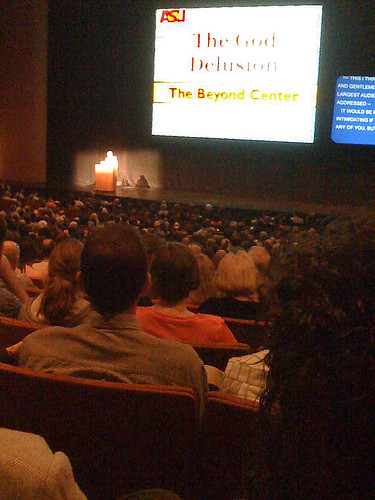
    Eminent scientist Richard Dawkins was in Tempe tonight, and it was quite a surprise for me. I knew that Dawkins had been making book tours through the US, and I knew that he had even made concerted forays into the southern bible belt, but I thought even Dawkins would have to turn tail and run from the pig-ignorant savages that dominate certain sectors of the great state of Arizona.

    In other words, it just never occurred to me that he would ever come here. Monday I learned that I was wrong – not only was he coming to the US for a new tour, but that he’d be starting at ASU, my old Alma Mater. My excitement was quickly crushed when, not 10 minutes after learning he was coming, I also learned that the show was “sold out” – which is only euphemistic, since the tickets were free. Luckily, with just a slight bit of whinging on RichardDawkins.net, a kind stranger gave me two tickets that he had but was going to be unable to use.

    Like most everyone else that frequents the RDF website, I’ve heard (and read) what Dawkins has to say. In addition to wanting to show my support for “the cause” (as it were) I also wanted to see the extemporaneous side of Dawkins. Would his presentation be a crafted and methodical lecture, or would it be more free-form? Dawkins is (in my opinion) at his best when he’s answering questions.

    To answer that question: His talk was well-honed and planned, which is a bit of a disappointment because, for the large part, it is just a recap of his book, the God Delusion. However, some parts of the lecture concerned response to the hardcover edition, and allowed him to rebut some of his critics, and to further clarify some central ideas to the book. Basically, I won’t recount the speech, just buy his book.

    I’m not sure if Dawkins was just playing the audience, but as he came out he stated this was the biggest audience he’d ever addressed. I’m not sure how big Grady Gammage Auditorium really is, but it was about 90-95% full – and this in Arizona! I was shocked and more than a little proud.

    The audience, as a whole, looked a bit like a casting call for eccentric university professors, complete with tweed jackets with patches on the elbows. The age of the audience was probably in the upper 40s, on average, although there was a fair-sized contingent of college-aged people.

    The Beyond Center, which sponsored the event, thoughtfully provided real-time close-captioning for the hard of hearing. The person doing the typing was amazing, but, unfortunately, from time to time he/she was either unable to keep up with Dawkins, unable to understand what he said, or just plain missed or paraphrased what he was saying. This resulted in a few unintentional laughs throughout Dawkins’ presentation at inappropriate times. I can’t help wondering if he knew why the audience was laughing. (Example: At one point he mentioned his wife, Lala. There was an unusually long delay before the words “Law Law” were written out on the screen. I didn’t notice if, when he mentioned PZ Myers at Pharnygula if it was spelled “Myers” or “Meyers”.)

    Even though I had no need of the subtitles, it was almost impossible not to watch them during the show.

    After the presentation, there was a Q&A. The questions were fairly typical. One person asked if perhaps it was better to approach converting people out of their religion by non-confrontational means. Dawkins responded that is not know as his long suit, but that others are good at that and that he hopes that his lectures and book help other atheists and agnostics and if they can, as he said, “seduce” them, that’s all good.

    Another fellow rambled incoherently about how perhaps rather than use the Celestial Teapot analogy, he should use one that is patently impossible, as a teapot is in theory more possible than god. He suggested using a triangle with three 90º angles as a more appropriate analogy. Dawkins kindly took that as a comment and not something that needed a response to.

    A doctor who specialized in cancer brought up points about religion being something that provides comfort for his terminal patients. He wanted to know if Dawkins felt that “happiness” ever should trump “the truth.” Dawkins responded with an emphatic, “no.” (Although he did say, in the case of someone on their death bed, he’d change the subject or something rather than debunk their delusion.

    Another audience member, from India, I should based on accent, appearance and question, asked about why Dawkins doesn’t address Hinduism and what he thought of that, and also Chinese religion. I thought the answer a little weak, basically, “Well, I don’t know anything about Hinduism, except that it is polytheistic and based on supernatural things. That’s why I restrict my book to the three Abrahamic religions.” He also showed an astounding lack of understanding of Chinese religion, confusing the typical Buddhism for Confucianism. He did mention that he was very interested in having a Hindu challenge the UK’s charitable laws which requires you to recognize “one” god only.

    Finally, I mentioned that the audience looked like it was dressed for a college professor-themed party. That wasn’t entirely true, there were a few very well dressed individuals – it would appear they were the bible thumper crowd. Based on the applause for their one question, there were 8 of them. His question was… you say religion leads to war, but it doesn’t, blah blah. It was rather incoherent and he put on his best duds for it, too. Dawkins simply reiterated that atheism doesn’t have a logical pathway to violence. That is, there’s no tenet of atheism that demands certain course of action, whereas religion, if truly believed, has many direct, logical paths to violence – if you really believe.

    Overall, it was an enjoyable couple of hours, and I was really pleased as how large the crowd was.


    Update 3-8-2008

    A couple other blogs have also posted some thoughts on Dawkins’ talk the other night:

    Jim Lippard over at the Lippard Blog

    Omnthought over at the Tribe

    John Wilkins over at Evolving Thought

    That later one just shows that there’s plenty of latitude in people’s attitudes about the subject.

  • Book Selection: Your Inner Fish by Neil Shubin


    Stop me if you’ve heard this one before… as I was approaching college age as the 80’s were dawning on us, I had three areas of interest that I explored for my future life’s work. Each would set the course of my adult life in three very different ways and each would have been a different University.

    I was interested in forestry, which would have taken me to Northern Arizona University, paleontology, which would have started at my home town university, the University of Arizona, or computer science at Arizona State University.
    Forestry was the long shot and got eliminated early, and plays no further part in this story.
    My deep and abiding interest was paleontology – I wanted to be a fossil hunter, but my aptitude was more computer science.
    Computers won because as I learned more about the coursework required for paleontology, I realized that there were large parts (like biology and zoology) of it that would really be painfully dull for me.
    Looking back, I didn’t make the wrong choice. Paleontology has developed significantly since the days of Edward Drinker Cope and Othniel Charles Marsh. Parallel developments in other fields, such as genetics and evolutionary biology have dovetailed with the old bone diggers and brought us to a quantum leap in our understanding of past life. (Yuck, I apologize for that sentence. Must be too much sugar in my iced tea.)
    That’s my long way of saying, I love a good book on the evolution of life, especially when there’s a paleontological adventure involved.
    Neil Shubin’s book Your Inner Fish (and Shubin himself, for that matter) first came to my attention when he plugged the book on the Colbert Report. Colbert, in his role as a conservative fundamentalist host, always throws his guests a few curve balls (or googlies, if you prefer a cricket analogy over baseball) and I was really impressed at how well Shubin comported himself on the show.
    That alone made me want to give him money by reading his book, but Shubin has another important claim to fame: He was an instrumental part of the team of paleontologists who discovered Tiktaalik, the important fish to amphibian transitional fossil.
    The book’s subtitle is “A Journey into the 3.5-Billion-Year History of the Human Body” and, as such, isn’t strictly about Tiktaalik, or even fossil-hunting. It is an excellent, and easily accessible book that gives a good primer into how genetics and fossils tell us why life is the way it is.
    As such, I’d recommend the book to anyone with even a passing interest in understanding “how it all comes together.”
    Your Inner FishA Journey into the 3.5-Billion-Year History of the Human Body
    by Neil Shubin
    Pantheon BooksISBN 978-0-375-42447-2

  • It’s all quantum physics, I tells ya!

    One of those fascinating little tidbits that always amuses me concerning quantum physics is that whole time/speed. Oh, you know what I’m talking about, it’s what happened to Charlton Heston in Planet of the Apes. Their spaceship travels at speeds upwards towards the speed of light, and they age less than the space around them. It’s an Einstein thing, look it up.

    So, the faster an object travels, the slower it’s relative time versus the time of the non-moving space around it, and, since the speed of light is the universal maximum, then at the speed of light, time stops. If that’s the case, light which travels as both particles and waves is really weird. Light particles would then be essentially “timeless”. From their relative perspective, they are passing through all points along their trajectory simultaneously. Then how can it have amplitude, which is a function of time? Quantum physicists apparently don’t like it when people say quantum physics is weird, but, come on! It is weird. It’s weird because, no matter how well documented and proven it is, it’s counter-intuitive. It behaves in ways that our senses tell us would be nonsense. That doesn’t make it nonsense, that’s just a natural bias we have.

    Then you get into causality, which, at the quantum level can happen mathematically in reverse. (OK, this is way out of my depth, but I got it out of a fairly well-regarded book on the subject, which I can’t call to mind right now.) That’s not saying it actually does happen with the cause coming after the effect, just that mathematically, it could work that way.

    Honestly, Doctor Who wouldn’t be any fun without this sort of science.

    Why do I bring up all this stuff? Because I was reading quite a funny article on intercessory prayer, and the incredibly flawed studies that have been published on the subject and popularized in the media indicating that they have values, despite being thoroughly invalid studies. You can read about it here.

    The article briefly looks at several prayer-related studies and points out some of the warning signs of a poor-constructed clinical trial. My favorite though, has to be an Israeli study which is summed up like this:

    In 2000, Leibovici looked at patients admitted to the hospital for brief stays in 1990-96. He randomly assigned them to one of two groups, and had prayers said for the members of one group. The control group got no treatment. Mortality rates showed no difference, but subjects in the prayed-for group had less fever and shorter hospital stays, significant at the p=4% level. Note that the praying was all done 4 to 10 years after the patients had either recovered or died. So Leibovici is making the extraordinary claim that prayers are altering the past.

    So my question is: If that’s true, does the act of looking at the records “freeze them”? That is, now that the doctors have looked at the records of the non-prayed for group, if another group of people prayed for them, would their records change or would it be too late? That vaguely sounds like another one of those quantum physics things where you can’t know where the particle behaves differently when you observe it.

    Anyway, that study would appear to have been a tongue in cheek, but the others aren’t.

    The article is good information if you’re not familiar with some of the potential mistakes in clinical trials that can render them invalid (or at least deeply flawed.)